
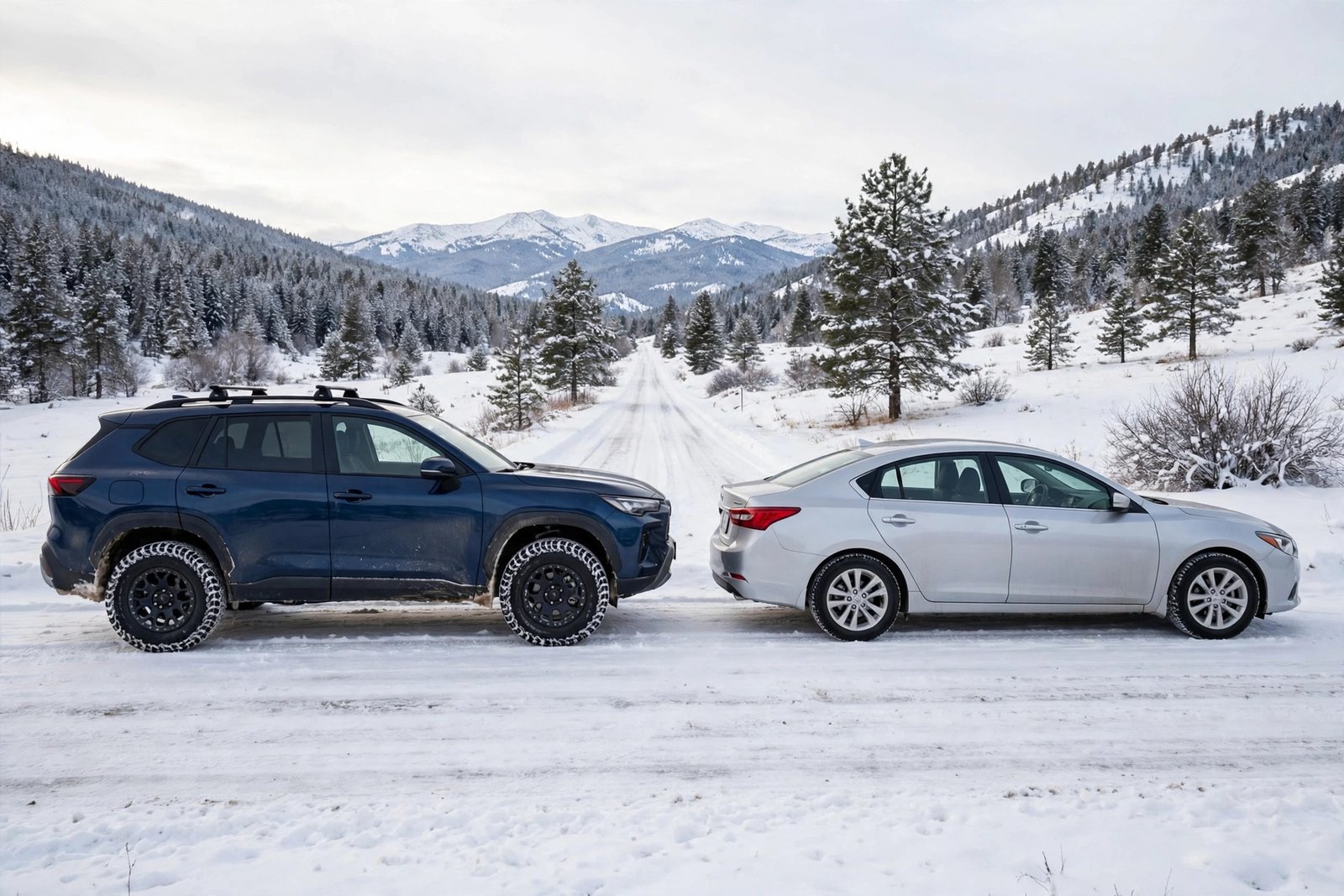
Quick answer: Ask the thermometer, not the snowfall forecast. If your daily temperatures regularly sit below 45°F (7°C) for weeks of the winter, or you have to drive on snow and ice no matter the weather, you need winter tires — they stop roughly 25 feet shorter from just 25 mph in snow. If your winters are mild, with only a few light snowfalls a year and temperatures mostly above 45°F, good all-season tires are enough. In between — cold snaps and occasional snow, but no appetite for swapping tires twice a year — all-weather tires are the middle option. Work through the five questions below and the answer picks itself.
The wrong question most drivers ask
When drivers ask do I need winter tires or all season, most decide by thinking about snow. “We only get a couple of snowstorms a year, so I don’t need winter tires.” That sounds reasonable, and it is the wrong variable.
The deciding factor is temperature. All-season tire rubber is formulated to stay pliable across a wide range of conditions, but it starts stiffening below 45°F (7°C). A stiffer tire grips worse even on cold, dry, perfectly clear pavement — before a single snowflake falls. Winter tires use a softer compound engineered to stay flexible well below freezing, which is why the swap matters even for drivers in places that get cold without getting much snow.
So the question is not “does it snow where I live?” It is “does it stay cold where I live?” A driver in dry, sunny, sub-freezing Colorado needs winter tires more than a driver in rainy, 40-degree Seattle who sees snow once a year. Keep that in mind through the rest of this guide.
What actually separates the two tires
The difference is the rubber first and the tread second.
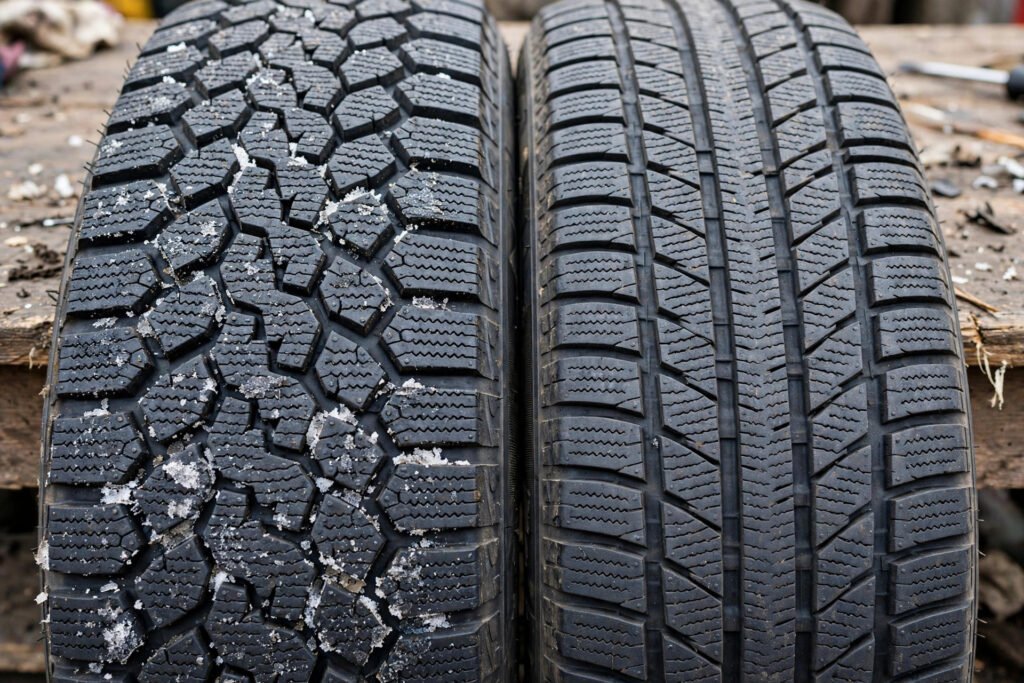
Winter tires use a high-silica rubber compound that stays soft and flexible in the cold, plus a tread with deep grooves and thousands of tiny slits called sipes. The sipes act like little biting edges that grip snow and ice, and the soft compound keeps the tire conforming to the road surface instead of skating over it. Every true winter tire carries the three-peak mountain snowflake (3PMSF) symbol on its sidewall — a mountain outline with a snowflake inside — which certifies it passed a standardized snow traction test.
All-season tires are the compromise tire. Their compound is designed to work acceptably from summer heat to light frost, which means it is not optimized for either extreme. Their tread is quieter, lasts longer, and performs better on dry and wet roads than a winter tire. Most all-season tires carry an M+S (mud and snow) marking instead of the 3PMSF symbol — and that marking is much weaker than it sounds. M+S is a tread-pattern designation, not a performance certification: it says nothing about how the rubber behaves in the cold.
That symbol gap is worth understanding, because it trips up a lot of shoppers. The 3PMSF test itself only measures acceleration traction on medium-packed snow. It does not measure braking distance, cornering grip, or ice performance. So a 3PMSF symbol is a floor, not a guarantee — but an M+S marking is not even a floor. When in doubt, look for the mountain and snowflake.
| Winter tires | All-season tires | |
|---|---|---|
| Best temperature range | Consistently below 45°F (7°C) | Mild to warm; loses grip below 45°F |
| Rubber compound | Soft, high-silica; stays flexible in the cold | Harder compound; stiffens in the cold |
| Tread | Deep grooves, thousands of sipes | Shallower tread, fewer sipes, quieter |
| Sidewall symbol | Three-peak mountain snowflake (3PMSF) | Usually M+S (mud and snow) only |
| Snow braking (25–0 mph) | ~56–57 ft (Tire Rack, Oct 2026) | ~81–85 ft (Tire Rack, Oct 2026) |
| Ice braking (12–0 mph) | ~39 ft (Tire Rack, Oct 2026) | ~55–58 ft (Tire Rack, Oct 2026) |
| Wet braking (50–0 mph) | ~118–129 ft — worse than all-season | ~99–111 ft — better than winter |
| Swap needed twice a year | Yes | No |
| Tread life | Wears fast in warm weather | Long; designed for year-round use |
Notice the last-but-one rows. Winter tires are not better at everything — they are worse than all-season tires on wet roads near freezing, and much worse in warm weather. That is exactly why they are a seasonal tire. The table is the whole argument in miniature: winter tires win big where it matters most (snow and ice stops) and lose where it matters least in winter (warm dry roads you will not be driving on while they are fitted).
What the tests actually show
Marketing claims are cheap; stopping distances are not. Tire Rack’s October 2026 test put the leading tires head to head on the same cars, same day, same surfaces, and the gaps were hard to argue with.
In snow, braking from 25 mph — a normal neighborhood speed — the Michelin X-Ice Snow winter tire stopped in 56.1 feet and the Bridgestone Blizzak WS90 in 57.3 feet. The conventional all-season tires needed far more road: the Michelin Primacy Tour A/S took 81.1 feet and the Michelin Defender2 84.5 feet. That is a gap of roughly 25 feet, or close to two car lengths, at a speed most people drive past a school. On ice, braking from just 12 mph, the X-Ice Snow stopped in 39.4 feet against 57.7 feet for the Primacy Tour A/S — more than a car length sooner from a parking-lot crawl.
Older tests tell the same story at higher speeds. In a MotorTrend ice-rink test, a Toyota Camry on Bridgestone Blizzak WS80 winter tires stopped from 30 mph about 63 feet sooner than the same car on all-season tires — roughly four car lengths. Kelley Blue Book summarizes the advantage as braking distances up to 30 percent shorter in winter conditions.
The 5-question decision framework
Answer these five questions honestly. If you answer yes to three or more, get winter tires. If you answer yes to one or none, all-season tires will serve you well. Two yeses means the middle option — all-weather tires — deserves a hard look.
1. Do daytime temperatures stay below 45°F (7°C) for weeks at a time?
This is the big one, and it outweighs all the others. Check your area’s average winter highs, not the record lows. If the answer is yes for a month or more, winter tires earn their keep on grip alone — even on dry roads.
2. Do you have to drive on snow or ice, or in freezing rain, more than a handful of times each winter?
“Have to” is the operative phrase. If you can work from home or wait for the plows, all-seasons plus patience can work. If you are a nurse, a delivery driver, a parent doing school runs at 7 a.m., or anyone whose job does not stop for weather, you cannot schedule around storms.
3. Do you drive on hills, rural roads, or unplowed streets?
Flat, well-plowed city streets are forgiving. Hills are not, and rural and unplowed roads stay snow-covered long after the main roads are clear — that is where the stopping-distance gap turns into a real crash risk.
4. Are your all-season tires already more than halfway worn?
Winter performance falls off a cliff as tread wears. Transport Canada advises against using tires worn close to 5/32 inch (4 mm) on snow-covered roads, and a worn all-season tire is a poor winter tire even in light snow. If your all-seasons are due for replacement anyway, that money may be better spent on a dedicated winter set — or on a new all-season set with strong snow ratings. Check your tread with the simple method in our guide to checking tire tread depth.
5. Is your car your only car, with no backup for bad-weather days?
A second car, a partner’s car, or reliable public transit gives you an escape hatch on the worst days. A single car that must do everything, every day, through the whole winter needs the safest tires you can fit.
How to read your score
- 0–1 yes: all-season tires. Your winters are mild enough that a good set of all-season tires with healthy tread is the sensible, economical choice. Spend the money on a quality all-season tire with strong snow test ratings rather than on a second set.
- 2 yeses: all-weather tires. You are in the middle ground. All-weather tires carry the 3PMSF snow certification and stay on the car all year — no swaps, no storage. Consumer Reports’ assessment is that they come close enough to dedicated winter tires for most needs in moderate climates, and Tire Rack’s testing found an all-weather tire stopping in snow in under 59 feet from 25 mph, more than 22 feet shorter than the all-season tires in the same test. Read our comparison of winter tires vs all-weather tires before you buy.
- 3–5 yeses: dedicated winter tires. Your climate and your driving make this a safety decision, not a preference. The stopping-distance gap is too large to ignore, and no other single purchase improves winter safety as much.
What it costs — the honest five-year math
Winter tires feel expensive until you count what you are not buying. The tires themselves are not the whole story, because every mile on winter tires is a mile your summer tires are not wearing out.
| Cost | Typical range |
|---|---|
| Set of four winter tires (mid-range) | ~$300–$400 |
| Budget winter tires per tire | ~$80–$100 |
| Premium winter tires per tire | ~$200 or more |
| Second set of steel wheels (four) | ~$280–$400 |
| Seasonal swap (tires already on rims) | ~$40–$100 per change |
| Full changeover (shared rims) | ~$60–$180 per change |
| Off-season storage at a shop | ~$60–$120 per season |
Worked example for a typical driver: a $350 set of winter tires on a $300 set of steel wheels, swapped twice a year at $60 a swap. First-year cost is about $770. But the winter set lasts roughly four to five seasons, the steel wheels last indefinitely, and the all-season set lasts an extra year or two because it sits out every winter. Spread over five years, the real cost is roughly $200–$300 a year — about the price of one tank of gas a month — for a stopping-distance advantage of two car lengths in snow. Most drivers who run the numbers decide the safety is cheap. If you want the full timing and cost breakdown, see our guide on when to put winter tires on.
There are two ways to cut the cost further. First, buy the winter tires in September or early October, before demand peaks and prices and wait times climb. Second, buy the second set of wheels: it turns every future change from a $60–$180 mount-and-balance into a $40–$100 swap, and it saves your summer wheels from twice-yearly remounting.
The AWD myth — and why it matters here
“I have all-wheel drive, so I don’t need winter tires” is the most dangerous sentence in winter driving. All-wheel drive helps you get moving from a stop. That is where its help ends.
Braking and cornering are the tire’s job, not the drivetrain’s. Consumer Reports testing found that all-wheel drive did not help with braking or with some cornering situations, and concluded that winter tires matter more than AWD in many winter situations. A front-wheel-drive car on winter tires out-brakes and out-turns an all-wheel-drive car on all-season tires. AWD gets you going; winter tires get you stopped.
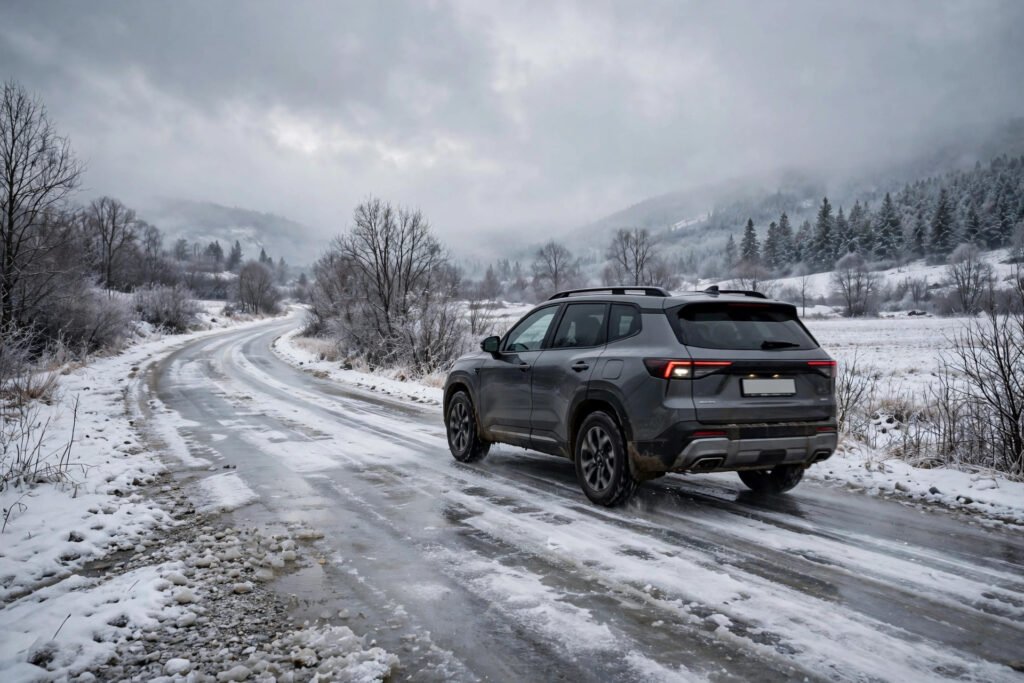
If you decide on all-season tires, do this
Choosing all-season tires is a legitimate decision for mild climates — but it comes with homework:
- Buy for snow ratings, not just price. Not all all-season tires are equal in winter. Check independent snow test results before buying, and prefer a model that tested well in snow even if it costs a little more.
- Keep the tread deep. Replace all-season tires before they reach 5/32 inch if you drive in any snow at all. A worn all-season tire is the worst winter tire there is.
- Check pressure monthly in winter. Pressure drops roughly 1 psi per 10°F, so a set inflated in fall will be several psi low by January. Check when the tires are cold and use the pressure on the door placard.
- Slow down and leave space. AAA’s winter guidance still applies whatever tires you run: slow down, increase following distance, and brake gently. Good tires shrink stopping distances; they do not abolish physics.
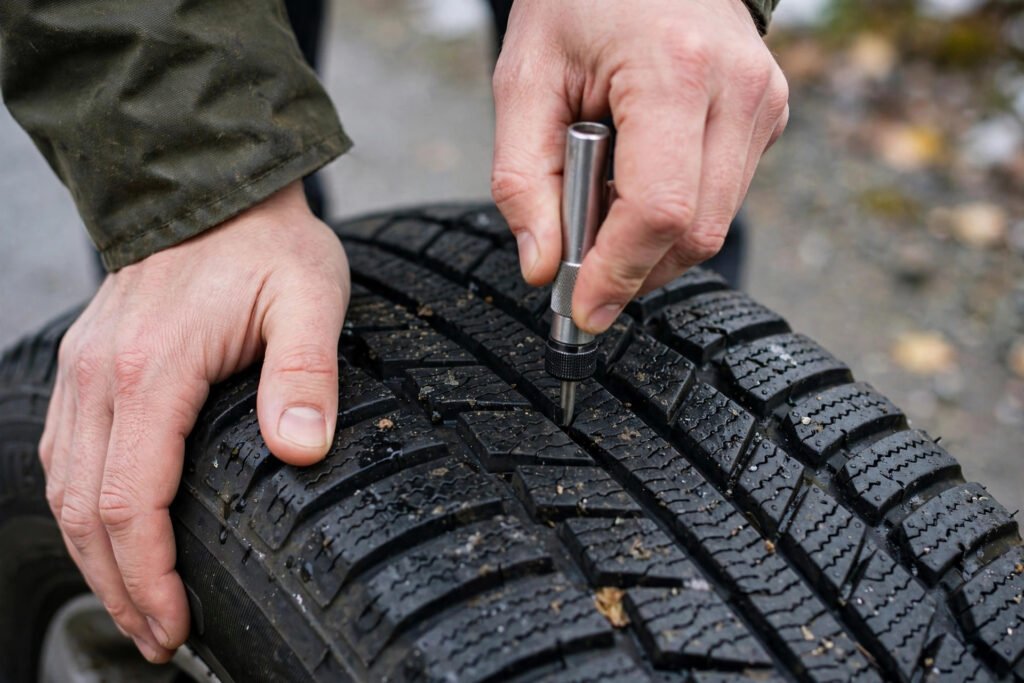
If you decide on winter tires, do this
- Buy all four. Never fit winter tires on only two wheels. A grip mismatch between axles can spin the car in a corner. Tire makers and safety agencies are unanimous on this.
- Look for the 3PMSF symbol. Every true winter tire carries it. If the tire does not have the mountain-and-snowflake mark, it is not a certified winter tire no matter what the marketing says.
- Consider studded vs studless. Studded tires grip better on sheer ice but are noisy, wear roads, and are restricted or banned in some states. For most drivers, modern studless winter tires are the better choice — our studded vs studless comparison covers the trade-off.
- Time the switch by temperature. Fit them when temperatures stay below 45°F (7°C), and take them off in spring when temperatures stay above it. Our timing guide covers exactly when.
- Store the off-season set properly. Clean, dry, dark, and bagged — good storage adds seasons to a set.
The verdict
There is no single right answer to “do I need winter tires or all season tires” — there is a right answer for your climate and your driving. Cold, snowy, hilly, must-drive winters: winter tires, without question. Mild winters, light snow, a flexible schedule: good all-season tires, kept deep and properly inflated. In between: all-weather tires, the no-swap middle ground.
The one answer that is wrong for almost everyone is deciding on snowfall alone. Temperature is the trigger, stopping distance is the payoff, and the five questions above are the test. Answer them honestly, and you will buy the right tires the first time — which is the cheapest way to buy tires.
Related reads
- Compare Cars tool — compare any two cars side by side
- Winter Tires vs All-Weather Tires
- All-Season vs Winter Tires: Which Do You Actually Need?
- Winter Tires Guide — everything about winter tires
- Studded vs Studless Winter Tires
- How to Check Tire Tread Depth
- Best Budget Tires
- When to Put Winter Tires On: The 7°C (45°F) Rule and Regional Timing
Sources
- Winter Tires vs. All-Season: What the Tests Actually Show — Tire Rack
- All-Weather vs. All-Season: The Snow Test — Tire Rack
- Testing on Ice: Winter / Snow vs. All-Season vs. Summer Tires — Tire Rack
- Winter Tires vs All-Season: Do You Actually Need Them? — PitCompare
- Winter Weather Driving Tips — NHTSA