
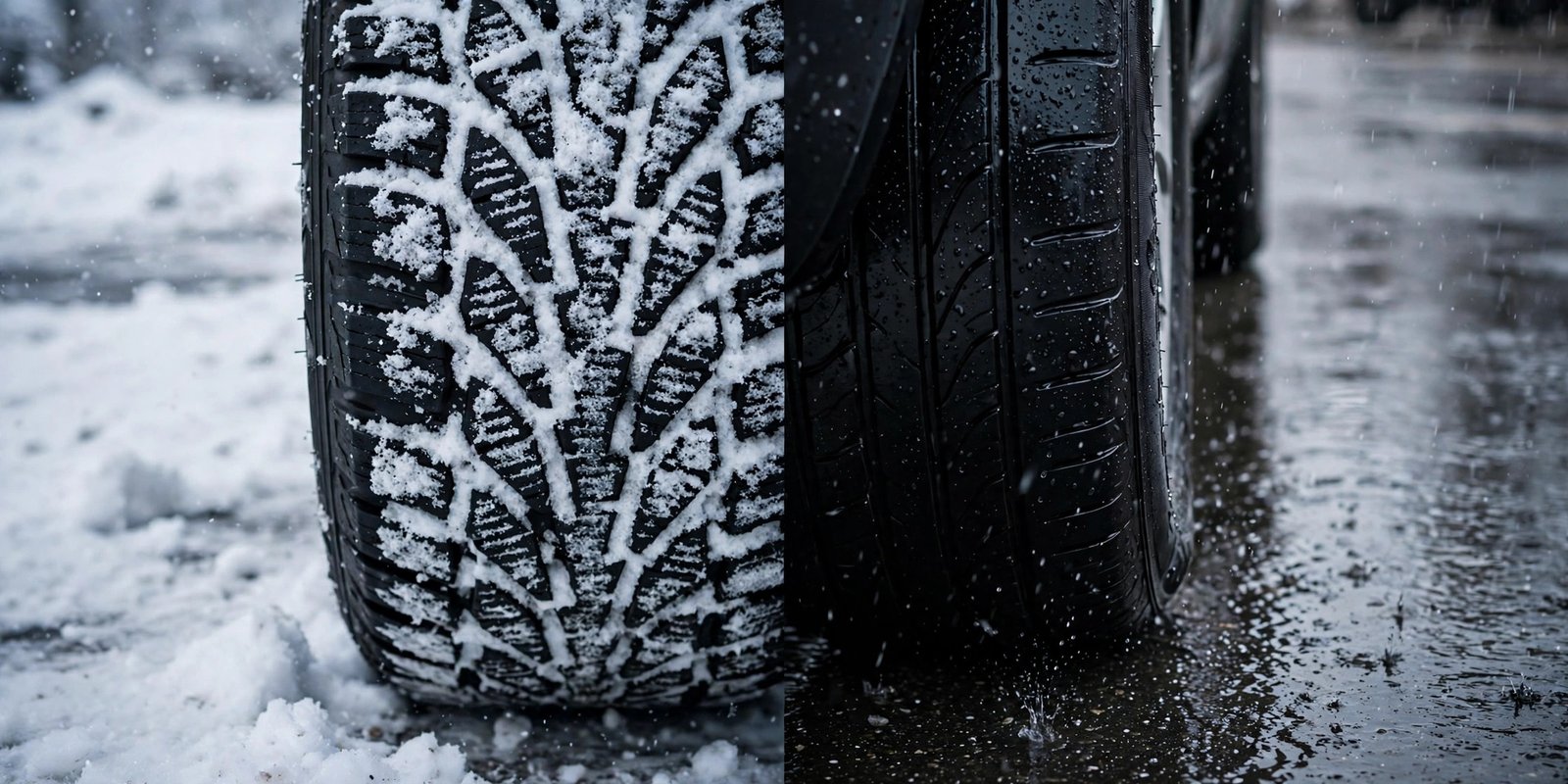
Quick answer: The all-season vs winter tires question comes down to temperature. Buy winter tires if your area regularly drops below 45°F (7°C) or sees real snow and ice — they stop dramatically shorter on frozen surfaces. Stick with all-season tires if your winters are mild, with only occasional light snow. If you want one set that handles genuine winter weather without seasonal swaps, look at all-weather tires carrying the three-peak mountain snowflake symbol.
Winter driving is a safety question, not just a comfort one. The Federal Highway Administration reports that 24% of weather-related vehicle crashes happen on snowy, slushy, or icy pavement — and that over 1,300 people are killed and more than 116,800 are injured in crashes on snowy, slushy, or icy roads each year. With over 70% of the nation’s roads in regions that get more than five inches of snow a year, the tire beneath you is one of the few things you control.
All-Season vs Winter Tires at a Glance
| All-Season Tires | Winter Tires | |
|---|---|---|
| Tread compound | Hardens below 45°F (7°C), losing grip | Stays flexible in freezing temperatures |
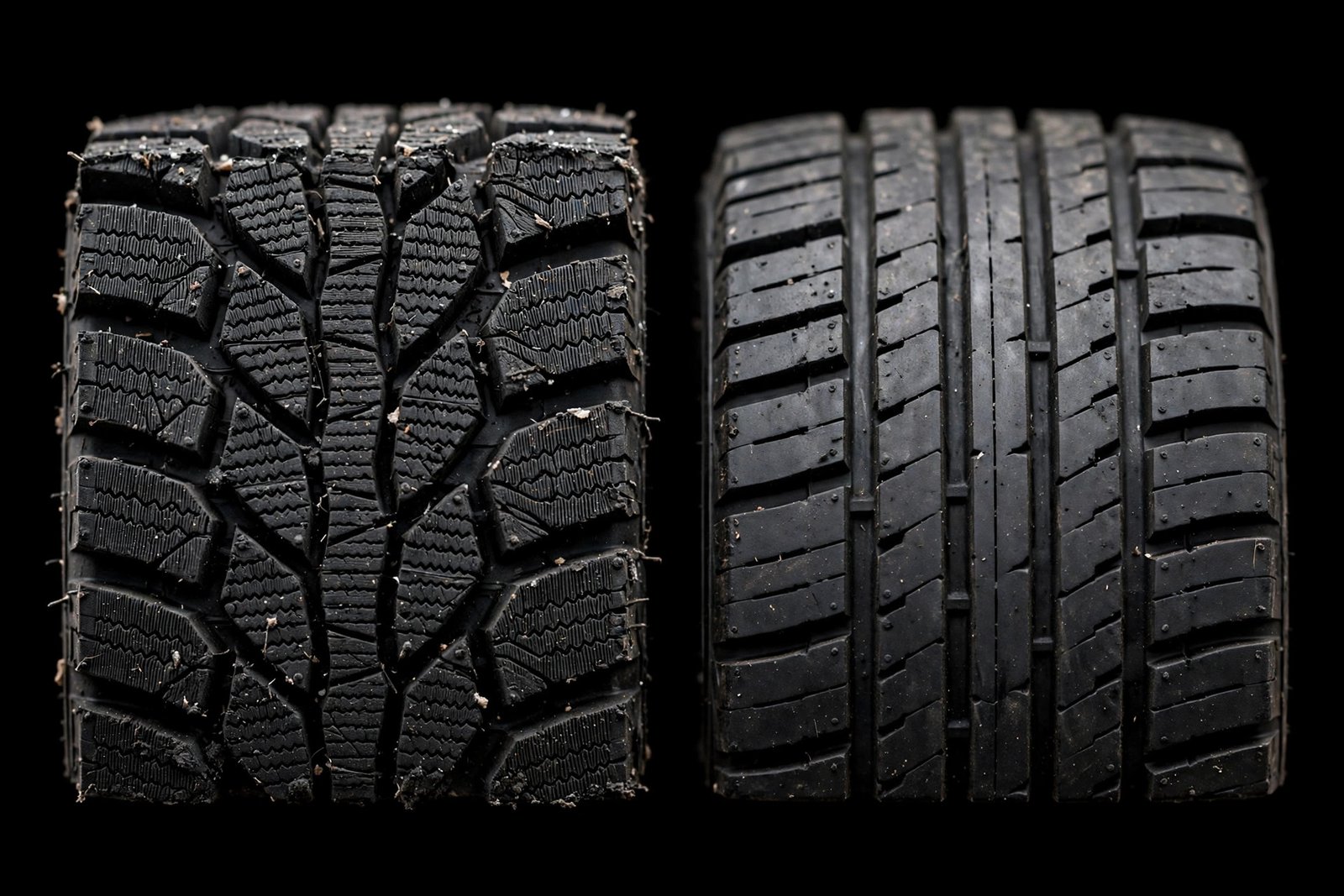
| Tread pattern | Shallower grooves, fewer sipes; tuned for wet roads | Deeper grooves, dense sipes and biting edges for snow and ice |
| Temperature range | Best above 45°F; usable year-round | Best below 45°F; should come off in spring |
| Braking on snow/ice | Much longer stops (see test data below) | Dramatically shorter stops |
| Braking on wet/dry clear roads | Stronger — the better clear-road tire | Weaker, especially in the wet |
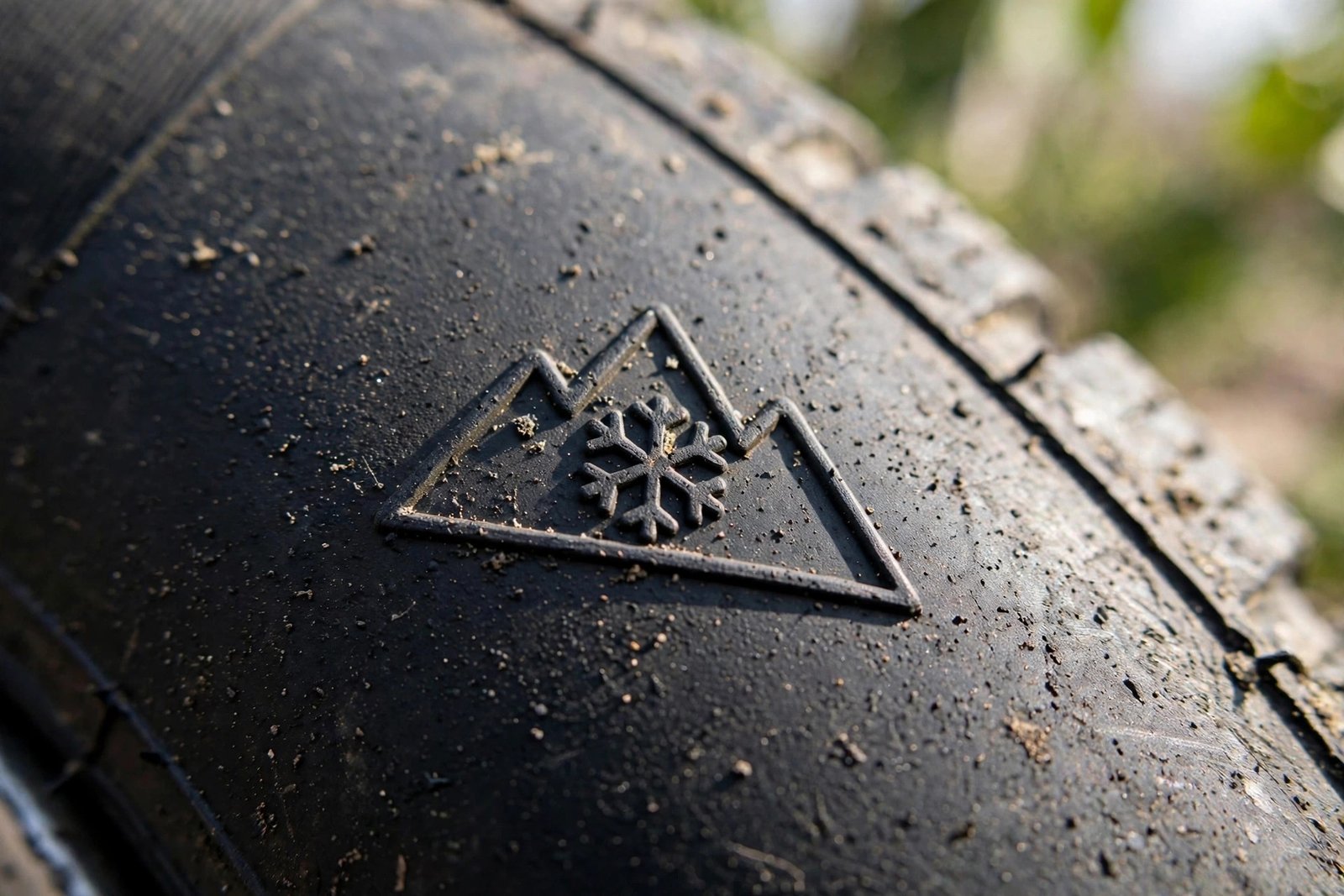
| Sidewall marking | Usually M+S only | Three-peak mountain snowflake (3PMSF) |
| Lifespan | Typically 40,000–70,000 miles, year-round | Typically 3–5 winter seasons with seasonal use |
| Cost (compact car, set of 4) | $400–$800 for tires alone | $400–$800 for tires alone, plus swap/storage |
| Storage | None needed | Off-season set needs cool, dry storage |
How All-Season Tires Work
All-season tires are the default on most new cars sold in the US, and the name promises more than it delivers. They are a compromise: one medium-firm compound and tread design asked to handle summer heat, autumn rain, and light winter weather, with the tread optimized mainly for evacuating water.
That compromise works well most of the year — a good all-season tire brakes confidently on dry pavement and in rain, and wears slowly. The problem starts when the thermometer drops. Around 45°F (7°C), the compound begins to stiffen, and stiff rubber cannot conform to the microscopic texture of cold pavement, so grip fades on dry cold roads as well as snowy ones. Most all-season tires carry the M+S sidewall marking, but that marking describes tread geometry, not tested performance — it certifies nothing about actual snow grip (our guide to what tire numbers mean decodes every sidewall marking).
How Winter Tires Work
Winter tires attack the cold-weather problem from the opposite direction. Their compound uses more natural rubber and silica additives that keep the tread pliable well below freezing, so the tire keeps hugging the road instead of skating over it. The tread is deeper and more aggressive, with hundreds of tiny slits called sipes cut into each block — every sipe another biting edge for packed snow and ice.
The trade-off: the same soft compound wears quickly on warm pavement and feels vague in summer handling. Winter tires are seasonal equipment — on in late fall, off in spring (see our winter tires guide for the full rundown). Run them year-round and you will burn through an expensive set fast while giving up clear-road braking.
The 45°F (7°C) Rule: When Rubber Chemistry Decides for You
Forget the calendar and the first snowfall — tire engineers use one threshold: 45°F (7°C). Below it, all-season compounds start losing elasticity; above it, winter compounds wear fast and lose their edge.
In practice, that means:
- Put winter tires on when daytime highs consistently stay below 45°F — in northern states, usually sometime between mid-October and mid-November. Book the swap before the first storm, not after: every tire shop in snow country gets slammed the week snow flies.
- Take them off when temperatures consistently climb back above 45–50°F, typically March or April. Warm spring pavement chews up soft winter rubber fast.
What the Tests Actually Show
Marketing claims are cheap, so here are measured stopping distances. In Tire Rack’s October 2026 head-to-head — ten tires in size 215/55R17 on a 2025 Toyota Camry in near-freezing conditions — the gap was enormous where it matters most:
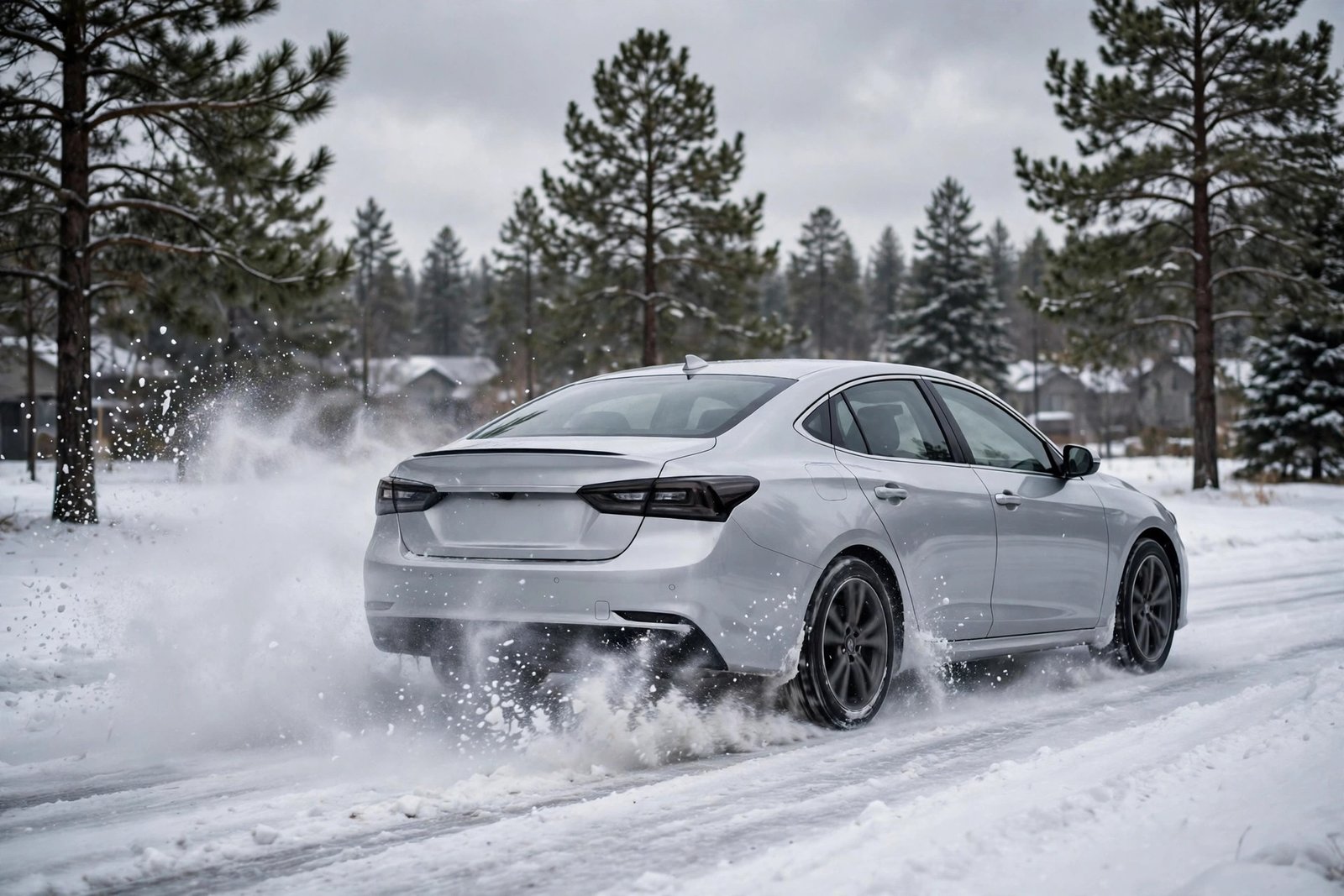
- Snow braking from 25 mph: the best winter tires stopped in about 56–57 feet. The conventional all-season tires needed roughly 81–85 feet. That is nearly 30 feet of extra sliding — about two car lengths — at neighborhood speeds.
- Ice braking from just 12 mph: the winter tires stopped more than a car length sooner than the all-seasons, at a speed most people would call a parking-lot crawl.
- Wet braking from 50 mph on near-freezing pavement: here the order flipped. The all-season tire stopped in about 99 feet; the winter tire needed roughly 129 feet.
That last line is the part most winter-tire articles skip, and it matters. Winter tires are specialists, not all-rounders: on snow and ice they win decisively, but on clear wet or dry roads the all-season is the stronger tire. An older Tire Rack test on a BMW 328i found the same pattern at lower speeds — from 10 mph on ice, winter tires stopped in roughly 21 feet versus about 40 feet for all-seasons.
The honest takeaway: if your winter driving happens mostly on cold, bare pavement with occasional rain, the all-season’s clear-road advantage is real. If it happens on snow and ice, the winter tire’s advantage is bigger and more safety-critical. Choose based on the roads you actually drive.
M+S vs the Snowflake: Reading Your Sidewall
- M+S (mud and snow): awarded for tread design — essentially, enough grooves and open space in the pattern. There is no performance test behind it, so an M+S tire may or may not grip snow adequately.
- Three-peak mountain snowflake (3PMSF): the tire passed the ASTM F1805 snow-traction test, accelerating on medium-packed snow at least 10 percent better than a standard reference tire — a genuine, measured result.
One important caveat: the snowflake test measures snow acceleration only — not braking, cornering, or ice. That is why two tires can carry the same badge yet stop very differently. Treat it as a useful minimum standard, not a complete ranking.
The Third Option: All-Weather Tires
All-weather tires are the middle ground most shoppers do not know exists. Unlike all-season tires, they carry the 3PMSF snowflake — they passed the same snow-traction test as winter tires. Their compound stays flexible in the cold yet is durable enough to run year-round: no seasonal swaps, no storage.
How close do they get to dedicated winters? In Tire Rack’s October 2026 test, the best all-weather tire stopped within about 2.5 feet of the best winter tire in snow braking from 25 mph — genuinely close. On ice, though, winter tires kept a 12- to 14-foot lead from just 12 mph, and in wet braking the all-weather tires were far stronger than the winters.
So the honest winter-surface ranking is winter tires > good all-weather tires > all-season tires, with the first gap small on snow but meaningful on ice. All-weather tires are the best one-set answer where winter is real but ice is not a daily fact of life.
Minnesota or Texas? Picking for Your Climate
The right tire is a climate decision more than a tire decision:
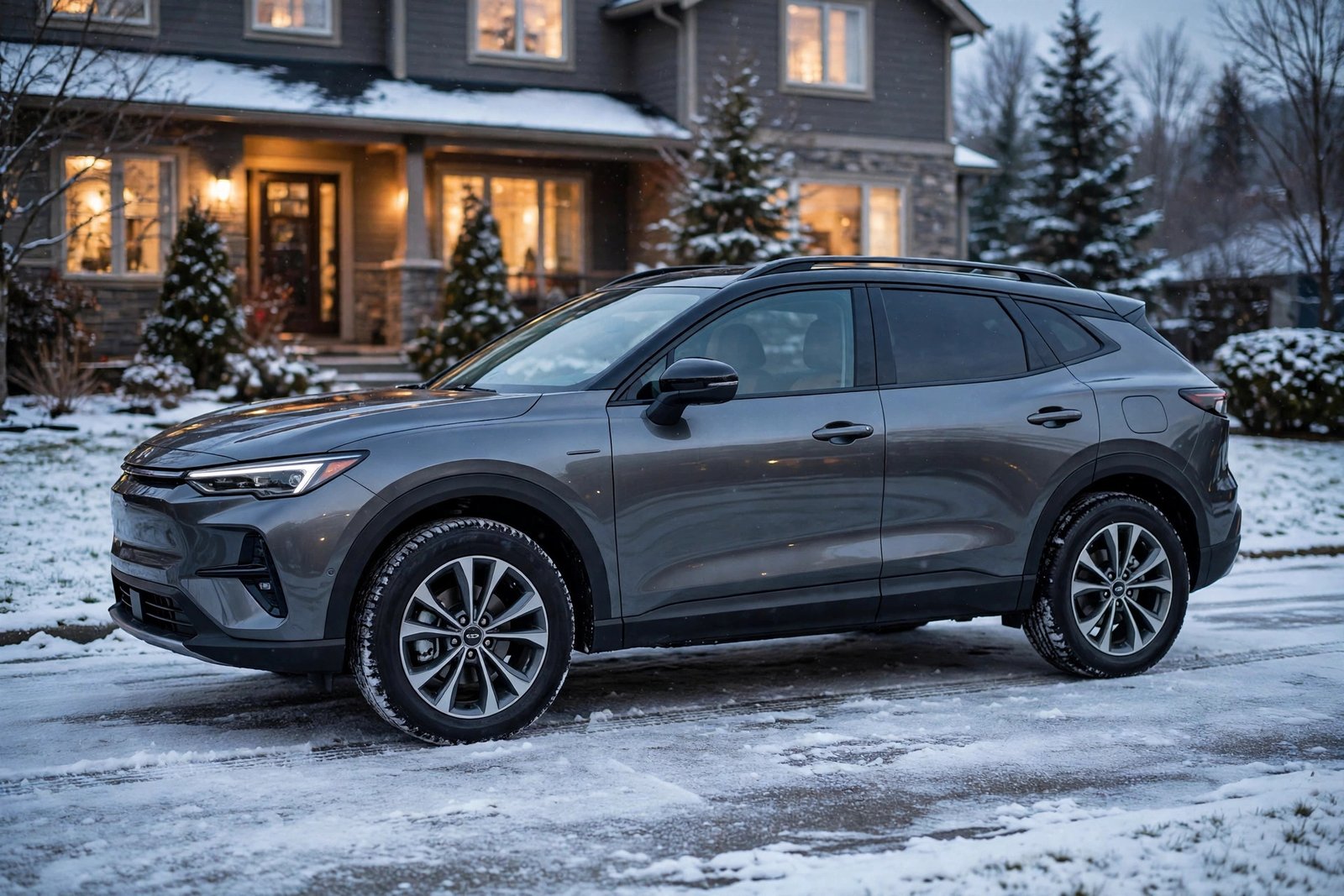
- Minnesota, Wisconsin, the Dakotas, New England, mountain states: months below freezing with regular snow and ice. Get dedicated winter tires — the stopping-distance data makes this the clearest call in the tire world.
- Mid-Atlantic, Tennessee, the Carolinas, the Pacific Northwest: cold rain and occasional snow around freezing. All-weather tires are the sweet spot — snowflake-certified grip for the bad weeks, no swaps for the mild ones.
- Texas, Florida, Arizona, Southern California, the Gulf Coast: winter barely exists. Quality all-season tires are all you need; winter tires would wear fast and never pay back.
- Everyone in between: count the weeks your area stays below 45°F. A few scattered weeks? All-season or all-weather. Two-plus solid months? Winter tires earn their keep.
One myth to retire: all-wheel drive does not change this math. AWD helps you accelerate; it does nothing to help you stop or turn. A front-wheel-drive sedan on winter tires will out-brake an AWD SUV on all-seasons on snow and ice, every time.
The Real Cost, Per Year
Sticker shock keeps many drivers on all-seasons, but the per-year math is friendlier than it looks. For a compact car or small crossover:
| Cost item | Typical range |
|---|---|
| Winter tires, set of 4 (rubber only) | $400–$800 |
| Mounted on basic steel wheels | Add ~$360 ($90/wheel) |
| Mounting and balancing per swap | $15–$50 per tire, twice a year |
| Off-season storage at a shop | $50–$150 per season |
| Winter tire lifespan | 3–5 winter seasons |
A $600 set of winter tires lasting four seasons costs about $150 per year in rubber — and while the winters are on, your all-season set sits in storage instead of wearing down, so both sets last longer than either would alone. A second set of steel wheels (around $360) usually pays for itself by the third winter by eliminating twice-yearly mount-and-balance fees, turning the swap into a 30-minute driveway job.
Installed, a set of four winter tires typically runs about $460–$1,000 (tires plus mounting and balancing) for a compact car — before wheels, TPMS sensors, storage, or taxes. Prices checked November 11, 2026.
Sizing matters when buying that second set — check your owner’s manual for approved alternate sizes, and read our tire size guide before ordering.
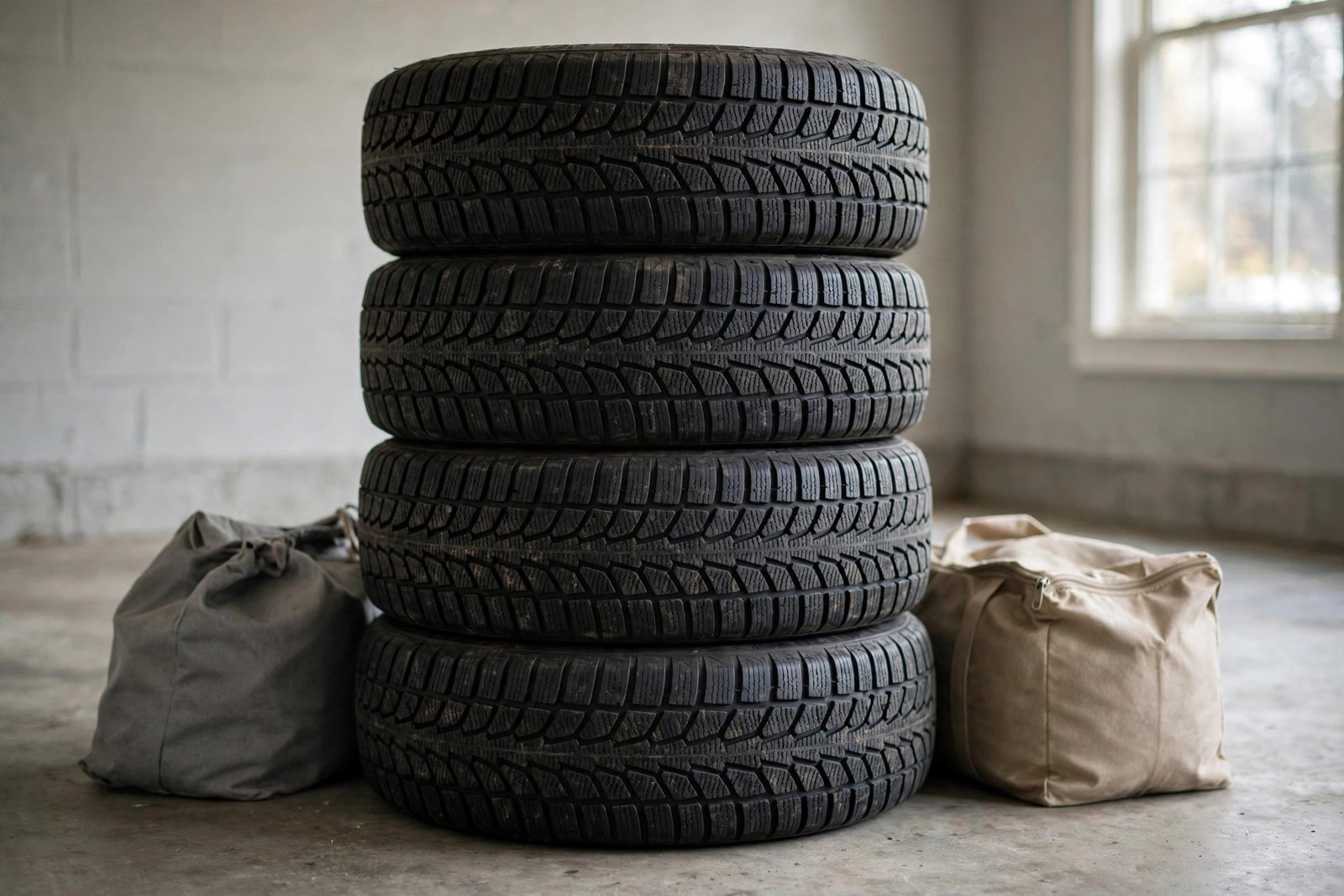
Storing a Winter Set Without Ruining It
A winter set only earns its keep if it survives storage. Rubber degrades in heat, sunlight, and ozone:
- Clean them first. Wash off road salt and brake dust, which corrode wheels and degrade rubber over months.
- Cool, dry, and dark. A basement or climate-controlled garage beats a sun-baked shed. Keep tires away from electric motors and furnaces, which produce ozone that cracks rubber.
- Stack or hang. Tires on wheels can stack flat or hang; unmounted tires should stand upright and be rotated occasionally.
- Bag them. Lawn bags or tire totes keep out light and moisture.
- Check pressure in fall. Tires lose roughly 1 psi per month sitting still; re-inflate to the door-jamb spec — not the sidewall maximum — before the first drive. NHTSA’s winter driving tips cover pressure checks and the 2/32-inch minimum tread depth.
Rotate whichever set is on the car on schedule — our guide to how often to rotate tires applies to winter sets too.
Frequently Asked Questions
Are winter tires really better than all-season tires?
In snow, on ice, and below about 45°F, yes — measurably. In Tire Rack’s 2026 testing, winter tires stopped roughly 25 feet shorter from 25 mph on snow than all-season tires. In warm weather and on clear wet roads, all-season tires are the better tire, so winter tires should come off in spring.
Can I just run winter tires all year?
You can, but you should not. The soft compound wears rapidly on hot pavement, wet braking gets worse, and handling feels vague. Seasonal use is what makes the per-year cost work.
Do I need winter tires if I have all-wheel drive?
AWD helps you get moving; it does not help you stop or turn. On snow and ice, tires decide braking and cornering grip, not the drivetrain. A two-wheel-drive car on winter tires out-brakes an AWD vehicle on all-seasons in winter conditions.
What does the three-peak mountain snowflake symbol mean?
It means the tire passed the ASTM F1805 snow-traction test — at least 10 percent better snow acceleration than a reference tire. It is a real measured standard, but it tests snow acceleration only, not braking, cornering, or ice.
Are all-weather tires as good as winter tires?
Close on snow, not equal on ice. In 2026 testing, the best all-weather tire stopped within about 2.5 feet of the best winter tire on snow, but winter tires held a 12- to 14-foot advantage on ice. All-weather tires are the best one-set compromise; dedicated winters remain the maximum-safety choice.
When exactly should I swap winter tires on and off?
Use temperature, not the calendar: on when daytime highs consistently stay below 45°F (7°C), off when they consistently rise above 45–50°F. In northern states that is typically October/November on, March/April off.
Sources and further reading: Tire Rack’s “Winter Tires vs. All-Season: What the Tests Actually Show” (https://www.tirerack.com/upgrade-garage/winter-tires-vs-all-season-what-the-tests-show) (October 2026 test data); NHTSA winter driving tips (https://www.nhtsa.gov/winter-driving-tips); Firestone’s all-season vs. winter tire comparison (https://www.firestonecompleteautocare.com/blog/tires/all-season-vs-summer-vs-winter-tires/). Test figures above are as published by Tire Rack for their 215/55R17 test on a 2025 Toyota Camry; your results will vary by tire model, size, and vehicle.