
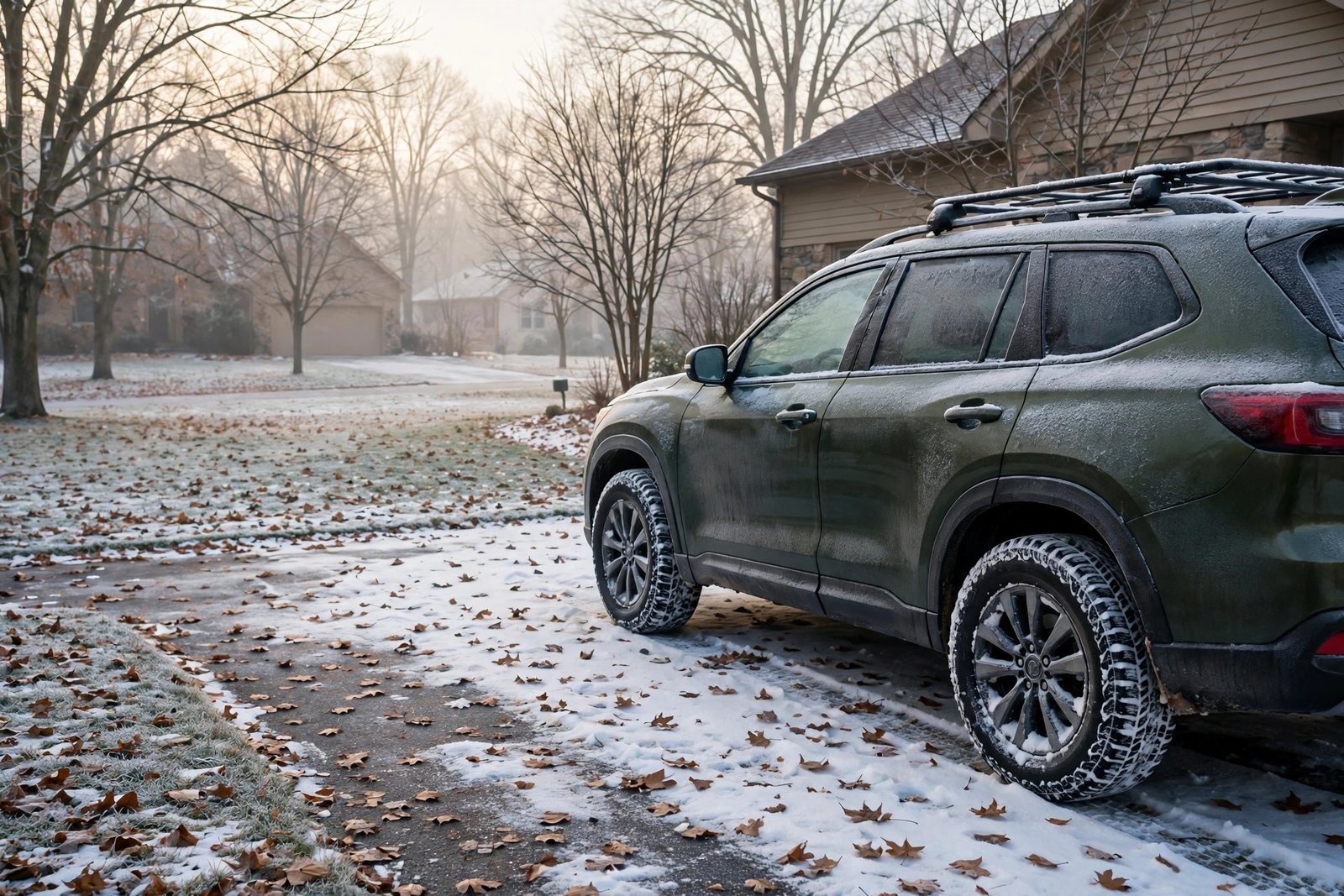
Quick answer: Put winter tires on when temperatures consistently stay at or below 7°C (45°F) — not when the first snow falls. The handy version is the 7-7 rule: fit them once it has stayed at or below 7°C for seven days in a row, and take them off in spring once it has stayed above 7°C for seven days. In most northern US states and Canada that means mid-October to early November; in milder regions it may be late November or not at all. Book early — the two weeks after the first snowfall are the most backed-up window of the year at tire shops.
Why temperature, not snow, decides the switch
Most drivers watch the sky for the first snowfall and treat that as the signal to change tires. That is the single most common timing mistake, and it leaves you driving on the wrong rubber for weeks.
The reason is chemistry, not weather. The rubber compound in all-season and summer tires is designed for warm conditions. Once the temperature drops below about 7°C (45°F), that rubber starts to harden and lose its elasticity. A hard tire cannot flex and conform to the road surface the way a soft one can, so grip falls away — on dry pavement, on wet pavement, everywhere. Snow has not even entered the picture yet.
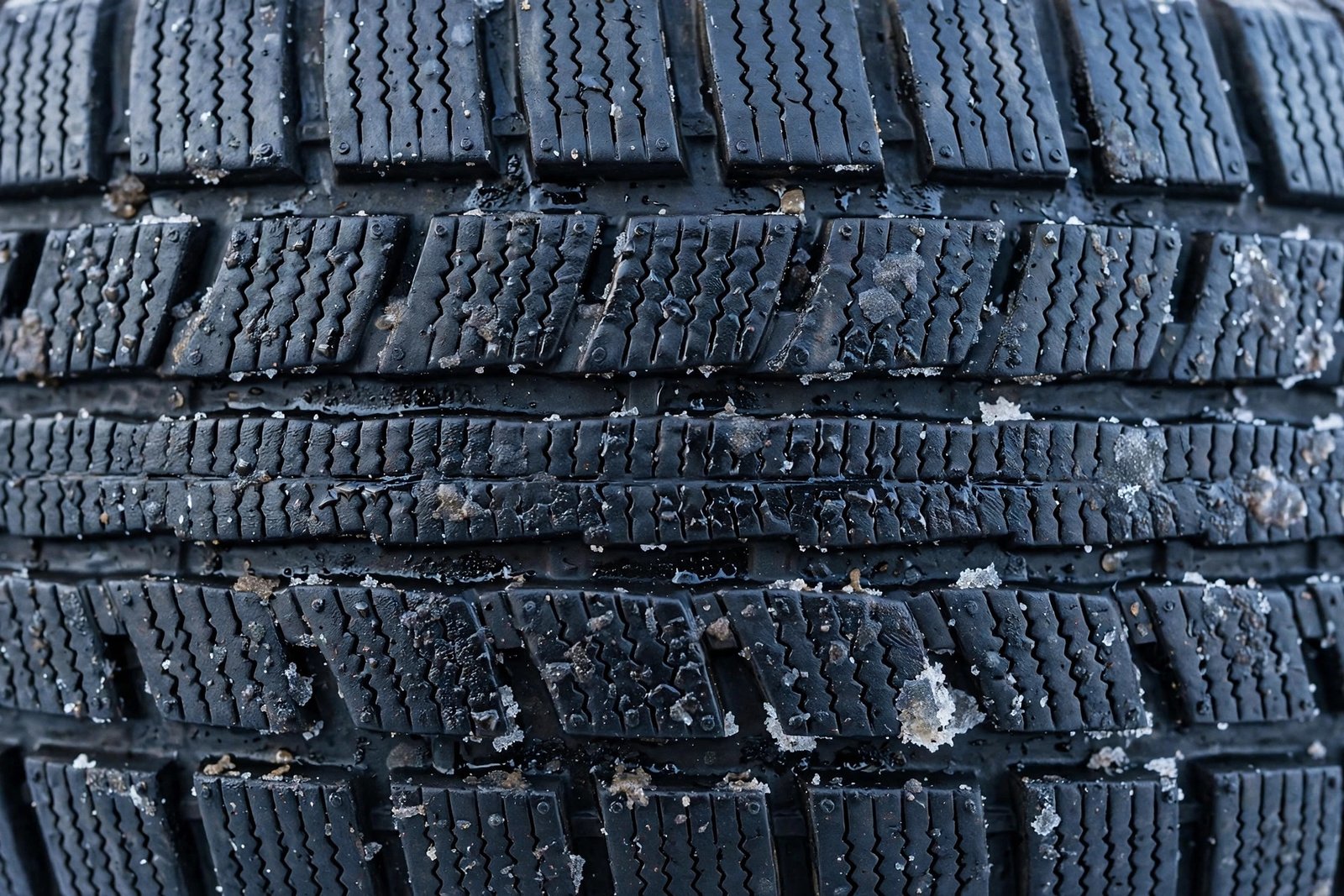
Winter tires are built the other way around. They use a softer, high-silica rubber compound that stays pliable far below freezing, plus a tread full of tiny slits called sipes that bite into snow and ice. That is why the switch matters even in places that get cold without getting much snow: a cold, dry morning in November is already a winter-tire morning, even if the roads are bare.
Tire makers agree on the number. Nokian Tyres advises changing to winter tires when the temperature consistently drops to about 45°F (7°C) or lower, and notes that nights and early mornings can be much colder than the daytime high. The same 7°C threshold shows up in guidance from CAA, Transport Canada, and tire retailers across North America. It is the closest thing the tire world has to a universal rule.
The 7-7 rule: the simplest timing test
If you remember one thing from this article, make it the 7-7 rule:
- Fit winter tires once the temperature has stayed at or below 7°C (45°F) for seven days in a row.
- Remove winter tires once it has stayed at or above 7°C (45°F) for seven days in a row.
The seven-day window matters because a single cold snap is not winter. Early fall is full of one cold night followed by a week of mild weather, and fitting winter tires for that one night means wearing soft rubber on warm roads for no benefit. Seven consistent days tells you the season has actually turned.
Watch the daily high, not just the overnight low. If daytime temperatures are still climbing past 10°C (50°F) most days, your winter tires will wear faster than they should. Once the daily high stops clearing 7°C, the season has turned and it is time to switch. A practical approach used by many drivers is to start watching the forecast in early October and book the appointment as soon as the long-range outlook shows a sustained drop — a proactive switch beats reacting to the first frost.
When to put winter tires on by region
The 7°C rule is universal, but the calendar date it lands on depends entirely on where you live. Use this table as a starting point, then let your local forecast have the final say.
| Region | Typical switch window | Notes |
|---|---|---|
| Northern US (Minnesota, North Dakota, Maine, upstate New York, Michigan) | Mid-October to early November | Cold arrives early and stays; book in early October to beat the rush |
| Mountain West (Colorado, Utah, Montana, Wyoming) | Early to mid-October | Mountain passes can freeze weeks before the valleys; check pass requirements |
| Northeast & Great Lakes (New England, Pennsylvania, Ohio, Illinois) | Late October to mid-November | Lake-effect snow can arrive suddenly; watch the 7-day forecast from mid-October |
| Mid-Atlantic (Virginia, Maryland, DC area) | Mid-November to early December | Milder winters; many drivers here manage on all-season tires — see our decision guide |
| Pacific Northwest (Washington, Oregon) | November | Rain and cold matter more than deep snow; lowland areas often stay above freezing |
| Southern US (Texas, Florida, Georgia, Arizona) | Usually not needed | Temperatures rarely stay below 7°C for a week; all-season tires are the norm |
| Southern Canada (Ontario, southern Quebec) | Mid-October to early November | Quebec has a legal deadline of December 1 — do not leave it that late |
| Western Canada (Alberta, BC interior) | Early to mid-October | BC mountain highways require winter tires or chains from October 1 |
Two patterns are worth noticing. First, the north switches a full month before the mid-Atlantic, even though both places get winter. Second, nobody in this table waits for snow: in every region, the temperature threshold arrives before the first serious storm. If you wait for the storm, you are already late — and so is everyone else, which is exactly why shops are booked solid.
Legal deadlines: the dates you cannot miss
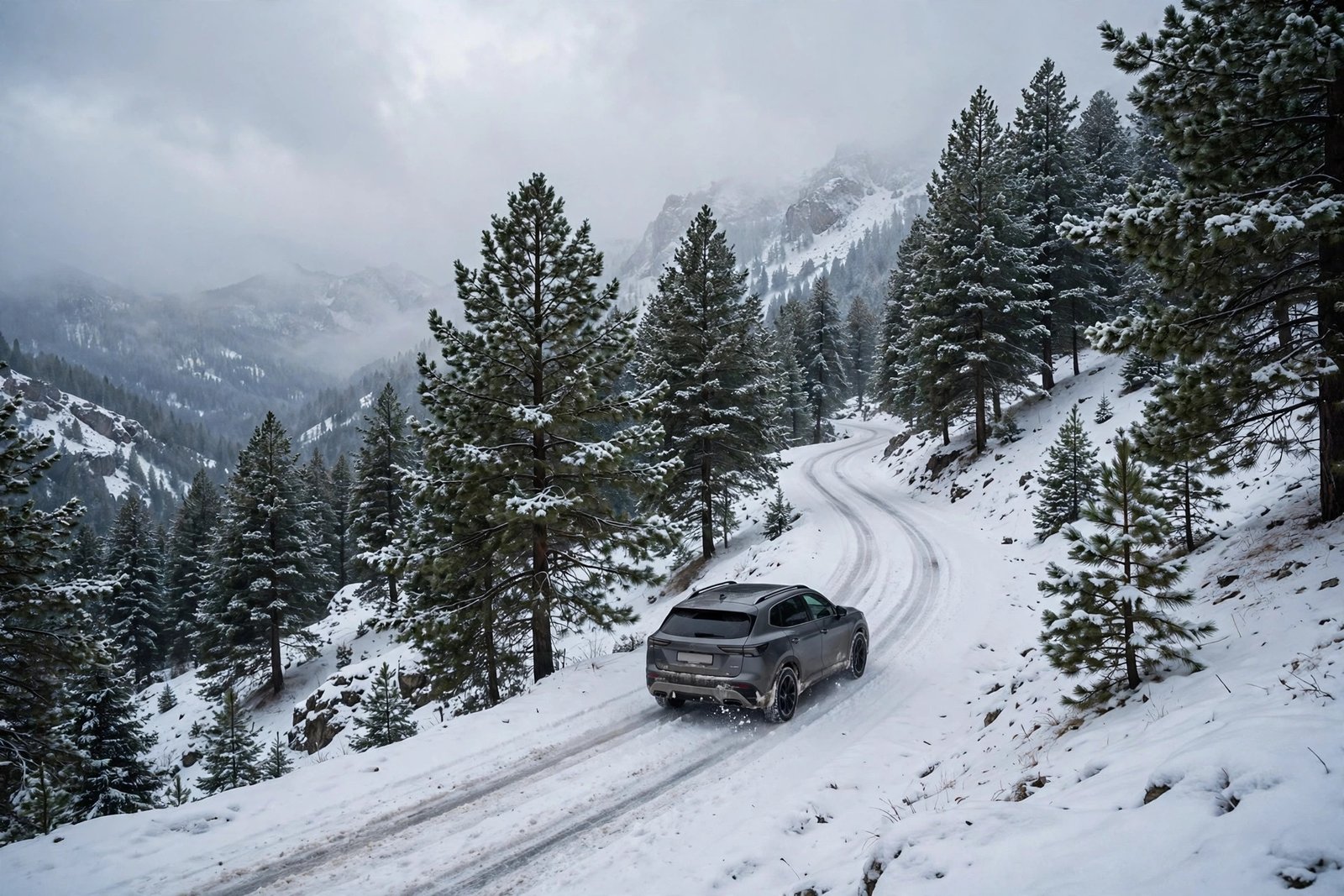
In most of the United States there is no law telling you when to fit winter tires. Some states and mountain passes require winter tires or chains during winter conditions, and those rules are enforced on the spot — a chain-control checkpoint does not care that you meant to switch next week. Check the rules for any mountain route you plan to drive.
Canada is stricter, and the deadlines are fixed dates rather than temperature rules:
| Jurisdiction | Requirement |
|---|---|
| Quebec | Winter tires mandatory December 1 to March 15 for all passenger vehicles; fines of $200–$300 for non-compliance |
| British Columbia (designated highways and mountain passes) | Winter tires or chains required October 1 to April 30 |
| Rest of Canada | No blanket law, but Ontario insurers must offer a winter tire discount on private passenger policies |
The Quebec deadline is the one that catches people out. Because every driver in the province is switching in the same two weeks, shops are at their busiest right when the law bites. If you live in Quebec, book your changeover for October — the legal deadline is a last resort, not a plan.
Five signs it is time to switch right now
You do not need to guess. If any of these are true, book the appointment this week:
- The 7-day forecast shows highs below 7°C. The season has turned. Do not wait for a colder signal.
- Overnight lows are regularly near or below freezing. Morning frost on the windshield means morning roads are cold enough to harden all-season rubber.
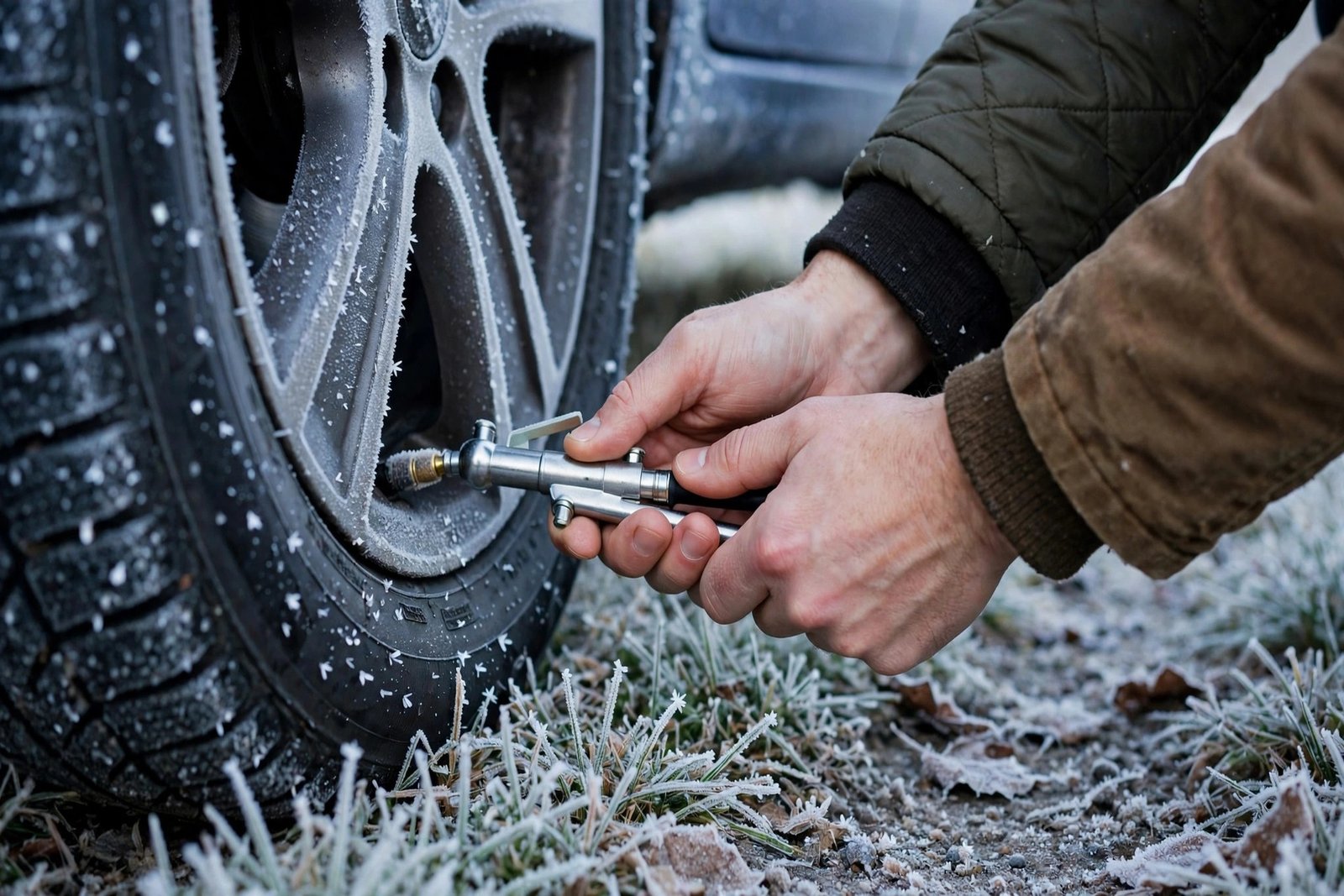
- Your tire pressure warning light keeps coming on. Tire pressure drops roughly 1 psi for every 10°F the temperature falls, so cold mornings trigger the light even with no leak. It is a useful early warning that winter has arrived — check pressures when the tires are cold and use the pressure on your door placard, not the maximum on the sidewall.
- You can see your breath in the morning and the roads are damp. Cold plus wet is the combination where hardened all-season rubber loses grip fastest, well before any snow.
- The first snow is forecast within two weeks. Shops will be fully booked by the time it arrives. A swap booked now takes under an hour; a swap booked after the first storm can mean days of waiting — and days of driving on the wrong tires.
How early is too early?
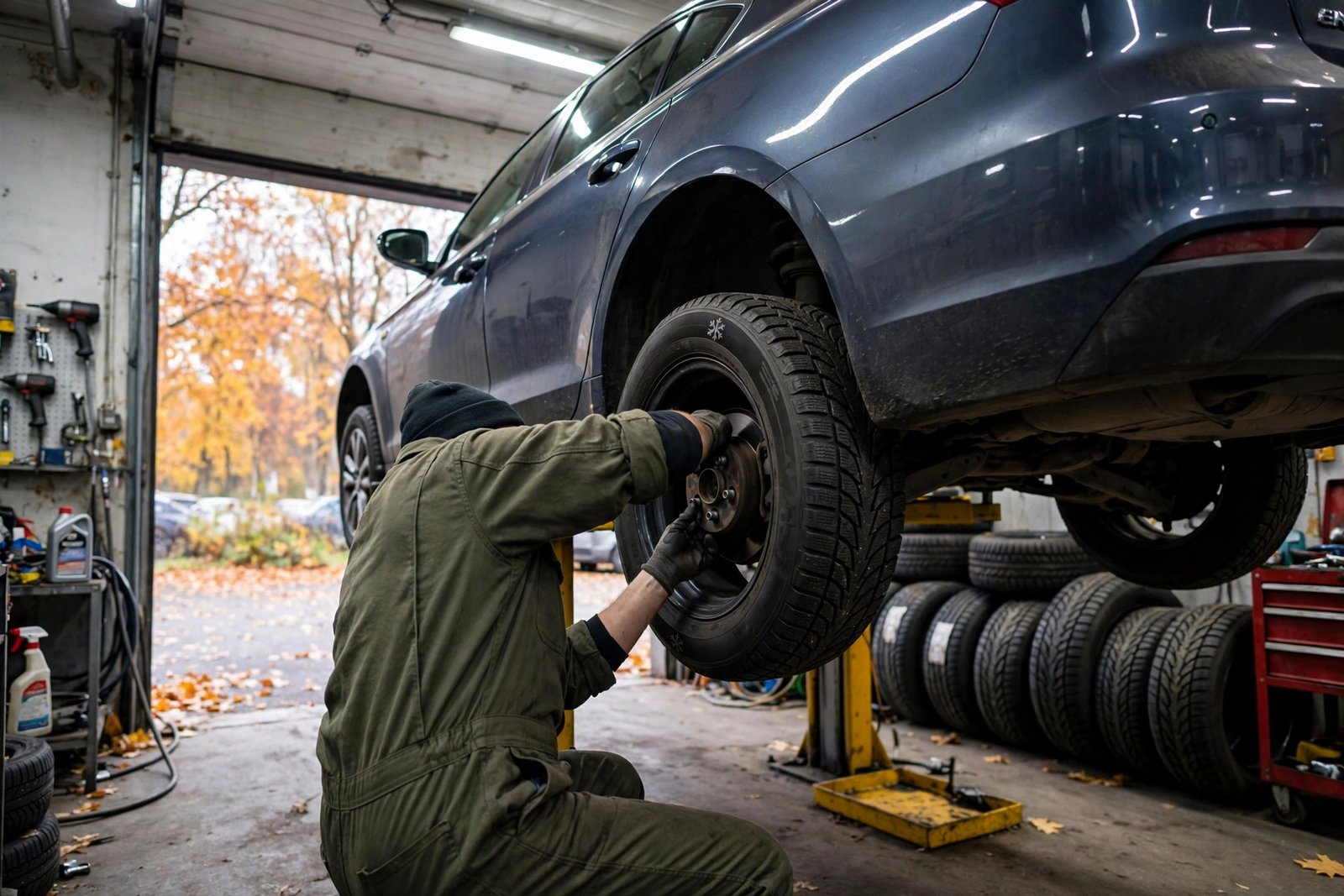
Fitting winter tires too early is a real but small mistake. The soft winter compound wears faster on warm, dry roads, and winter tires stop longer than all-season tires on warm dry pavement — Tire Rack’s near-freezing wet testing found a winter tire needing 129 feet to stop from 50 mph against about 99 feet for a good all-season tire. That is the trade-off: winter tires are worse than all-seasons in the warm, better in the cold.
In practice, “too early” means fitting them while daytime temperatures are still regularly above 10°C (50°F). A week or two of mild weather after an early-October switch costs you almost nothing in wear. A month of warm-weather driving on winter tires will visibly shorten their life. The practical rule: if the forecast says the cold is here to stay, switch. If it says one cold weekend followed by a warm spell, wait.
What the swap costs
Prices vary by shop, vehicle, and region, and few chains publish a fixed national price list — always confirm with your local shop. The ranges below come from published 2026 shop pricing surveys and tire retailer guides.
| Job | What the shop does | Typical cost (set of four) |
|---|---|---|
| Swap (winter tires on their own wheels) | Unbolt one set of wheels, bolt on the other, torque lug nuts, check pressure | $40–$100 |
| Changeover (both sets share one set of rims) | Dismount tires, mount the other set, rebalance each wheel | $60–$180 |
| TPMS relearn after the swap | Reset or relearn sensors so the warning light reads correctly | $0–$40 |
| Off-season storage at the shop | Store your off-season set in a climate-controlled room | $60–$120 per season |
The swap-versus-changeover gap is the whole story of winter tire costs. If your winter tires live on their own set of wheels, the shop does no tire-machine work at all, the visit takes 30–45 minutes, and the bill is roughly half. If both sets share one set of rims, every tire has to come off and go back on, the visit takes 45–60 minutes, and you pay for mounting and balancing twice a year.
That is why a second set of wheels pays for itself. Plain steel winter wheels run roughly $70–$100 each, so a set of four costs around $300 plus a one-time mount-and-balance of about $120. After that, every seasonal change is the cheaper swap price instead of the changeover price — a saving of roughly $40–$80 per change, or $80–$160 a year. Most drivers break even in two to three winters, and they also save their summer wheels from the wear of twice-yearly remounting.
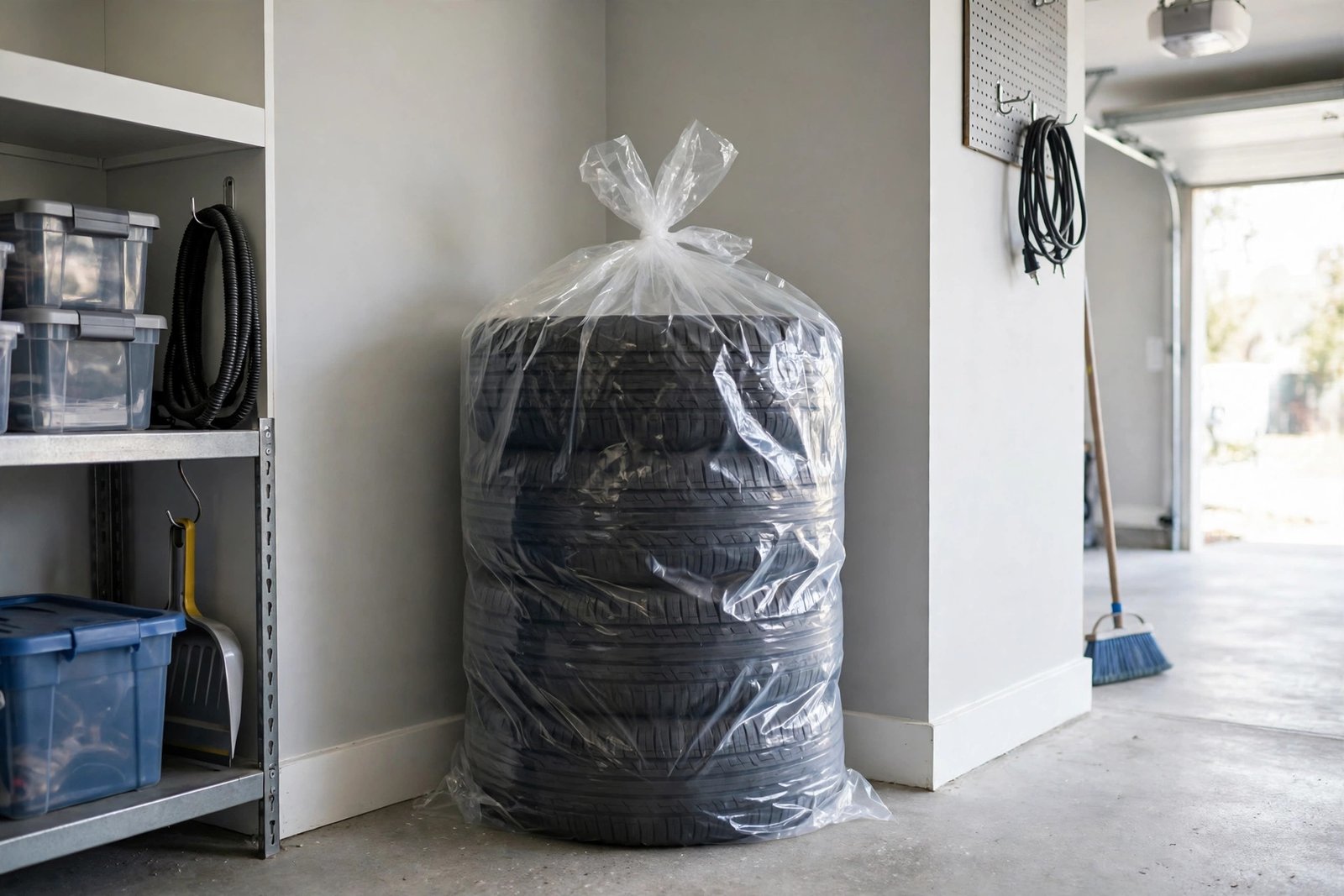
How to store your off-season tires
Good storage is what makes a winter set last five or six seasons instead of three. The enemies are sunlight, heat, ozone, and moisture, and the rules are simple:
- Clean them first. Wash off road salt and grime, and let them dry completely before storing.
- Keep them out of sunlight. UV degrades rubber. A dark corner of a garage or basement beats a sunny shed.
- Keep them cool and dry. A cool, dry room is ideal. Avoid storing tires near electric motors, furnaces, or solvents, which produce ozone and fumes that age rubber.
- Stack or stand them correctly. Tires mounted on wheels can be stacked flat or hung. Tires without wheels should be stored standing upright, and rotated occasionally so they do not develop a flat spot.
- Bag them. Sealing each tire in a large plastic bag keeps moisture and ozone out. Squeeze out as much air as you can before sealing.
- Note the position. Mark which corner each tire came from (front left, rear right, and so on) so you can rotate them properly when they go back on.
If you have no suitable space at home, shop storage at $60–$120 a season is a reasonable deal — and many shops include it free if you bought the tires there.
When to take winter tires off
The spring switch follows the same rule in reverse. Once temperatures consistently stay above 7°C (45°F), take the winter tires off. Leaving them on through warm spring and summer weather wears the soft compound quickly, lengthens stopping distances on dry roads, and eats into the life of a set you paid good money for.
Do not rush the spring switch either. A warm week in March followed by a late snowstorm is a classic trap in the Northeast and Great Lakes. Wait for the 7-7 rule — seven days above 7°C — and check that there is no late-season storm in the forecast before you book. In most northern regions that means late March to mid-April.
Mistakes to avoid
- Waiting for the first snow. By then you have been driving on hardened rubber for weeks, and every shop is booked.
- Fitting only two winter tires. Always fit a full set of four. Two winter tires on the front and two all-seasons on the rear (or the reverse) creates a grip mismatch that can spin the car in a corner. Tire makers and safety agencies agree on this without exception.
- Running winter tires all year. The soft compound wears fast in summer heat and stops longer on dry roads. Winter tires are a seasonal tool.
- Forgetting tire pressure. Pressure drops about 1 psi per 10°F, so a set inflated in October will be several psi low by January. Check monthly through winter, always when the tires are cold.
- Ignoring tread depth. Winter tires need deep tread to work. Transport Canada advises against using tires worn close to 5/32 inch (4 mm) on snow-covered roads. Check tread depth before the season starts, not in the middle of it — our guide to checking tire tread depth shows how.
The bottom line
Put winter tires on when the temperature says so, not when the snow does. The 7°C (45°F) threshold, the 7-7 rule, and a glance at the two-week forecast will get your timing right in almost any climate. Book early, fit all four, store the off-season set properly, and take the winter set off once spring temperatures settle above 7°C. Do that every year and your winter tires will last longer, stop shorter, and be on the car before the weather turns — which is the whole point.
Related reads
- Compare Cars tool — compare any two cars side by side
- Winter Tires Guide — everything about winter tires
- Studded vs Studless Winter Tires
- How to Check Tire Tread Depth
- How Often to Rotate Tires
- TPMS Sensor Replacement Cost
- Do I Need Winter Tires or All Season Tires? A Decision Guide