
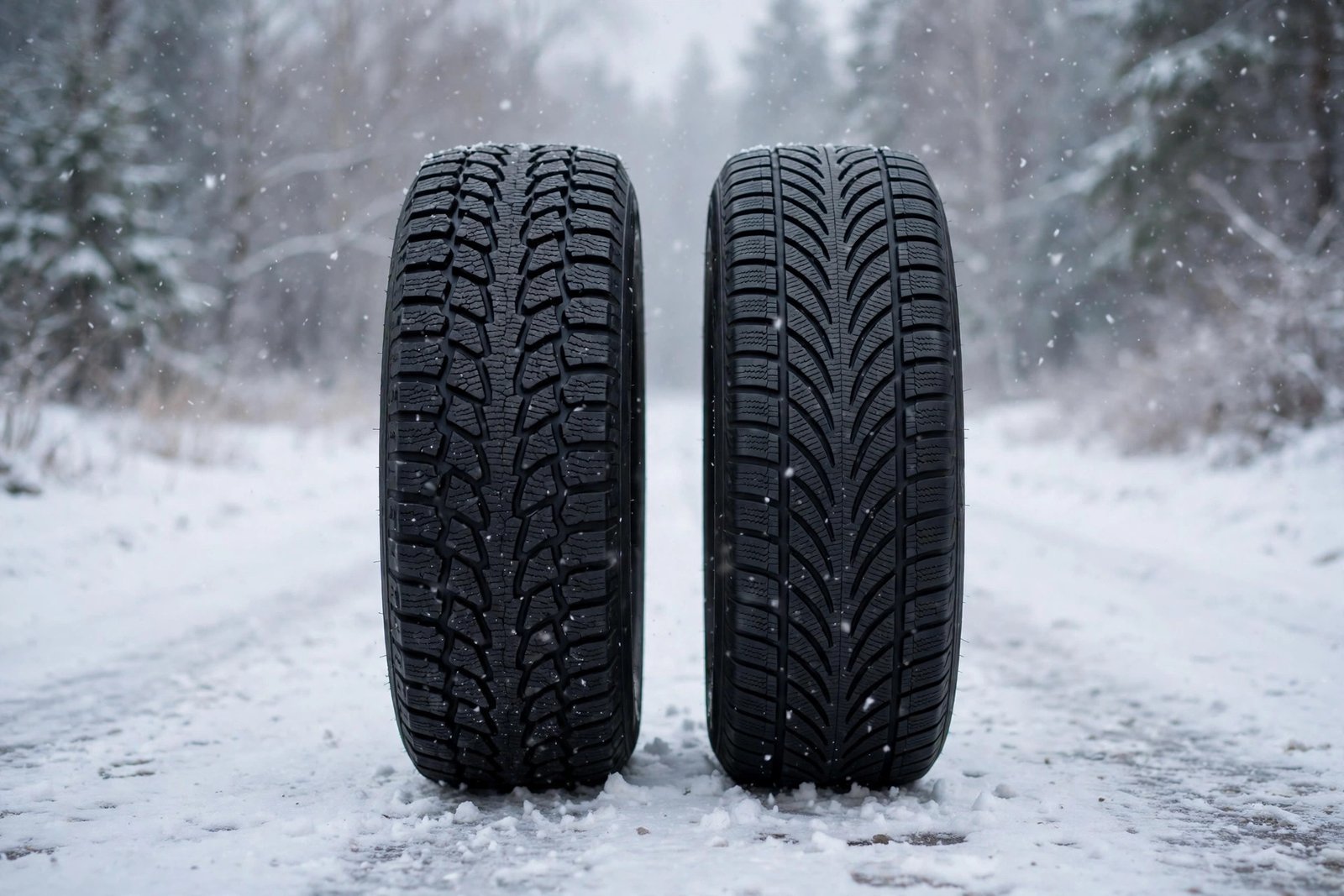
Quick answer: If your winters bring regular ice, deep snow, or weeks below freezing — and you have to drive no matter the weather — get dedicated winter tires. They stop noticeably shorter on ice and in snow. If your winters are mostly cold rain, slush, and a few snow days, and you can stay home on the worst days, a good set of all-weather tires is the smarter buy: one set, no seasonal swap, and real winter certification.
Every fall, the same question comes up across the northern US and Canada: do you really need a second set of winter tires, or can one set of all-weather tires handle the whole year? Both carry the mountain snowflake symbol and are sold as winter-ready — yet they are built for different drivers, and picking the wrong one can cost you money, or grip when you need it most.
This guide is about that exact choice — not all-season versus winter tires, which we covered in our all-season vs winter tires comparison — but the two categories people actually confuse, because they look alike and wear the same badge.
First, Don’t Confuse All-Weather With All-Season
“All-season” and “all-weather” sound like the same thing, and some sellers use them loosely. Here is how the terms are used in this article:
- All-season tires: despite the name, these are really three-season tires for spring, summer, and fall. Most carry only the M+S marking, not the mountain snowflake symbol, and are not designed for real winter driving.
- All-weather tires: tires built to stay on all year and certified for severe snow. They carry the Three-Peak Mountain Snowflake (3PMSF) symbol — all-season tires with a real winter test behind them.
- Winter tires: tires designed only for the cold season, with or without studs — also called snow tires. They go on in the fall and come off in the spring.
Whatever the name on the label says, check the sidewall. The symbol molded into the rubber tells you what the tire was actually tested for — more than any marketing name.
Why does it matter? An all-season tire is the weakest of the three in winter: in Tire Rack’s 2026 test, one needed 81.1 feet to stop from just 25 mph on snow, versus 56.1 feet for the best winter tire — a 25-foot gap at parking-lot speed. If you are shopping for winter capability, you are choosing between all-weather and winter tires.

What Makes Them Different
From a few steps away, the two can look surprisingly similar. The differences are in the rubber, the tread, and how far each design leans toward winter.
The rubber compound and the 45°F threshold
Tire rubber stiffens as it gets colder, and a stiff tire cannot conform to the road to grab onto it. Tire makers use 45°F (7°C) as the dividing line: below that, standard all-season rubber starts losing elasticity and grip, even on a dry road with no snow in sight.
Winter tires use a compound rich in natural rubber and silica that stays soft well below freezing, even at -22°F (-30°C). That is their biggest advantage — and why they win on cold, dry pavement as well as on snow.
All-weather tires use a compound that stays flexible in the cold too, but is engineered to also resist wear and heat in July — softer than an all-season tire in winter, firmer than a winter tire in summer. Good in both seasons, the best in neither.
Tread design and siping
Winter tires have deep, open tread blocks and a high density of sipes — thin slits that create thousands of extra biting edges for ice and packed snow. The open grooves pack with snow, and snow grips snow better than rubber does.
All-weather tires borrow this approach but tone it down. They usually have a directional or V-shaped pattern with plenty of siping, but with stiffer blocks so the tire stays stable and precise on warm, dry roads.
One detail buyers miss: many all-weather tires use a directional tread, which can only be rotated front to back on the same side. On a front-wheel-drive car, where front tires wear faster and unevenly, that limits your options for evening out wear. Worth deciding before you buy, not after.
Tread depth
New winter tires often start deeper than all-weather tires — typically 10/32 to 12/32 inch. Winter grip falls off sharply below 6/32 inch of tread, and most tire professionals treat 4/32 inch as the practical end of winter usefulness — long before the 2/32 inch legal minimum. That matters more for all-weather tires, which wear down 12 months a year instead of four or five.

The Snowflake Symbol: What 3PMSF Actually Proves (and What It Doesn’t)
Here is the most misunderstood fact in this comparison: the mountain snowflake symbol is a pass, not a ranking.
M+S (Mud and Snow) is a description of tread geometry, not a winter performance test. A manufacturer applies it based on the shape of the tread. Most all-season tires carry it. On its own, M+S does not mean a tire is suitable for real winter conditions.
Three-Peak Mountain Snowflake (3PMSF) means the tire passed a standardized severe-snow traction test. Under standards developed by the US Tire Manufacturers Association, a tire is run on medium-packed snow and must reach a snow grip index of at least 1.10 or 1.12 — roughly 10 percent better acceleration traction than a reference all-season tire — in the ASTM F1805 test. Both winter tires and all-weather tires carry it.
That is why the two categories get confused: the symbol tells you a tire meets a minimum snow standard, not how far above it it goes. Worse, the test measures acceleration traction on medium-packed snow only. It does not measure stopping distance, cornering grip, or ice at all. So 3PMSF tells you a tire will get you moving in snow — not how well it will stop you or hold a line through a curve, where winter driving actually goes wrong. That is how a CrossClimate 2 and a Blizzak can wear the same badge and stop 15 feet apart on snow.
Ice Grip symbol. This newer symbol, based on the ISO 19447 standard, means a tire must brake on ice at least 18 percent better than a reference tire. In practice it is found on dedicated winter tires, not all-weather models — so if you regularly drive on ice, this is the symbol that separates the two categories most clearly.
Winter Tires vs All-Weather Tires: Head-to-Head
| Feature | Winter Tires | All-Weather Tires |
|---|---|---|
| Best for | Ice, deep snow, sustained cold | Mild winters, slush, cold rain, year-round use |
| Snow braking (25–0 mph, Tire Rack 2026) | 56.1–57.3 ft (best models) | 58.6–72.4 ft (best models) |
| Ice braking (12–0 mph, Tire Rack 2026) | 38.7–45.9 ft | 50.6–53.0 ft |
| Wet braking (50–0 mph, Tire Rack 2026) | 117.6–129.0 ft | 99.6–110.7 ft |
| Summer driving | Poor — fast wear, longer stops | Good |
What the Tests Actually Show
In spring 2026, Tire Rack ran ten tires in the same size (215/55R17) on the same car — a 2025 Toyota Camry — in near-freezing weather: five dedicated winter tires, three all-weather tires, and two conventional all-season tires.
On snow, the best all-weather tire nearly caught the winter tires
| Tire | Category | Snow stop, 25–0 mph |
|---|---|---|
| Michelin X-Ice Snow | Winter | 56.1 ft |
| Bridgestone Blizzak WS90 | Winter | 57.3 ft |
| Bridgestone WeatherPeak | All-weather | 58.6 ft |
| Michelin CrossClimate 2 | All-weather | 72.4 ft |
| Michelin Primacy Tour A/S | All-season | 81.1 ft |
| Michelin Defender 2 | All-season | 84.5 ft |
The Bridgestone WeatherPeak, an all-weather tire, stopped in 58.6 feet — just two and a half feet behind the best winter tire, and ahead of three of the five dedicated winter tires. The CrossClimate 2, the tire most people mean by “all-weather,” needed 72.4 feet. Two all-weather tires with the same snowflake were 14 feet apart on the same snow: the model matters as much as the category.
On ice, winter tires keep a clear lead
This is where the gap stops being close. The winter tires stopped from 12 mph in 38.7 to 45.9 feet; the all-weather tires took 50.6 and 53.0 feet, and the all-season tires 55 and 57.7 feet — a 12-to-14-foot lead for winter tires over the best all-weather tire, from a speed barely above a crawl.
In the rain, the order flips
Winter tires came last in the wet. From 50 mph, the X-Ice Snow needed 129 feet to stop, 36 more than the best all-weather tire; the Blizzak WS90 needed 117.6 feet. The CrossClimate 2 stopped in 99.6 feet, nearly matching the all-season Primacy Tour A/S at 99.3 feet. If most of your January is cold rain and bare pavement, maximizing ice traction at the expense of wet braking may not be the right trade.
All-wheel drive does not change any of this: it helps you get moving, but braking and steering depend entirely on the tire.
Cost and Tread Life: The Real Math
All-weather tires look cheaper because you buy one set instead of two. The real math is more nuanced.
With winter tires, you buy two sets, but each only wears during its own season. Over several years, the two sets together often cover the same distance as two or three all-weather sets would. Your added costs are a second set of wheels, two changeovers per year, storage, and a second set of TPMS sensors if you want pressure monitoring all winter. A swap with tires already on their own wheels runs about $60 to $80 for all four; remounting each time runs about $60 to $200 per swap.

With all-weather tires, you buy one set and skip changeovers and storage. But that set wears every day of the year, and because the compound is softer than an all-season tire’s, it tends to wear faster in summer heat. Expect to replace all-weather tires sooner, in calendar years, than either of your seasonal sets.
One estimate, based on a car driving 12,000 miles a year with 5,000 of them in winter, puts the real price of the winter-tire advantage at roughly $200 a year — or about $100 a year if you swap the tires yourself and skip the extra sensors. Behind it: a CrossClimate 2 lists around $216 per tire with a 60,000-mile warranty, while a Blizzak WS90 runs about $155 to $175 per tire with no mileage warranty. Prices vary by size and retailer.
For drivers who cover modest distances and have no storage space, all-weather tires usually come out ahead on cost and convenience. For high-mileage drivers who already own a second set of wheels, the cost gap shrinks, and sometimes disappears. Either way, price should not decide it if your winters call for maximum grip: two hundred dollars a year is the price of the ice column — not a thousand.
Which One Should You Choose?
Picture two drivers: one commutes a short distance in a city where winter means rain, slush, and a few snowy days, with roads plowed quickly. The other lives in a rural area, drives before the plows pass, and faces freezing rain and packed snow for months. They need different tires.

Winter tires make more sense if:
- Your winters bring regular snowfall, prolonged cold, or frequent ice
- You live in a rural area, on unplowed or hilly roads, or drive before roads are cleared
- You cannot simply stay home when a storm hits — shift work, health care, long commutes
- You drive mountain passes or highways through high-snowfall areas
- You want the maximum safety margin, especially with a new driver
- You have space to store a second set
If that sounds like you, read our winter tires guide before you shop, and compare studded and studless options in our studded vs studless winter tires guide if ice is your main worry.
All-weather tires make more sense if:
- Your winters are mostly mild, wet, and slushy, with snow that does not last long
- You drive mainly in a city where roads are plowed and salted quickly
- You drive moderate distances each year
- You can delay or skip a trip on the worst days
- You have no space to store a second set and want to avoid seasonal changeovers
- You want one set certified for winter instead of all-season tires that are not
A quick self-test
If you answer “yes” to two or more of these four questions, winter tires are likely the better choice.
- Do I drive on icy roads several times a winter?
- Do I often drive before the roads are cleared?
- Do temperatures in my area stay well below freezing for weeks at a time?
- Would I be in trouble if I could not drive on a stormy day?
Mistakes to Avoid
- Confusing all-season and all-weather. An all-season tire is a three-season tire. Without the mountain snowflake symbol, it is not designed for real winter driving.
- Mixing tire types. Never install winter tires on one axle and all-weather or all-season tires on the other — different grip levels front and rear can cause a spin. Always install a matching set of four.
- Running winter tires all summer. They wear quickly in the heat and stop longer on warm, wet pavement. If you want one set for the whole year, it should be an all-weather tire — or a summer tire in hot climates, per our summer tire buying guide.
- Waiting for the first snowfall. Switch when daytime temperatures settle around 45°F, not when the first storm hits and every shop is booked. Learn the signs it is time to change your tires before the rush.
- Driving on worn tires. Replace winter or all-weather tires when tread drops to around 4/32 inch for winter driving, well before the legal wear limit.
- Ignoring tire pressure. Pressure drops about 1 PSI for every 9°F (5°C) decrease in temperature. Check it monthly in winter, when tires are cold.
The Verdict
There is no single “better” tire here — there is a better tire for your winter.
Winter tires are specialists: the safer choice wherever ice, deep snow, or extreme cold are a regular part of winter — shorter stops on snow, a 12-to-14-foot advantage on ice, and grip on cold, dry pavement nothing else matches. You pay for it with a second set, two swaps a year, and storage, roughly $200 a year for a typical driver.
All-weather tires are generalists with a winter certification. They stay on 12 months a year, handle moderate winter conditions well, and save you the twice-yearly changeover. The best of them now stop within a few feet of a winter tire on snow and beat winter tires by a wide margin in the rain, giving up some grip on ice and in deep snow in exchange.
So be honest about your winters. If ice, deep snow, and long cold stretches are part of your routine, dedicated winter tires are worth the extra steps. If your winters are mostly wet, slushy, and short, a good set of all-weather tires is a smart, certified compromise — either way, look for the mountain snowflake symbol and install a full set of four.
Frequently Asked Questions
Can all-weather tires replace winter tires?
Yes, for many drivers — if your winters are mostly cold rain, slush, and a few snow days, and you can stay home on the worst days. But on ice and in deep snow, all-weather tires are not equal to dedicated winter tires, so if ice and heavy snow are regular, buy the winter set.
What is the difference between all-weather tires and all-season tires?
All-season tires are really three-season tires for spring, summer, and fall. Most carry only the M+S marking, which describes tread shape, not winter performance. All-weather tires also stay on all year, but they carry the 3PMSF symbol, meaning they passed a severe-snow traction test, and their softer compound grips far better in snow.
Are all-weather tires good in deep snow and on ice?
In light to moderate snow, yes — and far better than all-season tires. But in Tire Rack’s 2026 test, winter tires stopped 12 to 14 feet shorter on ice from just 12 mph, and their deeper tread and denser siping also win in deep, unplowed snow.
Do all-weather tires wear out faster than winter tires?
In calendar years, yes. All-weather tires run 12 months a year, including hot summers, so they wear faster than a winter set that only runs four or five months. The CrossClimate 2 carries a 60,000-mile warranty while the Blizzak WS90 carries none — but since each seasonal set works only part of the year, two seasonal sets can last as long as two or three all-weather sets.
Can I run winter tires all year round?
You can, but you should not on a daily driver. Winter tires wear quickly in warm weather, handle less precisely, and stop longer on warm, wet roads — in Tire Rack’s 2026 test the X-Ice Snow needed 129 feet to stop from 50 mph in the wet, versus 99.6 feet for the CrossClimate 2. Swap them off once temperatures stay above 45°F (7°C).
Should I buy two or four winter or all-weather tires?
Always buy four matching tires. Mixing two winter or all-weather tires with two worn all-season tires creates a front-to-rear grip imbalance that can make the car handle unpredictably and take longer to stop.