
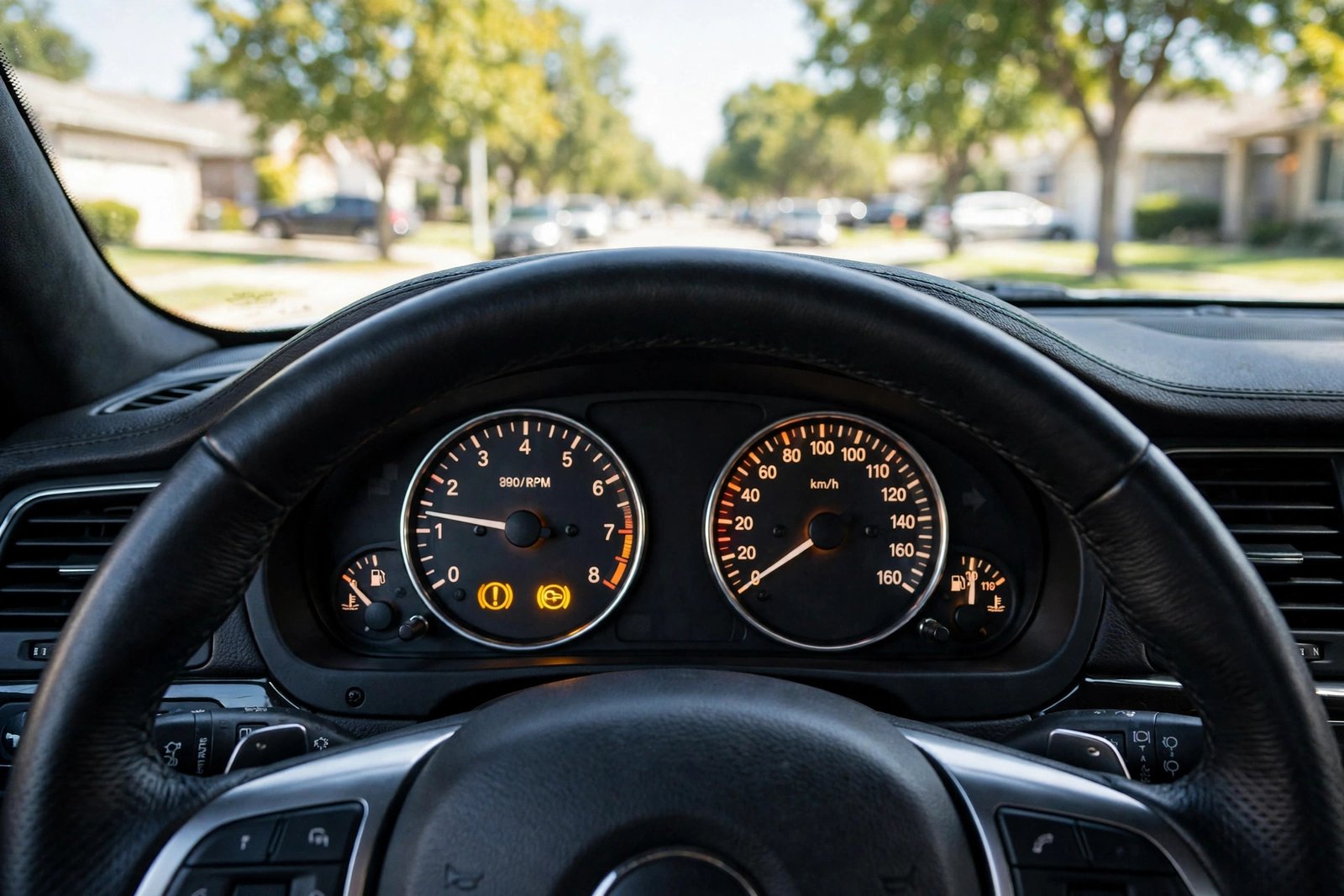
Quick answer: A solid TPMS light usually means a tire is low on air. A light that flashes for 60 to 90 seconds after startup and then stays on means the TPMS system itself has a fault — and a dead or dying sensor is the most common cause. Other giveaways: one tire showing dashes or a blank instead of a pressure reading, a dashboard reading that does not match a manual gauge, and a warning that keeps returning after a reset. The fix is replacement, not repair, and most drivers pay $70 to $150 per sensor at an independent tire shop.
First, a quick check: is it the sensor, or just low air?
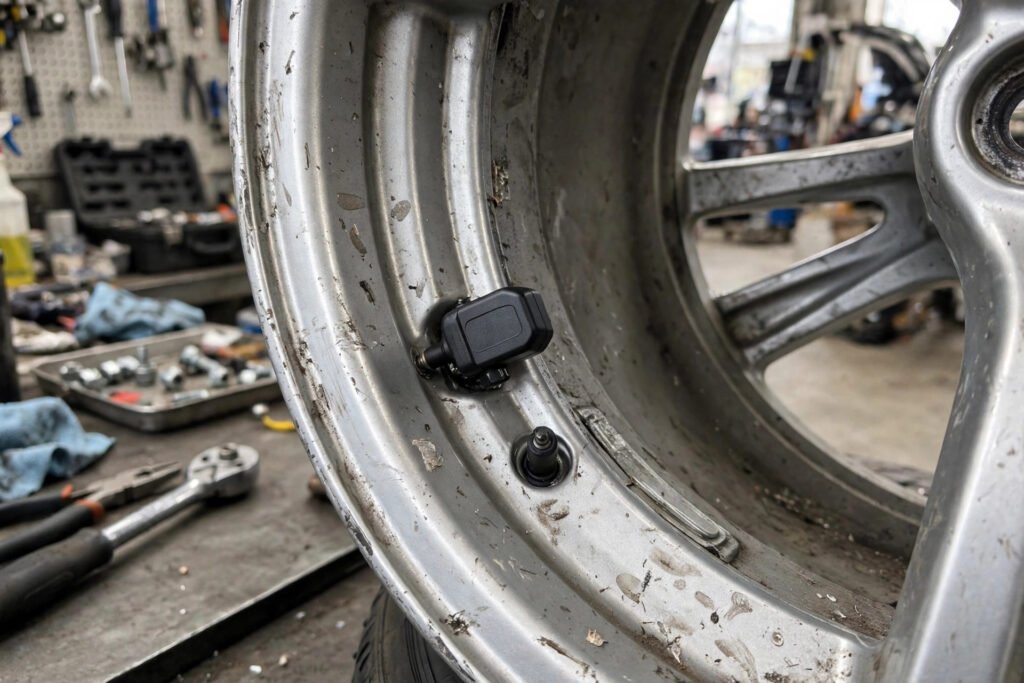
Learning how to tell if TPMS sensor is bad starts with the warning light — but first, rule out the simple stuff. A TPMS sensor is a small electronic device inside each wheel that measures air pressure and radios the reading to your car. When a tire drops about 25% below the pressure listed on the door-jamb placard, the system turns on the warning light. That is the system working correctly — not a failure.
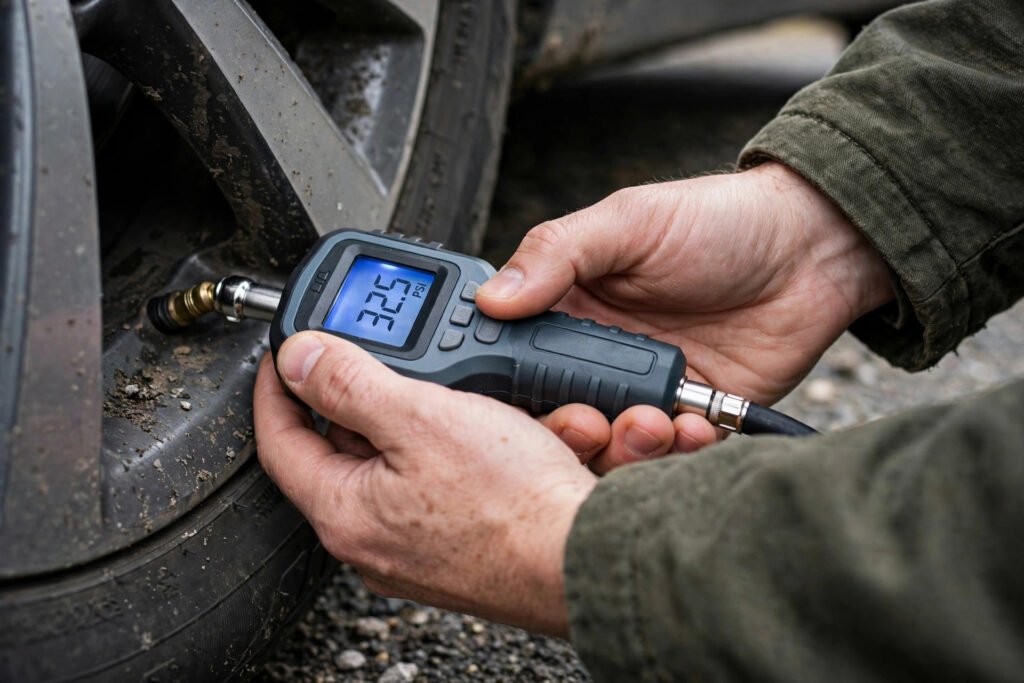
So step one is always the same: check all four tires with a reliable manual gauge, cold (before driving, or at least three hours after parking). Compare each reading to the placard pressure, not to the number on the tire sidewall. If a tire is genuinely low, fill it, drive for a few minutes, and see if the light clears. If the light goes out and stays out, you never had a sensor problem — you had a low tire.
If the pressures are all correct and the light is still on, or if it comes back, you are probably looking at a sensor or system fault. The rest of this guide walks you through the symptoms, the causes, and a simple at-home diagnosis you can do before spending money at a shop.
One more thing: there are two kinds of TPMS. Direct TPMS uses a sensor in each wheel and can show individual tire pressures — this is what most cars built since 2008 have. Indirect TPMS has no wheel sensors at all; it watches wheel speeds through the ABS system. If your dashboard never shows individual PSI readings, you may have an indirect system, in which case the symptoms below do not apply. This article is about direct TPMS sensors, the kind inside your wheels.
The 7 symptoms of a bad TPMS sensor
1. The TPMS light flashes, then stays on
This is the single most reliable clue, and it is the one mechanics look for first. On most vehicles, the warning light behaves differently depending on what is wrong:
- Solid light: a tire is underinflated. Add air.
- Flashing light (about 60 to 90 seconds after startup), then solid: the TPMS system has detected a fault in itself. The tires may be perfectly fine — the system just cannot talk to one or more sensors.
If your light flashes every time you start the car and then settles into a steady glow, stop topping off air that was never low. The problem is in the system, and a dead or failing sensor is the usual suspect. Your owner’s manual will confirm the exact flashing pattern for your model, since it varies slightly by make.
2. One tire shows no reading at all
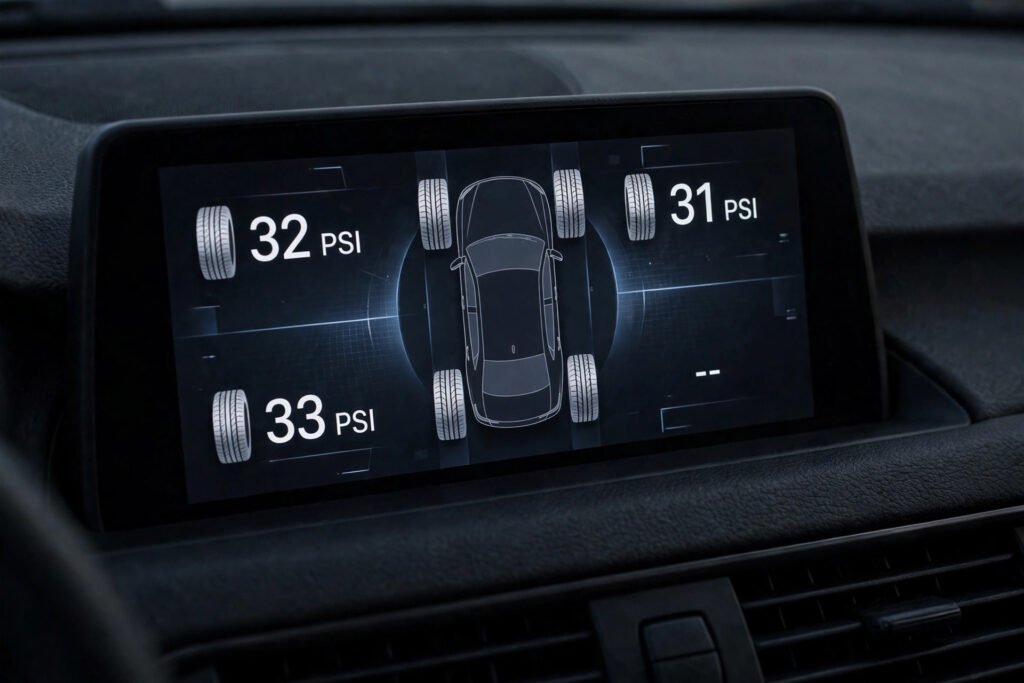
If your dashboard displays individual tire pressures, a dead sensor often shows up as a blank, a pair of dashes, or a missing value for one wheel while the other three report normal numbers. That is usually the battery finally giving out: a dead sensor cannot transmit anything at all, so the car has nothing to display for that wheel.
This symptom is worth paying attention to because it is specific. A general low-pressure problem would show a low number, not a blank. A blank for one wheel, with the others fine, points at that one sensor.
3. The dashboard reading does not match a manual gauge
A sensor that is still transmitting but reporting bad data can leave the dashboard permanently off from what your own gauge shows. Check with a reliable digital gauge on cold tires — even a good sensor has a psi or two of built-in tolerance, and gas-station gauges are notoriously inaccurate, so do not panic over a 1 or 2 psi difference.
What points to a failing sensor is a reading that is off by a fixed amount and never budges, even after driving and reinflating — or a reading that jumps around erratically from one drive to the next. If the gauge says 35 psi and the dashboard insists on 22 psi, or 48 psi, the sensor is not measuring correctly anymore.
4. The warning comes and goes, especially in cold weather
A sensor battery does not always die all at once. As it nears the end of its life, the warning light may come on for a day or two, clear itself, then return weeks later — often once temperatures drop. Cold weather makes a weak battery perform worse, so the first sign of a dying sensor frequently shows up on the first cold morning of fall.
Intermittent warnings are easy to dismiss as a fluke. If the pattern repeats — light on, light off, light on again, always with correct tire pressures — treat it as a sensor on its way out rather than a one-off glitch.
5. The warning returns after a reset
A reset that only holds for a few days, rather than fixing the problem for good, is a common sign of a sensor that is failing. The reset clears the warning, but it does not fix the sensor. Once the car re-checks the system and finds the same sensor unresponsive or reporting bad data, the light comes back.
If you have already tried the reset procedure for your car and the light keeps returning, that is real diagnostic information — it tells you the fault is persistent, not a one-time pressure dip.
6. The problem starts right after tire service
Did the warning appear right after a tire rotation, a new tire, a flat repair, or a wheel swap? Sensors live inside the wheel, clamped to the valve stem or banded to the rim, and they are easy to damage during tire work. A sensor can be cracked by a tire machine, its valve stem can be snapped, or corrosion on the stem can be disturbed during service.
This does not automatically mean the shop did something wrong — sensors on older cars are fragile, and a stem that was already corroded can break during perfectly normal service. But the timing is a strong clue: if the light was fine before the tire work and flashing after it, the sensor (or its valve stem) is the first thing to check.
7. The car is older and the sensors are original
Every TPMS sensor has a sealed, non-replaceable lithium battery inside it, and that battery is the most common reason sensors fail. Manufacturer and industry sources consistently put sensor battery life at 5 to 10 years, with many guides narrowing the typical range to 5 to 7 years. Once the battery dies, the sensor stops transmitting and must be replaced as a unit — there is no way to recharge it or swap the battery.
If your car is 7 or more years old and still has its original sensors, age alone is a likely explanation. Sensors installed at the same time also tend to wear out around the same time, which is why many shops recommend replacing all four together once the first one dies. That is a judgment call, not a rule — but it saves you a second trip to the shop a few months later.

What causes a TPMS sensor to go bad?
| Cause | How it happens | How common |
|---|---|---|
| Dead battery | Sealed lithium battery inside the sensor runs out after 5–10 years | Most common by far |
| Physical damage | Road debris, potholes, curb strikes, or damage during tire service | Common |
| Corrosion | Road salt and moisture corrode the valve stem and sensor body, especially in winter climates | Common in the Rust Belt and coastal areas |
| Wrong sensor or bad programming | A replacement sensor that was never programmed to the car, or programmed to the wrong wheel position | Happens after tire or wheel work |
| Receiver or module fault | The car’s TPMS receiver or control module fails — rare, but possible | Uncommon |
| Radio interference | Aftermarket electronics or a nearby strong radio signal interfering with the sensor’s signal | Rare |
The battery is the story for most cars. Everything else is worth knowing about because it changes the fix: a corroded valve stem sometimes means only the stem needs replacing, and a programming problem needs a relearn, not a new sensor. But for a sensor that has simply reached the end of its battery life, replacement is the only answer.
How to diagnose a bad TPMS sensor at home
You do not need a shop to narrow this down. Work through these steps in order — they take about fifteen minutes and a tire gauge.
Step 1: Check pressures cold. Use a reliable digital gauge on all four tires before driving. Inflate any tire that is low to the placard pressure. If the light clears after a short drive, you are done — it was a pressure problem.
Step 2: Watch the light’s behavior. Start the car and watch the TPMS light. Solid means low pressure. Flashing for 60 to 90 seconds and then staying on means a system fault — a sensor problem. Note which behavior you see; it is the single most useful piece of information you can give a mechanic.
Step 3: Compare dashboard readings to your gauge. If your car shows individual pressures, write down what the dashboard says for each tire and compare it with your gauge readings. A blank, dashes, or a reading that is far off from the gauge points to that specific wheel’s sensor.
Step 4: Try a reset — once. Follow the reset procedure for your car (many cars have a reset button under the dash or a menu option; some relearn automatically after driving). If the light stays off for good, great. If it comes back within days, the sensor is failing.
Step 5: Check the age and the service history. If the car is over 7 years old with original sensors, or the problem started right after tire work, that supports a sensor diagnosis.
Step 6: Get a TPMS scan. If you have done all of the above and the light is still flashing, a shop with a TPMS scan tool can confirm it in minutes. The tool wakes each sensor up wirelessly and reads its pressure, temperature, sensor ID, and — most importantly — its battery status. A healthy sensor shows a battery status of “OK” or a voltage around 3.0 volts. A sensor that gives no signal at all after several attempts is dead. Many tire shops will run this check for free or for a small fee, and it is the definitive answer before you pay for a replacement.
Bad sensor vs. other causes: a quick comparison
Not every TPMS warning means a bad sensor. Here is how to tell the common causes apart:
| Problem | Light behavior | Dashboard reading | What fixes it |
|---|---|---|---|
| Low tire pressure | Solid light | Low number on one tire | Add air |
| Bad TPMS sensor | Flashes 60–90 sec, then solid | Blank, dashes, or wrong number on one tire | Replace the sensor |
| Dead sensor battery | Flashes, then solid; may be intermittent in cold weather | No reading on one tire | Replace the sensor |
| Faulty receiver/module | Flashes, then solid | All readings missing or erratic | Diagnose the module |
| Needs a relearn after tire work | Solid or flashing | Readings may be assigned to the wrong wheels | Relearn/programming procedure |
| Spare tire in use | Solid light | Spare shows no reading (most spares have no sensor) | Nothing — this is normal |
The key distinction is simple: low pressure gives you a solid light and a low number; a bad sensor gives you a flashing light and a missing or wrong number.
What does it cost to replace a TPMS sensor?
Replacement is a routine job. The tire has to come off the wheel to reach the sensor, the old sensor is swapped for a new one, and the new sensor is programmed to your car. Expect to pay:
| Job | Typical cost |
|---|---|
| One sensor installed, independent tire shop | $70–$150 |
| One sensor installed, dealership (OEM part) | $140–$250 |
| One sensor, part only (aftermarket) | $40–$80 |
| One sensor, part only (OEM) | $90–$180 |
| Full set of four installed (aftermarket) | $250–$600 |
| RepairPal national average, one sensor | $240–$299 |
| Kelley Blue Book national average, one sensor | $314–$368 |
The wide range reflects real differences: aftermarket sensors are far cheaper than OEM parts, dealer labor rates are higher than independent shops, and luxury or European cars cost more. The national estimators (RepairPal and Kelley Blue Book) sit at the high end because their figures lean toward OEM parts and dealer-style labor. Most drivers at an independent tire shop land in the $70 to $150 range per sensor. For the full cost breakdown, see our guide to TPMS sensor replacement cost.
If one sensor has died of old age, consider replacing all four. The other three were installed at the same time and have the same battery, so they are likely to fail within months of each other. Paying for four at once is cheaper than four separate shop visits.

Can you drive with a bad TPMS sensor?
Yes — a bad sensor does not make the car unsafe by itself, and it does not affect braking, steering, or handling. The risk is that you lose the warning system. If a tire slowly loses air, or picks up a nail, you will not get an alert — and driving on a badly underinflated tire can cause overheating and a blowout.
So the practical advice is: drive normally, but check your tire pressures with a gauge once a week until the sensor is replaced, and do not put the repair off for months. Also note that some states treat a flashing TPMS light as a failed safety inspection, so a dead sensor can become a problem at inspection time depending on where you live.
When it is not the sensor
A few situations look like a bad sensor but are not:
- The spare tire is on the car. Most space-saver spares have no TPMS sensor, so the light stays on while you drive on the spare. This is normal and clears once the regular wheel is back on.
- You just rotated or swapped wheels. The sensors may need a relearn so the car knows which sensor is at which corner. This is a programming step, not a replacement.
- A recent tire repair used sealant. Tire sealant (the kind in a can, or injected at a shop) can clog or damage a sensor. If the light appeared right after a sealant repair, tell the shop — the sensor may need cleaning or replacement.
- The receiver has failed. Rare, but if a TPMS scan shows all four sensors transmitting fine and the light is still flashing, the problem is in the car’s receiver or control module, not the sensors.
Related reads
- Compare Cars tool — compare any two cars side by side
- TPMS Sensor Replacement Cost: $50–$250 Per Wheel (2026)
- How Long Do TPMS Sensors Last? Lifespan, Signs & Replacement
- How to Program TPMS Sensors
- How to Reset TPMS Without a Tool
- TPMS Light On But Tires Are Fine
- Tire Pressure Light Still On After Filling Tires
- Flashing Tire Pressure Light
Sources
- 5 Symptoms of a Bad TPMS Sensor (and Replacement Cost in 2026) — CarTreatments
- How to Tell If Your Tire Pressure Sensor Is Bad — TireGrades
- How to Know If a Tire Pressure Sensor Is Bad — EngineerFix
- TPMS Sensor Replacement Cost: What You’ll Actually Pay — TirePressureCheck
- Tire Sensor Replacement Cost — AutoZone
- TPMS Sensor Replacement Cost in 2026 — CostFlock