
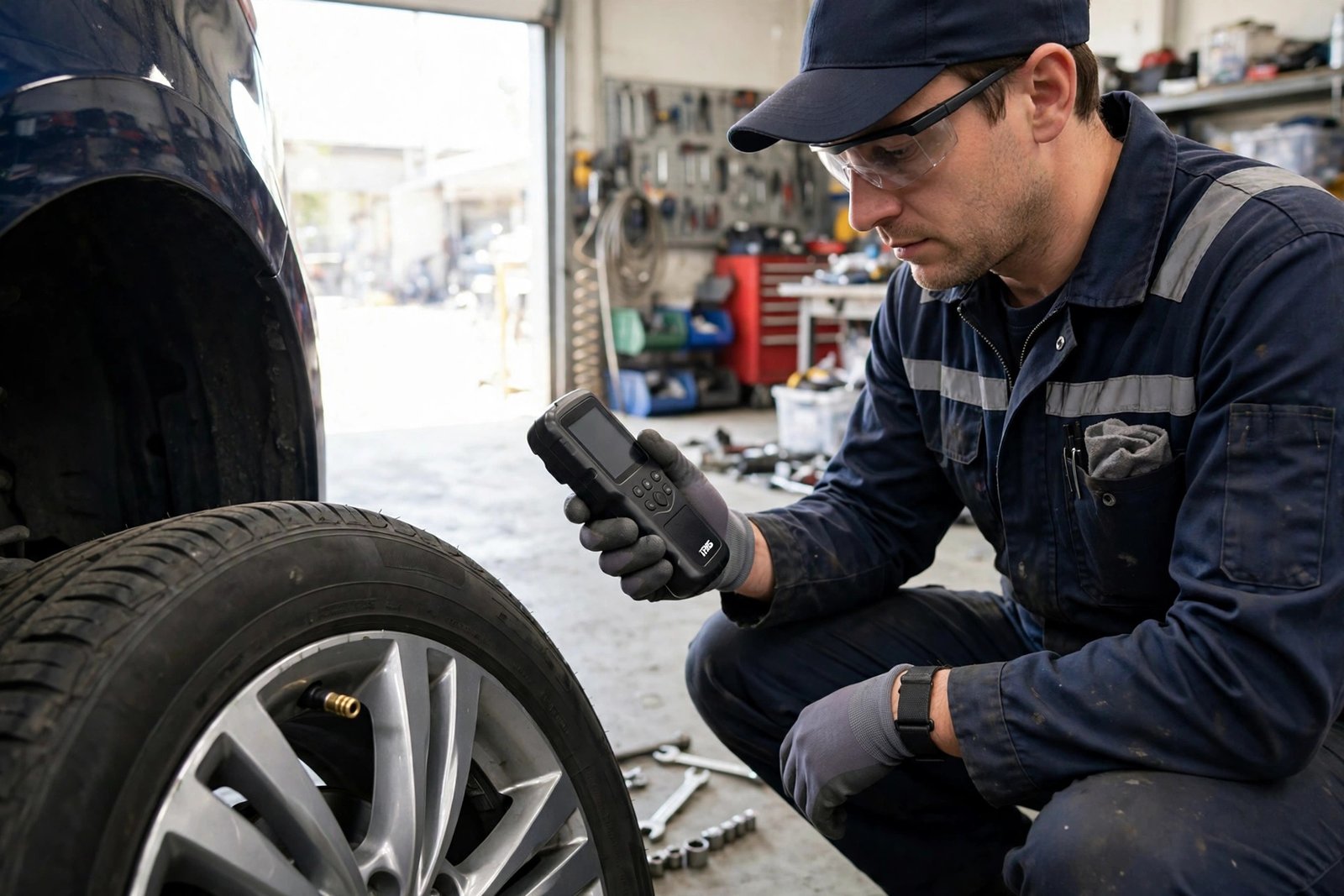
New TPMS sensors installed — or a second set of wheels swapped on — and now the tire pressure light will not go away. The tires are fine, the pressures are right, but the dashboard still complains. The problem is simple: your car does not know the new sensors yet.
Every direct TPMS sensor has a unique ID number, and your car’s computer only listens to the four IDs it has stored. Programming TPMS sensors — also called a relearn — teaches the computer those new IDs. It is a 10-minute job on some cars and a scan-tool job on others, depending entirely on your car’s make and model.
Quick answer: To program TPMS sensors, first find out which relearn method your car uses: auto relearn (just drive 10–30 minutes), stationary relearn (put the car in learn mode, then trigger each sensor in order with a TPMS tool), or OBD relearn (use a TPMS scan tool to write the sensor IDs into the car’s computer through the OBD-II port). GM and Ford mostly use stationary relearn, Toyota, Honda, and Nissan mostly use OBD relearn, and many BMW, Mercedes, Hyundai, and Kia models relearn automatically while you drive.
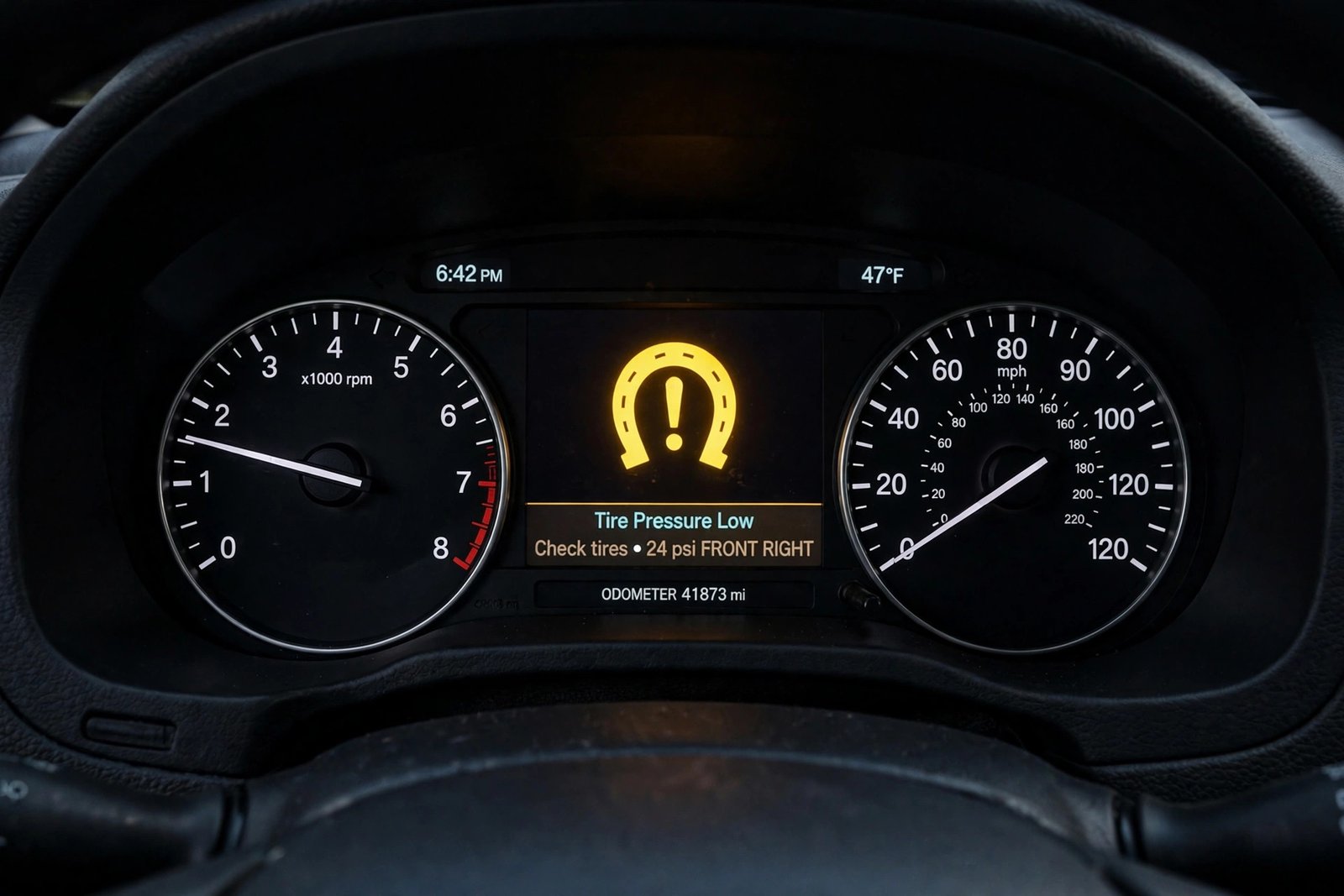
When Do TPMS Sensors Need Programming?
Not every tire pressure light means programming is needed. Here is when a relearn is actually required — and when a simple reset will do.
| Situation | Programming needed? | What to do |
|---|---|---|
| New TPMS sensors installed | Yes | Full relearn with the correct method for your car |
| New wheels with different sensors | Yes | Full relearn — the car has never seen these IDs |
| Seasonal wheel swap (winter/summer set) | Yes, each swap | Relearn each swap (some BMWs store two sets) |
| Tire rotation | Sometimes | GM/Ford cars need a relearn; auto-relearn cars usually handle it by driving |
| Tires inflated after a low-pressure warning | No | Just inflate to the placard pressure and reset if needed |
| Battery disconnected or replaced | Sometimes | Stored sensor IDs can be lost; try a reset first, then a relearn if the light stays on |
| Sensor battery died (5–10 years old) | Yes, after replacement | The new sensor’s ID must be registered |
The key distinction: a reset re-checks pressures against sensors the car already knows. Programming introduces sensors the car has never met. If you replaced a sensor or a wheel, you need programming. If you only added air, you almost certainly do not. (A dead sensor battery is the most common reason a sensor needs replacing — see how long TPMS sensors last.)

The 3 TPMS Relearn Methods
There is no universal method — every manufacturer picks one of three. Find your car in the table below, then jump to the matching section.
| Method | How it works | Tool needed | Difficulty |
|---|---|---|---|
| Auto relearn | Drive the car; it detects and maps new sensors itself | Usually none | Easy |
| Stationary relearn | Car enters learn mode; you trigger each sensor in order with a tool | TPMS trigger/activation tool | Moderate |
| OBD relearn | A scan tool reads sensor IDs and writes them to the car’s computer via the OBD-II port | TPMS scan tool with OBD function | Moderate to hard |
Which Brands Use Which Method?
The exact method varies by model year and trim — check your owner’s manual.
| Relearn method | Brands that commonly use it |
|---|---|
| Auto relearn | BMW, Mercedes-Benz, Audi, Volkswagen, Hyundai, Kia, Mazda, Tesla, Genesis, Mitsubishi, Jaguar, Land Rover |
| OBD relearn | Toyota, Lexus, Honda, Acura, Nissan, Infiniti, Porsche |
| Stationary relearn | Chevrolet, GMC, Cadillac, Buick, Ford, Lincoln, Chrysler, Dodge, Jeep |
The method changed across model years, so sources disagree on a few brands.
Method 1: Auto Relearn (Just Drive)
Auto relearn is the easiest method — if your car supports it, you may not need any tool at all.
How it works: After new sensors are installed, the car’s TPMS module listens for unknown sensor IDs while you drive, compares signal strength from each wheel position, and assigns each sensor to the correct corner automatically.
Step-by-step: auto relearn
- Inflate all four tires to the pressure on the door jamb placard — not the number on the tire sidewall. The system learns pressures as well as IDs.
- Start the engine and drive. Most vehicles need 10–30 minutes of driving, usually at speeds above 20 mph, with some manufacturers specifying 50 mph or more for part of the drive. Highway driving in a straight line works best.
- Check the dashboard. The TPMS light should go out once all four sensors are recognized. If your car shows individual tire pressures, confirm all four readings look correct.
- If the light is still on after 30 minutes of driving, the relearn failed. Either a sensor is faulty, the wrong frequency sensor was installed (315 MHz vs 433 MHz), or your car needs a different relearn method — check the manual.
Method 2: Stationary Relearn (Learn Mode + Trigger Tool)
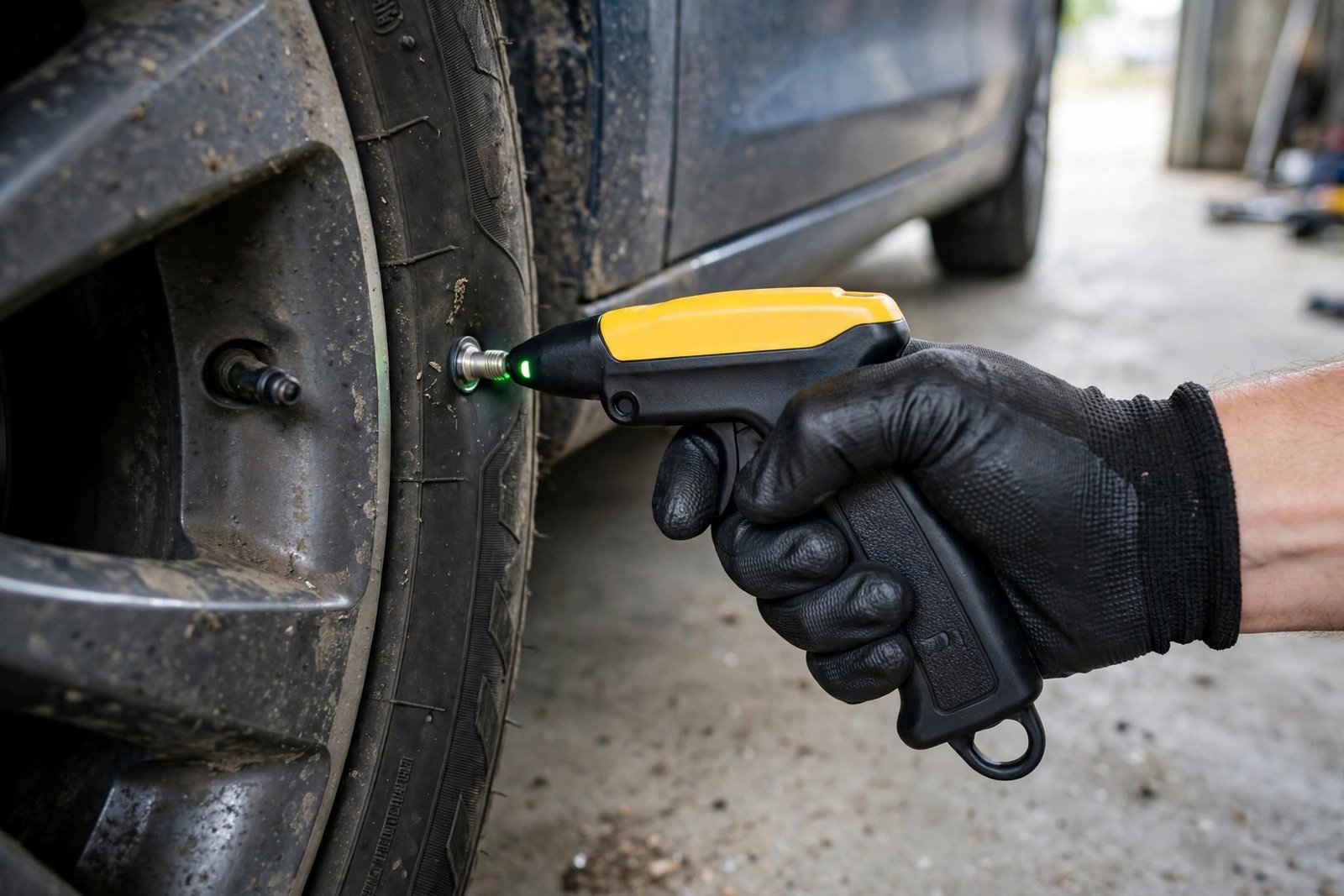
Stationary relearn is the most common method on American cars — GM, Ford, and Chrysler products especially. The car stays parked. You put it into learn mode, then wake up each sensor one by one with a trigger tool, in a specific order. The tool sends a low-frequency signal (125 kHz) that wakes each sensor and forces it to transmit its ID immediately, and the car records each ID in the order you trigger them — so the order matters.
Step-by-step: stationary relearn (GM example)
GM’s procedure is the best-documented version; Ford and Chrysler follow the same pattern with slightly different button sequences. Steps below are from the GMC Sierra owner’s manual — your exact buttons may differ.
- Set the parking brake and inflate all tires to the placard pressure.
- Turn the ignition to ON/RUN with the engine off.
- Enter relearn mode. On many GM vehicles, press the LOCK and UNLOCK buttons on the key fob at the same time for about 5 seconds. The horn sounds twice and the Driver Information Center shows "TIRE LEARNING ACTIVE." (Without a fob, use the DIC buttons or the trip odometer reset stem.)
- Start with the driver-side front tire. Hold the relearn tool against the sidewall near the valve stem and press the button. One horn chirp confirms that sensor’s ID is matched.
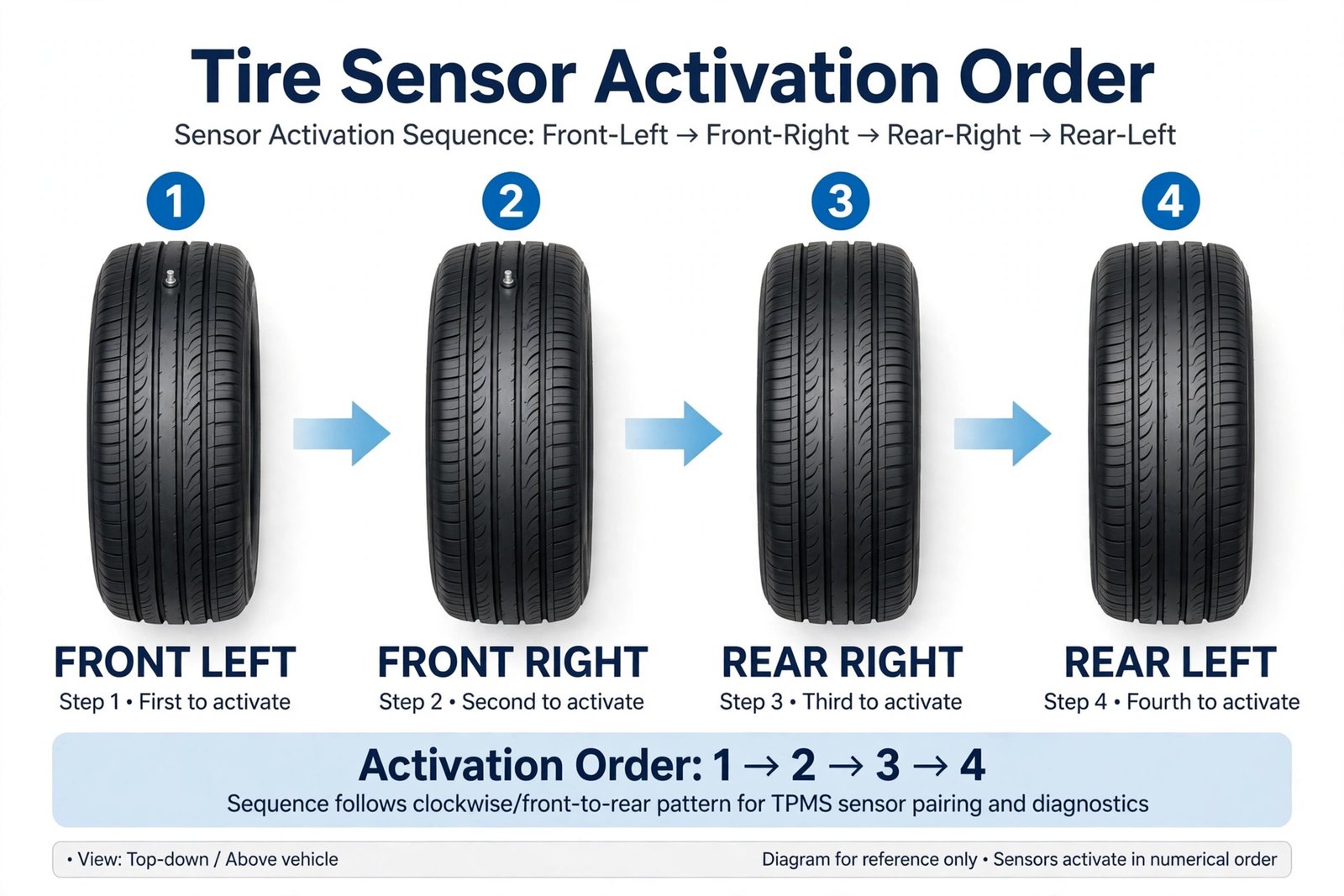
- Repeat in order: passenger-side front, passenger-side rear, driver-side rear. The order is always front left → front right → rear right → rear left.
- Two horn chirps after the last tire mean the process is complete and learn mode is off.
Watch the clock: On GM vehicles you have 2 minutes to match the first tire and 5 minutes total for all four. If you run out of time, the process stops and you must start over. Have the tool in your hand and know the order before you enter learn mode.
Stationary relearn on Ford and Chrysler
- Ford: Many models enter learn mode by cycling the ignition off and on three times, pressing the brake pedal, then cycling the ignition three more times — the horn sounds once to confirm. Then trigger each sensor in the same front-left, front-right, rear-right, rear-left order, listening for a horn chirp after each; the horn sounds twice when done.
- Chrysler: On many models, use the EVIC display menu to select "Retrain Tire Sensor," then trigger each sensor at the valve stem (early models used a magnet). Some Chrysler models relearn automatically after 10 minutes of driving above 15 mph instead.
Method 3: OBD Relearn (Scan Tool Writes IDs to the Computer)
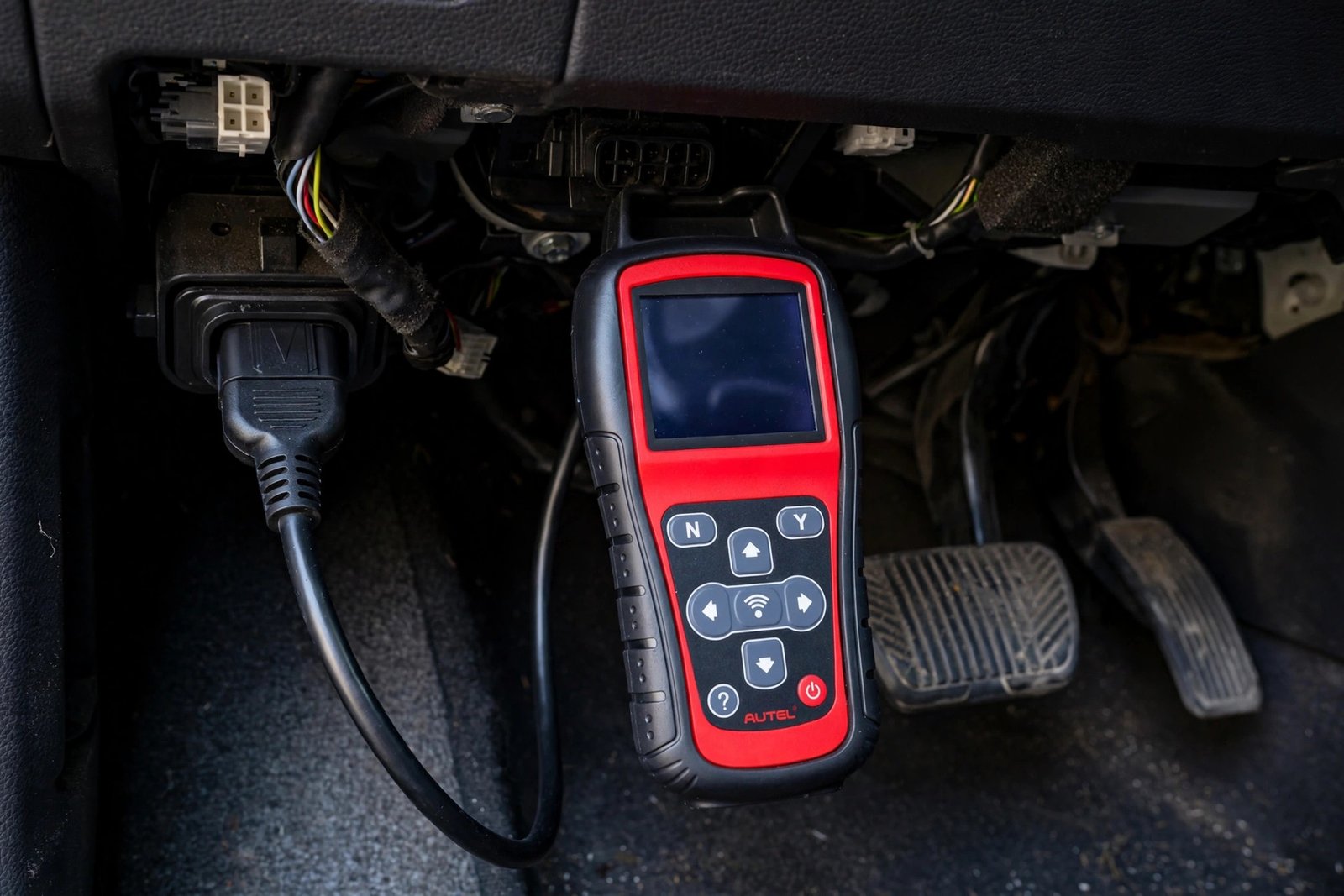
OBD relearn is the method most Japanese and Korean cars use — Toyota, Lexus, Honda, Acura, Nissan, and Infiniti in particular — and it genuinely requires a proper scan tool. You cannot do it with a cheap trigger tool or by driving. The tool triggers each sensor to read its ID, then connects to the car’s OBD-II port (under the dashboard, near the steering column) and writes all four sensor IDs directly into the car’s computer. Some cars then need a short drive to finish.
Step-by-step: OBD relearn
- Inflate all tires to the placard pressure and set the parking brake.
- Trigger each sensor with the TPMS tool in order: left front → right front → right rear → left rear. The tool stores each ID as you go.
- Turn the ignition to ON (engine off) and plug the tool’s OBD-II cable into the car’s OBD-II port.
- Follow the tool’s on-screen prompts for your exact year, make, and model. The tool uploads the sensor IDs to the vehicle — this usually takes about a minute.
- Wait for the confirmation message ("IDs uploaded" or similar), then turn the ignition off and disconnect the tool.
- Start the engine and check the TPMS light. Some vehicles need a short drive afterward. If the OBD upload fails, your tool may not support that vehicle — the car may still relearn by driving, or you will need a shop with a professional-grade tool.
What about "cloning" a sensor?
Universal programmable sensors (such as Autel MX-Sensors) can be cloned: the tool copies the old sensor’s ID onto the new sensor before installation. Because the car sees an ID it already knows, no relearn is needed. Cloning requires a programming tool that supports it, and it only works when the old sensor can still be read.
Tools You Need to Program TPMS Sensors
The tool you need depends entirely on the relearn method — buying the wrong tool is the most common DIY mistake, so match the tool to your car before you spend anything.
| Tool | What it does | Typical price | Who needs it |
|---|---|---|---|
| Magnetic trigger tool | Wakes early Chrysler sensors with a magnet | $15–$25 | Older Chrysler/Dodge owners |
| TPMS activation/trigger tool | Wakes sensors at 125 kHz | $10–$30 | GM, Ford, Chrysler owners doing stationary relearn |
| DIY TPMS scan tool (e.g., Autel MaxiTPMS TS508) | Triggers sensors, reads IDs, OBD relearn, programs universal sensors | $80–$150 | Toyota, Honda, Nissan owners; anyone doing OBD relearn |
| Professional TPMS tool (e.g., ATEQ VT56, Autel TS608) | Full coverage, cloning, diagnostics, all relearn types | $300–$800 | Shops, or DIYers with several cars |
What will NOT work: A generic OBD2 code reader — the kind that reads check-engine codes — cannot program TPMS sensors: it has no sensor activation function and cannot write sensor IDs to the TPMS module. If a tool listing does not specifically say "TPMS relearn" or "TPMS programming," assume it cannot do the job. Before buying, check the manufacturer’s vehicle coverage list for your exact year, make, and model.
DIY vs Shop: What Does TPMS Programming Cost in 2026?
Typical prices from published pricing guides:
| Service | Typical cost |
|---|---|
| Relearn only, independent tire shop | $25–$50 |
| Relearn only, dealership | $50–$100 |
| Full set of 4 programmed, independent shop | $40–$80 |
| Full set of 4 programmed, dealership | $100–$150 |
| Per-sensor programming fee (one sensor replaced) | $20–$50 |
A standalone relearn runs $25–$100 and takes a shop 15–30 minutes.
When DIY makes sense: Your car uses auto relearn (free — just drive) or stationary relearn (a $10–$30 trigger tool pays for itself the first time you use it).
When the shop makes sense: Your car needs OBD relearn and you will only do this once — an $80–$150 tool costs more than the $25–$50 a shop charges. It also makes sense if the light stays on after your own attempt: the problem may be a dead sensor, a wrong-frequency sensor, or a faulty TPMS module.
Always ask whether programming is included in the quote. Some shops bill the sensor, mounting labor, and programming separately, and a cheap-looking quote can grow by $25–$100 if the relearn fee is added afterward. Ask for an itemized quote first — and see our breakdown of TPMS sensor replacement cost for the full picture.
Common Mistakes When Programming TPMS Sensors
- Triggering sensors in the wrong order. Stationary relearn assigns IDs by sequence, not by location. Trigger the wrong sensor at the wrong step and the dashboard will show the wrong pressure at the wrong corner. Always go front left → front right → rear right → rear left.
- Forgetting the placard pressure first. The system learns the pressures present during the relearn. Program sensors on under-inflated tires and the light will come back as soon as temperatures drop.
- Using the wrong frequency sensor. US-market sensors operate at 315 MHz or 433 MHz depending on the vehicle. A 433 MHz sensor in a car that listens on 315 MHz will never be detected.
- Running out of time in learn mode. On GM vehicles, you get 2 minutes for the first tire and 5 minutes for all four. Fumbling for the tool mid-procedure means starting over.
- Using a generic OBD2 scanner. It cannot activate sensors or write IDs — the most common wasted purchase in TPMS DIY.
- Programming when only a reset was needed. If the light came on after you inflated the tires or rotated them on an auto-relearn car, try the reset procedure in your owner’s manual first — it takes 30 seconds and costs nothing.
- Cloning a sensor with a dead battery. A dead sensor cannot be read, so it cannot be cloned. The new sensor must be programmed with a fresh ID instead.
- Ignoring a flashing light. A steady light usually means low pressure, but a flashing light means a system fault — a dead sensor or module problem — that no reprogramming will fix until the faulty part is replaced. See our guide to the flashing tire pressure light.
Programming vs Reset: The Difference in 30 Seconds
| Programming (relearn) | Reset | |
|---|---|---|
| What it does | Teaches the car new sensor IDs | Re-checks current pressures |
| When you need it | New sensors, new wheels | After inflating tires, after rotation (some cars) |
| Tool needed | Trigger tool or TPMS scan tool (except auto relearn) | Usually just a dashboard button or menu |
| Cost at a shop | $25–$100 | Often free, or $20–$50 |
| How long | 5–30 minutes | Under a minute |
The Bottom Line
Programming TPMS sensors sounds technical, but it comes down to one question: which of the three methods does your car use? Auto-relearn cars do it themselves while you drive. Stationary-relearn cars need a $10–$30 trigger tool and five careful minutes in the driveway. OBD-relearn cars need a proper TPMS scan tool — and for a one-time job, paying a shop $25–$50 is usually cheaper than buying the tool.
Get the method right, trigger the sensors in order, inflate the tires first, and the light will go out — verify it stays out after a 10–20 minute drive. If it does not, the problem is almost never the procedure — it is a dead sensor, the wrong sensor, or a fault that needs a scan tool to find.
Frequently Asked Questions
Can I program TPMS sensors myself?
Yes, if your car uses auto or stationary relearn and you have the right tool. Auto relearn often needs no tool at all — just a drive. Stationary relearn needs a basic TPMS trigger tool ($10–$30). OBD relearn (Toyota, Honda, Nissan) needs a TPMS scan tool ($80–$150 for a DIY model).
How much does it cost to program TPMS sensors at a shop?
A standalone relearn typically costs $25–$100: $25–$50 at an independent tire shop, $50–$100 or more at a dealership. A full set of four runs about $40–$80 at an independent shop; $100–$150 at a dealership.
What is the difference between programming TPMS sensors and resetting TPMS?
Programming (relearning) teaches the car’s computer the unique ID of each sensor — required after installing new sensors or new wheels. A reset only tells the system to re-check current pressures.
Do I need to program TPMS sensors after a tire rotation?
Sometimes. On many GM and Ford vehicles you must run a stationary relearn so the car knows which sensor is now at each corner. On many auto-relearn cars, a 10–30 minute drive handles it. If you rotate your own tires, see our tire rotation pattern guide first.
How long does a TPMS relearn take?
A stationary relearn takes about 5–10 minutes with a tool. An OBD relearn takes a few minutes once connected. An auto relearn takes 10–30 minutes of driving, usually above 20–50 mph. On GM vehicles, relearn mode gives you 2 minutes for the first tire and 5 minutes total for all four.
Can a regular OBD2 scanner program TPMS sensors?
No. A generic OBD2 code reader cannot program TPMS sensors. You need a dedicated TPMS tool with sensor activation and relearn functions, such as an Autel MaxiTPMS or ATEQ tool, that can trigger sensors and write their IDs to the vehicle’s computer.
Sources: Autel TPMS FAQs (three relearn methods and brand usage); TOTO Tire, "How to Relearn Your TPMS Sensors" (method overviews and brand lists); GMC Sierra Owner’s Manual via GMcia.com (stationary relearn procedure, 2-minute/5-minute limits, sensor order); CarSymp TPMS service cost guide and EngineerFix TPMS programming cost guide (shop pricing and tool prices). Brand-to-method mapping varies by model year — confirm your exact procedure in your owner’s manual.
