
Quick answer: Mostly no. In 2026, a true smart tire — sensors built into the tire, reporting tread wear, load, temperature, and road grip to your car — is not something a regular US driver can buy. Smart tires exist as factory equipment on a few supercars, in commercial fleets, and on farm tires sold outside the US. What you can buy are pressure-monitoring add-ons and good conventional tires. Anything on a retail shelf with “smart” in the name is a conventional tire with a clever model name.
So can you buy smart tires for your own car in 2026? Mostly no — not if you mean a tire with sensors built in that talks to your car about tread wear, load, temperature, and road grip. That technology is real and running on real vehicles today, and you still cannot walk into a tire shop and buy it. Here is the honest picture: where smart tires exist, what you can buy instead, the misleading names to watch, what the systems cost, and a realistic timeline.
First, what counts as a smart tire?
The confusion starts with the definition. For this article, a smart tire means a tire with sensors built into the tire itself — not the wheel, not the valve stem — that measure more than pressure and send that data somewhere useful: to the car’s safety systems, to a fleet dashboard, or to a phone app. At minimum, a smart tire reports tread wear, load, temperature, or road grip, in addition to pressure. A tire that only reports pressure is not a smart tire. It is a tire with a pressure sensor, and you almost certainly already own four of those.
Your car probably already monitors pressure. Under Federal Motor Vehicle Safety Standard No. 138, every new light vehicle sold in the US has had to carry a tire pressure monitoring system (TPMS) since September 1, 2007, warning the driver when a tire drops 25% or more below its recommended pressure. TPMS was a genuine safety advance — an NHTSA effectiveness study found it cut the share of vehicles driving on a severely underinflated tire by more than half — but it only watches pressure. It knows nothing about tread depth, load, or whether the road is icy. A smart tire knows all of that.
Smart tires were not designed to be sold one tire at a time. A smart tire only works when the vehicle is built to receive, understand, and act on its data — sensor, software, and safety systems designed together. That is why smart tires arrive fitted to new cars and fleet vehicles, not in boxes at the tire shop.
Where smart tires actually exist today
Smart tires are not science fiction. They are rolling on roads right now, just not in vehicles you can buy:
| Where | System | Who gets it |
|---|---|---|
| McLaren Artura (2021 onward) | Pirelli Cyber Tyre | Supercar buyers |
| Pagani Utopia | Pirelli Cyber Tyre | Hypercar buyers |
| Aston Martin (future models) | Pirelli Cyber Tyre | Announced, no car on sale yet |
| Delivery and cargo van fleets | Goodyear SightLine | Fleet operators, North America and Europe |
| Autonomous delivery trucks | Goodyear SightLine | Gatik’s fleet, US and Canada |
| Farm tractors (Europe, Australia, NZ) | Nokian Intuitu | Farmers buying Soil King VF tires |
| Concept cars | Goodyear SightLine | Nobody — design studies only |

The Pirelli story is the closest thing to a consumer product. Pirelli’s Cyber Tyre debuted on the McLaren Artura in 2021, the first production car with sensor-equipped tires as standard. Each tire’s sensor reports its identity — type, prescribed pressure, load index, speed rating — plus live temperature and pressure, and the car’s electronics use that data to calibrate alerts and adapt pressures for track driving. Pirelli has since fitted the system to the Pagani Utopia and partnered with Aston Martin and Bosch Engineering on deeper braking and stability integration. In testing reported by evo in October 2026, a Cyber Tyre-equipped car stopped 5.7 meters sooner in a wet-braking test with the system active. Impressive — and out of reach unless you are buying a supercar.
Goodyear’s SightLine took the opposite route: fleets first. Since 2021 it has run on cargo vans in field service, construction, and last-mile delivery, reporting tire health to operators before breakdowns happen. Its work with Gatik estimates tire-road friction in real time, including in Canadian winters. And its concept-car appearances — tire data on the Peugeot Polygon’s heads-up display, pressure shown by an LED strip on the Citroën ELO’s rim — show where the technology is heading. None of it is for sale to drivers yet.
The one system an individual can buy is the least likely to help you. Nokian Intuitu 2.0 is a genuine smart tire system: sensors in Nokian Soil King VF farm tires, reporting pressure guidance to a phone app based on the tractor’s load. But Nokian states it is available in Europe, Australia, and New Zealand only — not the US, and not for passenger cars.

What you CAN buy today
“No” is the headline, but it is not the whole story. Several products on sale today give you part of what a smart tire promises, and for most drivers they are enough:
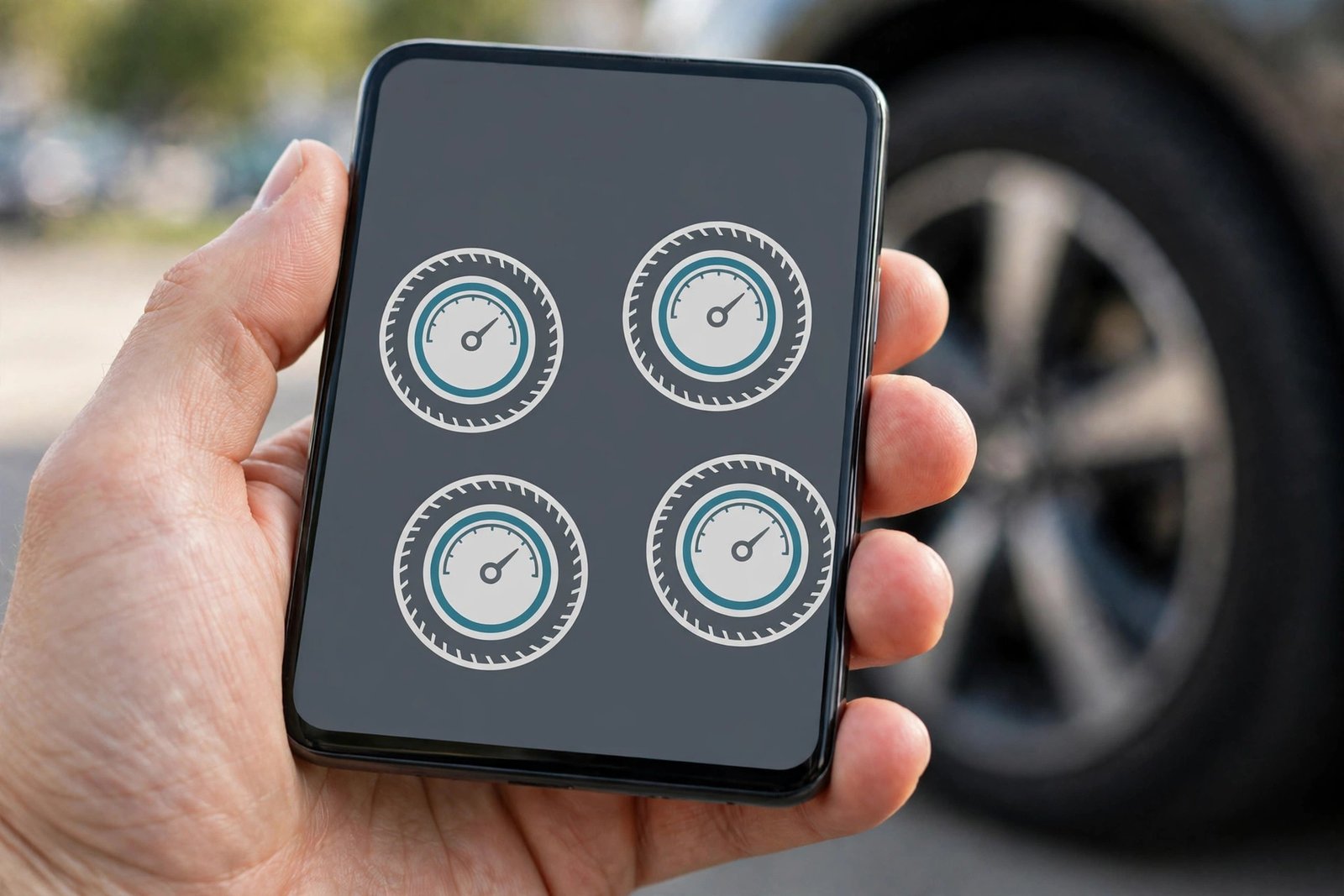
Aftermarket TPMS and Bluetooth sensor kits. If your car predates the TPMS mandate, or you tow a trailer or drive an RV, retrofit kits add pressure and temperature monitoring where none exists. Bluetooth kits pair wheel sensors with a phone app that warns about pressure drops and rising temperatures. These are pressure monitors, not smart tires — but pressure and temperature are the readings that prevent the most common tire failures.
Replacement TPMS sensors for your existing car. If your car already has factory TPMS and a warning light keeps coming on, the problem is often a dying sensor battery rather than a tire problem. Our guides explain how to tell if a TPMS sensor is bad, how long TPMS sensors last, and what TPMS sensor replacement costs. Keeping the system you already have working is the cheapest “smart tire” upgrade available.
Self-sealing tires. Several major brands sell tires with a sealant layer that plugs small punctures as they happen. Not smart tires — no sensors, no data — but they prevent the slow leak a smart tire would warn you about.
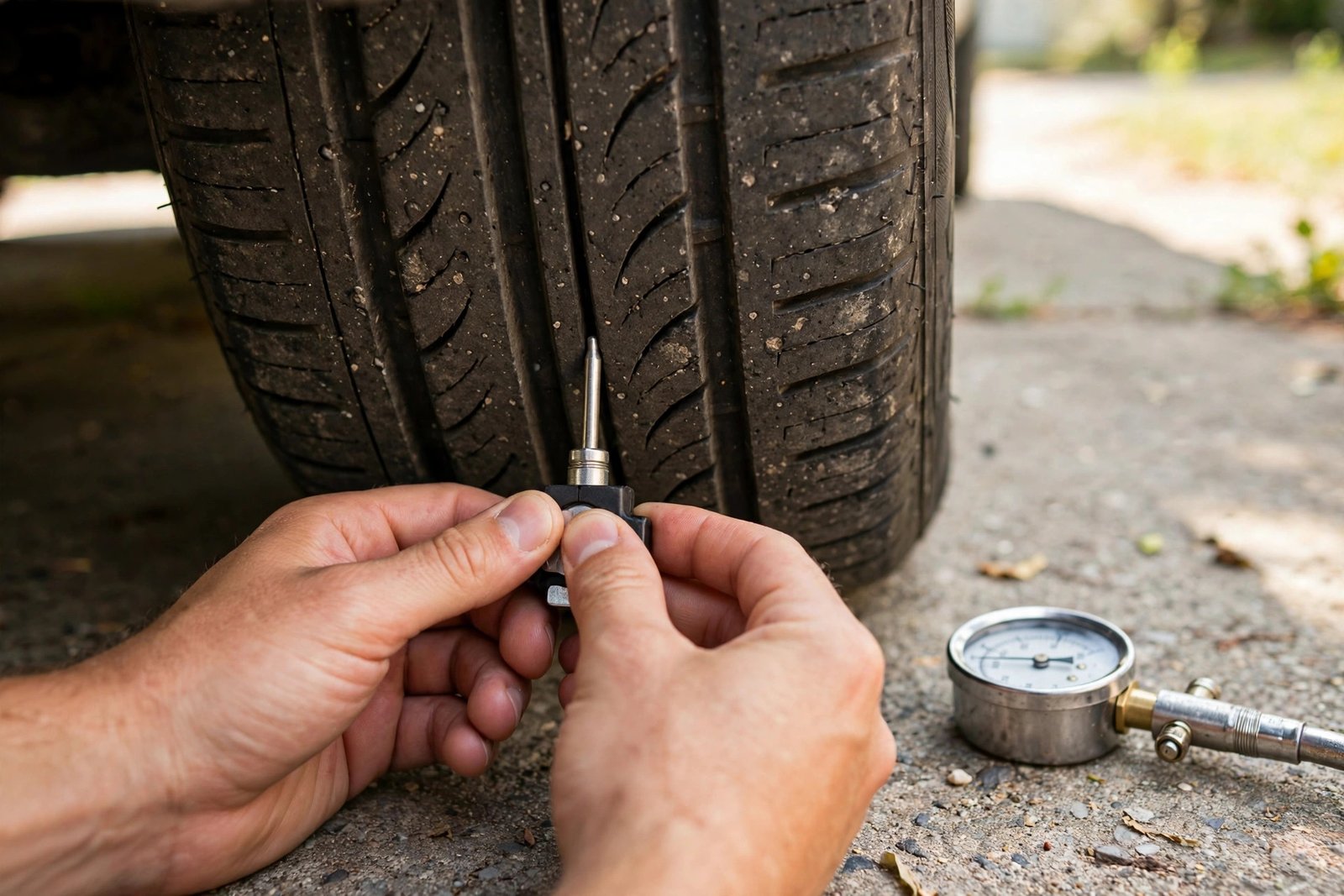
A good pressure gauge and a portable inflator. A monthly pressure check catches slow leaks TPMS only flags after pressure has dropped 25%. A portable inflator lets you fix the problem in your driveway.
A tread depth gauge and five minutes. Tracking wear is a job for a coin or a two-dollar gauge. Our guide to how to check tire tread depth shows how, and our guide to when to change tires lists the other warning signs.
What you cannot buy, at any price, is a tire with embedded sensors reporting wear, load, and grip to your car — unless that car was built for it. No retailer stocks one, and no shop can fit one to a car not designed to receive its data. If a listing claims otherwise, read the next section first.
Beware misleading names: “smart” on the box means nothing
Search for smart tires online and Google will show you products to buy. Almost all are conventional tires whose model names contain the word “smart” — the single most expensive misunderstanding in this topic. Here are the names to watch:
Hankook Smart Flex. A line of commercial truck and bus tires — the Smart Flex DL12 is a drive-axle tire for long-haul and regional freight, and the Smart Flex TH31 is a trailer-axle tire. Hankook’s own catalog describes the line as optimized for long tread life and durability. No sensors, no connectivity, no data. The “smart” is a marketing name for a tread compound and pattern. These are also truck tires in truck sizes like 11R22.5 — they would not fit your car even if you wanted them.
GiTi WeatherSmart. A conventional all-weather passenger tire sold by Les Schwab, with the three-peak mountain snowflake mark and a 60,000-mile warranty. A normal tire with a weather-themed name: no sensors, nothing reported. Its retail price is the price of a conventional tire, and anyone presenting it as “what smart tires cost” is misleading you. We deliberately do not quote it here.
Anything with “smart” in an online marketplace listing. Third-party sellers routinely attach popular search words to ordinary tires. If a listing calls a tire “smart” but the manufacturer’s own page mentions no sensor, no chip, no Bluetooth, and no app, it is not a smart tire. The test is simple: does the tire send data anywhere? If nobody can tell you where the data goes, it is a conventional tire with an adjective attached.
What smart tires cost (where any price exists at all)
This section is short, because honest pricing for smart tires barely exists. Here is everything we could verify:
No retail price exists. Neither Goodyear nor Pirelli publishes a consumer price for a SightLine or Cyber Tyre tire, because neither sells one to consumers. Any website quoting a per-tire smart tire price is pricing something else — usually a conventional tire named above.
Factory-fitment cost is bundled and invisible. When Cyber Tyre ships on a McLaren Artura or a Pagani Utopia, its cost is inside the price of the car. Nobody publishes the line item, and the cars cost enough that the tire system’s share is a rounding error.
Fleet pricing is by contract. Goodyear SightLine for fleets is sold through fleet channels as a service, with sensors, software, and support bundled into an agreement sized to the fleet. No public price list exists.
Farm pricing is by dealer quote. Nokian Intuitu is sold through Nokian dealers with the Soil King VF tires it is built into. Nokian’s page directs buyers to contact their nearest dealer and publishes no price.
The only shelf price in this topic belongs to an add-on. A Schrader AirCheck BLE retrofit kit — Bluetooth sensors plus an app for trailers, RVs, and cars without factory TPMS — was listed at $279.99 at Advance Auto Parts at research time. That is the price of a pressure-monitoring kit, not a smart tire.
| Product | What it really is | Verified price |
|---|---|---|
| Pirelli Cyber Tyre | Factory-fitted smart tire system | None — bundled into car price |
| Goodyear SightLine | Fleet / OE tire intelligence | None — fleet contract |
| Nokian Intuitu 2.0 | Farm tire system (not US) | None — dealer quote |
| Schrader AirCheck BLE kit | Bluetooth pressure-monitoring retrofit | $279.99 at Advance Auto Parts (Nov 2026) |
| Replacement TPMS sensor | Factory-system sensor, per wheel | See our TPMS replacement cost guide |
| GiTi WeatherSmart | Conventional all-weather tire | Not quoted — conventional tire pricing |
A realistic timeline for consumer smart tires
Nobody with authority has announced a date when regular drivers can buy smart tires, so any timeline is judgment, not fact. With that stated plainly, here is how the path looks from late 2026:
| Period | What is realistic | What is not |
|---|---|---|
| Now (2026) | Supercar fitment, fleets, farm systems outside the US, concepts | Retail smart tires, aftermarket wear/grip kits |
| Late 2020s | More premium factory systems; wider fleet adoption | Smart tires for economy cars; universal aftermarket tire |
| Early 2030s | Systems reaching mainstream new cars as costs fall | Your 2019 sedan gaining smart tires |
| 2030s and beyond | Tire intelligence becoming ordinary, like TPMS | A smart tire working on any car with no integration |
The pattern to expect is the TPMS pattern. Pressure monitoring started on expensive cars, became a legal requirement under FMVSS No. 138, and is now something nobody thinks about. Tire intelligence will likely follow a similar curve: premium cars first, then a slow spread downmarket as sensors get cheaper. No mandate for tire intelligence exists or has been proposed, so the spread will be driven by safety ratings and competition — which usually means slower.
One milestone worth watching is Goodyear’s stated goal, from its 2021 SightLine launch, of tire intelligence in all new products by 2027 — covering fleet and original-equipment tires broadly, not a retail tire. Whether 2027 brings a first mainstream factory fitment will tell us a lot about how fast the late-2020s phase will move. The other milestone is the car, not the tire: a smart tire needs a vehicle computer designed to use its data, and vehicle platforms take years to develop. If tire intelligence appears in a production car from the platforms behind the Peugeot and Citroën concepts, it will be the first sign the technology is leaving the supercar and fleet world. Until then, the timeline above is the honest expectation: years, not months.
What to buy instead, right now
Your car needs good tires now: buy good conventional tires in the right size (see our tire size guide and best budget tires roundup), keep your TPMS sensors working, check pressure monthly and tread before winter, consider a Bluetooth retrofit kit if you tow or drive an older car, and ignore the word “smart” on the box. Judge a tire by its type, tread, warranty, and test results — not its name.
Verdict: the honest 2026 answer
Can you buy smart tires? In 2026, for a regular US driver, the answer is no — and anyone telling you otherwise is selling a conventional tire with a clever name, a pressure-monitoring kit dressed up as something more, or a promise about the future. The real technology is running today on supercars, in fleets, and on farms in other countries. It will reach ordinary drivers eventually, most likely fitted to new cars in the late 2020s and mainstream models in the 2030s. Until then, the smartest purchase you can make is a good conventional tire, correctly inflated, with healthy tread, monitored by the TPMS your car already has. That is not the futuristic answer. It is the honest one.
Frequently asked questions
Can you buy smart tires in the US in 2026?
Mostly no. A true smart tire — sensors built into the tire reporting tread wear, load, temperature and road grip — is not sold at retail to US drivers in 2026. Smart tires today come fitted to a handful of expensive new cars, run in commercial fleets, or exist as farm-tire systems sold outside the US. What you can buy are add-ons that monitor pressure, not smart tires themselves.
Which cars come with smart tires from the factory?
Very few, and all expensive. Pirelli Cyber Tyre debuted on the McLaren Artura in 2021, the first production car with sensor-equipped tires as standard, and has since appeared on the Pagani Utopia, with Aston Martin signed on as a partner. No mainstream US-market car from Toyota, Honda, Ford, or Hyundai ships with a true smart tire system as of 2026.
What is the closest thing to a smart tire I can buy?
An aftermarket tire pressure monitoring kit is the closest practical option. Bluetooth retrofit kits reporting pressure and temperature to your phone exist for cars, trailers, and RVs without factory TPMS. If your car already has factory TPMS — every new light vehicle sold in the US since September 2007 does — keeping those sensors working and checking tread by hand covers most of what a smart tire would tell you.
Are Hankook Smart Flex or GiTi WeatherSmart tires smart tires?
No. Both are ordinary tires with suggestive model names. Hankook Smart Flex is a line of commercial truck and bus tires built for long tread life, with no sensors or connectivity. GiTi WeatherSmart is a conventional all-weather passenger tire sold by Les Schwab. Neither reports any data to your car. A model name containing ‘smart’ does not make a tire a smart tire.
How much do smart tires cost?
There is no published retail price, because there is no retail product. Smart tire systems are priced into a new supercar, sold through fleet contracts, or quoted by dealers for farm equipment. The only smart-tire-adjacent product with a shelf price is a Bluetooth pressure-monitoring kit — a Schrader AirCheck BLE kit was listed at $279.99 at Advance Auto Parts at research time. Anyone quoting a per-tire smart tire price is almost certainly pricing a conventional tire.
When will regular drivers be able to buy smart tires?
No manufacturer has announced a retail launch date. The realistic path is factory fitment first: premium cars in the late 2020s, then mainstream models as costs fall. A smart tire you can buy off the shelf and fit to any car is further away, because the tire only works when the car is designed to receive its data. Mainstream availability is a 2030s story, not a 2026 one.