
Quick answer: A smart tire has a sensor bonded inside it that measures pressure, temperature, tread wear, and load. It radios that data to the car, where software turns it into dashboard warnings, app readings, and better-calibrated braking and stability control. The tire reports; the car decides.
The question of how do smart tires work comes down to one journey: data travels from a sensor buried inside a spinning tire to a computer that can actually use it. The tire still holds air, grips the road, and wears down like any other tire. What changes is that it can now describe its own condition, in real time, to the car it is fitted to. Every system follows the same basic path: sense, power, transmit, receive, interpret, act. This guide follows that path step by step, and draws a clear line between smart tires and the tire pressure monitoring system (TPMS) your car already has.
The journey in one picture
| Step | What happens | Where it happens |
|---|---|---|
| 1. Sense | A sensor measures pressure, temperature, and more | Inside the tire |
| 2. Power | A small battery runs the sensor | Inside the sensor unit |
| 3. Transmit | Data leaves the tire by short-range wireless radio | Sensor to car body |
| 4. Receive | A receiver picks up the signal | On the car, often one per axle |
| 5. Interpret | Software turns readings into useful information | Car electronics or phone app |
| 6. Act | Warnings, displays, and safety adjustments follow | Dashboard, app, brakes, stability control |
Step 1: The sensor inside the tire
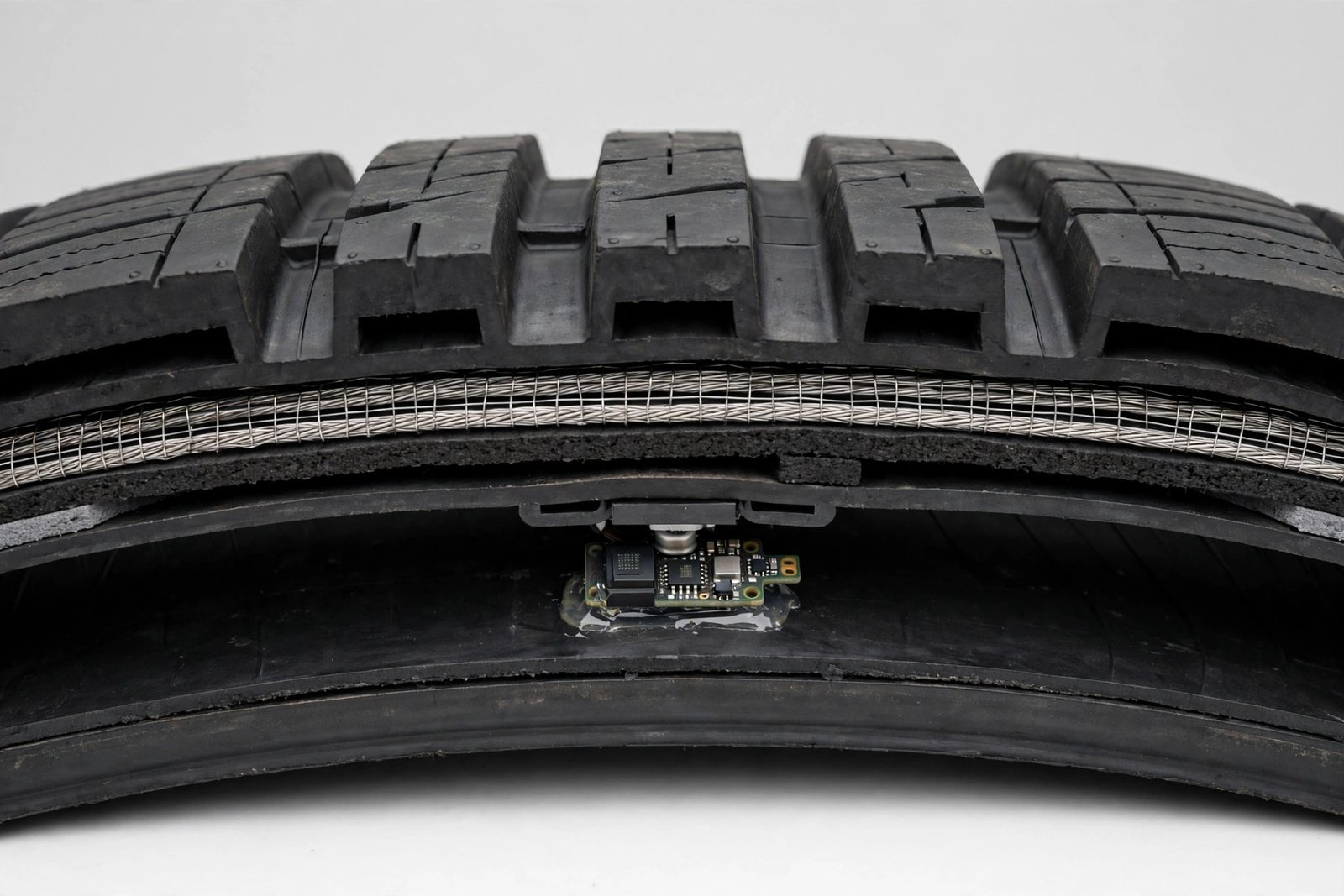
The sensor lives in a hostile place: constant flexing, high temperatures, moisture, and centrifugal forces far beyond anything your phone experiences. Smart tire sensors are small, sealed units bonded to the inner liner of the tire, under the tread.
Pirelli’s current sensor shows the scale. As described by evo in its hands-on report, each battery-powered sensor is about the size of a stack of three 10p coins, sits in a starfish-shaped base pad stuck to the inside of the tire, weighs about 12 grams, and must withstand 3,000 g. One sensor goes in each tire.
Bonding the sensor to the tire, rather than the wheel rim, is deliberate. A sensor in direct contact with the tire measures the tire’s own temperature and deformation, not the air near the valve. Pirelli made this point when it launched its system on the McLaren Artura in 2021: direct contact with the tire gives more precise data than a traditional valve-mounted sensor. The trade-off is that the sensor lives and dies with the tire. When the tread wears out, the sensor goes with it, unlike a valve-mounted TPMS sensor that a shop can often reuse or replace separately.

Step 2: What the sensor actually measures
A smart tire sensor is a small package of sensing elements, and different systems include different ones.
| What is measured | How it is sensed | Why it matters |
|---|---|---|
| Air pressure | Pressure transducer in the air chamber | Underinflation hurts handling and raises failure risk |
| Temperature | Temperature sensor inside the tire | Heat changes tire behavior and explains pressure changes |
| Tread wear | Inferred from deformation, vibration, or electrical signals | Worn tread grips less, especially in the wet |
| Load and forces | Accelerometers and deformation sensing | Load changes how much grip is available |
| Vibration | MEMS accelerometers | Vibration reveals road surface, slip, and impacts |
| Tire identity | Stored data: type, size, load index, speed rating | The car knows which tires are fitted and their limits |
| Grip and hydroplaning risk | Estimated from the readings above | Lets safety systems react to real grip, not a guess |
Two measurements are where smart tires leave TPMS behind. The first is tread wear. Continental’s ContiSense concept used electrically conductive rubber, where the electrical signal changed as tread wore thinner; other systems infer wear from deformation and vibration. Either way, the car sees a slow process drivers usually discover only when a shop measures it. The second is tire identity, the tire’s “passport”: type, summer or winter fitment, prescribed pressure, load index, and speed rating. When winter tires go on, the car reads the passport and adjusts its warnings and limits itself.
Grip and hydroplaning estimates are inferences, not direct measurements. Software combines pressure, temperature, deformation, and vibration data with a model of tire behavior. Those conclusions can be very good, but they are estimates built from tire data, not a camera reading the road ahead.
The three places a sensor can live
| Mounting position | Where it sits | What it senses best | Typical use |
|---|---|---|---|
| Tire-mounted | Bonded to the inner liner, under the tread | Temperature, deformation, tread wear, vibration, load | Smart tires and fleet sensors |
| Valve-mounted | On the valve stem, inside the air chamber | Air pressure and air temperature | Direct TPMS on most modern cars |
| Wheel-mounted | Fixed to the rim or a band around the rim | Air pressure; survives tire changes more easily | Some direct TPMS and aftermarket sensors |
Tire-mounted sensors get the richest data because they feel what the tire feels. Valve-mounted sensors measure the air, which is what a pressure warning needs, but they cannot feel tread wear or deformation.
RFID is often mentioned alongside these, and it is widely misunderstood. An RFID tag embedded during manufacturing carries identity information, such as the tire’s serial number and size, that a nearby reader can pick up. That helps track tires through factories and fleets. It does not stream live pressure and temperature readings to a moving car. Identity and live sensing are different jobs, and a tag alone does not make a tire smart.
Step 3: How it is powered
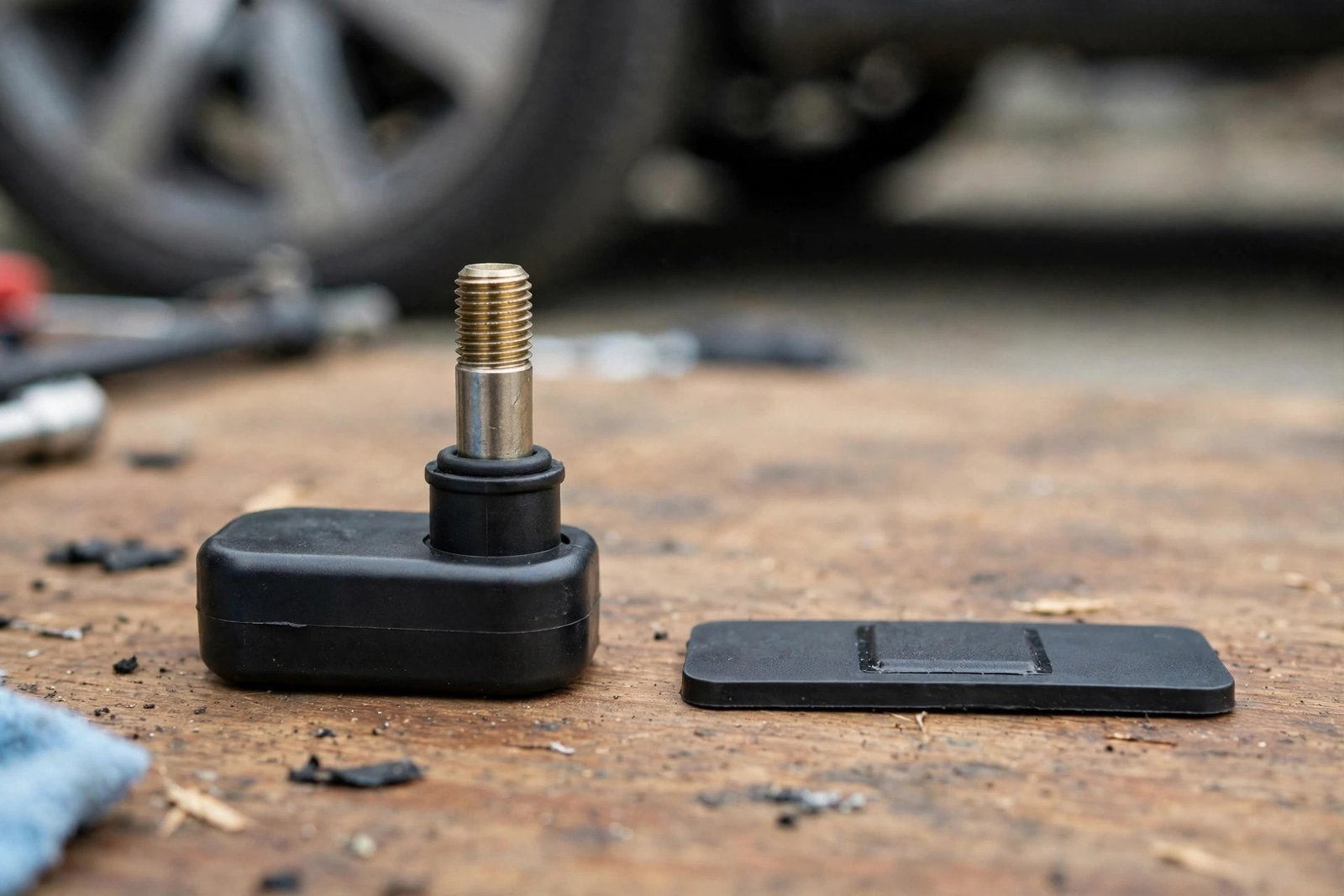
A sensor inside a tire cannot be plugged in, and changing its battery means removing the tire. Batteries are what ships today: a small sealed battery, stretched by sleep. While the car is parked, the sensor powers down or transmits rarely. When the wheel turns, an accelerometer wakes it. Pirelli’s sensor, in evo’s description, can transmit via Bluetooth for around five years, roughly a tire’s service life. The battery is sized to outlast the tire it is bonded into.
Energy harvesting is the longer-term answer. As a tire rolls, it deforms each time a section passes through the contact patch. Piezoelectric materials convert that mechanical strain into electric charge, and in principle a piezoelectric element could power a sensor with no battery at all. Patent filings describe this approach, and academic work has shown harvesters on the inner liner generating usable power. In practice, harvesting is not yet the standard power source in a car you can buy. Continental said in 2017 that its concept ran on a battery but could one day generate its own power, similar to a mechanical watch. Treat harvesting as the direction of travel, not the current reality.
Step 4: How data leaves the tire
Metal and rubber are unkind to radio signals, and the wheel is spinning, so the link must be short-range and low-power. Most current systems use Bluetooth Low Energy (BLE). Pirelli and Bosch describe BLE as the link for the current Pirelli system, chosen for real-time data with very low power use. The sensor transmits in short bursts, and a receiver on the car body picks up the signal. Pirelli uses a receiver or anchor for each axle, keeping the receiver close to the wheels so the weak signal gets through reliably.
Older TPMS designs typically use a dedicated ultra-high-frequency transmitter sending occasional pressure updates to a central receiver. Smart tire systems send more data, more often, including vibration signals safety systems need quickly, which is one reason newer designs moved to BLE and axle-mounted receivers.
Continental’s ContiSense concept tried a third route: electric signals sent through electrically conductive rubber built into the tire, to a receiver in the car, with Bluetooth to a smartphone as well. As Digital Trends reported, a nail penetrating the tread would close a circuit between two conductive layers, triggering an immediate warning, much faster than waiting for pressure to drop. The concept never became a retail product, but it shows there is more than one way out of a tire.
Step 5: Receiver, car computer, and phone app
Raw sensor data means nothing until software interprets it. The receiver collects packets from the sensors on its axle and passes them to the car’s electronics, where software built by the tire maker, the car maker, or both runs them through algorithms and tire models. This is where Bosch’s role in the Pirelli system sits: turning raw data into parameters the car’s control systems can use. The software must separate real signals from noise, because a tire’s vibration signature changes with speed, load, road surface, and wear all at once.
Some processed information goes to the driver: a dashboard display, a warning, or a phone app message. Fleet systems go further, sending data to a central database where a manager sees every tire on every truck. And some information never reaches the driver at all. It goes straight to the car’s control systems to calibrate their responses. That is Step 6.
Step 6: What the car does with it
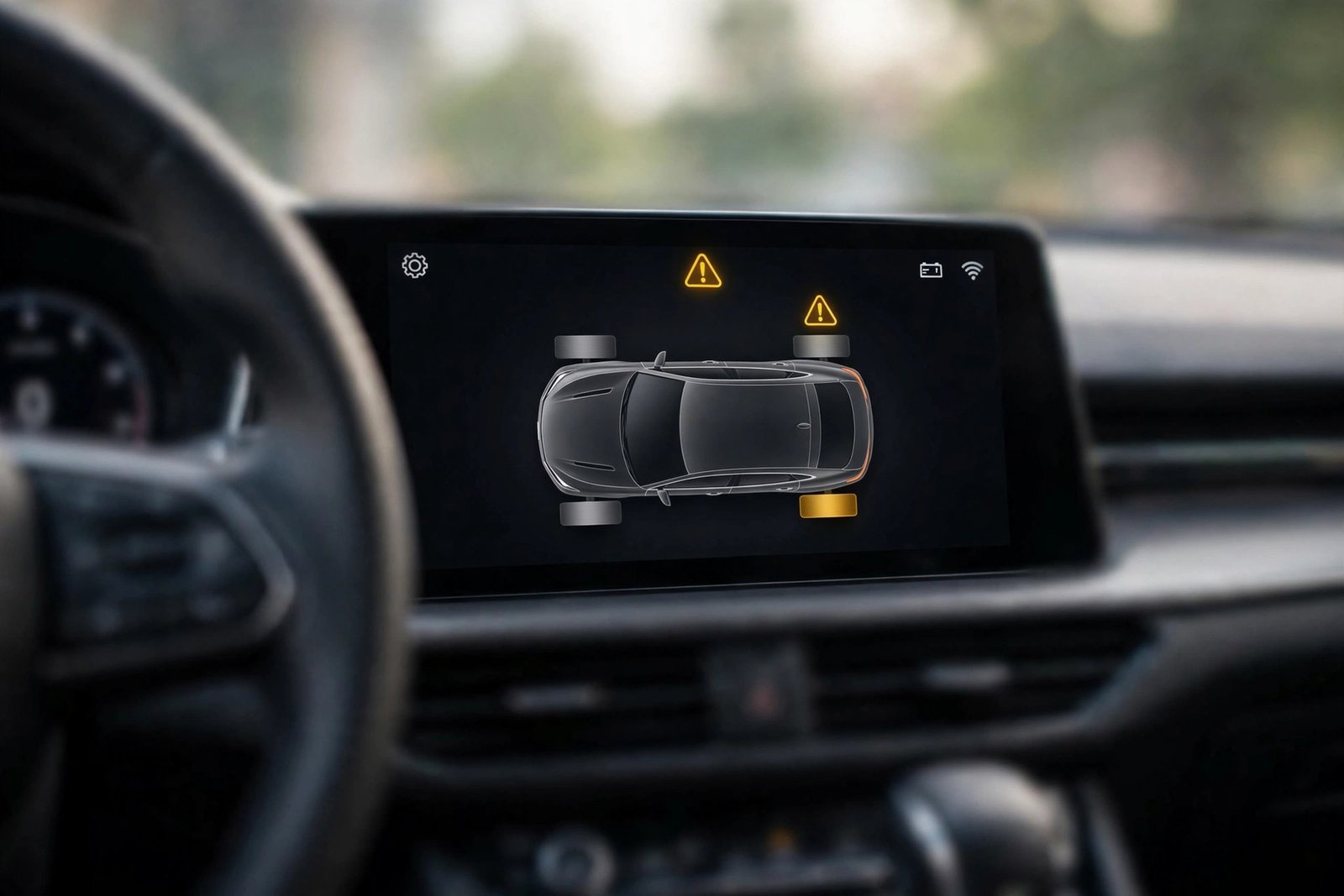
This step separates a smart tire from a fancy pressure gauge. Warnings come first: a tire needs air, is running hot, has worn to a limit, or has been punctured. A puncture warning from a system sensing the penetration can arrive before pressure has dropped far enough to trigger a pressure warning, and warnings name the tire and the problem rather than lighting a single amber lamp.
Calibration comes second. Anti-lock braking (ABS) and stability control (ESP) are normally tuned for an average of the tires that might be fitted. When the car knows the exact tire, its temperature, pressure, and tread depth, those systems tune themselves to the grip actually available. In evo’s account of the Pirelli demonstrations, the car stopped 5.7 meters sooner from 68 mph with the system active. That figure comes from a Pirelli-arranged demonstration, not an independent test.
Active intervention comes third, with tire data feeding traction control and torque management, such as limiting torque when tires are cold. Predictive maintenance comes fourth: tracking wear, load, and temperature over months lets software predict replacement timing and flag uneven wear. What no current system does is fix the tire. No shipping smart tire inflates itself or seals its own puncture. The tire tells the truth about itself; the fixing is still your job, or your tire shop’s.
How smart tires differ from TPMS
TPMS has been required on new passenger vehicles in the United States since the 2008 model year, under Federal Motor Vehicle Safety Standard 138. Its job is to warn you when a tire is significantly underinflated.
| TPMS | Smart tire | |
|---|---|---|
| Main job | Warn when pressure is significantly low | Report tire condition and feed safety systems |
| Measures | Pressure (direct systems also read temperature) | Pressure, temperature, tread wear, load, forces, identity, grip estimates |
| Warning threshold | Around 25% below recommended cold pressure | Varies; can warn earlier on punctures and heat |
| Sensor location | Valve-mounted or wheel-mounted | Tire-mounted, bonded to the inner liner |
| Car’s response | Dashboard warning light | Warnings, displays, and ABS/ESP/traction calibration |
| Knows tire type or tread? | No | Yes, identity stored; tread depth estimated |
Direct TPMS uses a sensor in each wheel and warns when pressure drops at least 25% below the recommended cold pressure. Indirect TPMS uses wheel-speed sensors instead, spotting a low tire because it rolls at a different speed. Both catch underinflation well. Neither knows how much tread is left or what tire is fitted. Smart tires do not replace TPMS; they build on it. If your TPMS light is on, act on that first. Our guides cover how to tell if a TPMS sensor is bad, how long TPMS sensors last, how to reset TPMS, and TPMS sensor replacement cost. This article deliberately does not repeat those instructions. TPMS watches pressure; smart tires watch the tire.
Real systems, limits, and honest unknowns
Pirelli’s system shipped as standard equipment on the McLaren Artura in February 2021 and has since moved into deeper integration with vehicle dynamics on the Pagani Utopia Roadster, through Bosch Engineering. Continental’s ContiSense, shown in 2017, proved tread-depth and puncture sensing but never became a product. Knowing which side of the concept-to-product gap a system sits on is the difference between useful advice and hype.
Availability is the biggest limit in 2026: smart tires are original equipment on a small number of expensive cars, and no aftermarket kit can wire tire data into your car’s braking systems. A tire-mounted sensor also shares the tire’s life, so the system’s cost is bundled into every set of tires, and repair training and data-ownership rules are still unresolved. The technology works in demonstrations and on flagship cars; the work now is cost, standardization, and proof across millions of ordinary cars.
Verdict: a sensor, a radio, and a brain, working together
A sensor bonded inside the tire measures pressure, temperature, tread wear, load, and identity. A small battery powers it, waking it when the wheel turns. It sends readings by short-range wireless radio to a receiver on the car, usually one per axle. Software turns those numbers into warnings, displays, and calibration data for braking and stability systems. The tire reports what it senses, and the car acts on what it learns.
The tire is the only part of the car that touches the road, and until now it has been the only part that could not speak. Giving it a voice lets safety systems work with real information instead of averages. Until the technology reaches ordinary cars, the best sensing system most drivers have is the TPMS light, a tire gauge, and a regular look at the tread. Use all three.
Frequently asked questions
How do smart tires work in simple terms?
A sensor inside the tire measures pressure, temperature, and other conditions, then sends that data wirelessly to a receiver in the car. Software in the car turns the raw readings into warnings on the dashboard, information in an app, or adjustments to safety systems such as anti-lock brakes and stability control. The tire itself does not inflate or repair itself; it reports what it senses, and the car acts on it.
What do smart tire sensors measure?
Depending on the system, a smart tire sensor can measure air pressure, internal temperature, tread wear, vertical load, acceleration and vibration, and the tire’s own identity, such as its type, size, load index, and speed rating. Some systems use those readings to estimate available grip and the risk of hydroplaning. No single system measures everything, and what your car shows you depends on the system fitted.
How are smart tire sensors powered?
Most shipping systems use a small built-in battery. The sensor sleeps while the car is parked and wakes when the wheel turns, which stretches battery life. Pirelli’s current sensor, as described by evo, can transmit via Bluetooth for around five years. Self-powered designs that harvest energy from the tire flexing as it rolls, using piezoelectric materials, exist in patents and research but are not the standard power source in cars you can buy today.
Do smart tires replace TPMS?
No. Smart tires build on the idea behind TPMS but go further. TPMS watches pressure and warns you when a tire is significantly underinflated. A smart tire adds temperature, tread wear, load, and road-grip information, and in some systems feeds that data directly to braking and stability control. Your car still needs its TPMS warning function, and a smart tire system does not remove the need to check pressures with a gauge.
How does data get out of a spinning tire?
Through short-range wireless radio. Most current systems use Bluetooth Low Energy or a similar low-power radio link to send data from the sensor to a receiver mounted on the car, often one receiver per axle. Continental’s ContiSense concept took a different route, sending signals through electrically conductive rubber in the tire itself. RFID tags are different again: they carry identity information that a nearby reader can pick up, but they do not stream live pressure and temperature readings on their own.
Can I add smart tire sensors to my current car?
Not in the full sense. The systems described here are fitted as original equipment on a small number of new cars, with software built into the car’s electronics. Aftermarket tire pressure sensors and Bluetooth valve-cap monitors can show pressure and temperature on your phone, but they cannot feed data to your car’s braking and stability systems. If your TPMS light is on or a sensor has failed, fix that first: it is the safety system your car already has.
