
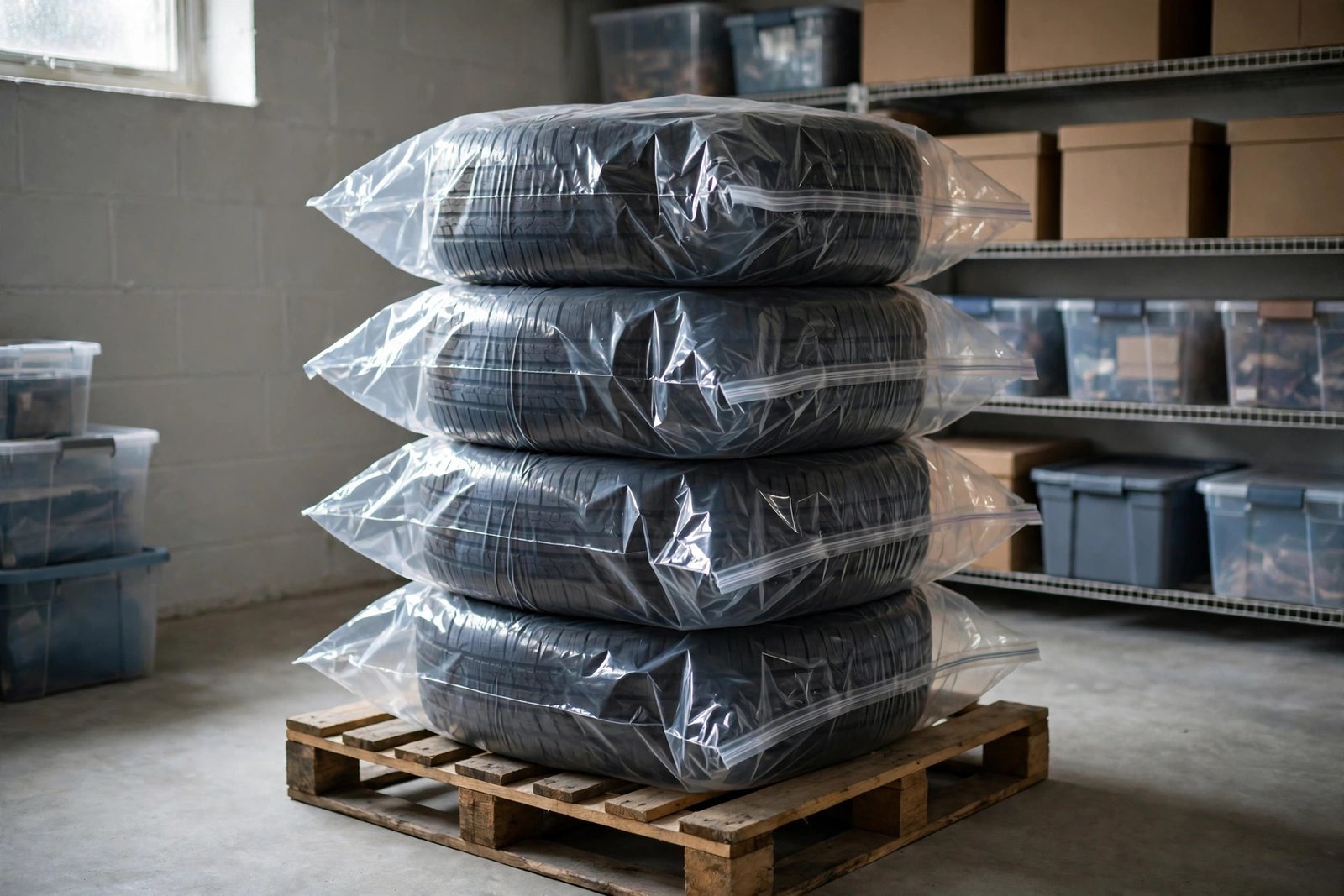
Quick answer: Wash each tire with water and mild detergent, let it dry completely, mark its position (LF, RF, LR, RR), and seal it in a large airtight bag with the air squeezed out. Then keep the set indoors, cool, dark, and dry — below 25°C, ideally below 15°C — off bare concrete, and away from the furnace, sump pump, and any electric motor. Tires mounted on wheels stack flat or hang (drop the pressure to about 15 psi first); loose tires stand upright side by side and get rotated monthly. Never store a set outdoors, even under a cover — a season in the open air can dry the rubber out enough to crack.
Why storage matters: rubber ages even when it sits still
When drivers ask how to store tires properly, the short answer is: clean, dry, bagged, and kept cool, dark and dry. It feels wrong, but a tire wears out even when it never touches the road. Rubber is a living material in the chemical sense: sunlight, heat, oxygen, and ozone slowly break down the compounds that keep it flexible. A tire that spends six months in the wrong place — leaning against a sunny garage wall, sitting on a damp concrete floor next to the furnace — can come back in worse shape than a tire that was driven every day.
That is the whole point of seasonal storage. Twice a year, drivers swap between winter and summer sets, and each set then spends roughly half the year on a shelf. Store it right and it comes back the way it went in. Store it wrong and you pay next season: cracked sidewalls, flat spots, a set replaced a year early.
Proper storage is not complicated or expensive: a short checklist, a few bags, and the right corner of the house. Everything below follows the tire makers’ own guidance — Michelin, Continental, Nokian, and the US Tire Manufacturers Association (USTMA) agree on the basics, and where they differ, this guide says so.
Before the set goes into storage: the prep checklist
Ten minutes of prep makes the next six months safe for the rubber. Work through these steps in order, while the tires are still easy to reach.
1. Mark each tire’s position
Before the tires come off the car, mark where each one sat: LF (left front), RF (right front), LR (left rear), RR (right rear). Chalk on the sidewall works, or a tag tied to the wheel, or a sticker on the bag later. Michelin advises recording each tire’s position so you can rotate the set when it goes back on — the tire that was on the front left goes to a different corner next season, which evens out wear over the life of the set.
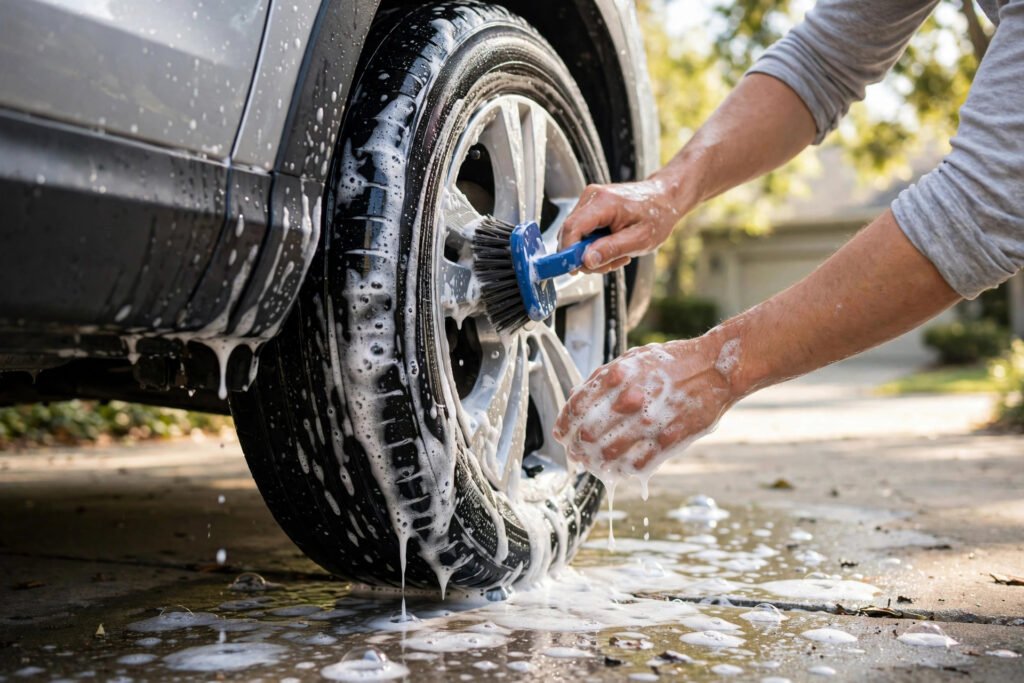
2. Wash with water and mild detergent
Wash the tires — and the wheels, if the set is mounted — with water, a brush, and a mild detergent. Road salt is the enemy: a winter set comes off coated in it, and salt left on rubber and rims for six months corrodes the rim coating and wheel studs. Pick stones out of the tread grooves too — a wedged stone can press into the rubber for months.
A pressure washer is fine, but keep the jet at least 50 cm (about 20 inches) from the tire — ADAC’s guidance warns against holding it right against the rubber.
3. Dry completely — and give it time
This is the step people rush, and rushing it causes the most trouble. A tire bagged while damp traps moisture against the rubber for months, which invites mold and corrosion on the wheel. Let the set air-dry completely before bagging — a full 24 hours in a ventilated spot is a safe rule of thumb, longer if the weather is humid. If you can still feel dampness in the tread grooves, it is not dry yet.
4. Skip the tire shine
Do not dress the tires with tire shine, gloss, or dressing products before storage. Continental is clear on this: tires need no dressing or gloss product, and those products can hinder rather than help, because some dressings contain solvents that dry the rubber out. Clean rubber, nothing else.
5. Inspect while the tires are off
The swap is the best inspection opportunity you will get all year. Look at each tire with the tread facing you and the sidewalls in good light:
- Tread depth and wear pattern. Uneven wear — more worn on one edge than the other — points to an alignment or inflation problem worth fixing before the set goes back on.
- Sidewall cracks. Fine hairline cracks are a sign of aging; deep cracks, cracks that show fabric or cord, or any bulge mean the tire should be replaced, not stored.
- Damage. Cuts, embedded nails, and chunked tread should be dealt with now, not discovered next season.
If a tire fails any of these checks, storing it is pointless — it will not be safer in six months. A tire six or more years old deserves a professional inspection before it goes back on, and any tire over ten years old should be replaced, however well it was stored.
Bagging: the step most people skip
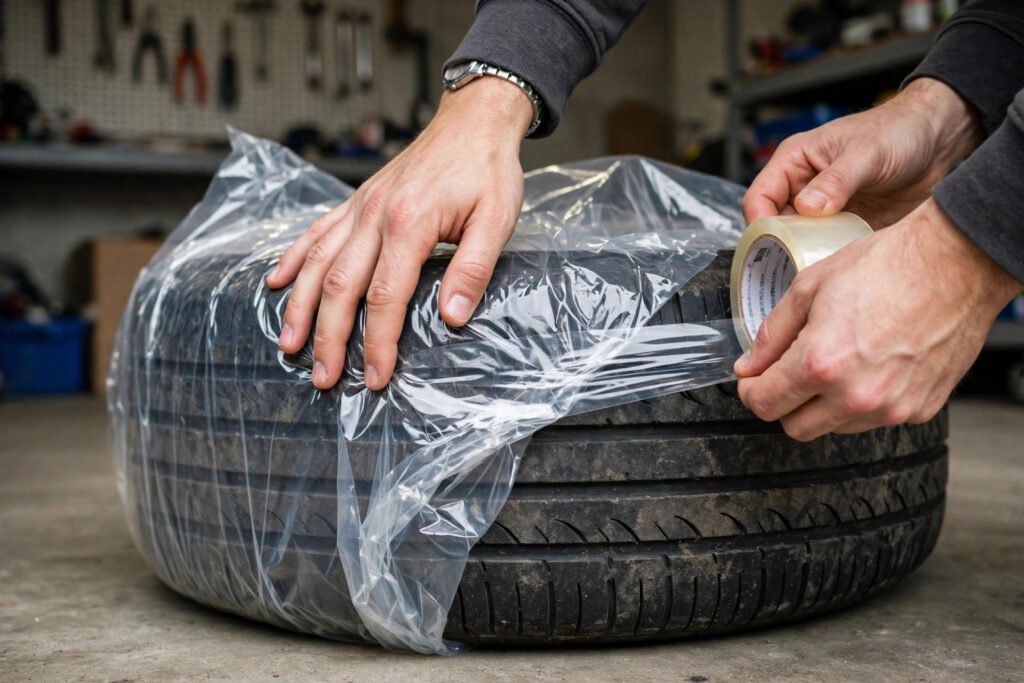
Each tire goes into its own large, airtight plastic bag. Squeeze as much air out as you can, then tape the bag shut. Continental recommends exactly this, and the reason is chemical, not cosmetic: sealing the tire in slows the evaporation of the protective oils from the rubber compound. Those oils are what keep the rubber flexible, and once they are gone, the rubber dries, hardens, and cracks.
Bagging also keeps dust, moisture, and light off the tire for the whole storage period — a bagged tire in a dark corner is about as close to a tire maker’s warehouse as a home can get.
Use bags made for the job if you can find them — tire storage bags are sold by most auto parts stores — but a large, heavy-duty plastic bag works too, as long as it seals. Do not use a bag with holes in it, and do not leave the bag open “for ventilation.”
Where to keep them — and where not to
The storage location is where most home storage goes wrong, because the obvious places are often the worst. Every tire maker agrees on the same four words: indoors, cool, dark, and dry.
Temperature. Nokian sets a specific limit: the room must stay below +25°C (77°F), and a dark, cool place below +15°C (59°F) is ideal. Above 25°C, or below freezing, the rubber’s properties can change. That rules out most attics and unheated sheds, which swing from hot to freezing across the year.
Light. Sunlight is the fastest way to age rubber. UV breaks down the compound and makes it brittle. Store the set out of direct sunlight and away from strong artificial light. A basement corner with no windows is ideal; a garage spot under a window is not.
Moisture. Dry matters as much as cool. Humidity high enough for condensation to form on the tires is too high. And never set tires directly on bare concrete — Michelin warns that concrete draws moisture, so put the set on a pallet, a shelf, or a rack, or at minimum on a thick sheet of cardboard or plywood. The surface underneath should be clean, free of oil stains, nails, and stones.
The best spot in most homes is a basement or another climate-controlled room. Continental calls a basement or climate-controlled space ideal. A garage can work only if it is insulated and temperature-stable — most are not, and Continental warns that most garages, sheds, and attics go through temperature and humidity swings that storage should avoid.
Ozone: the forgotten killer
Here is the one most drivers never think about: ozone, a gas that attacks rubber and causes the fine network of surface cracks called ozone cracking or dry rot. It is produced by electric motors with contact brushes, generators, compressors, furnaces, sump pumps, central vacuums, welding equipment, and even fluorescent and mercury vapor lamps.
That makes the furnace room one of the worst places in the house to store tires — and it is exactly where many people put them, because the furnace room is empty space. Keep the set well away from the furnace, the sump pump, the air compressor, and any electric motor. The USTMA’s storage bulletin lists the same warning: do not store tires in the same area as electric motors, battery chargers, generators, welding equipment, or other ozone-generating sources.

What about outside?
Short answer: no. Continental says tires should never be stored in the open air, even under a cover. Michelin allows outdoor storage for a short time only, raised off the ground under a waterproof cover with ventilation holes — and warns that tires left unused outdoors for a month or more dry out and can develop surface cracks. A season on the deck or under a tarp goes against both makers’ guidance. If the outdoors is genuinely your only option, raise the tires off the ground and cover them with an opaque, waterproof cover that has ventilation openings so moisture does not build up underneath — but understand this is a compromise, not a solution.
Mounted or loose: two opposite rules
How you position the set depends on one question: are the tires still on their wheels? The answer flips the rule completely, and getting it backwards is the most common storage mistake.
| The set | How to store it | Never do this |
|---|---|---|
| Mounted on wheels | Stack flat, one on top of the other, or hang from a rack or hooks | Stand them upright on the tread |
| Loose tires (no wheel) | Stand upright, side by side, on the tread — rotate monthly | Stack them flat, or hang them |
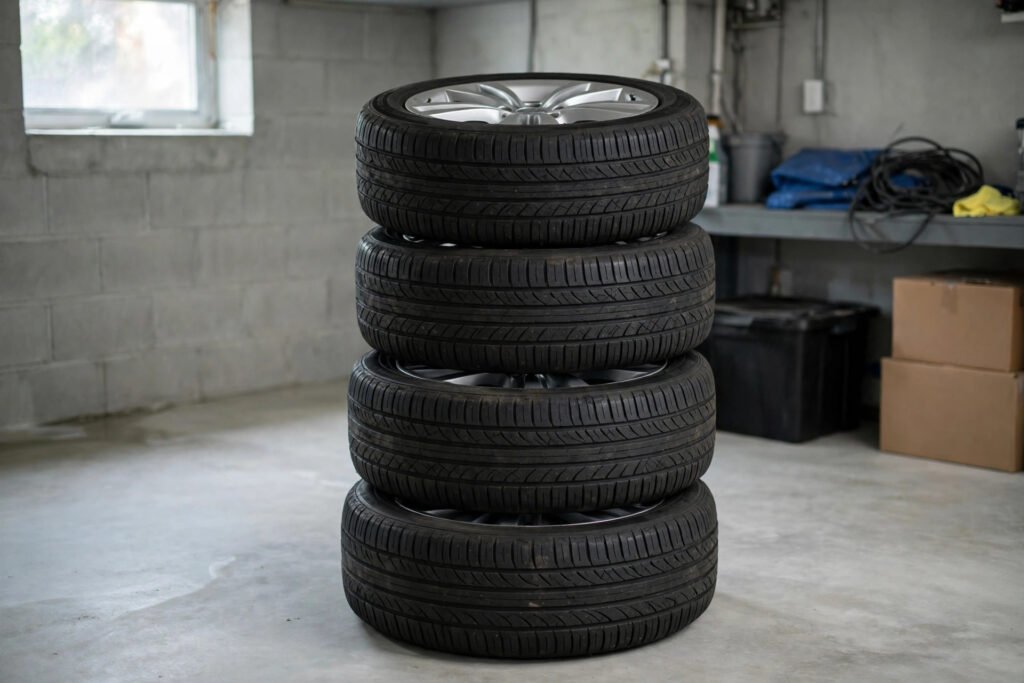
Mounted on wheels — stack or hang. The wheel holds the tire’s shape, so stacking is safe. Stack the set flat, one wheel on top of the next, and keep the stack low enough that it cannot tip — Continental warns against stacking too high. Hanging from a sturdy rack or hooks is equally fine. Before stacking or hanging, lower the pressure to about 103 kPa (15 psi), as Transport Canada advises, to avoid cracking and deformation while the tire sits under no load. The set needs its full pressure back — the number on the driver’s door-jamb placard — before anyone drives on it.
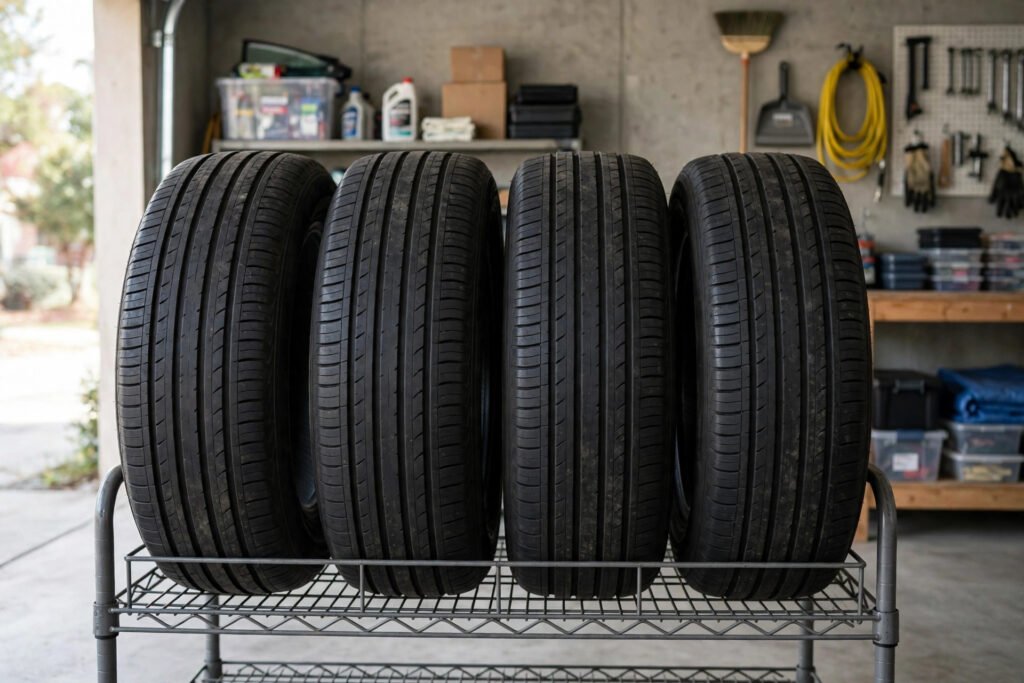
Loose tires — stand upright. A tire with no wheel has nothing holding its shape, so it is happiest standing on its tread, side by side with its neighbors, the way tires sit on a shop rack. Rotate each tire a quarter turn about once a month so the same spot is not carrying the weight all season — otherwise the tire can develop a flat spot that takes miles to work out, or never fully does.
Never hang a loose tire on a hook or peg: the bead carries the whole weight at one point, and the tire deforms. Never stack loose tires either: the weight of the stack presses down on the tires at the bottom, and the USTMA warns that too much weight can damage them. (The USTMA does allow short horizontal stacks of unmounted tires in a warehouse setting, but for a home set, standing upright is the safer rule — and at least one major tire maker advises against stacking unmounted tires at all.)
The tire hotel option: paying a shop to store them
If you have no good spot at home — an apartment with no basement, a garage that swings from freezing to baking, a furnace room as the only free corner — a shop’s seasonal storage service, often called a “tire hotel,” is a real option, and for many drivers it is the right one.
When the shop swaps your tires, the off-season set stays with them instead of going home in your trunk. The shop washes it, bags it, tags it to your name and vehicle, and racks it in a climate-controlled room — ready to go back on next season.
What it costs. Prices vary by city and by what is included, so treat these as a guide, not a quote — and ask any shop for its own price before committing:
- In Canada, major chains charge roughly $60–$120 CAD per season for a set of four, with Kal Tire’s “Tire Hotel” typically $80–$120 CAD and often bundled with the swap labor, and Canadian Tire around $70–$90 CAD.
- In the US, independent shops advertise around $80–$95 per season for a set, with some full-service pickup-and-delivery operations charging $150–$200 per season.
- In Europe, ADAC lists typical professional storage at about €30–€60 per season for a set, with premium packages running €40–€120 depending on what is included.
When it makes sense. A tire hotel is worth considering when your only space has big temperature swings or an ozone source, when you live in an apartment with no indoor spot for four tires, when four tires on wheels are too heavy to carry up and down stairs, or when the shop already does your seasonal swap. Ask what the fee includes — cleaning, bagging, tagging, insurance, and whether the swap labor is bundled — before you sign up.
Spring and fall: the re-check before the set goes back on
Storage is only half the job. Before the set goes back on the car, inspect it the same way you did when it came off:
- Look for new damage. Cracks, stiffness, bulges, or anything that was not there in the fall. Continental recommends a check by a tire professional before stored tires are mounted again.
- Check the tread. A winter set worn close to 4 mm (about 5/32 inch) is past its useful life on snow, even if it is legal.
- Check the age. Read the DOT code on the sidewall — the last four digits are the week and year the tire was made. Compare it with the makers’ guidance: inspect from five years, replace by ten.
- Set the pressure cold. Inflate to the figure on the driver’s door-jamb placard, measured when the tires are cold. Tires lose about 1 psi for every 5°C (9°F) drop in temperature, so pressure set on a mild day will read low when the weather turns cold.
- Check the TPMS sensors. If the stored set is on its own wheels, make sure the tire pressure monitoring sensors are the correct ones for the vehicle — a mismatched set can trigger warnings that have nothing to do with pressure.
The bottom line
Storing tires properly is not a project. It is a wash, a dry, a bag, and the right corner of the house: clean, dry, bagged, and kept cool, dark, and dry — away from the furnace. Mounted tires stack, loose tires stand. Get those two sentences right and the set you take off this season will be the set you put back on next season, with its life intact.
Frequently asked questions
Is it better to store tires in the garage or the basement?
A basement or another climate-controlled room is better. Continental calls a basement or climate-controlled space ideal, and warns that most garages, sheds, and attics go through big swings in temperature and humidity that storage should avoid. If the garage is your only option, bag the tires, set them on a pallet out of window light, and keep them away from the furnace, the compressor, and fuel cans.
How long can tires sit in storage?
There is no fixed shelf life, and tires keep aging even in storage. Michelin says tires kept in ideal conditions can be stored for several years without meaningful degradation, but rubber still ages through oxidation. Both Michelin and Continental say any tire more than 10 years old should be replaced, however well it was stored, and a tire older than six years should get a professional inspection before use.
Can I store tires outside under a cover?
No, not for a season. Continental says tires should never be stored in the open air, even under a cover. Michelin allows outdoor storage for a short time only, with the tires raised off the ground under a waterproof cover with ventilation holes — and warns that tires left unused outdoors for a month or more dry out and can develop surface cracks.
Do I need to deflate tires before storing them?
Only if the tires are mounted on wheels, and only partway. Transport Canada advises lowering a set stored on wheels to about 103 kPa (15 psi) to avoid cracking and deformation. Loose tires with no wheel have no air in them to let out. Either way, inflate the tires back to the pressure on the driver’s door-jamb placard before driving on them.
Should tires be stored standing up or lying down?
It depends on whether the tires are on wheels. Tires mounted on wheels should be stacked flat or hung — never stood upright. Loose tires with no wheel should stand upright, side by side, and be rotated monthly. Never hang a loose tire, and never stack loose tires, because the weight deforms the ones at the bottom.
Do I need to bag tires before storing them?
It is strongly recommended. Continental advises putting each tire in a large airtight plastic bag, squeezing the air out, and taping it shut, because sealing the tire in slows the evaporation of the protective oils from the rubber. Bagging also keeps dust, moisture, and light off the rubber while the set sits for months.
Related reads
- When to Put Winter Tires On: The 7°C (45°F) Rule and Regional Timing
- Do I Need Winter Tires or All-Season Tires?
- Winter Tires Guide
- How to Check Tire Tread Depth
- Best Budget Tires
- How Much Does Tire Rotation Cost in 2026?
- Compare Cars tool — compare any two cars side by side
Sources
- How to Store Winter or Summer Tires — West Yale Auto & Tires (summarizing Michelin Canada and Continental Tire Canada storage guidance, plus Transport Canada)
- How to store tyres properly, step by step — Rīgas Riepas (Nokian Tyres storage recommendations, ADAC, Continental, Tire Industry Association)
- Tire Storage Recommendations — US Tire Manufacturers Association
- How to Store Tires Properly — MH USA (USTMA storage bulletin, commercial and home storage)
- Tire hotel pricing, Canada 2026 — RIDEZ (Canadian Tire, Kal Tire, OK Tire surveyed retail rates)
- Seasonal tire storage costs, Europe 2026 — Living Space Guide (ADAC guidance €30–€60 per season; market overviews €40–€120)
- Seasonal tire storage, Woodside NY — Woodside Car Service ($95 per season for a set of four)
- How to Store Your Tires in the Off-Season — SVS Tires ($80 per season, Cambridge ON)