
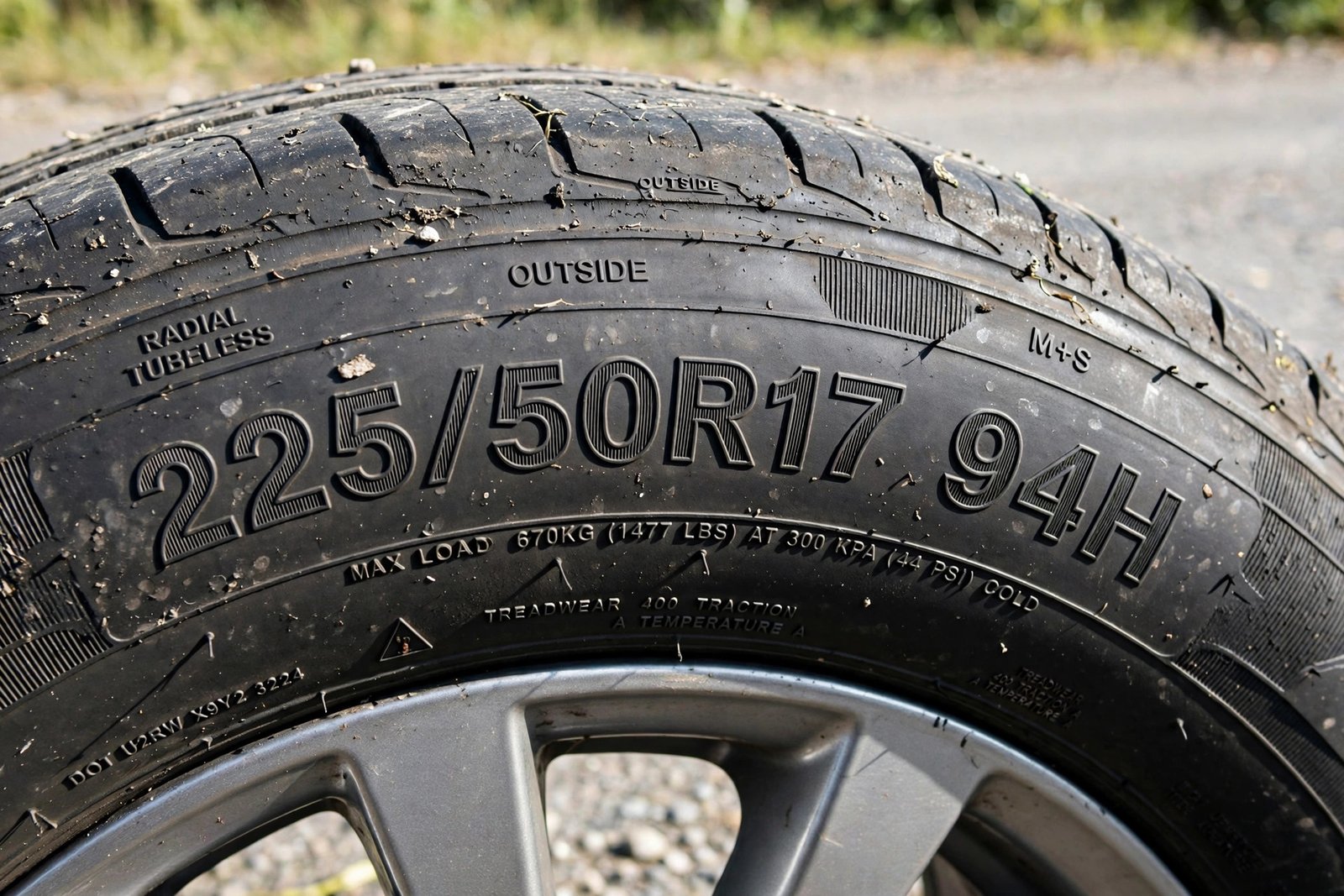
Quick answer: 94H is your tire’s service description — two safety ratings packed into three characters. The 94 is the load index: each tire can carry up to 1,477 lbs (670 kg) when properly inflated. The H is the speed rating: the tire is certified to sustain up to 130 mph (210 km/h) under its rated load. So if your sidewall reads 225/50R17 94H, you are looking at a tire that is 225 mm wide, fits a 17-inch wheel, carries 1,477 lbs per tire, and is rated to 130 mph. The number to match is the one on your driver’s door-jamb sticker — never fit a tire rated lower than that.
Where 94H sits on the sidewall
When drivers ask what does 94H mean on a tire, the answer is two ratings: load index 94 and speed rating H. Pick up any passenger-car tire and you will find a string of letters and numbers molded into the sidewall, usually the biggest marking on it. A typical one reads 225/50R17 94H. Every part of that string means something, and 94H is the last part — the bit most drivers skip over.
Here is the full decode of that example:
| Code | What it means |
|---|---|
| 225 | The tire’s width in millimeters, measured sidewall to sidewall |
| 50 | The aspect ratio — the sidewall height is 50% of the width |
| R | Radial construction (nearly every passenger tire today) |
| 17 | The wheel diameter in inches the tire fits |
| 94 | The load index — max weight per tire |
| H | The speed rating — max sustained speed |
The first four parts describe the tire’s size. The last two — 94 and H — describe what the tire can safely handle. Together they are called the service description, and they are the two ratings that matter most when you buy replacement tires. Get the size right but the service description wrong, and you can end up with a tire that looks perfect and still is not safe for your car.
If the size part still feels like alphabet soup, our full guide to reading tire numbers walks through every marking on the sidewall, one piece at a time.
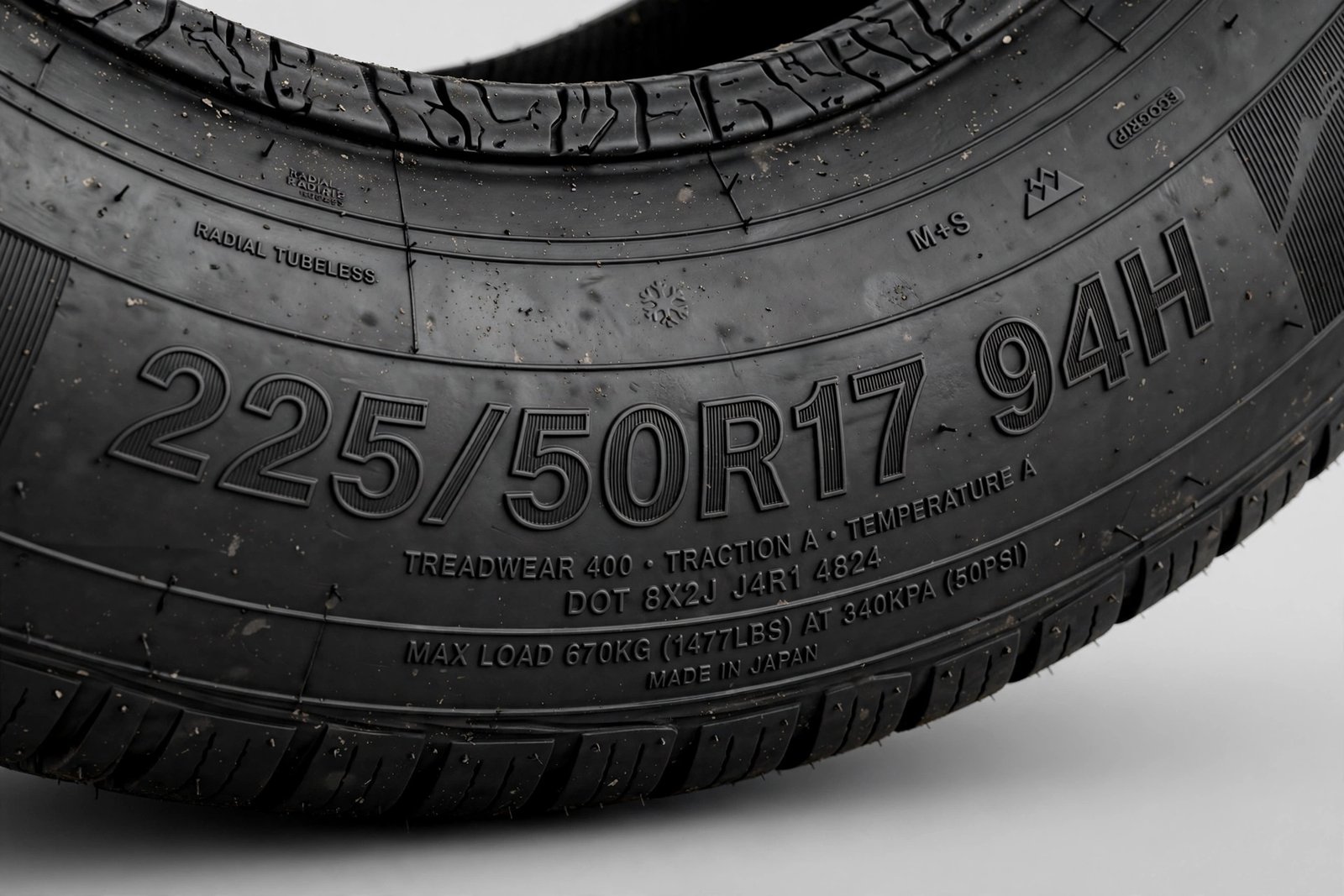
The 94: load index explained
The load index is a standardized code number. It does not mean 94 pounds, or 94 anything — it is a lookup number, and each number on the scale maps to a specific maximum weight. The scale is set by international bodies (ISO and ETRTO), so a 94 means the same thing in the US, the UK, and Europe.
For load index 94, the value is 1,477 lbs (670 kg) per tire, at the tire’s maximum rated pressure. That figure is confirmed by CarsBibles, EngineerFix, It Still Runs, TiresPick, and The Tire Reviews — all of which list 94 as 1,477 lbs / 670 kg.
One important detail: that is per tire, not per car. Four 94-rated tires together can carry up to 5,908 lbs (4 × 1,477). Your car’s actual weight is shared across all four tires, so the per-tire figure is what you compare against a quarter of your car’s fully loaded weight — and your car maker’s engineers have already done that math for you when they chose the rating on your door-jamb sticker.
The load index only counts when the tire is properly inflated. An underinflated tire cannot carry its rated load safely — the sidewall flexes too much, heats up, and the tire can fail even though the weight on it is technically within the rating. That is one reason checking pressure monthly matters as much as buying the right tire in the first place.
Load index neighbours: what one step up or down means
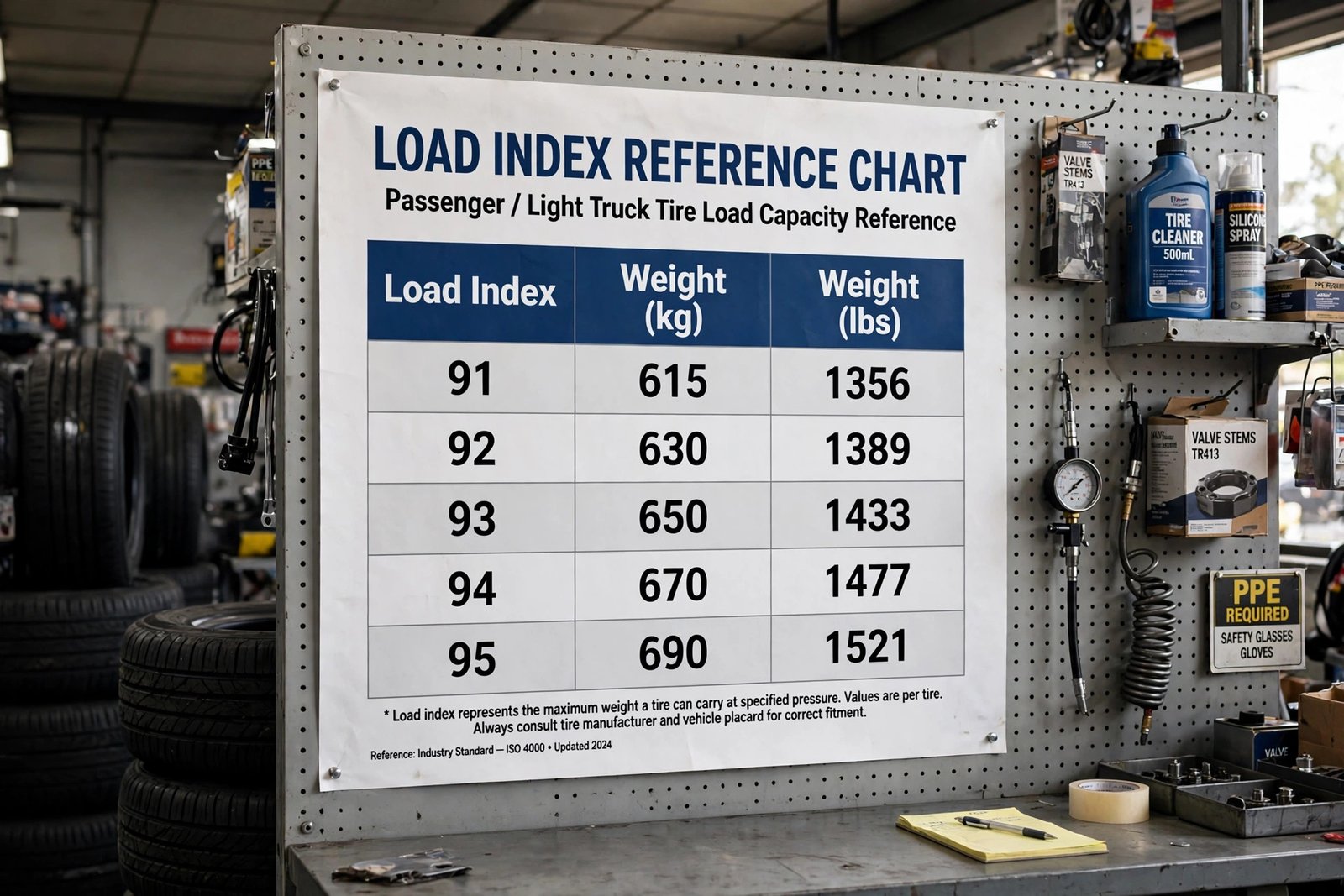
The load index scale is not linear — one step is not a fixed number of pounds. Here are the ratings around 94, so you can see what a single step is worth:
| Load index | Max load per tire | Difference from 94 |
|---|---|---|
| 91 | 1,356 lbs (615 kg) | −121 lbs |
| 92 | 1,389 lbs (630 kg) | −88 lbs |
| 93 | 1,433 lbs (650 kg) | −44 lbs |
| 94 | 1,477 lbs (670 kg) | — |
| 95 | 1,521 lbs (690 kg) | +44 lbs |
Notice how small the steps are near the top of the passenger-car range. Going from 94 down to 93 loses only 44 lbs per tire — but that is still 44 lbs your car maker decided you need, and the rule is simple: never go below the specified figure. Going up to 95, on the other hand, is perfectly fine. A higher load index is never a safety problem; it just means the tire is built a little stronger than your car strictly requires.
The H: speed rating explained
The speed rating is a letter that tells you the maximum speed the tire can sustain while carrying its rated load. The rating comes from laboratory testing: the tire is run against a high-speed metal drum in controlled conditions, in steps, until it reaches the speed it is certified for.
H means 130 mph (210 km/h). That is the figure every source agrees on — from The Tire Reviews’ speed rating chart to CarsBibles, EngineerFix, and StartMyCar.
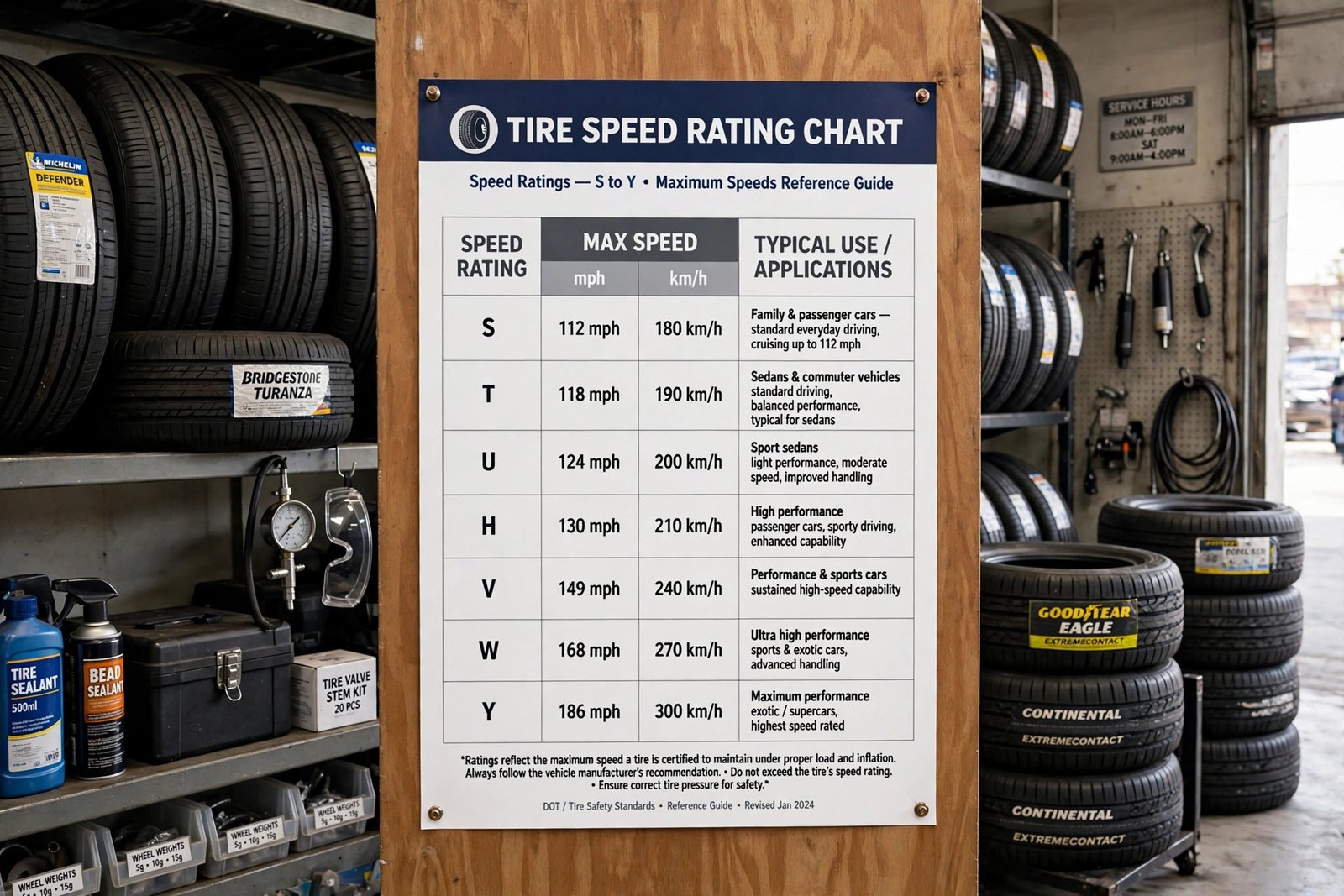
Here is where H sits in the ratings you will actually see on passenger cars:
| Speed rating | Max speed | Typical use |
|---|---|---|
| S | 112 mph (180 km/h) | Family sedans, minivans |
| T | 118 mph (190 km/h) | Family sedans, touring tires |
| H | 130 mph (210 km/h) | Sport sedans, coupes |
| V | 149 mph (240 km/h) | Performance sedans, sports cars |
| W | 168 mph (270 km/h) | High-performance cars |
| Y | 186 mph (300 km/h) | Ultra-high-performance cars |
H is the first step into performance territory. S and T are the touring ratings you find on most family cars and minivans. H shows up on sport sedans and coupes — cars with a little more power and a firmer suspension, where the tire needs to stay stable and cool at higher sustained speeds. V, W, and Y climb further into sports-car territory, and you will rarely need them unless your car came with them.
A quick warning about what the rating is not: it is not a speed limit, and it is not permission. The H rating says the tire survived laboratory testing at 130 mph under its rated load, at correct pressure, in good condition. It does not say your car can reach 130 mph, it does not say you should try, and it does not mean the tire is safe at 130 mph if it is underinflated, worn out, or overloaded. In the US, no public road lets you drive anywhere near that speed legally — the rating is a safety margin, not a target.
Where to find the rating your car actually needs
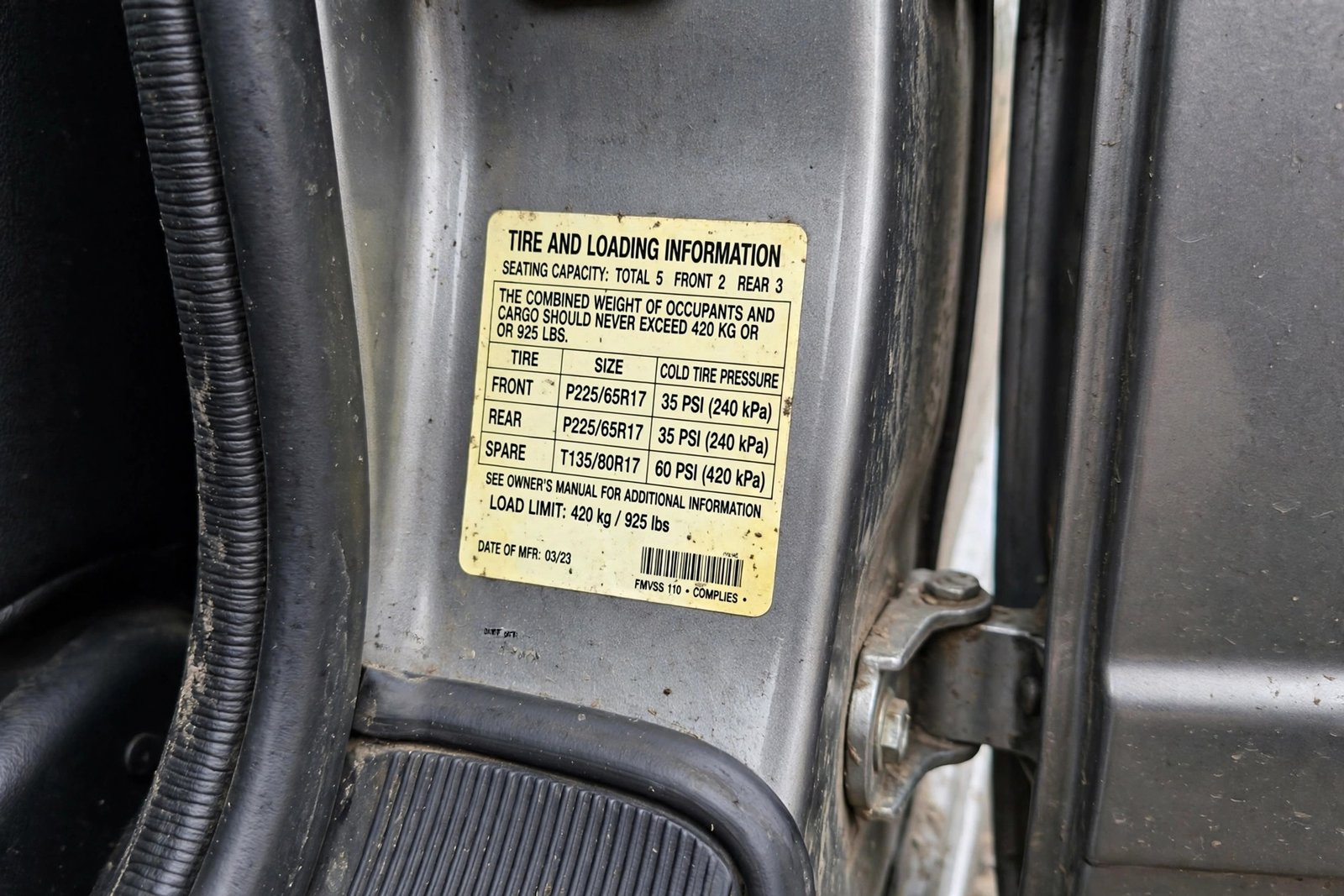
Here is the mistake that causes most service-description problems: drivers copy the rating off their old tires instead of checking what the car maker specifies. That usually works — unless a previous owner fitted the wrong tires, in which case you would be copying their mistake.
The rating your car needs is printed in two places:
- The driver’s door-jamb sticker. Open the driver’s door and look at the sticker on the door frame (the B-pillar). It lists the original tire size, the service description, and the recommended cold tire pressure. This is the fastest check, and it takes ten seconds.
- The owner’s manual. The manual lists the same figures, usually in the tires or specifications section. Use it if the sticker is worn or missing.
A real-world example from StartMyCar shows how it works: an Audi A3’s door-jamb sticker lists 225/45R17 94H — that is the car’s specified service description, and any replacement tire for that car needs a load index of 94 or higher and a speed rating of H or higher.
Match the sticker, and you are done. The size, load index, and speed rating on the sticker are the minimum your replacement tires must meet.
Can I go higher? Can I go lower?
This is the question every tire shop hears, and the answer is one-directional:
Going higher is fine. Fitting a 95H where your car calls for 94H, or a 94V where it calls for 94H, is completely safe. The tire is simply built to handle a little more weight or speed than your car needs. You might pay a few dollars more, and a higher speed rating sometimes comes with a slightly firmer ride or faster tread wear, but there is no safety downside.
Going lower is not fine — ever. Fitting a 91H where your car needs 94H, or a 94T where it needs 94H, means the tire was never tested for the weight or speed your car can put on it. As StartMyCar puts it, citing Tirebuyer: you should never replace your tires with a lesser speed and load rating than the original equipment tires. A tire carrying more than its rated load can overheat and fail, and a blowout at highway speed is the failure mode you are trying to avoid.
The practical rule: match or exceed, never go below. If the sticker says 94H, your replacement tires must be 94H or better on both halves of the code. If a shop offers you a cheaper tire with a lower rating, that is not a bargain — it is the wrong tire.
One more nuance: all four tires should match. Mixing a 94H on one axle with a 91T on the other gives the car two different grip and handling levels, and in hard braking or a sudden swerve, that mismatch is exactly when you least want it.
94H vs 94V vs 94T on the same car
The load index stays the same across all three — 94 means 1,477 lbs per tire whether the letter after it is T, H, or V. Only the speed ceiling changes:
| Code | Load capacity | Speed rating |
|---|---|---|
| 94T | 1,477 lbs (670 kg) | 118 mph (190 km/h) |
| 94H | 1,477 lbs (670 kg) | 130 mph (210 km/h) |
| 94V | 1,477 lbs (670 kg) | 149 mph (240 km/h) |
So if your car calls for 94H, here is how the three compare:
- 94T — do not fit it. The load is right, but the speed rating is a step below what your car needs. The tire was never certified for the speeds your car is built to reach.
- 94H — the correct match. Exactly what the car maker specified.
- 94V — fine, and often the upgrade a shop will suggest. The load is identical, the speed ceiling is higher, and the tire will usually have a slightly stiffer sidewall and sharper steering response. Expect to pay a little more, and check the treadwear rating — higher speed ratings sometimes trade a bit of tread life for grip.
The same logic runs in reverse if your car calls for 94T: a 94H tire is a safe upgrade, and a 94V is a safe upgrade too. The rating only ever goes one way — up is safe, down is not.

What the rating does not tell you
94H answers two questions — how much weight, and how fast. It does not answer several others, and it is worth knowing the limits so you do not read more into the code than it says:
- It says nothing about tread life. That is the UTQG treadwear number, a separate marking on the sidewall.
- It says nothing about grip in rain or snow. Traction and temperature grades (also UTQG markings) cover that, and winter performance depends on the tire type, not the service description.
- It says nothing about the tire’s age. A ten-year-old 94H tire is still stamped 94H, but the rubber has aged and the tire should be inspected yearly from age five and replaced by age ten. Read the DOT date code to check.
- It is only valid in good condition. The rating assumes correct pressure, no overload, no damage, and a tire that is not past its safe life. A cracked, bulging, or badly worn 94H tire is not a 1,477-lb, 130-mph tire anymore — it is a tire that needs replacing.
Think of the service description as the tire’s birth certificate: it tells you what the tire was built to do when new and properly cared for. It does not promise the tire is still in that condition today.
The bottom line
94H is one of the most common service descriptions on the road, and now it is also one of the easiest to read. 94 = 1,477 lbs per tire. H = 130 mph. Find the same two figures on your door-jamb sticker, match them or beat them, and you have bought the right tire. Everything else — the size, the brand, the tread pattern — is a choice. The service description is not a choice. It is the minimum your car needs, written on the sidewall in plain sight, once you know how to read it.
Frequently asked questions
What does 94H mean on a tire?
94H is the tire’s service description. The 94 is the load index — the tire can carry up to 1,477 lbs (670 kg) when properly inflated. The H is the speed rating — the tire is certified to sustain speeds up to 130 mph (210 km/h) under its rated load. Together they tell you how much weight the tire can carry and how fast it can safely go.
What if my tire says 94V instead of 94H?
The 94 is the same, so the load capacity is identical — 1,477 lbs per tire. Only the speed rating changes: V is certified to 149 mph, while H is certified to 130 mph. A 94V tire can replace a 94H tire, because going up in speed rating is fine. Going down — fitting 94H where your car calls for 94V — is not recommended.
Does an H speed rating mean I can drive 130 mph?
No. The H rating means the tire is certified to sustain 130 mph under controlled laboratory conditions, at its rated load and correct pressure. It is a safety rating for the tire, not a speed limit or a target. Your legal speed limit, your car’s top speed, and safe driving conditions are separate things — and in the US, you will not legally drive anywhere near 130 mph.
Where is the 94H code on my tire?
It sits right after the tire size on the sidewall, as the last part of the size marking — for example, 225/50R17 94H. The number and letter together are called the service description. Your car’s required load index and speed rating are on the driver’s door-jamb sticker and in the owner’s manual.
Can I use a tire with a lower load index than my car needs?
No. Never fit a tire with a load index or speed rating below the figure your car maker specifies on the door-jamb sticker or in the owner’s manual. A tire carrying more weight than it is rated for can overheat and fail, and a lower speed rating means the tire was never tested for the speeds your car can reach. Going higher than the specified rating is fine; going lower is not.
Is 94H a good tire rating?
Yes, for the cars it is made for. 94H is a very common rating on midsize sedans, sport sedans, and coupes: 1,477 lbs of load capacity per tire and a 130 mph speed rating cover normal family-car and highway use with plenty of margin. Whether it is right for your car depends on what your door-jamb sticker calls for — match or exceed that figure, and the rating is right.
Related reads
- What Does 265/70R17 Mean? Tire Size Explained
- What Do Tire Numbers Mean?
- How to Check Tire Tread Depth
- When to Change Tires: 7 Warning Signs
- Best Budget Tires
- Compare Cars tool — compare any two cars side by side
Sources
- 94H Tire Code Explained: Load & Speed Ratings Revealed — Tread and Brake
- What Is 94h On Tires? Decoding Tire Speed & Load Ratings — CarsBibles
- Tire Speed Rating Chart: Every Speed & Load Rating Explained — The Tire Reviews
- Tyre Speed Rating And Load Index — StartMyCar
- The Differences in the 94H & 94T Tires — It Still Runs
- What Does 94v, 94h, 94w, 94t & 94y Mean On A Tire? — TiresPick
- What Is the Difference Between 94V and 94H Tires? — EngineerFix
- How to Read a Tire Size Number: 5 Simple Steps Explained — Tread and Brake