
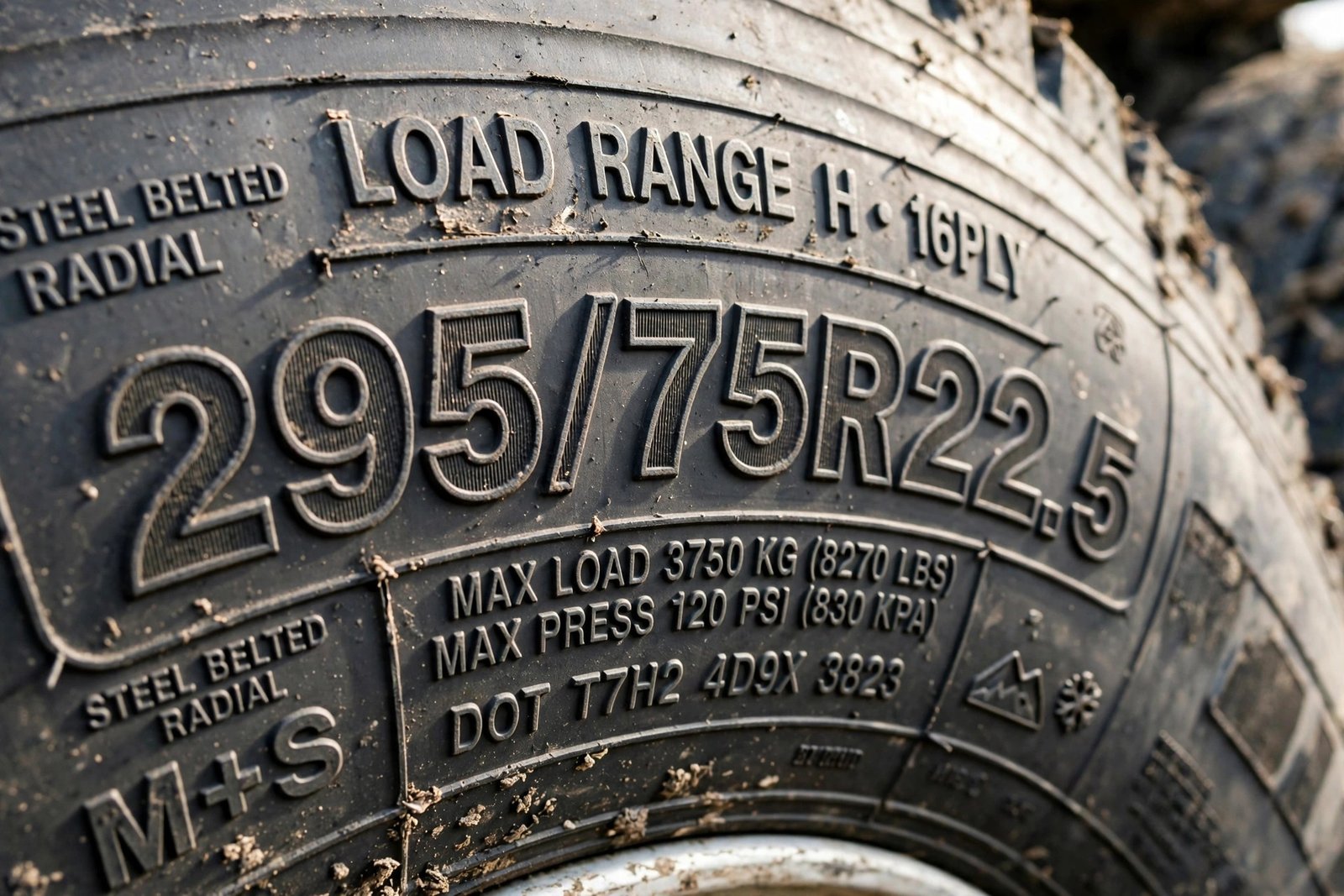
What Does 265/70R17 Mean?
If you drive a truck or a big SUV, you have probably seen 265/70R17 stamped on your tire’s sidewall — and wondered what on earth it means. It looks like a random code, but it is actually a complete description of the tire’s size, written in a standard language used all over the world.
Here is the short version: 265/70R17 is a tire that is 265 millimeters wide, with a sidewall height equal to 70% of that width, built with radial construction, made to fit a 17-inch wheel. Its overall diameter is about 31.6 inches. That is why it is such a popular size for mid-size and full-size trucks and SUVs — it is tall enough to look right and ride well, without being so big that it needs a lift kit.
Below, we will decode each piece one by one, do the math step by step so you can check it yourself, and cover what vehicles use this size and what happens if you change it.
Quick Answer: 265/70R17 Decoded in 30 Seconds
265/70R17 means: a tire 265 mm (10.43 in) wide, with a sidewall 185.5 mm (7.30 in) tall — that is 70% of the width — built with radial construction, to fit a 17-inch rim. Overall diameter is about 31.6 inches (802.8 mm), circumference about 99.3 inches, and it turns about 638 times per mile.
| Code | What it means | Value |
|---|---|---|
| 265 | Section width | 265 mm (10.43 in) wide, sidewall to sidewall |
| 70 | Aspect ratio | Sidewall height = 70% of width = 185.5 mm (7.30 in) |
| R | Construction | Radial (plies run across the tire) |
| 17 | Rim diameter | Fits a 17-inch wheel |
| Overall diameter | Rim + two sidewalls | 802.8 mm ≈ 31.6 in |
| Circumference | Distance around the tire | ≈ 99.3 in |
| Revolutions per mile | How often it turns | ≈ 638 |
That is the whole code. Now let us look at each piece properly — because each one affects how your truck drives, rides, and fits.
265 — The Width in Millimeters
The first number, 265, is the tire’s section width: how wide the tire is from one sidewall to the other, measured in millimeters when the tire is mounted on its recommended rim and inflated.
265 mm converts to 10.43 inches. That is a fairly wide tire — wider than the 225 mm or 245 mm tires you find on sedans and small crossovers, and right in the sweet spot for trucks and larger SUVs.
A few things worth knowing about the width: it is the section width, not the tread width — the tread that actually touches the road is slightly narrower than 265 mm. A wider tire puts a bigger contact patch on the road, which can mean more traction and more stable cornering, but also more rolling resistance and slightly worse fuel economy. And the width alone does not tell you the tire’s height — a 265-wide tire with a 70 aspect ratio is much taller than a 265-wide tire with a 60 aspect ratio.

70 — The Aspect Ratio (the Confusing One)
The second number, 70, is the aspect ratio. This is the number that confuses people most, because it is not a measurement — it is a percentage. It tells you the sidewall height as a percentage of the section width.
For our tire, the math is simple:
265 mm × 70% = 185.5 mm of sidewall
That is 7.30 inches of rubber between the rim and the road. That tall sidewall is the defining character of this tire size: it is what gives trucks and SUVs their comfortable ride over potholes and rough roads, and it is what lets the tire flex off-road without damaging the wheel.
Here is the trap to avoid: the aspect ratio is always relative to the width. A 70 aspect ratio on a 265 mm tire gives a 185.5 mm sidewall — but a 70 aspect ratio on a 235 mm tire gives only a 164.5 mm sidewall. Same “70,” very different tire. You can never compare aspect ratios without knowing the width.
And the aspect ratio shapes the whole personality of the tire: a higher number (70, 75) means a taller sidewall, more cushion over bumps, a softer ride, and more protection for the wheel off-road — which is why trucks and SUVs use 70-series tires. A lower number (55, 50, 45 and below) means a shorter sidewall, sharper steering, and a sportier feel, but a harsher ride and wheels that are easier to damage. See our low-profile tires pros and cons guide for the full trade-off.

R — Radial Construction
The letter R stands for radial. It describes how the tire’s internal cord layers are arranged: running straight across the tire, at 90 degrees to the direction of travel, with steel belts under the tread.
Almost every tire on the road today is a radial. Radial tires last longer, ride smoother, handle heat better, and grip better than the older bias-ply construction (sometimes marked with a D instead of an R), which you will still see on some trailer tires and farm equipment — but not on a normal truck or SUV.
For practical purposes, the R is the least interesting part of the code, because it is the same on nearly every tire you will buy. But it is worth knowing what it means, because it completes the picture: 265/70R17 is a radial tire, like virtually everything else on the road in 2026.
17 — The Rim Diameter in Inches
The last number, 17, is the diameter of the wheel (rim) the tire is made to fit, measured in inches from bead seat to bead seat.
This number is non-negotiable: a 265/70R17 tire only fits a 17-inch wheel. It will not fit a 16-inch wheel, and it will not fit an 18-inch wheel. If you are buying new wheels, the rim diameter has to match exactly.
The approved rim width range for a 265/70R17 is roughly 7.5 to 9.0 inches, with 7.5, 8.0, and 8.5 inches being the most common factory and aftermarket widths. The bolt pattern, hub bore, and offset are set by your vehicle, not by the tire — but the rim width has to be in that range for the tire to seat and perform correctly.
The Full Math: How Tall Is a 265/70R17, Really?
This is where the code turns into real dimensions. Let us do it step by step, so you can check every number yourself — and use the same method for any tire size. (Our figures match 247TyreCheck’s 265/70R17 breakdown.)
Step 1 — Sidewall height: 265 mm × 0.70 = 185.5 mm (7.30 in)
Step 2 — Rim diameter in millimeters: 17 in × 25.4 mm/in = 431.8 mm
Step 3 — Overall diameter: 431.8 mm + (2 × 185.5 mm) = 431.8 + 371 = 802.8 mm
802.8 mm ÷ 25.4 = 31.61 inches — about 31.6 inches
Step 4 — Circumference: π × 31.61 in = 99.3 inches around the tire
Step 5 — Revolutions per mile: 63,360 inches per mile ÷ 99.3 in = about 638 revolutions per mile
| Measurement | Metric | Inches |
|---|---|---|
| Section width | 265 mm | 10.43 in |
| Sidewall height | 185.5 mm | 7.30 in |
| Rim diameter | 431.8 mm | 17 in |
| Overall diameter | 802.8 mm | 31.6 in |
| Circumference | 2,522 mm | 99.3 in |
| Revolutions per mile | — | ~638 |
So a 265/70R17 is roughly 31.6 inches tall and 10.4 inches wide. Tire shops often call it a “32-inch” tire, but it is not a true 33 — that distinction matters when you are checking whether a bigger tire will fit without rubbing.
One caveat: these are computed dimensions. The actual measured diameter varies slightly by brand and model, so treat 31.6 inches as “about,” not exact.
What Comes After 265/70R17: Load Index and Speed Rating
The size code is usually followed by two more pieces of information, like this: 265/70R17 115T. These are not part of the size, but they are just as important.
The load index (115) is a number that tells you how much weight each tire can carry. A load index of 115 means 2,679 lbs per tire; a common alternative, 113, means 2,535 lbs. Multiply by four tires and you get the total carrying capacity — but never exceed your vehicle’s own limits, which are printed on the door jamb sticker.
The speed rating (T) is a letter that tells you the maximum speed the tire is certified to carry its load at. T means 118 mph, S means 112 mph, and H means 130 mph. Most 265/70R17 tires carry an S or T rating, which is more than enough for any legal highway driving in the US.
You may also see a letter before the size, like P265/70R17 or LT265/70R17. P means passenger construction; LT means light truck construction — tougher, built for heavier loads and towing. A P-metric and an LT tire can share the same size numbers and carry very different loads, so always match the type your vehicle asks for. For the full guide to every marking on the sidewall, see our related read: What Do Tire Numbers Mean.
What Vehicles Use 265/70R17?
This is one of the most common truck and SUV tire sizes in the US. You will find it as original equipment or a factory option on vehicles including:
- Toyota 4Runner — a very common factory fitment, especially on 5th-generation models
- Toyota Tacoma — a common factory size and a popular upgrade size
- Ford F-150 — on certain trims
- Chevrolet Silverado 1500 — on certain trims
- GMC Sierra 1500 — on certain trims
- Jeep Grand Cherokee and Jeep Wrangler — on certain trims
It generally does not fit sedans or smaller vehicles — the tire is too tall and too wide for their wheel wells, and the load and handling characteristics are wrong for a car.
If you are not sure what size your vehicle needs, do not guess from a list like this. Check the sticker on the driver’s door jamb or your owner’s manual — that is the size your vehicle was designed around.

265/70R17 vs Other Common Sizes
Seeing this size next to its neighbors makes the differences concrete. All figures below are computed from the size code the same way as above — you can verify them on a tire size calculator.
| Tire size | Overall diameter | Sidewall height | Difference vs 265/70R17 |
|---|---|---|---|
| 245/70R17 | 30.5 in | 6.75 in | −1.1 in (−3.5%) |
| 265/65R17 | 30.6 in | 6.78 in | −1.0 in (−3.3%) |
| 265/70R17 | 31.6 in | 7.30 in | — |
| 265/75R16 | 31.6 in | 7.82 in | ~same height, 16-in rim |
| 275/70R17 | 32.2 in | 7.58 in | +0.6 in (+1.8%) |
| 285/70R17 | 32.7 in | 7.85 in | +1.1 in (+3.5%) |
Two things jump out. First, the 265/75R16 is almost exactly the same height as the 265/70R17 — the taller sidewall compensates for the smaller rim. Second, going up to a 285/70R17 adds more than an inch of height, which is enough to matter for clearance and for your speedometer.
If you like this kind of head-to-head size comparison, our 225/65R17 vs 235/65R17 article breaks down another popular pair the same way, and EngineerFix’s 265/70R17 guide walks through the same decode independently.
What Happens If You Change Tire Size?
This is the question that usually follows the decode — and it matters, because changing size changes more than looks.
Your speedometer will be off. The speedometer is calibrated for your factory tire’s revolutions per mile (about 638 for a 265/70R17). Fit a taller tire and it turns fewer times per mile, so the speedometer reads slower than you are actually going. Going from 265/70R17 to 285/70R17 adds about 3.5% to the diameter — at a displayed 60 mph you would actually be doing about 62 mph. Fit a shorter tire and the reverse happens. The same error hits your odometer, so your recorded mileage drifts too.
The 3% rule. As a rule of thumb, keep the overall diameter within about 3% of your factory size. Beyond that, you risk rubbing on the wheel wells or suspension, speedometer and odometer error, and on some vehicles, strain on the transmission and driver-assistance systems that rely on wheel-speed readings.
Ride and handling change. A taller sidewall (higher aspect ratio) gives a softer ride and more off-road flex but slightly slower steering response. A wider tire gives more grip but can tramline — follow grooves in the road — and usually costs a little fuel economy. A shorter sidewall sharpens handling but makes the ride harsher and the wheels easier to damage.
Clearance is the hard limit. Before fitting a bigger tire, check for rubbing at full steering lock and full suspension compression. A tire that clears when parked can still rub when you turn sharply over a bump with a full load.
All-wheel drive needs matching tires. On AWD vehicles, all four tires must be the same size and similar in wear. A big difference in diameter between axles can damage the drivetrain. Never mix sizes on an AWD vehicle.
When in doubt, ask a tire shop. A good shop will check the fitment against your exact year, trim, and suspension, and can tell you whether a size change needs a lift, trimming, or just a speedometer recalibration.
Is 265/70R17 a Good Tire Size?
For the vehicles it is made for — mid-size and full-size trucks and SUVs — yes, it is one of the best-balanced sizes on the market. Here is why it is so popular:
- Comfort: the 7.3-inch sidewall soaks up potholes and rough roads far better than a low-profile tire.
- Off-road ability: the tall sidewall flexes over rocks and ruts and protects the wheel.
- Choice: because it is so common, almost every tire maker offers it in highway, all-terrain, and winter versions, at every price point — which keeps prices competitive.
- No modifications needed: on the trucks and SUVs it comes standard on, it fits without a lift kit or trimming.
The trade-offs are modest: it is heavier and has more rolling resistance than a smaller tire, so fuel economy is slightly worse than a smaller size would give, and the tall sidewall means handling is less sharp than a low-profile setup. For a truck or SUV, that is a trade most drivers are happy to make. If you are choosing between highway and off-road rubber in this size, our all-terrain vs highway tires guide covers that decision.

How to Find the Size on Your Own Tire
Walk up to any tire on your vehicle and look at the sidewall. You will find the size molded into the rubber in raised lettering, usually in large characters near the rim — something like P265/70R17 115T. The full service description (115T) follows the size, and the DOT code nearby tells you the week and year the tire was made.
If the lettering is worn or hard to read, the same size is printed on the driver’s door jamb sticker and in your owner’s manual. That sticker also lists the recommended tire pressure — check it while you are there. And if you want to know how much life your tires have left, our guide on how to check tire tread depth shows the penny test and the gauge method.

Frequently Asked Questions
What does 265/70R17 mean in inches?
A 265/70R17 tire is about 10.43 inches wide, with a 7.30-inch sidewall, fitting a 17-inch rim. Its overall diameter is about 31.6 inches and its circumference is about 99.3 inches.
How tall is a 265/70R17 tire?
About 31.6 inches (802.8 mm) tall overall. That is the rim diameter (17 inches) plus two sidewalls of 7.30 inches each. Tire shops often group it as a “32-inch” tire, but it is not a true 33-inch tire.
What vehicles use 265/70R17 tires?
It is a common factory size for mid-size and full-size trucks and SUVs, including the Toyota 4Runner and Tacoma, Ford F-150, Chevrolet Silverado 1500, GMC Sierra 1500, and Jeep Grand Cherokee and Wrangler (depending on trim). Always check your door jamb sticker for your exact vehicle.
Can I put 265/70R17 tires on a 17-inch rim?
Yes — that is exactly what the size means. The 17 is the rim diameter the tire is made for, and the approved rim width range is roughly 7.5 to 9.0 inches. It will not fit a 16-inch or 18-inch rim.
What is the difference between 265/70R17 and 265/65R17?
Both are 265 mm wide and fit a 17-inch rim, but the 265/65R17 has a shorter sidewall (65% of the width = 172.25 mm / 6.78 in) and an overall diameter of about 30.6 inches — roughly an inch shorter than the 265/70R17’s 31.6 inches. The 70-series tire rides softer; the 65-series handles a little sharper.
Can I replace 265/70R17 with 285/70R17?
Physically it often fits on trucks with enough clearance, but it is about 1.1 inches taller (+3.5% in diameter), so your speedometer will read about 3.5% slow, and you should check for rubbing at full steering lock and full suspension travel before committing. Keep diameter changes within about 3% of factory size unless you are prepared to lift or trim.