
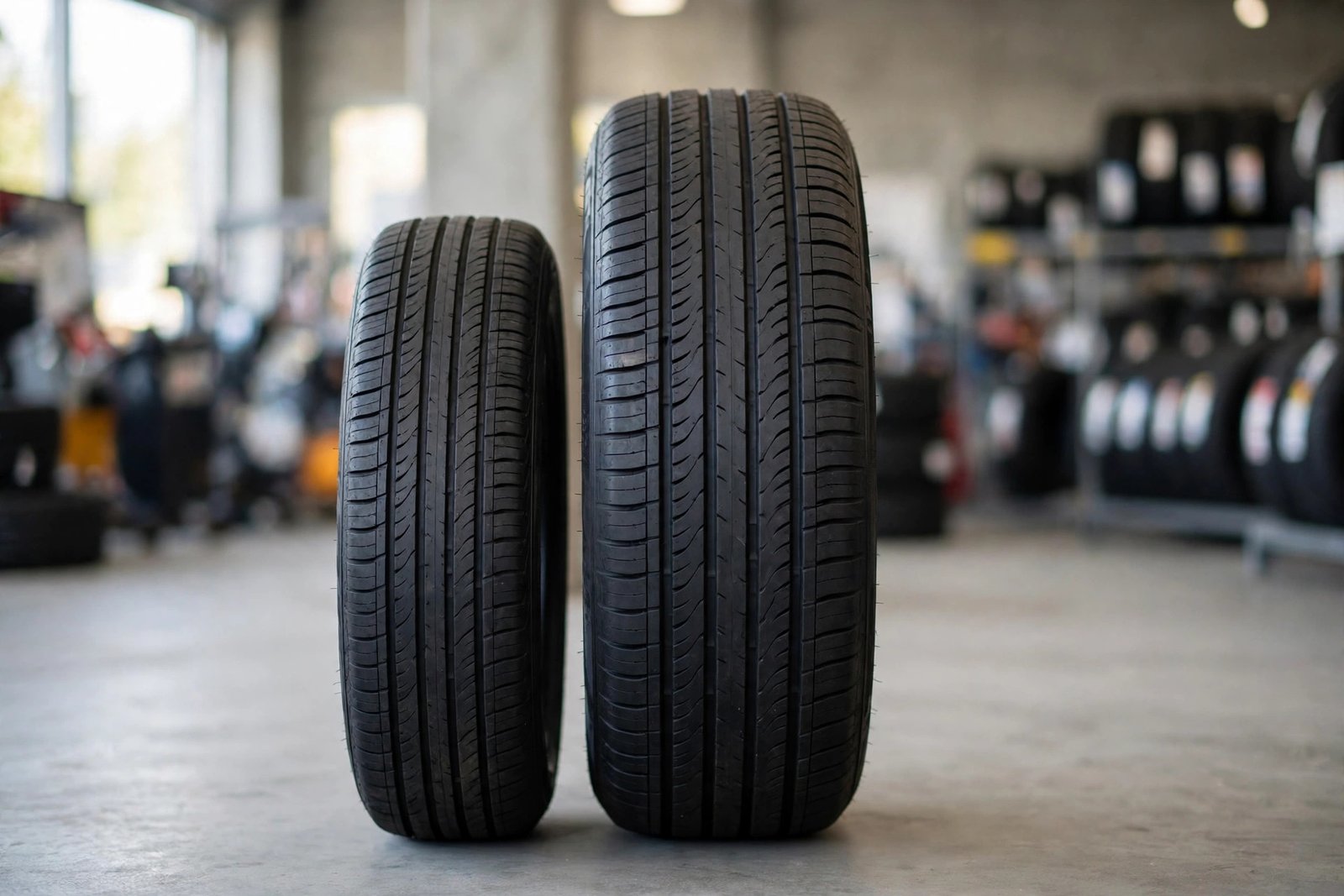
Quick answer: A 235/65R17 is 10 mm wider and 13 mm (0.51 inches) taller than a 225/65R17 — a 1.8% larger diameter. That is inside the widely accepted 3% limit, so the swap is generally safe on most crossovers, but your speedometer will read about 1 mph low at 60 mph, fuel economy dips slightly, and you must check fender and suspension clearance first. If your car came with 225/65R17 and you are happy with it, there is no reason to change; the 235 is a modest upgrade in grip and ground clearance, not a transformation.
If you drive a RAV4, CR-V, Forester, or Rogue, you have probably stared at these two sizes side by side on a tire website and wondered whether the wider one is better. They look almost identical — same 65 aspect ratio, same 17-inch rim — and the price difference is often a few dollars. But that 10 mm of extra width changes more than it looks like it should: because the aspect ratio is a percentage of the width, a wider tire is also a taller tire, and a taller tire changes your speedometer, your gearing, and your ground clearance.
This guide works through the real numbers, what they mean on the road, which cars use each size, and when the swap is safe — and when it is not.
What the Numbers Mean

Every tire size code packs three measurements into one short string. If you are new to reading them, our guide to what tire numbers mean walks through the full decoder.
- 225 / 235 — the section width in millimeters, measured across the widest part of the tire.
- 65 — the aspect ratio: the sidewall height is 65% of the section width. This is the part people miss. Because it is a percentage, the 235 tire does not just get wider — its sidewall gets taller too.
- R17 — radial construction, built for a 17-inch wheel. Both sizes fit the same rim diameter.
So the two tires share a rim size and a sidewall ratio, but differ in width — and that difference ripples through every other dimension.
225/65R17 vs 235/65R17: The Full Spec Table
| Measurement | 225/65R17 | 235/65R17 | Difference |
|---|---|---|---|
| Section width | 225 mm (8.86 in) | 235 mm (9.25 in) | +10 mm (+0.39 in, +4.4%) |
| Sidewall height | 146.25 mm (5.76 in) | 152.75 mm (6.01 in) | +6.5 mm (+0.26 in, +4.4%) |
| Overall diameter | 724.3 mm (28.52 in) | 737.3 mm (29.03 in) | +13 mm (+0.51 in, +1.8%) |
| Circumference | 2,275.5 mm (89.58 in) | 2,316.3 mm (91.19 in) | +40.8 mm (+1.61 in, +1.8%) |
| Revolutions per mile | 707.26 | 694.79 | −12.47 (−1.8%) |
| Approved rim width | 6.0–8.0 in | 6.5–8.5 in | Overlaps on most factory wheels |
| Ground clearance change | — | — | +0.26 in (half the diameter gain) |
The headline number is the 1.8% diameter increase. Tire professionals generally treat anything within about 3% of the original diameter as acceptable without recalibration, so this swap sits comfortably inside that window. Past 3%, you should have the speedometer recalibrated — many cars can be reflashed by a dealer or tire shop.
Two things worth noting from the table. First, the 235 is only half an inch taller, so the visual difference is subtle — your crossover will sit about a quarter inch higher and the tires will fill the wheel wells a touch more. Second, most factory 17×7-inch wheels accept both sizes, since the approved rim-width ranges overlap heavily. That is why this is one of the most common one-step size-ups in the crossover world.
Speedometer and Odometer: What Actually Changes

A taller tire covers more ground with every revolution, so the car travels farther than the speedometer believes. The gauge was calibrated for the original size, and it has no way of knowing you fitted a taller tire.
| Speedometer reading | Actual speed on 235/65R17 | Difference |
|---|---|---|
| 20 mph | 20.4 mph | +0.4 mph |
| 30 mph | 30.5 mph | +0.5 mph |
| 40 mph | 40.7 mph | +0.7 mph |
| 55 mph | 56.0 mph | +1.0 mph |
| 60 mph | 61.1 mph | +1.1 mph |
| 70 mph | 71.3 mph | +1.3 mph |
In practice, that means you are going about 1 mph faster than the needle says at highway speed. It is small enough that most drivers never notice, but it is real — and it is worth remembering in a speed-camera zone. The odometer is affected the same way: it undercounts by about 180 miles for every 10,000 miles you drive, which also means your calculated fuel economy will look very slightly worse than it really is unless you correct for it.
One more knock-on effect: taller effective gearing slightly dulls acceleration from a stop and can drop highway cruising rpm a touch. With a 1.8% change, both effects are barely noticeable — you will not feel your RAV4 turn sluggish — but they are the reason a much bigger jump (say, to a 245) starts to feel different.
Fitment and Compatibility: Check Before You Buy

The numbers say the swap is fine. Fitment is where swaps actually go wrong, and it is the one thing no size calculator can check for you.
Rim width. As the table shows, a 225/65R17 fits rims roughly 6.0 to 8.0 inches wide, and a 235/65R17 fits about 6.5 to 8.5 inches. Most factory crossover wheels in this size are 17×7, which sits inside both ranges. If your wheels are narrower than 6.5 inches, the 235 may not be approved for them — check the approved rim-width range on the specific tire you are buying.
Clearance. A wider tire can rub the fender liner or suspension components at full steering lock, and a taller tire can foul the liner over big bumps. The 235/65R17 is a popular size-up on Subaru Outbacks, Foresters, and Crosstrek Wilderness models precisely because those cars have room for it on stock suspension — but “popular on a Forester” is not a guarantee for your car. Turn the wheel to full lock and check the gap, or ask the tire shop to test-fit one tire before mounting all four.
Load index and speed rating. Your replacement tires must meet or exceed the load index and speed rating on your door-jamb placard. A common load index for 225/65R17 fitments is 102 (1,874 lbs per tire). Never drop below the original specification to save money — the placard figure is a safety rating, not a suggestion.
Your door placard is the authority. Check the sticker on the driver’s door jamb before ordering. Some manufacturers list the 235/65R17 as an approved optional size for the same vehicle, which makes the decision easy. If your placard lists only 225/65R17, the 235 is still a reasonable aftermarket choice — but the placard is what your dealer, your warranty, and your insurer will look at.
All-wheel drive. If your car has AWD, replace all four tires at once and keep them the same size. Mismatched diameters front to rear make the AWD system work overtime and can damage the center differential over time. This applies to any size change, not just this one.
Ride, Grip, and Fuel Economy on the Road

Ride comfort. The 235’s taller sidewall — 6.01 inches versus 5.76 — gives it a little more cushion over potholes and broken pavement. The difference is subtle, roughly a quarter inch of extra sidewall, but owners who size up often report a slightly softer ride. If your crossover already rides firmly, this is a small point in the 235’s favor.
Grip and handling. The wider contact patch gives the 235 a modest grip advantage in dry braking and cornering, and a slightly bigger footprint in the rain. It is not a night-and-day difference — 10 mm is about the width of a fingertip — but it is real. The trade-off is that wider tires can tramline more, following grooves and ruts in the road, and they can feel a touch less precise on initial turn-in.
Fuel economy. Wider tires mean more rolling resistance, and the taller gearing changes how the engine works at a given speed. Expect a small fuel-economy penalty — typically well under 1 mpg in everyday driving. Over a year of commuting that adds up to a few gallons, not a budget crisis. If maximum mpg is your priority, stick with the narrower factory size.
Noise. There is no consistent noise difference between these two sizes. Tread pattern matters far more than 10 mm of width — a quiet touring tire in 235 will be quieter than an aggressive all-terrain in 225. Choose the tire by its tread design and reviews, not by its width.
Winter driving. The narrower 225 has a small theoretical advantage in snow: a narrower tire concentrates the car’s weight on a smaller patch, which helps it cut through snow to the pavement below. In practice, the difference between 225 and 235 is minor compared with the difference between an all-season and a proper winter tire. If you drive in real winter, read our all-season vs winter tires guide before spending money on a size change.
Which Cars Use Each Size?

The 225/65R17 is one of the most common crossover sizes on the road. It is factory equipment on the Toyota RAV4 (LE and XLE trims), Honda CR-V, Subaru Forester and Outback, Nissan Rogue, Ford Escape, Jeep Cherokee, Hyundai Tucson, Kia Sportage, and Chevrolet Equinox, among others. The RAV4 alone makes it the highest-volume 17-inch crossover size in America.
The 235/65R17 is the natural one-step size-up from it. It comes factory-fitted on some trims of the RAV4, Sienna, and other crossovers, and it is the most popular upgrade size for Subaru Outback, Forester, and Crosstrek Wilderness owners who want a slightly taller, more planted look without touching the suspension. If you are shopping for either size, availability is excellent — nearly every major tire brand makes both, from budget all-season tires to all-terrain options.
Whichever size your car came with, the replacement process is the same: confirm the size on the placard, match the load index and speed rating, and get an alignment check if your old tires wore unevenly. Our guide to tire balancing vs alignment explains why that last step matters more than most drivers think.
When the Swap Is Safe — and When It Is Not
Safe in most cases when:
- Your door placard lists 235/65R17 as an approved size, or your vehicle has the clearance for it (most RAV4s, CR-Vs, Foresters, and Outbacks do).
- You are replacing all four tires at the same time with the same size, brand, and model.
- The new tires meet or exceed the original load index and speed rating.
- Your rims are at least 6.5 inches wide.
- You accept a ~1 mph speedometer error at highway speed.
Think twice — or don’t do it — when:
- The wider tire rubs at full lock or over bumps on your specific car. A test fit settles this in minutes.
- Your car has a staggered setup (different sizes front and rear) — the rules are different, and this guide does not apply.
- You are only replacing two tires. Never run 225s on one axle and 235s on the other, especially on an AWD vehicle.
- Your lease or warranty paperwork requires the factory size. Some leases charge for non-standard sizes at turn-in.
- You are chasing a big change. If you want a dramatically different look or much more ground clearance, 10 mm of width will disappoint you — you would need a larger jump, a lift, or both, and that is a different conversation with different risks.
Pros and Cons at a Glance
225/65R17 — the factory size
Pros: Exact speedometer and odometer readings; best fuel economy of the two; widest tire selection and usually the lowest price; guaranteed fitment with zero clearance worries; slightly better in snow.
Cons: Narrower contact patch means slightly less dry grip; less ground clearance; fills the wheel well a little less.
235/65R17 — the size-up
Pros: More grip from the wider contact patch; about a quarter inch more ground clearance; slightly softer ride from the taller sidewall; fills out the wheel wells for a more planted look; huge tire selection.
Cons: Speedometer reads about 1 mph low at 60 mph; small fuel-economy penalty; possible rubbing on tight-fitting cars; usually costs a few dollars more per tire.
The Verdict
For most crossover drivers, this is a genuinely close call — which is exactly why it is such a popular search. The 235/65R17 is a safe, sensible size-up from 225/65R17: the 1.8% diameter difference sits well inside the 3% rule, it fits the same wheels, and it buys you a little more grip, a little more clearance, and a slightly softer ride for a small fuel-economy cost and a 1 mph speedometer error.
But “safe” is not the same as “worth it.” If your 225/65R17 tires are serving you well, there is no performance reason to switch — the gains are modest, and the factory size keeps your gauges honest and your fuel economy at its best. The drivers who benefit most from the 235 are the ones who want a slightly more aggressive stance, a touch more ground clearance for gravel roads and deep snow, or a wider tire choice in an all-terrain tread.
Whichever you choose, buy four matching tires from a reputable brand, check the placard, and have the shop confirm clearance before mounting. And if you are still learning how tire sizes work, our tire size guide and our explainer on what tire aspect ratio means will make your next tire purchase much easier.
Frequently Asked Questions
Can I use 235/65R17 instead of 225/65R17?
In most cases, yes. The 235/65R17 is only 1.8% larger in overall diameter than the 225/65R17, which is inside the commonly accepted 3% limit for tire size changes. Check your door-jamb placard first, confirm the wider tire clears your fenders and suspension at full lock, and match or exceed the original load index and speed rating.
How much bigger is a 235/65R17 than a 225/65R17?
The 235/65R17 is 10 mm (0.39 inches) wider and 13 mm (0.51 inches) taller in overall diameter than the 225/65R17 — a 4.4% increase in width and a 1.8% increase in diameter. It also raises ground clearance by about 0.26 inches and turns about 12 fewer revolutions per mile.
Will 235/65R17 tires throw off my speedometer?
Yes, slightly. Because the 235/65R17 is 1.8% taller, your speedometer will read low: at an indicated 60 mph you are actually traveling about 61.1 mph, and at 30 mph you are doing about 30.5 mph. Your odometer will also undercount by roughly 180 miles for every 10,000 miles driven.
Do wider tires hurt fuel economy?
Slightly. A wider tire has more rolling resistance and a larger contact patch, so moving from 225/65R17 to 235/65R17 can cost a small amount of fuel economy — usually well under 1 mpg in everyday driving. The effect is small because the size change itself is small.
Will 235/65R17 tires fit on the same rims as 225/65R17?
Usually, yes. A 225/65R17 typically fits rims 6.0 to 8.0 inches wide, and a 235/65R17 fits rims about 6.5 to 8.5 inches wide, so most factory 17×7 wheels accept both sizes. Confirm the approved rim-width range printed on the tire you are buying, and check clearance on your specific vehicle.
Which cars use 225/65R17 tires?
The 225/65R17 is factory equipment on the Toyota RAV4 (LE and XLE trims), Honda CR-V, Subaru Forester and Outback, Nissan Rogue, Ford Escape, Jeep Cherokee, Hyundai Tucson, Kia Sportage, and Chevrolet Equinox, among other compact and midsize crossovers. Always confirm your exact size on the driver’s door-jamb placard.