
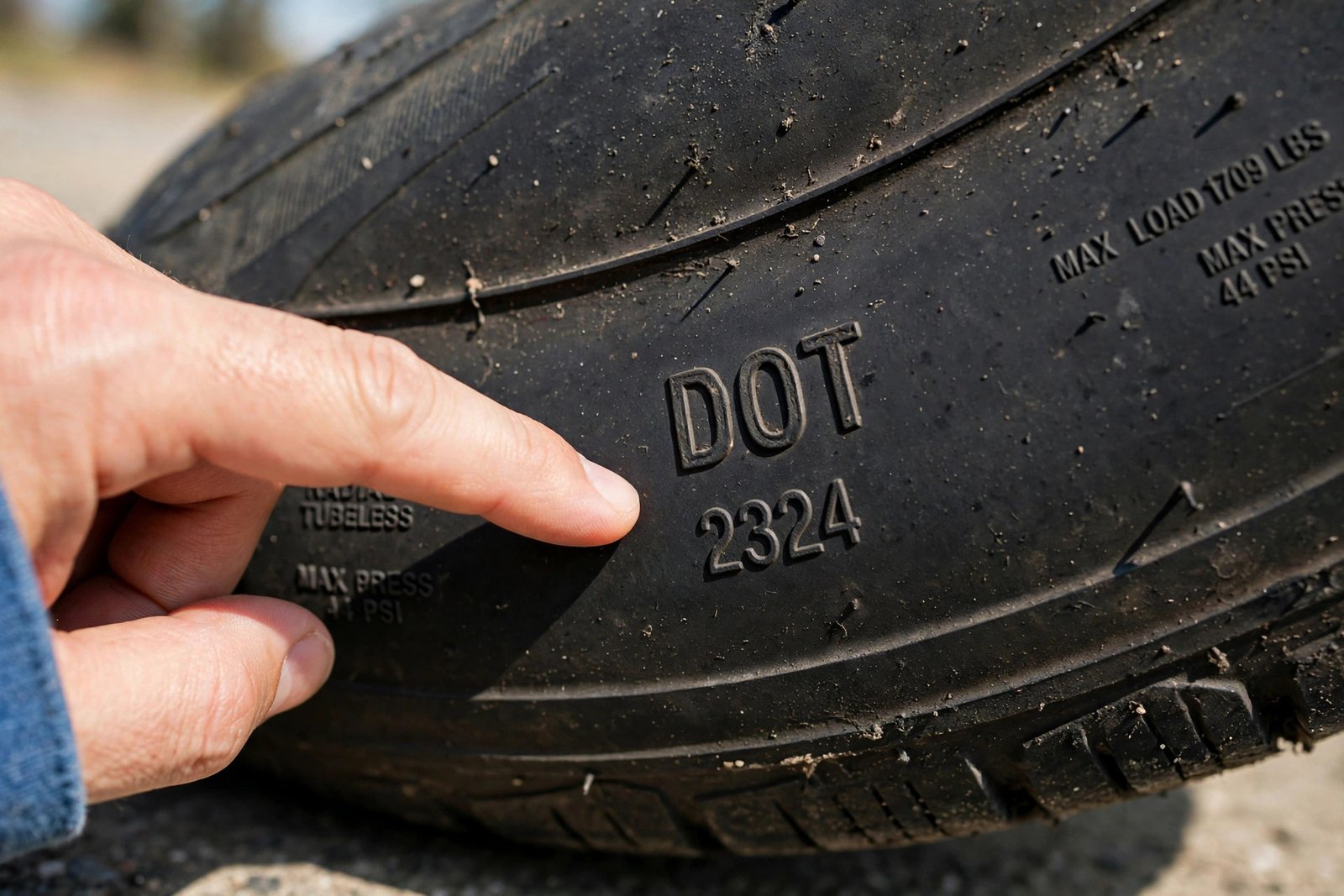
Quick answer: Read the DOT date code on the sidewall — the last four digits are the week and year the tire was made. From 5 to 6 years old, have your tires inspected by a tire professional every year. At about 6 years, many car makers say replace them. At 10 years, the tire makers say replace them, full stop — even if the tread still looks fine, even if the tire has never been used. There is no US law setting a tire age limit, so the manufacturers’ numbers are the ones that count. And age is measured from the day the tire was made, not the day it was fitted to your car.
The tread is not the whole story
When drivers ask how old is too old for tires, the answer comes from the DOT date code, not the tread. Most drivers judge a tire by its tread. If the grooves are deep, the tire must be fine — right? Not quite. Tread depth tells you how much rubber is left on top of the tire. It tells you nothing about what is happening inside the rubber itself.
A tire is a chemical product as much as a mechanical one. The rubber compound slowly hardens, dries out, and loses flexibility from the day it leaves the factory — whether the tire is rolling down the highway or sitting in a garage. A tire can have plenty of tread left and still be unsafe, because the rubber holding that tread together has gone brittle.
That is why the tire industry talks about age separately from wear. The two clocks run at the same time: one counts miles, the other counts years. Most drivers only ever watch the first one.
How to read the DOT date code
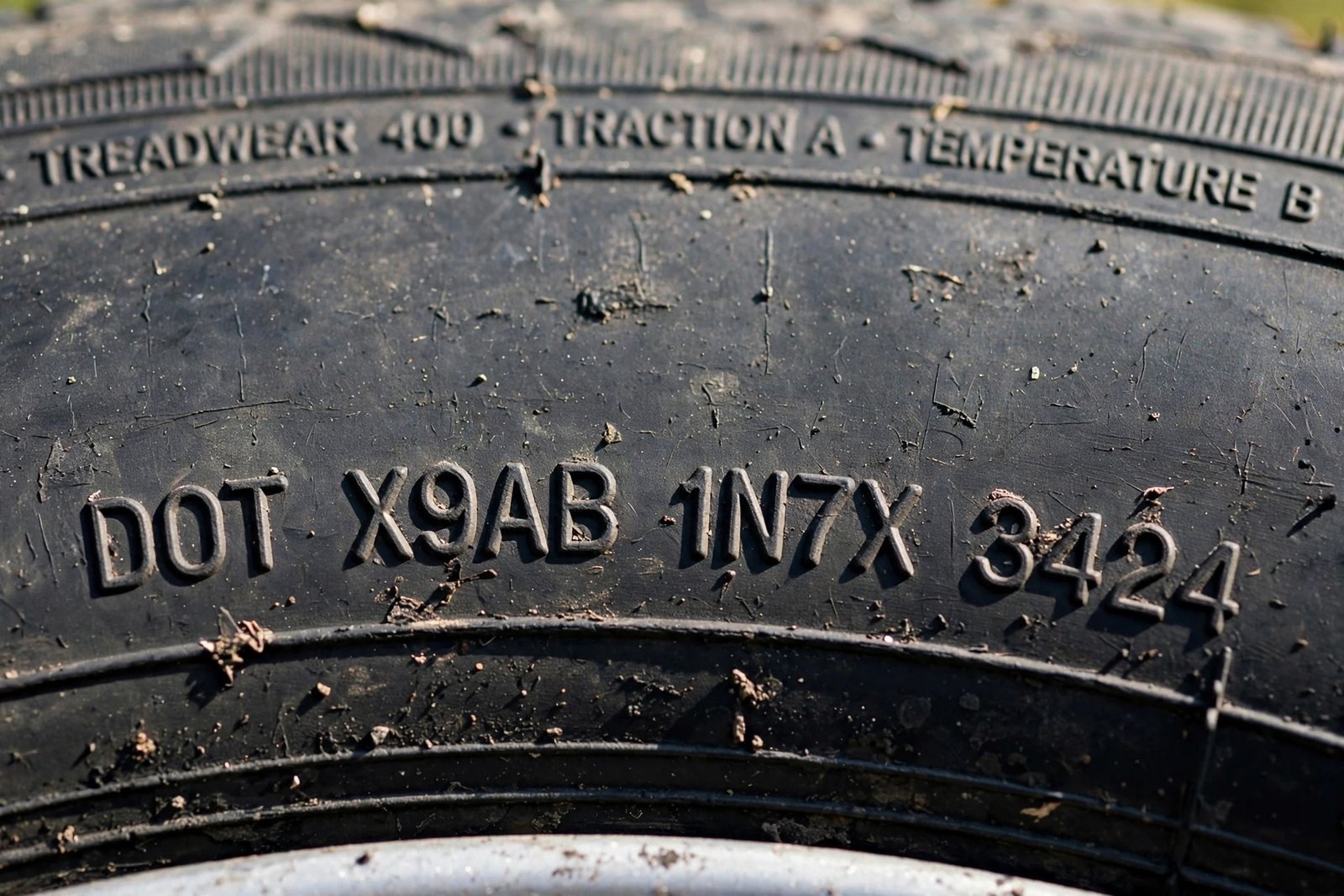
Every tire sold for road use in the US carries a DOT code — the Tire Identification Number — molded into the sidewall. It looks like a long string of letters and numbers after the letters “DOT.” You only need the last four digits.
The format is WWYY:
- The first two digits are the week of the year (01 to 52).
- The last two digits are the year.
Worked examples:
- 3219 — made in the 32nd week of 2019 (early August 2019). In November 2026, that tire is about 7 years old.
- 2419 — made in the 24th week of 2019 (mid-June 2019). About 7 years old in late 2026.
- 0219 — made in the 2nd week of 2019 (early January 2019). Nearly 8 years old in late 2026.
- 4023 — made in the 40th week of 2023 (early October 2023). About 3 years old in late 2026.
Where to find it: look on the sidewall near the bead, where the tire meets the wheel. The full DOT code is stamped on only one side of the tire, so if you cannot find it on the outer sidewall, check the inner sidewall — you may need to turn the steering wheel to full lock to see it, or crouch down with a flashlight.
One warning: if the code ends in only three digits, the tire was made before 2000 — at least 26 years old — and Bridgestone says it should be replaced due to age. Do not drive on it.
The 6-year line vs the 10-year line
This is where the advice gets confusing, because there are two different numbers from two different groups of manufacturers — and they are both right, just measuring different things.
The 6-year line comes from the car makers. Several vehicle manufacturers put a tire age limit in their owner’s manuals. Ford (2025 F-150), Mazda (CX-5, CX-9, CX-30, Mazda3, MX-5), GMC (2025 Sierra), and Tesla (Model 3, Model Y) say to replace tires at about 6 years. Toyota and Lexus say a tire over 6 years old must be checked by a qualified technician. Audi says tires over six years old should only be used when absolutely necessary. The German motoring organization ADAC recommends replacing tires after 6 years as a precaution. The car makers are conservative because they are responsible for the whole vehicle, and they would rather you replace a tire early than drive on one that is starting to degrade.
The 10-year line comes from the tire makers. Michelin says to replace tires in service 10 years or more from the date of manufacture, including spares, even if they appear serviceable. Bridgestone says to remove its tires from service after 10 years regardless of tread depth. Continental and Michelin both treat 10 years as the absolute maximum. The tire makers know their own rubber best, and 10 years is where they draw the line no matter how good the tire looks.
NHTSA sits in the middle. The US National Highway Traffic Safety Administration says some vehicle and tire manufacturers recommend replacing tires that are six to 10 years old, regardless of treadwear. That range — 6 to 10 — is the honest summary of the whole industry.
Here is how to use the two numbers in practice:
| Tire age | What to do |
|---|---|
| 0–5 years | Normal use. Check pressure monthly, rotate regularly, and inspect the tread and sidewalls when you do. |
| 5–6 years | Start annual professional inspections. Bridgestone recommends inspection from 5 years, and if a tire older than 6 shows signs of aging, ask a tire expert. |
| 6 years | The car makers’ line. Check your owner’s manual — Ford, Mazda, GMC, and Tesla say replace at about this age; Toyota and Lexus say have it checked by a qualified technician. |
| 6–9 years | Caution zone. Inspect frequently, watch for cracking, and avoid sustained high-speed driving and heavy loads on old tires. In a hot climate, consider replacing sooner. |
| 10 years or more | Replace immediately, whatever the tread looks like. This includes the spare. |
The simple version: 6 years is where you start paying close attention, and 10 years is where the debate ends.
Why rubber ages even when a tire looks fine
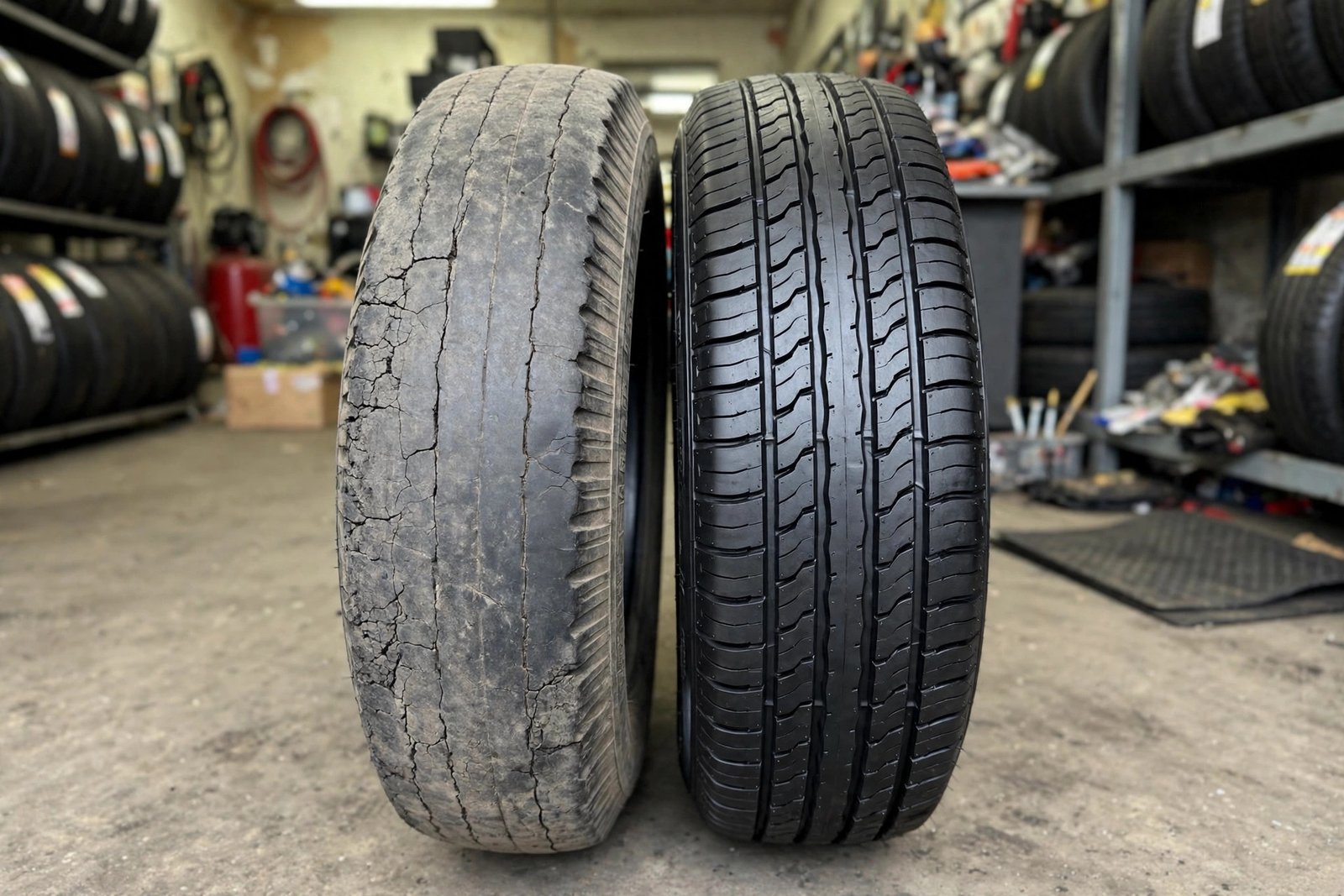
The dangerous thing about tire aging is that it happens from the inside out — the outside can look perfectly normal while the rubber inside is losing the flexibility that keeps it in one piece at highway speed.
Three things drive the aging:
Heat. Rubber ages faster when it is hot. A tire that lives in Arizona or Texas ages faster than the same tire in a cool climate, and a tire that runs underinflated flexes more and generates more heat inside itself. Some guides suggest that in areas consistently above 80°F (27°C), the safe lifespan drops to about 4 to 6 years.
Sunlight and ozone. Ultraviolet light breaks down the rubber compound, and ozone in the air attacks it too. That is why tires parked outdoors in the sun crack faster than tires kept in a garage, and why tires stored near electric motors — which generate ozone — age faster.
Time itself. Even in perfect storage, the rubber compound changes. The oils and waxes that keep rubber supple slowly migrate and evaporate, and the rubber hardens. This is the part no amount of careful storage can stop.
The result is a tire that looks fine and fails suddenly. The tread can separate from the casing, or the sidewall can let go, and it tends to happen at highway speed, where the consequences are worst. That is the whole reason the 10-year rule exists: it is not about the tread wearing out, it is about the rubber giving up.
Signs of age: cracking and dry rot
Age does leave visible clues, especially once tires pass 5 years old:
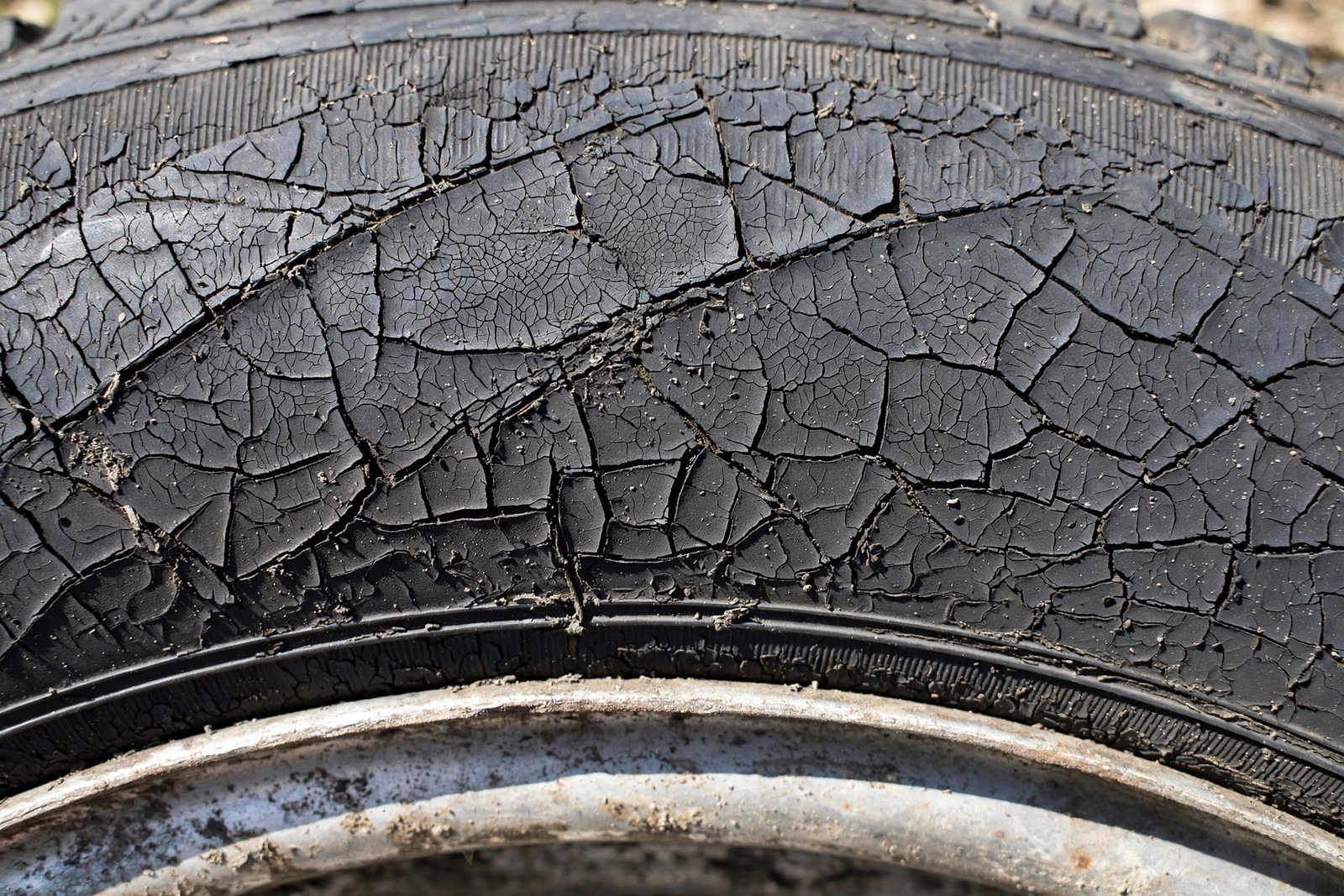
- Fine cracks in the sidewall. Look for a network of small cracks in the rubber, like a spiderweb, often near the rim or around the raised lettering. This is called weather checking or dry rot. Shallow hairline cracks are usually cosmetic at first, but they are a sign the rubber is drying out — and they only get deeper.
- Cracks between the tread blocks. Look down into the grooves between the tread blocks. Cracks there mean the rubber is hardening where it matters most for grip.
- A hard, shiny, or brittle feel. Fresh rubber is slightly soft and flexible; old rubber feels hard and slick and does not give when you press it.
- Bulges or flat spots. A bulge on the sidewall means the internal cords have broken, and the tire can fail without warning. That tire is finished, whatever its age.
- Uneven wear that came out of nowhere. Aging rubber wears differently, and a tire that has started to harden will often wear unevenly even with correct pressure and alignment.
If you see any of these on a tire over 6 years old, have it inspected by a tire professional before your next long drive — and if a crack shows fabric or cord inside it, or the sidewall bulges, replace the tire now. For a full guide to telling a harmless hairline crack from a dangerous one, see our sidewall crack guide.
Buying “new” tires that are already old
Here is a trap most drivers never think about: the tire you buy “new” may already be years old.
Age is counted from the date of manufacture, not the date of sale. A tire can sit in a warehouse or on a shop shelf for two or three years before it is ever fitted to a car, and the clock has been running the whole time. Buy a tire made in 2023 in late 2026 and you have already used up three years of its life before your first mile.
Before you pay for new tires, check the DOT date code on every tire while it is still on the shelf or the rack:
- Less than a year old is ideal.
- One to two years old is normal and fine — most tires reach shops within that window.
- Three years or older is worth questioning. Ask for a fresher tire, or a discount that reflects the lost years.
- Five years or older and still unsold — walk away. That tire is already at the age where inspections begin.
The same check applies to used tires, only more so. A used tire with deep tread and a 2018 date code is not a bargain — it is a tire in its final years. Treat 6 years as a reason to inspect and negotiate hard, and 10 years as a hard no, whatever the tread depth.
And remember that all four tires on your car may not be the same age — tires get replaced one or two at a time, so check each one separately and write the dates down.
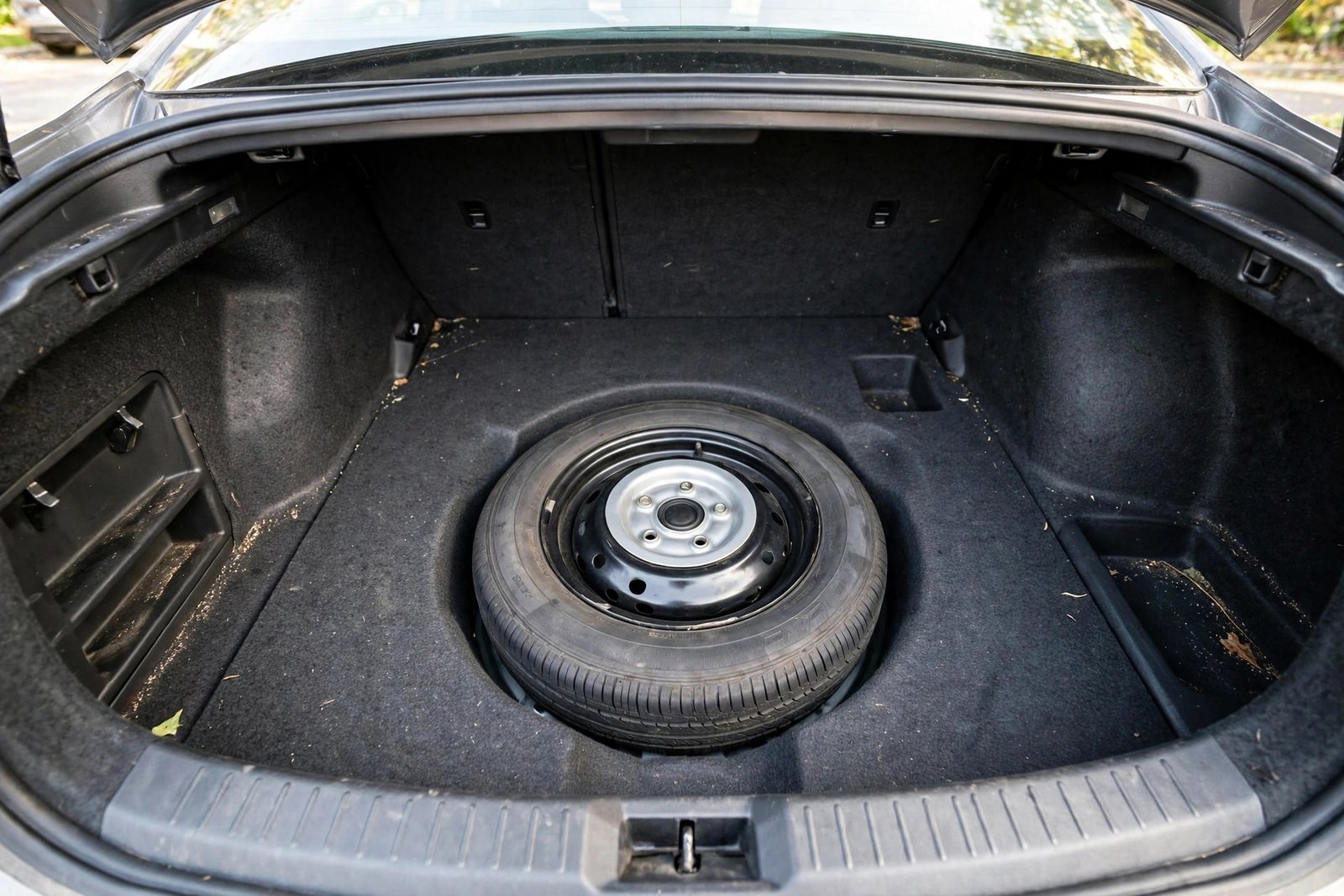
Do not forget the spare
The spare is the tire most likely to be too old, and the one most likely to be forgotten.
A full-size or space-saver spare can sit under the trunk floor or under the car for years without ever being used. It has full tread and looks brand new — but its rubber has been aging the entire time, often faster, because it sits in a hot trunk or exposed under the car, and a tire that never flexes does not release the protective compounds in its rubber to the surface.
Michelin’s 10-year replacement rule explicitly includes spares, and Bridgestone’s 10-year removal rule applies to them too. Read the DOT code on your spare today:
- Under 6 years old: fine, but check it when you check the other four.
- 6 to 10 years old: have it inspected, and do not rely on it for a long trip without checking it first.
- 10 years or older: replace it. A spare that fails when you need it is worse than no spare at all, because you counted on it.
While you are there, check the spare’s pressure too. A spare that has been sitting for years is often badly underinflated, and a space-saver spare is only meant for temporary use — typically no more than 50 miles at 50 mph — so drive straight to a tire shop after fitting it.
How to check all five tires in ten minutes
Here is the whole job:
- Find the DOT code on each tire — all four on the car, plus the spare. Remember it may only be on the inner sidewall.
- Write down the last four digits of each code and work out the age. 3219 is the 32nd week of 2019; 4023 is the 40th week of 2023.
- Sort them by the table above. Anything 10 or older goes on the replace list. Anything 6 to 9 goes on the inspect list.
- Look at each tire for cracking, dry rot, bulges, and uneven wear, especially the older ones.
- Check the pressure against the driver’s door-jamb placard, when the tires are cold.
- Check your owner’s manual for your car maker’s own age recommendation — it may be stricter than 10 years.
That is it. Ten minutes, once a year, and you will never be surprised by a tire that was older than you thought.

The bottom line
Tires do not last forever, and tread depth is not the test that matters. From 5 to 6 years, get your tires inspected every year. At 6 years, follow your car maker’s manual — several makers say replace. At 10 years, replace them, whatever they look like, including the spare. The DOT code on the sidewall tells you everything you need to know, and it takes ten minutes to read all five tires. A new set of tires costs a few hundred dollars. A blowout at highway speed costs far more.
Frequently asked questions
Do tires expire?
Tires do not have a printed expiration date, but they do have a service life. The US National Highway Traffic Safety Administration says some vehicle and tire manufacturers recommend replacing tires that are six to 10 years old, regardless of treadwear. The tire makers draw the hard line at 10 years: Michelin says to replace tires in service 10 years or more from the date of manufacture, including spares, even if they still look serviceable, and Bridgestone says to remove its tires from service after 10 years regardless of tread depth.
How do I read the DOT date code on my tires?
Find the letters DOT on the tire sidewall, near where the tire meets the wheel. The last four digits of the code that follows are the date code, in WWYY format: the first two digits are the week of the year and the last two are the year. A code ending in 3219 means the tire was made in the 32nd week of 2019. If the code ends in only three digits, the tire was made before 2000 and should be replaced. Note that the full DOT code is stamped on only one side of the tire, so if you cannot see it, check the inner sidewall.
Can I drive on 8-year-old tires?
You can, but only with your eyes open. At 8 years old a tire is past the 6-year line many car makers use and is in the final stretch before the 10-year limit tire makers set. Have it inspected by a tire professional, check it for cracking and dry rot, and avoid sustained high-speed driving and heavy loads on it. If it shows any cracking, bulging, or uneven wear, replace it now rather than waiting for 10 years. In a hot climate, consider replacing it sooner.
Is my spare tire too old?
Quite possibly — and that is exactly the trap. A spare can sit unused for years, so it often has full tread and looks brand new, but its rubber has been aging the whole time. Michelin’s 10-year replacement rule explicitly includes spares, and Bridgestone’s 10-year removal rule applies to them too. Read the DOT date code on your spare today: if it is 10 years old or more, replace it. If it is between 6 and 10 years old, have it checked before you rely on it for a long trip.
Does storing tires stop them from aging?
No. Storage slows aging but does not stop it. Rubber degrades with time even when a tire is never used — heat, sunlight, and ozone in the air break down the rubber compound, and the protective waxes and oils in the rubber are only released to the surface when the tire flexes in use, so a tire that sits still can actually crack faster than one that is driven. A cool, dark, dry place away from electric motors and sunlight is the best storage, but a 10-year-old tire is still a 10-year-old tire, stored or not.
Is there a legal age limit for tires in the US?
No. There is no single federal age limit for tires in the United States. The limits that matter are the manufacturers’ recommendations: vehicle makers generally say replace at about 6 years, and tire makers say 10 years at the absolute maximum, regardless of tread depth. Check your own owner’s manual, because some car makers are stricter than others, and have any tire over 6 years old inspected by a tire professional.
Related reads
- Tire Sidewall Crack: Is It Safe to Drive?
- When to Change Tires: 7 Warning Signs
- Why Do Tires Wear Unevenly? Causes & Fixes
- Compare Cars tool — compare any two cars side by side
