
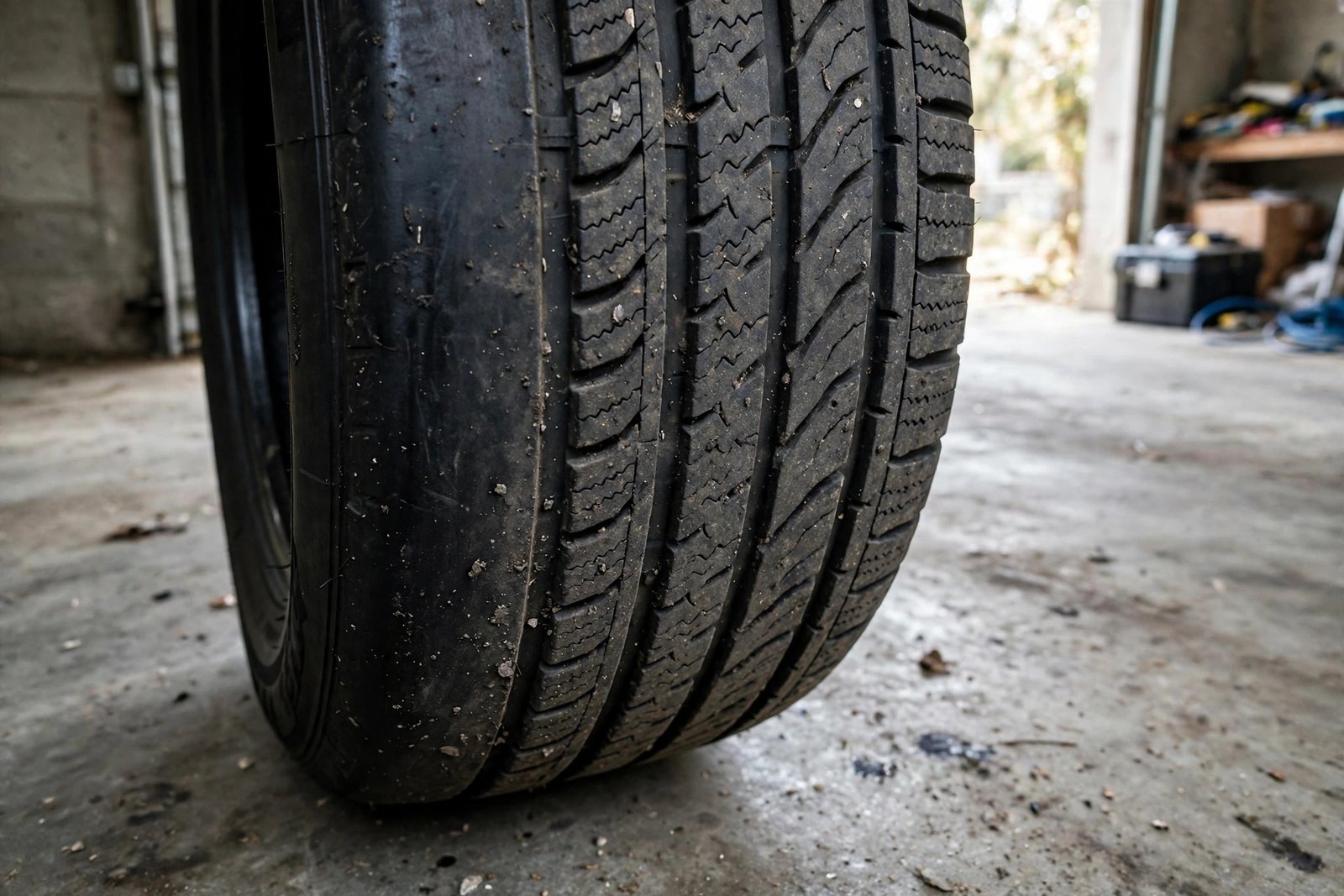
Quick answer: Tires wear unevenly because something is stopping the tread from meeting the road flat and evenly. The usual culprits are wrong tire pressure, bad wheel alignment, unbalanced wheels, worn suspension parts, skipped rotations, and aggressive driving. The good news is that the wear pattern itself tells you the cause: center wear means overinflation, edge wear means underinflation, one-sided wear means alignment, feathering means toe misalignment, and cupping means worn shocks or an out-of-balance wheel. Fix the cause first — then rotate or replace the tire, or the new one will wear exactly the same way.
Even wear is normal — uneven wear is a message
Every tire wears down. That is normal. A tire that is doing its job wears evenly across the whole tread, a little at a time, over tens of thousands of miles. The tread gets shallower, but it gets shallower everywhere at roughly the same rate.
Uneven wear is different. It means one part of the tread is working much harder than the rest. The center wears while the edges stay deep. One edge goes bald while the other looks new. Dips and scallops appear around the tire like waves. Each of these patterns is your car telling you something is wrong — and each pattern points to a different problem.
Ignoring uneven wear is expensive in two ways. First, the tire wears out far earlier than it should, so you buy replacements sooner. Second, the underlying problem is usually also hurting your fuel economy, your handling, and your safety. An underinflated tire does not just wear badly — it also runs hotter and is more likely to fail. A misaligned car does not just eat tires — it pulls, wanders, and stops less predictably. Learning to read your tread is one of the cheapest and most useful skills a driver can have.
How to read your tires: the wear-pattern chart
Before you look at the causes, learn the patterns. Run your hand across the tread — some patterns, like feathering, are easier to feel than to see — and compare what you find with this chart.
| Wear pattern | What it looks like | Most likely cause | What fixes it |
|---|---|---|---|
| Center wear | Middle of the tread worn down, shoulders still deep | Overinflation | Set pressure to the door-jamb placard figure |
| Edge (shoulder) wear | Both outer edges worn, center still deep | Underinflation (or overloading) | Inflate to placard pressure; check for leaks |
| One-sided wear | Inner edge or outer edge worn faster than the rest | Camber misalignment | Wheel alignment |
| Feathering | Tread blocks smooth in one direction, sharp in the other | Toe misalignment | Wheel alignment |
| Cupping / scalloping | Wavy, dish-shaped dips around the tread | Worn shocks or struts, or out-of-balance wheel | Suspension inspection, wheel balancing |
| Diagonal or patchy wear | Scuffed patches with no clear symmetry | Skipped rotations, out-of-balance wheel | Rotate tires, rebalance wheels |
| Flat spots | One bald patch on the tread | Hard braking, skidding, or a car parked for months | Replace the tire if severe; check brakes |
Take a photo of each tire when you spot a pattern. It helps the mechanic, and it lets you check later whether the fix actually worked.
Cause 1: Wrong tire pressure — the cheapest cause and the easiest to miss
Tire pressure is the most common cause of uneven wear, and also the easiest to fix. A tire wears evenly only when it meets the road flat. Change the pressure and the shape of the contact patch changes with it.
Overinflation — center wear. When a tire has too much air, the center of the tread bulges outward slightly and takes most of the car’s weight. The center wears faster while the shoulders stay relatively fresh. A common mistake is inflating to the pressure printed on the tire sidewall — that number is the tire’s maximum pressure, not the pressure your car needs. The correct figure is on the driver’s door-jamb placard or in your owner’s manual.

Underinflation — edge wear. When a tire has too little air, the sidewalls sag and the shoulders of the tread carry the load instead of the center. Both outer edges wear faster, and the tire also runs hotter, uses more fuel, and handles worse. A tire can look fine while being underinflated by as much as 20 percent, so do not trust your eyes — use a gauge. Tires lose about 1 PSI per month naturally, and pressure drops further in cold weather, so check at least once a month on cold tires, before you drive.

If only one tire keeps losing pressure while the others hold steady, it may have a slow leak, a damaged valve stem, or a bead problem. Get it checked rather than just topping it up every week.
Cause 2: Wheel alignment — when the tire does not point straight
Wheel alignment sets the angles at which each tire meets the road — camber (the tilt in or out at the top), toe (whether the tires point slightly inward or outward), and caster (the steering angle). When any of these is out of specification, the tire drags or scrubs instead of rolling cleanly, and one part of the tread does far more work than the rest.
One-sided wear — camber. If the inner edge of a tire is wearing faster, the top of the wheel is likely tilted inward (negative camber). If the outer edge is wearing faster, it is tilted outward (positive camber). Either way, the tire is not sitting flat on the road. Hitting a pothole or curb can knock alignment out, and worn suspension parts can let it drift out gradually.
Feathering — toe. Feathering is the pattern most drivers miss, because it is easier to feel than to see. Run your hand across the tread from the inside to the outside, then back again. If the tread blocks feel smooth in one direction and sharp or saw-toothed in the other, that is feathering, and it usually means the toe setting is off — the tire is being dragged slightly sideways as it rolls. A proper wheel alignment corrects it, but the feathered tire itself will not smooth out again; it will just stop getting worse.
Alignment is not a do-it-yourself job. It needs a professional alignment machine, and it should be checked at least once a year, after any hard pothole or curb hit, and whenever you replace suspension parts. Our guide to tire balancing vs alignment explains the difference between the two services — they fix different problems, and confusing them is one of the most common mistakes drivers make.

Cause 3: Worn suspension — shocks, struts, and steering parts
Shocks and struts do more than smooth the ride. They keep each tire pressed against the road at a consistent pressure. When they wear out, the tire starts to bounce — lifting off the road slightly and slamming back down with every rotation. That bouncing gouges out the tread in a wavy pattern called cupping or scalloping: a series of dips around the circumference of the tire, often with a humming or buzzing noise at highway speed.
Other suspension and steering parts cause uneven wear too. Worn ball joints, tie rod ends, control arm bushings, and wheel bearings all let the wheel shift slightly out of position under load. The tire then meets the road at a changing angle, and the tread wears in patches or on one edge. These parts wear gradually, so the driver often does not notice anything is wrong until the tire shows it.
Cupping is the pattern that most clearly says “see a mechanic.” Pressure and alignment will not fix it. The worn parts need to be found and replaced, and the wheels rebalanced. If cupping is left alone, it gets worse as the parts wear further, and the tire becomes noisy, uncomfortable, and eventually unsafe.

Cause 4: Unbalanced wheels
A wheel-and-tire assembly is balanced when its weight is evenly distributed around the axle. When it is not — because a wheel weight fell off, the tire was mounted unevenly, or the rim is slightly bent — the assembly hops or wobbles as it spins. At highway speed you usually feel it first as a vibration through the steering wheel or the seat.
That vibration is also uneven wear in the making. The tire presses harder against the road at some points in each rotation and lighter at others, which produces diagonal or patchy wear, and in some cases contributes to cupping. Balancing is quick and inexpensive, and it should be done whenever a tire is mounted, whenever a vibration appears, and whenever a wheel weight goes missing.
Cause 5: Skipped tire rotations
Front tires and rear tires do different jobs. The front tires steer and, on most cars, also drive the car — so they wear faster and differently than the rears. Tire rotation moves each tire to a different position so the wear evens out over the tire’s life. Skip rotations and the wear differences between positions become permanent patterns: diagonal wear, patchy wear, and one axle’s tires going bald while the other’s look fine.
Most manufacturers recommend rotating roughly every 6,000 miles (about 10,000 km), or at every oil change — check your owner’s manual for your car. Rotation will not reverse wear that has already happened, but it will stop a developing pattern from getting worse, and it will extend the life of the set. If you are unsure of the pattern your car needs, our guide to tire rotation covers the common patterns for front-wheel, rear-wheel, and all-wheel drive.
Cause 6: Driving habits — the wear you cause yourself
How you drive shows up in your tread. Hard acceleration spins the drive tires and scrubs rubber off the tread. Hard braking, especially a panic stop that locks a wheel, can grind a flat spot into the tire. Fast cornering loads the outside shoulder of the tire and wears the edges. Repeated curb strikes can bruise the tire’s internal structure and knock the alignment out at the same time.
None of this means you have to drive slowly. It means smooth driving — gentle acceleration, early braking, moderate cornering speeds — is the cheapest way to make a set of tires last. It also means that if one tire shows unusual wear and the others do not, driving style is rarely the explanation: a problem that affects one tire is almost always mechanical.
Cause 7: Wrong size, overloading, and age
A tire that is the wrong size for the car, or a car that is regularly overloaded, can also wear unevenly. Overloading presses the shoulders of the tire into the road in the same way underinflation does, and it generates extra heat. Check the load rating and the maximum load on the door-jamb placard, and do not exceed it — towing and heavy cargo count.
Age matters too. Rubber dries out and cracks over time, even if the tread is still deep. Cracked rubber, sidewall bulges, and chunking from gravel roads are all reasons to replace a tire regardless of the tread pattern. A tire that is more than six years old deserves a close inspection, even if it has rarely been used — a spare tire is a good example.
How to fix uneven tire wear: fix the cause, then the tire
The order matters. Fixing the tire without fixing the cause just gives you a new tire that will wear the same way.
- Read the pattern. Use the chart above to identify what you are looking at.
- Check pressure first. It costs nothing. Inflate or deflate to the door-jamb figure and check again in a week.
- Get an alignment if one edge is worn or the tread is feathered, or if the car pulls to one side.
- Balance the wheels if you feel vibration or see patchy or cupped wear.
- Inspect the suspension if there is cupping, noise, or bouncing — shocks, struts, ball joints, and tie rods.
- Rotate the tires once the cause is fixed, so the remaining tread wears evenly.
- Replace the tire if the worn area is at or below the legal limit, cords are showing, or the damage is severe.
If the tread depth is still adequate and you caught the wear early, correcting the cause will stop it getting worse and you can get reasonable life out of the remaining tread. Once wear has reached the tread wear indicator bars, or the pattern is deep cupping or heavy feathering, replacement is usually the safer call — the alignment then protects the new tires, not the old ones.
How to check your tread and know when to replace
The legal minimum tread depth in the US is 2/32 of an inch. At that depth, the tread wear indicator bars — small raised bars in the grooves — sit flush with the tread surface. If the bars are level with the surrounding tread, the tire is done. For a quick check at home, use the penny test described in our guide to how to check tire tread depth: insert a penny into the groove with Lincoln’s head down, and if you can see the top of his head, the tread is at or below 2/32 of an inch.
Replace a tire immediately if you see any of these:
- Tread at or below 2/32 of an inch in the worn area
- Cords or fabric showing through the rubber
- A bulge, bubble, or deep cut in the sidewall
- Cracks across the tread or sidewall
- A flat spot so severe the car vibrates or thumps
And remember: fix the cause first. A new tire on a misaligned car or a car with worn shocks will wear unevenly just as fast as the old one did.

Prevention checklist: keep your tires wearing evenly
- Check tire pressure monthly, on cold tires, with a gauge — not by eye
- Rotate tires roughly every 6,000 miles, or as your owner’s manual says
- Get a wheel alignment once a year, and after any hard pothole or curb hit
- Balance wheels whenever tires are mounted and whenever vibration appears
- Have suspension inspected when you notice cupping, noise, bouncing, or uneven wear
- Drive smoothly — gentle acceleration, early braking, moderate cornering
- Avoid potholes and curbs where possible; they knock alignment out and damage tires
- Inspect your tread every month — look at all four tires, and run a hand across the tread to feel for feathering
- Do not overload the car, and respect the load rating on the placard
Most uneven wear is preventable. The drivers who get the longest life from their tires are not lucky — they are the ones who check pressure, rotate on schedule, and fix small problems before the tread shows them.
Frequently asked questions
What causes tires to wear unevenly?
The most common causes are wrong tire pressure, wheel alignment out of specification, wheels out of balance, worn suspension parts such as shocks and struts, skipped tire rotations, and aggressive driving. The wear pattern on the tread usually tells you which cause is responsible.
Can uneven tire wear be fixed?
The cause can be fixed, but wear that has already happened cannot be reversed. Correct the tire pressure, get a wheel alignment, balance the wheels, or replace worn suspension parts, then rotate the tires so the remaining tread wears evenly. If the tread is already worn to the wear bars or cords are showing, the tire must be replaced.
What does wear in the center of the tire mean?
Wear in the center of the tread, with the shoulders still deep, almost always means overinflation. Too much air makes the center of the tread bulge outward, so it carries most of the car’s weight and wears faster. Check the pressure on the driver’s door-jamb placard and let air out to the correct figure.
What does wear on both edges of the tire mean?
Wear on both outer edges, with the center still deep, almost always means underinflation. Too little air lets the tire sag so the shoulders carry the load. Inflate the tires to the pressure on the door-jamb placard and check pressure at least once a month, on cold tires.
What causes cupping on tires?
Cupping, or scalloping, is a wavy pattern of dips around the tread. It is most often caused by worn shock absorbers or struts that let the tire bounce instead of staying planted on the road, or by a wheel that is out of balance. A suspension inspection and wheel balancing are the usual fixes.
When should a tire with uneven wear be replaced?
Replace the tire when the tread in the worn area reaches 2/32 of an inch, which is when the tread wear indicator bars sit flush with the tread, or sooner if cords are visible, the sidewall is damaged, or the tire is cracked. Fix the cause first, or the new tire will wear the same way.
Sources and further reading
- Monroe Shocks & Struts — “Uneven Tire Tread Wear” — https://www.monroe.com/technical-resources/shocks-101/why-do-tires-wear-unevenly.html
- Les Schwab — “How to Read Tire Wear Patterns” — https://www.lesschwab.com/article/tires/how-to-read-tire-wear-patterns.html
- AutoTrader.ca — “Uneven Tire Wear: Common Causes, Warning Signs” — https://www.autotrader.ca/editorial/owner-tips/uneven-tire-wear-common-causes-warning-signs-and-how-to-fix-it/
- Related on Smart Tire Guide: Tire Balancing vs Alignment, How to Check Tire Tread Depth, Low Profile Tires Pros and Cons, Best Budget Tires