
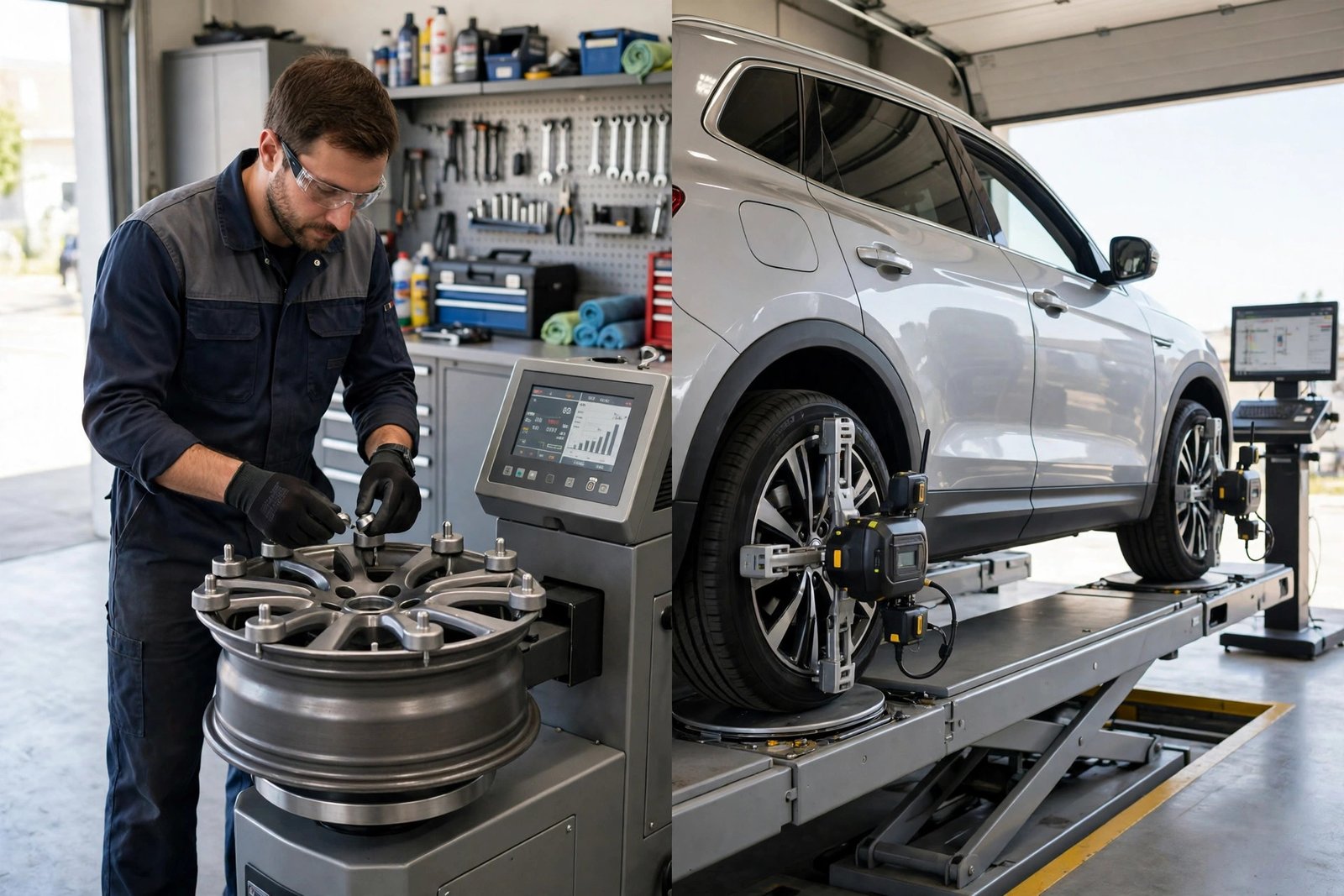
Quick answer: Tire balancing is about weight, wheel alignment is about angles. Balancing stops vibration by evening out each tire and wheel assembly’s weight. Alignment stops pulling and uneven wear by resetting your suspension angles — camber, toe, and caster — to the manufacturer’s specifications. One cannot substitute for the other.
If you have ever stood at a tire shop while an advisor recommended "a balance and alignment," you have probably wondered whether you needed both — or whether one was an upsell. This guide settles it: what each service does, how to tell which one you need, what each costs in 2026, and when you need both.
Tire Balancing vs Alignment at a Glance
| Feature | Tire Balancing | Wheel Alignment |
|---|---|---|
| What it fixes | Uneven weight distribution in the tire and wheel assembly | Suspension angles out of spec (camber, toe, caster) |
| Main symptom | Vibration at a specific speed, usually 50–70 mph | Car pulls to one side; steering wheel sits crooked |
| Second symptom | Cupped (scalloped) tread wear; vibration in the seat or floor | Smooth wear on one tire edge; feathered tread |
| What the technician does | Spins the wheel on a balancing machine and adds small metal weights to the rim | Puts the car on an alignment rack and adjusts tie rods, control arms, and struts |
| Typical cost (2026, US) | $15–$25 per tire; $60–$100 for all four | $90–$150 for a four-wheel alignment; $60–$90 for a two-wheel alignment |
| How often | Every 5,000–8,000 miles, with rotation; always with new tires | Check every 6–12 months or 6,000–10,000 miles; after any hard impact |
| Time needed | About 15–30 minutes per tire; roughly 1 hour for all four | About 45–60 minutes on the rack |
| What it protects | Your comfort and your suspension parts | Your tire life and your wallet |
The one-line version to remember: balancing protects your comfort (a smooth ride), while alignment protects your wallet (your tires lasting as long as they should).
What Is Tire Balancing?
No tire and wheel combination is perfectly balanced from the factory — the rubber can be thicker on one side, the belts can overlap, or the rim can be denser in one spot. Invisible at low speeds, those differences matter a lot at highway speed.
Tire balancing equalizes the weight of the tire and wheel assembly so it spins smoothly at high speeds. Think of a washing machine with a heavy blanket thrown to one side: during the spin cycle it bangs and shakes. That is what happens to your car when a tire is out of balance.
How balancing is done
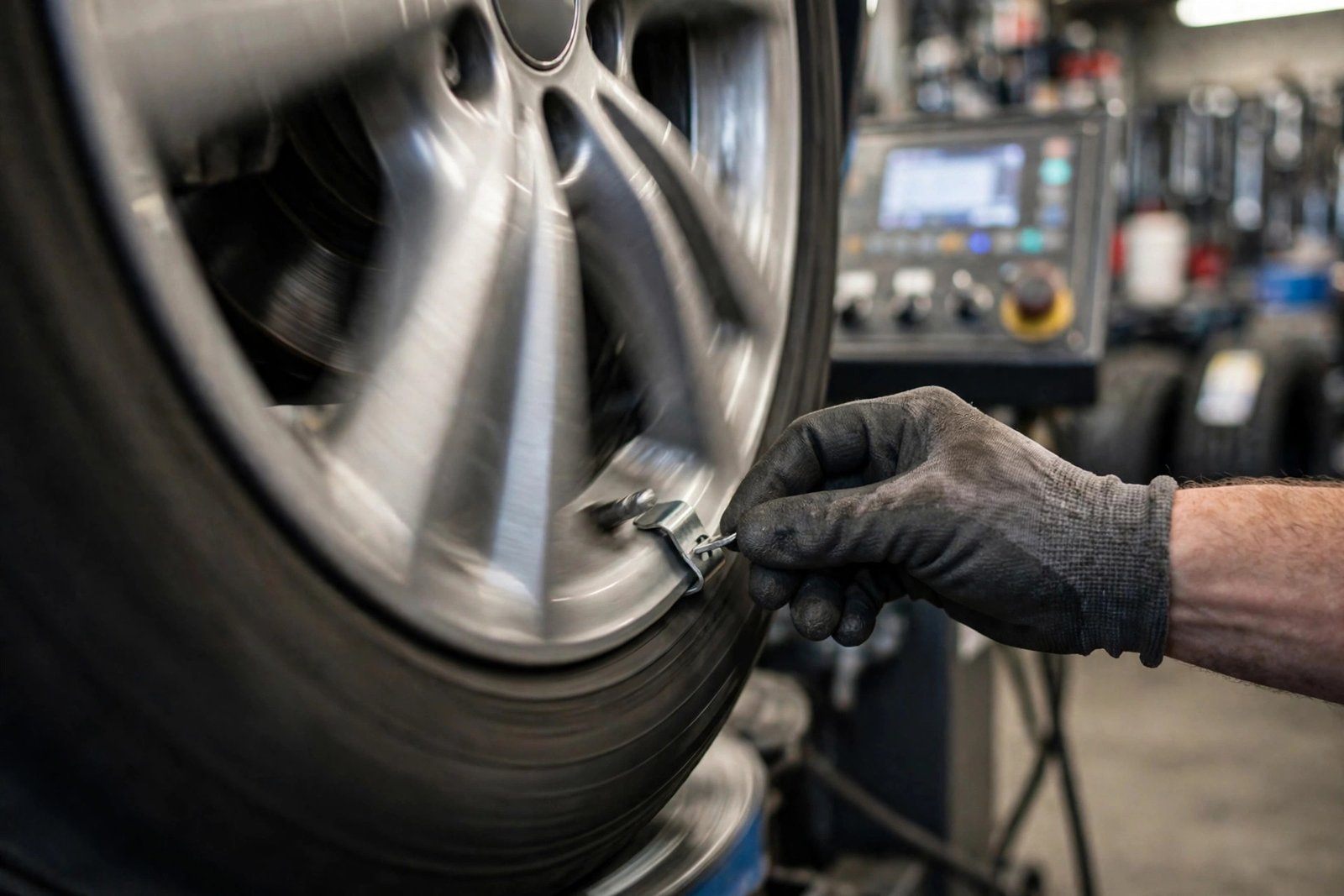
A technician mounts the wheel on a dynamic balancing machine, which spins it and uses sensors to find the heavy spots. Small metal weights are then attached to the rim opposite the heavy spot to cancel it out — clip-on weights on the rim lip, or adhesive stick-on weights inside the barrel on modern alloy wheels. The amounts are tiny, often just a couple of ounces, but the difference is immediate. Tires also fall out of balance over time from potholes, curbs, normal wear, or a lost wheel weight.
Symptoms of unbalanced tires
The dead giveaway is speed-specific vibration — a shake starting around 50 to 55 mph, peaking around 60 to 70 mph, and sometimes smoothing out if you go faster. That on-again, off-again pattern is the classic signature of a balance problem.
Where you feel it tells you which tires are at fault:
- Steering wheel shake: the imbalance is in a front tire — the vibration travels straight up the steering column to your hands.
- Seat or floor vibration: the imbalance is in a rear tire — the vibration travels through the chassis and body.
Other signs include cupped (scalloped) tire wear — high and low spots around the tread from the bouncing tire — and a clean patch on a dirty rim where a weight used to sit. Ignore it and the constant vibration stresses wheel bearings, suspension, and steering parts that cost far more to replace than a balance.
Road force balancing: the upgraded version
Standard balancing spins the wheel in the air, which misses one thing: the road. A tire can be balanced in weight yet still have a stiff spot in the sidewall. A road force balancer presses a roller against the tire with up to 1,200 lbs of force while it spins, measuring stiffness and roundness under load. It is worth the extra cost for low-profile tires, large wheels (19-inch or bigger), or a vibration standard balancing has not fixed. It typically costs $25 to $40 per tire, according to The Tire Reviews.
What Is Wheel Alignment?
Most drivers get this wrong: wheel alignment has almost nothing to do with your tires or wheels themselves. It is about your suspension and steering systems. It adjusts the angles at which your tires sit and point. Potholes, curbs, minor collisions, and normal wear on suspension bushings can knock those angles out of spec.
On an alignment rack, sensors on each wheel let a computer measure the angles against your vehicle’s factory specifications, and the technician adjusts the tie rods, control arms, and struts until the readings fall back within range.
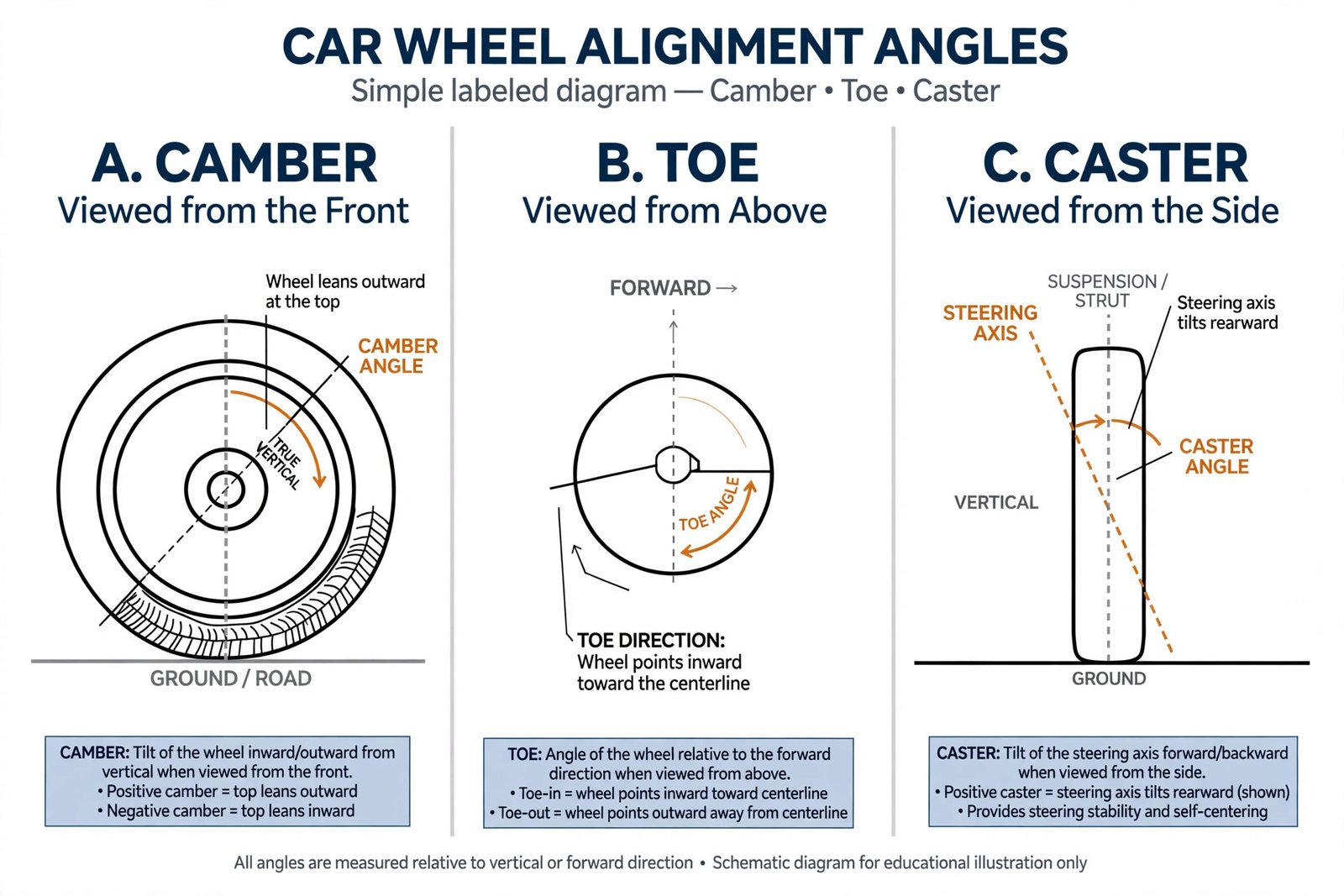
The three alignment angles: camber, toe, and caster
1. Camber — the lean. The inward or outward tilt of the tire viewed from the front. Top leaning out is positive camber; top leaning in is negative. A little negative camber is normal and helps cornering, but too much tilt wears one edge of the tread smooth.
2. Toe — the direction. Look down at your feet: toes in is toe-in, toes out is toe-out. Toe is the number-one killer of tires — even a small error (The Tire Reviews notes just 1/8th of an inch can matter) makes your tires drag sideways, causing rapid, feathered wear.
3. Caster — the stability. The angle of your steering axis viewed from the side. Most modern cars run positive caster, tilted back toward the driver. It gives straight-line stability and returns the steering wheel to center after a turn. If caster is off, your car wanders on the highway or the steering feels light and twitchy.
| Angle | What it measures | What goes wrong when it is off |
|---|---|---|
| Camber | Tilt of the wheel viewed from the front | Smooth, excessive wear on one edge (inner or outer shoulder) |
| Toe | Direction the tires point viewed from above | Rapid feathered wear; tires scrub sideways — the biggest tire-life killer |
| Caster | Tilt of the steering axis viewed from the side | Wandering on the highway; steering wheel does not return to center |
Symptoms of bad alignment
The clearest symptom is a vehicle that pulls consistently to one side. On a flat, straight road, if you briefly let go of the wheel and the car drifts left or right, that is alignment — not balance. (Test on a flat stretch, and never take your hands off the wheel for more than a second or two.)
Other signs of bad alignment:
- Crooked steering wheel: you are driving straight, but the logo on your steering wheel sits rotated to one side.
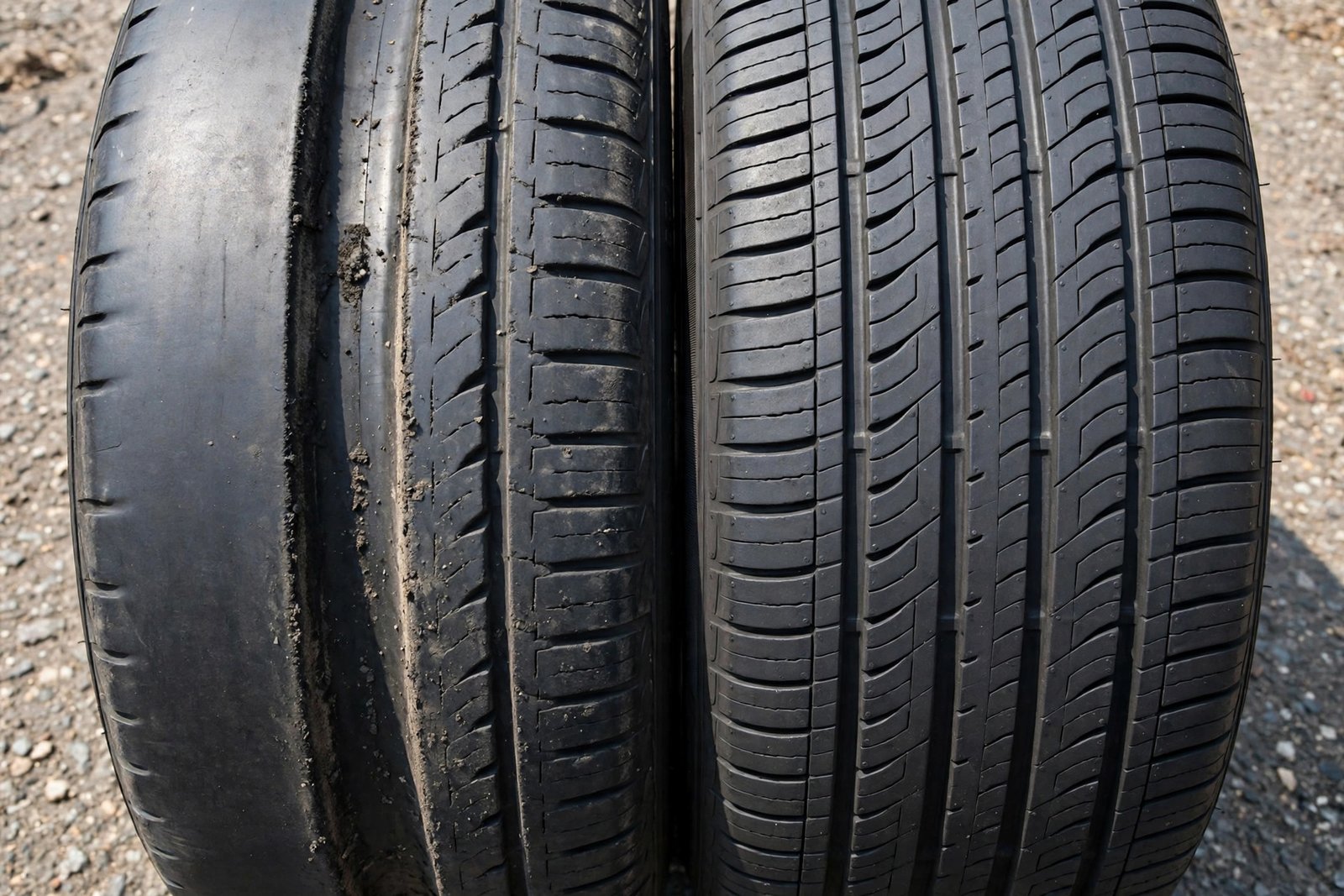
- Uneven tire wear: smooth wear on just one edge, feathering across the tread, or one tire worn much more than its partner on the same axle.
- Squealing tires: a screeching noise when turning at low speeds, like in a parking garage.
- Wandering: the car needs constant small steering corrections to stay in its lane.
What happens if you ignore it
A set of quality all-season tires might last 50,000 to 70,000 miles with proper alignment, rotation, and balancing — but far less, around 30,000 miles in one guide’s example, with chronic misalignment. A set replaced 20,000 miles early can easily cost $600 to $800, so a $90 to $150 alignment is cheap insurance. Misalignment can also hurt fuel economy.
The Speed Test: Diagnose It Yourself in 5 Minutes
Take your car on the highway and pay attention to when and how the problem shows up:
- Steering wheel shakes at 45 mph but smooths out at 65 mph? Almost certainly a balance issue — the vibration appears at a specific speed and fades outside that range.
- Car fights you constantly, at every speed, pulling to one side? An alignment issue. Pulling does not come and go with speed.
- Car drifts right when you let go of the wheel on a flat road? Definitely alignment.
- Shake felt in your seat rather than the steering wheel? Points to a rear tire balance problem.
This test does not replace a professional check, but it tells you which service to ask for.
How Much Do Tire Balancing and Wheel Alignment Cost in 2026?
Prices vary by location, vehicle size, and shop type. Always get a local quote before booking.
Tire balancing cost
| Service | Typical US price (2026) | Source |
|---|---|---|
| Standard balancing, per tire | $15–$25 | The Tire Reviews; Tire Agent cites $10–$50 per tire |
| All four tires balanced | $60–$100 | The Tire Reviews ($60–$80); chain pricing $48–$100 |
| Road force balancing, per tire | $25–$40 | The Tire Reviews |
| Rotate and balance bundle (all four) | $109–$160 | RepairPal estimator, updated September 3, 2026 |
Benchmarks: Discount Tire charges about $13 per wheel ($52 for four) and Walmart Auto Care about $15 per wheel ($60 for four). Many shops bundle rotation and balancing for $50 to $85. If you bought your tires at Costco, Sam’s Club, or Discount Tire, rotation and balancing are often free on tires you bought there.
Wheel alignment cost
| Service | Typical US price (2026) | Source |
|---|---|---|
| Two-wheel (front-end) alignment | $60–$90 | The Tire Reviews |
| Four-wheel alignment | $90–$150 | The Tire Reviews; Neufutur cites $75–$150 |
| Four-wheel alignment (RepairPal estimator) | $137–$200 for a Honda Civic | RepairPal estimator |
| Lifetime alignment package | $180–$220 one-time | The Tire Reviews (e.g., Firestone) |
Why the gap? RepairPal’s estimator reflects full labor rates at repair shops, including dealerships, while tire chains advertise lower menu prices. Treat the shop range as what you will usually pay at a chain and the RepairPal figure as the higher end. A four-wheel alignment is what most modern cars need; two-wheel alignments are mainly for older vehicles with solid rear axles. A lifetime alignment package — typically $180 to $220 at chains like Firestone — pays for itself if you keep your car for more than two years.
What does it cost to get both?
Expect roughly $150 to $250 total for a four-wheel balance plus a four-wheel alignment at a typical tire shop, before taxes and fees. If you just bought new tires, balancing is usually included in the installation price — you are mainly paying for the alignment on top.

How Often Should You Balance and Align Your Tires?
| Service | Recommended interval | Also do it when… |
|---|---|---|
| Tire balancing | Every 5,000–8,000 miles, usually with a tire rotation | You buy new tires (always); you repair or patch a tire; you lose a wheel weight; you feel vibration |
| Wheel alignment | Check every 6–12 months or every 6,000–10,000 miles | You buy new tires; you hit a deep pothole or curb; you have suspension or steering work done; you are in a minor collision |
Do not wait for symptoms: by the time you notice vibration or pulling, your tires have already been taking on uneven wear. Combine balancing with your regular tire rotation (see our guides on how often to rotate tires and the tire rotation pattern), and get an alignment check once a year even if the car feels fine — alignment drifts gradually as suspension parts wear.
When You Need Both — and When You Need Only One
Get both when:
- You buy new tires. Balancing is mandatory — new tires always need it. Alignment is strongly recommended, because if your alignment was already off, your new tires will start wearing unevenly from day one. Get the alignment done after the new tires are installed.
- You hit a hard pothole or curb. An impact can knock a wheel weight off and bend a tie rod — vibration and pulling after one means both are likely needed.
- You have suspension or steering work done. Replacing struts, shocks, tie rods, or ball joints changes the geometry, so an alignment is mandatory afterward.
- Your tires show both wear patterns. Cupping (balance) plus one-edge wear (alignment) means both problems are present.
Get only balancing when:
You feel speed-specific vibration, but the car tracks straight, the steering wheel is centered, and the tread wear looks even. That is a balance problem, full stop.
Get only alignment when:
The car pulls to one side or the steering wheel is crooked, but there is no vibration at any speed. That is an alignment problem, and balancing will not fix it.
Rotation is a third, separate service
Rotation moves your tires to different positions to promote even wear; balancing corrects weight distribution. They are different jobs, but they are almost always done at the same visit. When you book, ask exactly what is included.

Can You Check Alignment or Balance at Home?
You can check for symptoms at home, but you cannot measure or fix the actual angles or weights without professional equipment:
- The tread check: run your hand across the tread when the tire is cool. Feathering feels like a sawtooth edge in one direction; cupping feels like a series of dips; one smooth, worn edge points to camber trouble. Our guide on when to change tires explains the warning signs to look for.
- The penny test for camber wear: insert a penny into the tread groove with Lincoln’s head facing down. Compare the inside and outside edges — a big difference in tread depth between them suggests a camber issue.
- The vibration test: note where you feel vibration (steering wheel = front tires, seat or floor = rear tires) and at what speed it appears and disappears.
A precise alignment needs an alignment rack; balancing needs a spin balancer. If your checks point to a problem, book the professional service.
The Bottom Line
Tire balancing fixes weight. Wheel alignment fixes angles. Vibration at highway speed means balance; pulling to one side means alignment. Balance every 5,000 to 8,000 miles with your rotation, check alignment every 6 to 12 months, and get both with new tires. At roughly $60 to $100 for balancing and $90 to $150 for a four-wheel alignment, the two together cost less than a single tire — and they are the reason the other four last as long as they should.
If your tires are already showing uneven wear, check our winter tires guide and all-season vs winter tires comparison before your next set. If a warning light is part of the story, see our guides on the flashing tire pressure light and how long TPMS sensors last.
Frequently Asked Questions
Is tire balancing the same as wheel alignment?
No. Tire balancing corrects uneven weight distribution in the tire and wheel assembly so it spins smoothly without vibration. Wheel alignment adjusts the angles of your suspension and steering — camber, toe, and caster — so your wheels point in the direction the manufacturer intended. They fix different problems and are separate services.
How much does tire balancing cost in 2026?
Standard tire balancing typically costs $15 to $25 per tire, or about $60 to $100 for all four, according to The Tire Reviews and Tire Agent. Road force balancing costs more, usually $25 to $40 per tire. Many shops include balancing free with new tires.
How much does a wheel alignment cost in 2026?
A four-wheel alignment typically costs $90 to $150 at most tire shops, while a two-wheel (front-end) alignment runs $60 to $90. RepairPal’s estimator puts common models higher — for example, $137 to $200 for a Honda Civic — so get a local quote first. A lifetime package usually costs $180 to $220 one-time.
Do I need both balancing and alignment with new tires?
Yes, get both. New tires always need balancing because no tire and wheel combination is perfectly even in weight. An alignment is strongly recommended too — not because new tires change your alignment, but because if your alignment was already off, your new tires will start wearing unevenly from day one. Get the alignment done after the new tires are installed.
How do I know if I need balancing or alignment?
If your steering wheel shakes or your seat vibrates at a specific speed — usually 50 to 70 mph — you likely need balancing. If your car pulls to one side, your steering wheel sits crooked while driving straight, or one edge of a tire is wearing faster than the rest, you likely need an alignment. If you have both symptoms, you likely need both services.
How often should I balance and align my tires?
Balance your tires every 5,000 to 8,000 miles, usually at the same time as a tire rotation, and always when you buy new tires. Have your alignment checked every 6 to 12 months or every 6,000 to 10,000 miles, and immediately after hitting a deep pothole or curb, or after any suspension or steering work.
Sources: The Tire Reviews — Tire Balancing vs. Alignment (costs, intervals, angles, road force balancing); Tire Agent — A Driver’s Guide to Tire Balancing and Wheel Alignment (costs, time needed, intervals); Neufutur — Wheel Alignment vs Tire Balancing (vibration speed range, tire-life figures, alignment cost); RepairPal — Tire & Wheel Assembly Rotate & Balance Cost Estimator and Honda Civic Wheel Alignment Cost Estimator (estimates updated September 3, 2026). Prices vary by vehicle, location, and shop — get a local quote before booking.
