
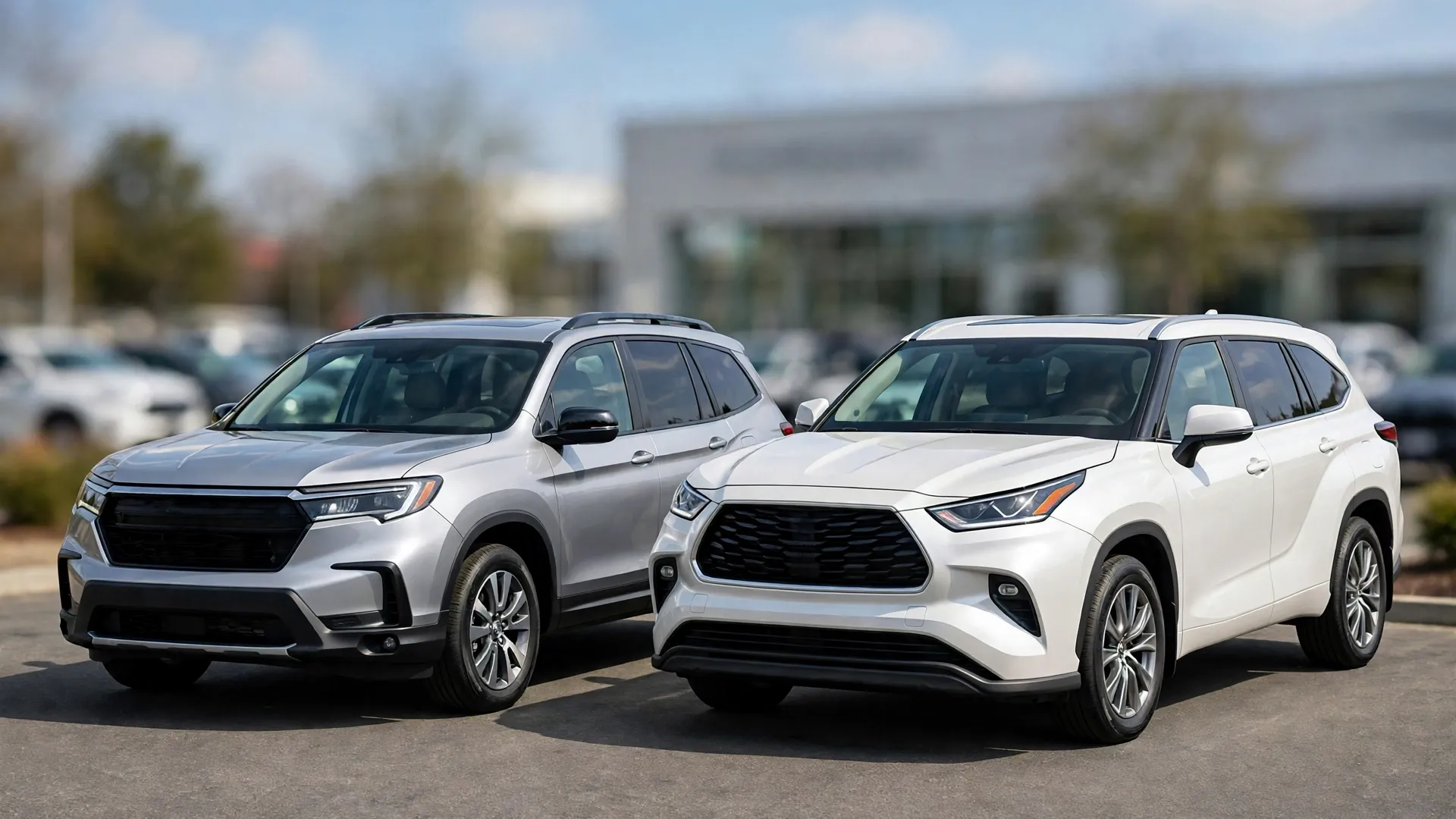
Honda Pilot vs Toyota Highlander: Family SUV Showdown
If you’re shopping for a three-row family SUV in the US, you’ve probably already narrowed it down to these two. The Honda Pilot and the Toyota Highlander have been circling each other for years, and on paper they’re close: both seat up to eight, both start around the low-$40k mark, both tow up to 5,000 pounds, and both come from brands famous for building cars that last.
But they’re not the same vehicle, and the differences matter more than the similarities. Here’s the short version: the Pilot is the bigger, more traditional family hauler — V6 power, a roomier cabin, and a genuinely usable third row. The Highlander is the more efficient, easier-to-live-with option — and the Highlander Hybrid is one of the most fuel-efficient three-row SUVs you can buy. Which one wins depends entirely on what your family needs.
Note: figures below are typical US 2026 versions and vary by trim, options, and model year. Always confirm the exact specs with your dealer before buying.
Verdict
Winner: split — the Honda Pilot wins on space and value; the Toyota Highlander Hybrid wins on fuel economy and resale. The Pilot is the bigger, roomier hauler from $42,395 with a proven 285-hp V6 and a genuinely usable third row, while the Highlander Hybrid returns about 35 mpg combined — roughly 60% better than the Pilot — and holds its value better. This article says there is no universal winner: pick by family need.
Scored comparison
| Category | Honda Pilot | Toyota Highlander | Winner |
|---|---|---|---|
| Price (starting) | 9 – from $42,395 (2026) | 8 – from $46,270 (XLE, 2026) | Pilot |
| Fuel economy | 7 – about 19 city / 27 hwy (FWD); around 21–22 combined | 9 – gas 24 mpg combined; hybrid about 35 mpg combined | Highlander |
| Power | 8 – 3.5L V6, about 285 hp / 262 lb-ft | 8 – 2.4L turbo, about 265 hp / 310 lb-ft (gas); about 243 hp net (hybrid) | Tie |
| Cargo space | 9 – about 87–88 cu ft max | 8 – about 84 cu ft max | Pilot |
| Towing | 8 – up to 5,000 lb (AWD) | 8 – up to 5,000 lb (gas AWD); 3,500 lb (hybrid) | Tie |
| Safety (IIHS) | 9 – Top Safety Pick (2025 award) | 7 – no Top Safety Pick for 2026 (Marginal in updated moderate-overlap test) | Pilot |
| Resale value | 8 | 9 – Toyota’s resale edge is well documented | Highlander |
| Reliability | 9 – Honda reliability | 9 – no meaningful gap between the two | Tie |
| Third-row usability | 9 – roomier third row | 8 | Pilot |
Scores are our 1–10 reading of the figures already in this article; they are not separate test results.
How we rank / Sources & method
We ranked the two SUVs only on the figures in this article: starting MSRP and specifications from the Honda and Toyota official pages, EPA fuel economy via fueleconomy.gov, and IIHS safety ratings. Prices are starting MSRP excluding destination unless stated. Figures change by model year and trim, so check the manufacturer’s site before you buy.
Data as of / Prices as of: October 2026 (specs and prices checked October 2026).
Head-to-Head Specs at a Glance

| Spec | Honda Pilot | Toyota Highlander |
|---|---|---|
| Starting price | From $42,395 (2026) | From $46,270 (XLE, 2026) |
| Engine | 3.5L V6 | 2.4L turbocharged 4-cylinder (+ hybrid option) |
| Power | ~285 hp / 262 lb-ft | ~265 hp / 310 lb-ft (gas); ~243 hp net (hybrid) |
| Transmission | 10-speed automatic | 8-speed automatic (gas); CVT-style (hybrid) |
| Fuel economy (EPA, typical) | ~19 city / 27 hwy (FWD); around 21–22 combined | 21/28/24 mpg (gas); ~35 mpg combined (hybrid) |
| Seating | Up to 8 | Up to 8 (varies by trim) |
| Maximum cargo space | ~87–88 cu ft | ~84 cu ft |
| Cargo behind third row | ~16.5+ cu ft | ~16 cu ft |
| Max towing (properly equipped) | Up to 5,000 lb (AWD) | Up to 5,000 lb (gas AWD); 3,500 lb (hybrid) |
| All-wheel drive | Available (i-VTM4) | Available (gas); standard on hybrid |
| Safety | IIHS Top Safety Pick (2025 award); 5-star NHTSA (recent years) | No IIHS Top Safety Pick award for 2026 (Marginal in updated moderate-overlap test); 5-star NHTSA (recent years) |
| Basic warranty | Typically 3 yr/36k mi; 5 yr/60k powertrain | Typically 3 yr/36k mi; 5 yr/60k powertrain; hybrid components 8 yr/100k |
Prices climb into the mid-$50s at the top of both lineups; none of these figures are exact — your dealer’s window sticker is the final word.
Still comparing? See our Toyota Corolla vs Honda Civic compact-car comparison, the Toyota Tacoma vs Ford Ranger midsize-truck comparison, the Ford F-150 vs Chevy Silverado reliability comparison, and the Jeep Wrangler vs Ford Bronco off-road comparison.
Which Is Better For…?
- Big families (all 3 rows used daily): Pilot — boxier shape and roomier third row make daily kid-duty easier.
- Fuel economy: Highlander Hybrid — Toyota’s hybrid system is the proven MPG leader in this class.
- Towing: Tie — both tow up to 5,000 lb properly equipped (AWD gas); the front-wheel-drive Pilot and the Highlander Hybrid are limited to 3,500 lb.
- City driving: Highlander — slightly easier to park and maneuver in tight streets.
- Long road trips: Highlander Hybrid — fewer fuel stops and a quieter highway ride.
- Tech lovers: Pilot — bigger screens and more standard driver-assist features on most trims.
- Resale value: Highlander — Toyota’s resale edge is well documented.
- Tight budget: Pilot — typically lower transaction prices for comparable trims.
The fuel math, worked: at 15,000 miles a year, annual fuel cost = (15,000 ÷ combined MPG) × price per gallon — run it for each SUV with its EPA combined rating (verify current figures on fueleconomy.gov; do not use old numbers). At 35 mpg the Hybrid uses about 429 gallons a year versus about 625 gallons for the 24-mpg gas Highlander — a saving of roughly 196 gallons, or about $685 a year at $3.50 a gallon — so the $1,750 hybrid premium pays back in about 2½ years.
Engines, Power, and Fuel Economy
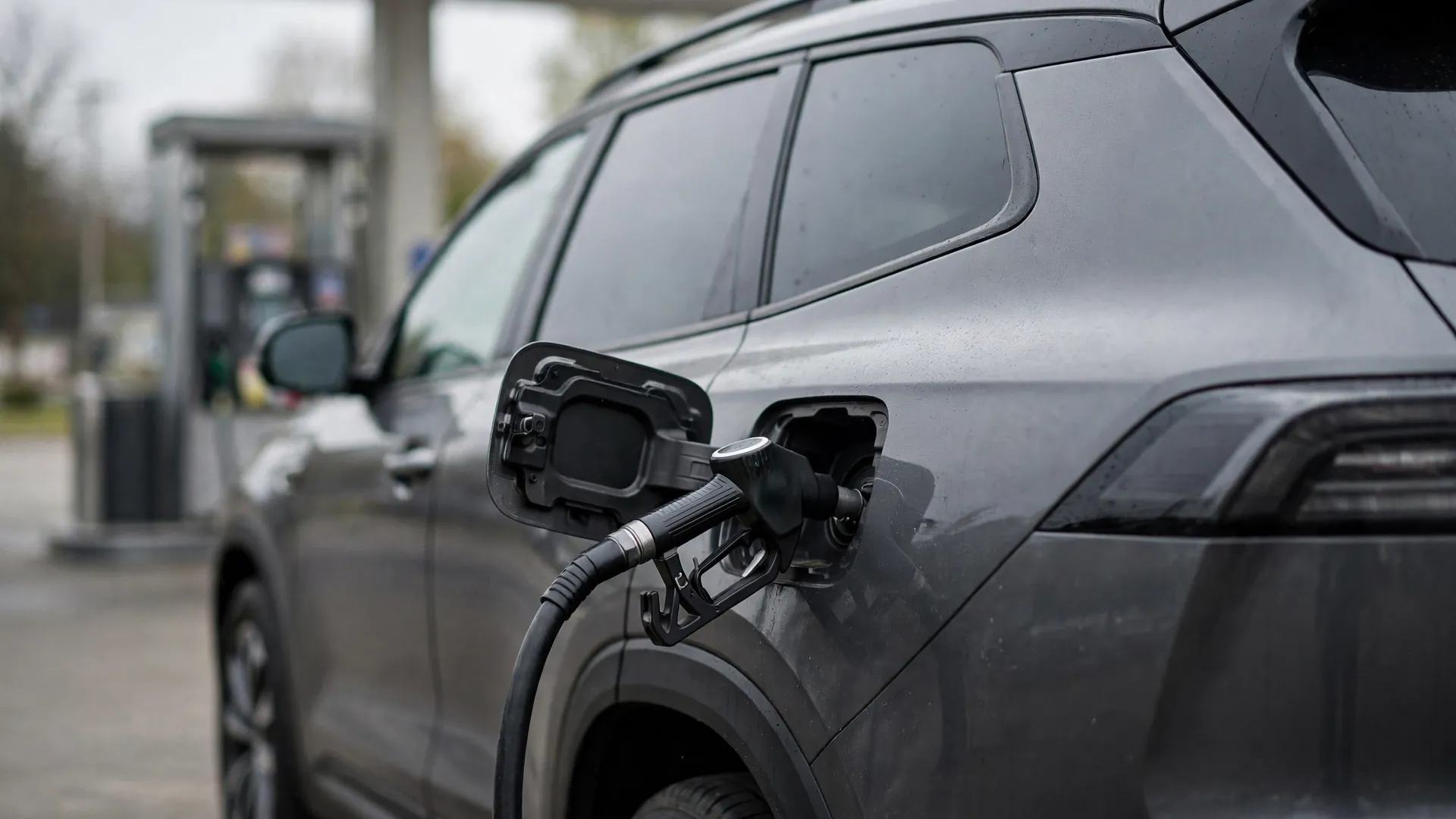
The Honda Pilot keeps it old-school — in a good way. Every Pilot runs the same 3.5-liter V6 making around 285 horsepower and 262 lb-ft of torque, paired with a 10-speed automatic. No turbo, no hybrid, no complexity. It pulls smoothly, and the V6 is a known quantity Honda has refined for years. Fuel economy is decent but unremarkable: roughly 19 mpg city and 27 highway in front-wheel-drive form, landing around 21–22 mpg combined depending on drivetrain. You don’t buy a Pilot to save gas — you buy it for effortless power and a powertrain that asks nothing of you.
The Toyota Highlander bets on efficiency. The gas model uses a 2.4-liter turbocharged four-cylinder making around 265 horsepower and a stout 310 lb-ft of torque — more twist than the Pilot’s V6, delivered lower in the rev range, so around-town driving feels perfectly adequate. It runs through an 8-speed automatic and returns EPA estimates around 21 city / 28 highway / 24 combined.
But the real story is the Highlander Hybrid. It pairs a 2.5-liter four-cylinder with Toyota’s proven hybrid system for about 243 net horsepower — and delivers around 35 mpg combined, per EPA estimates (see the official numbers on fueleconomy.gov). That’s roughly 60% better fuel economy than the Pilot in a vehicle that seats the same people — thousands of dollars in savings over the car’s life for a family driving 15,000 miles a year.
Honda, notably, still doesn’t offer a Pilot Hybrid. If a hybrid three-row is non-negotiable, the decision is already made.
On the road, the Pilot is the most relaxed — the V6 never strains — while the Highlander feels lighter in traffic and the Hybrid calmest in stop-and-go driving.
Interior Space and Third-Row Reality
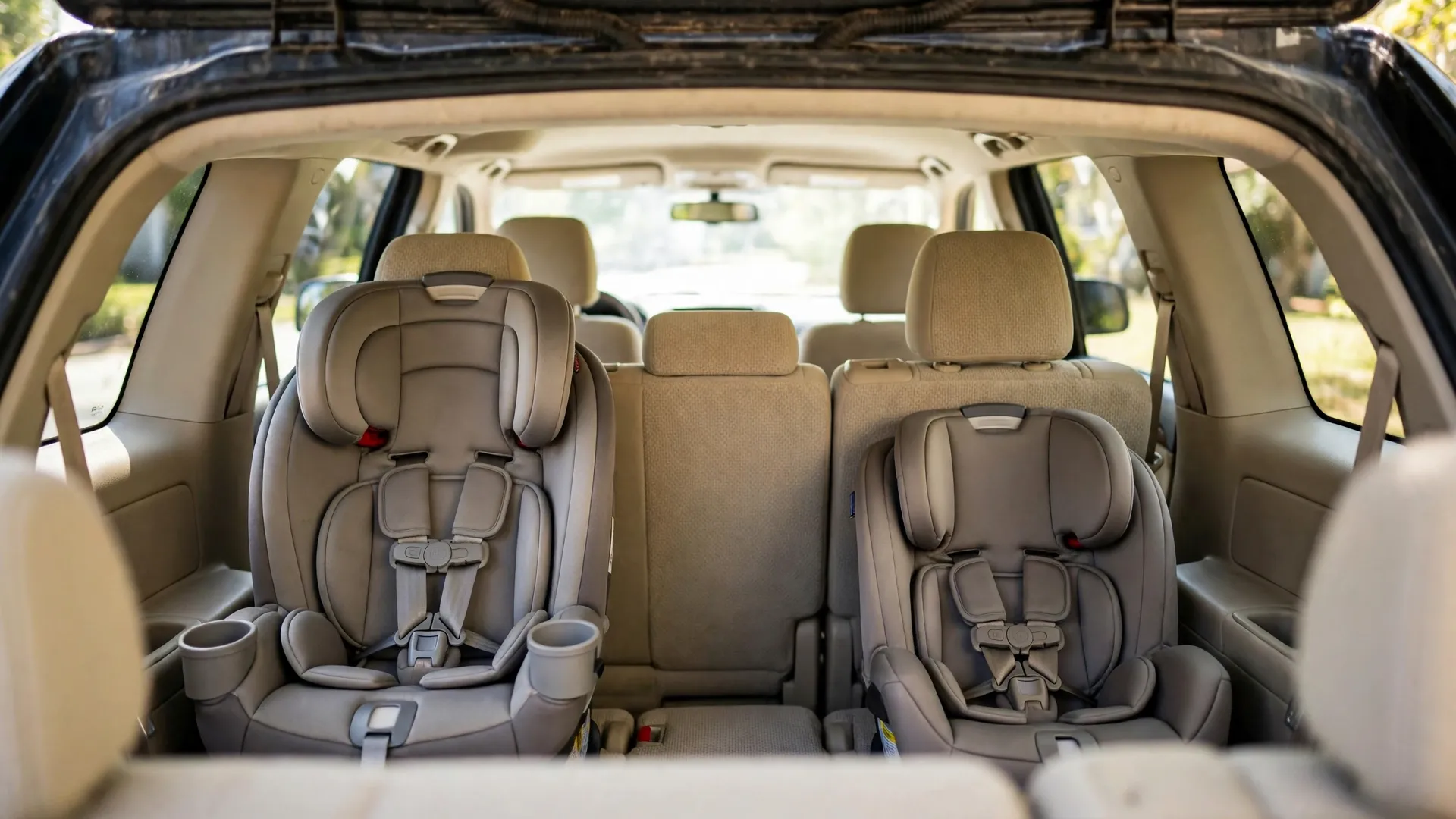
The Pilot is simply the roomier vehicle — and that matters if you regularly fill all three rows.
The Pilot’s box is bigger in nearly every published dimension: around 87–88 cubic feet of maximum cargo space versus about 84 for the Highlander, and more usable room behind the third row (roughly 16.5+ cubic feet versus 16). That sounds like a small gap until you’re trying to fit a stroller, sports bags, and groceries behind the back seat. More importantly, the Pilot’s third row is genuinely usable for adults on longer trips, while the Highlander’s third row is best thought of as kids-and-short-trips territory.
Both seat up to eight by trim, with second-row captain’s chairs on higher trims. The Pilot has one clever party trick: on select trims, the second row’s middle seat is removable and stows under the cargo floor, so you can switch between 8-passenger capacity and a walk-through to the third row — genuinely useful for families with car seats.
The Highlander counters with a slightly more compact footprint, which pays off in tight parking lots and crowded school pickup lines. Its cabin is comfortable and well-built, just a bit cozier — “spacious enough” rather than “cavernous.”
One practical tip: test the third row with your actual car seats before you sign anything. Fifteen minutes in a dealership parking lot teaches you more than any spec sheet.
Safety Ratings

The Honda Pilot holds an IIHS Top Safety Pick award (2025 award year), which puts it in rare company among three-row SUVs. It’s also carried 5-star overall ratings from NHTSA. The Highlander has earned 5-star NHTSA ratings too, but it holds no IIHS Top Safety Pick award for 2026 — IIHS rates the 2026 Highlander Marginal in the updated moderate-overlap front test, which keeps it out of the awards.
One caveat: IIHS ratings can shift by model year and build date, and sources report the standings differently. Before you buy, check the current ratings for the exact vehicle on iihs.org — the only source that actually counts.
Beyond the crash scores, both include automatic emergency braking, adaptive cruise, lane-keeping assist, and blind-spot monitoring as standard (Honda Sensing; Toyota Safety Sense) — no trim-climbing required.
Reliability and Ownership Costs

The good news: you can’t really go wrong here. Both Honda and Toyota sit at the very top of the independent reliability studies — we break down the actual data in our most reliable cars of 2025 guide.
A few ownership notes worth knowing:
- Toyota’s hybrid system is famously durable. Refined over millions of vehicles and two decades, the hybrid hardware shouldn’t worry you — and hybrid components typically carry an 8-year/100,000-mile warranty.
- The Pilot’s V6 is equally proven. Naturally aspirated engines with conventional automatics are about as low-drama as powertrains get. There’s simply less to go wrong.
- Watch the trim-level trap. Upper trims wear larger wheels and tires, and replacements for 20-inch wheels cost meaningfully more than 18-inch versions. Price a set before you commit — tire costs are one of the most overlooked SUV ownership expenses.
- Resale value favors the Highlander, slightly. Toyotas — hybrids especially — have a long reputation for holding value, lowering your true ownership cost when you sell. The Pilot holds value well too, but the Highlander is usually the safer bet at trade-in time.
- Warranties are typical for the class: around 3 years/36,000 miles basic and 5 years/60,000 miles powertrain on both, with the Highlander Hybrid adding longer hybrid-component coverage.
Pricing and Value
Both start in the $40,000s — the 2026 Pilot from $42,395 and the 2026 Highlander from $46,270 — and climb into the mid-$50s fully loaded — close enough at entry level that price shouldn’t decide anything.
The value question is the Hybrid. Toyota lists the 2026 Highlander XLE at $46,270 and the Hybrid XLE at $48,020 — a $1,750 premium over the equivalent gas trim. At 15,000 miles a year, moving from 24 to 35 mpg saves about 196 gallons — roughly $685 a year at $3.50 a gallon — so fuel alone pays the premium back in about 2½ years. The Hybrid also brings standard AWD, stronger resale, and a calmer drive — judge it on the whole package, not just the math.
The Pilot’s value argument is simpler: one engine, no hybrid premium, no turbo complexity — just a big, comfortable, proven V6 SUV for the money. If your annual mileage is modest, the Pilot can easily be the cheaper car to own.
Which Should You Buy?
No universal winner — here’s the verdict by family need:
Buy the Honda Pilot if: you regularly use all three rows, you want the roomiest cabin and cargo area in the class, you tow toys or a camper (up to 5,000 pounds with AWD), or you prefer the simplicity and smoothness of a proven V6 with no hybrid battery and no turbo. For big families with big lives, the Pilot is the stronger pick.
Buy the Toyota Highlander Hybrid if: fuel costs matter to you, you drive a lot of miles, most of your driving is city or suburban stop-and-go, or you just want one of the most efficient three-row SUVs on sale. The Hybrid is the efficiency champion here by a wide margin, and Toyota’s hybrid track record removes most of the risk.
Buy the gas Highlander if: you want a slightly smaller, easier-to-park three-row with Toyota’s reputation and solid turbo-four torque, but don’t drive enough miles to justify the Hybrid premium.
One more thing: Toyota has announced that the Highlander name will go all-electric for the 2027 model year, and the roomier Grand Highlander already exists. If you keep cars for a decade, it’s worth knowing where the lineup is headed.
Still torn? Compare any two cars side by side with our free tool — plug in the exact trims you’re cross-shopping and see price, MPG, space, safety, and warranty in one table. And if you’re also looking at smaller two-row SUVs, our Toyota RAV4 vs Mazda CX-5 comparison covers the next size down.
Frequently Asked Questions
Which is bigger: the Honda Pilot or the Toyota Highlander?
The Pilot. It offers around 87–88 cubic feet of maximum cargo space versus about 84 for the Highlander, more room behind the third row, and a more adult-friendly third row. The Highlander is the more compact, easier-to-park package.
Is there a Honda Pilot Hybrid?
No. Honda does not currently offer a hybrid version of the Pilot — every trim runs the 3.5L V6. If you want a hybrid three-row from these two brands, the Highlander Hybrid is your only option here.
Which gets better gas mileage, the Pilot or the Highlander?
The Highlander, by a lot. The gas model is EPA-rated around 24 mpg combined, and the Highlander Hybrid hits around 35 mpg combined. The Pilot lands around 21–22 mpg combined. Exact figures vary by trim and drivetrain.
Which is more reliable: Honda Pilot or Toyota Highlander?
Both come from brands that top the independent reliability studies, with no meaningful gap between them. The Highlander’s hybrid system is extremely proven, and the Pilot’s V6 is equally low-drama. Reliability shouldn’t decide this one.
Can both tow 5,000 pounds?
When properly equipped, yes — both are rated up to 5,000 pounds in their AWD gas configurations. Exceptions: the Pilot’s front-wheel-drive models and the Highlander Hybrid are rated at 3,500 pounds. Confirm with your dealer for your exact trim.
Which holds its value better?
The Highlander, typically — Toyotas, and hybrids in particular, have a long track record of strong resale. The Pilot holds value respectably too, but for minimizing depreciation, the Highlander (especially the Hybrid) is the safer bet.
Should I wait for the 2027 electric Highlander?
Toyota says the 2027 Highlander will be its first all-electric three-row SUV. Worth watching if you can wait — but first-year models carry more risk, since new platforms have teething problems. The current gas and hybrid models are proven quantities you can buy today.
More head-to-heads on the site: Hyundai Tucson vs Kia Sportage and Kia Telluride vs Hyundai Palisade.
Related Comparisons
Specs and prices checked October 2026 against Honda and Toyota official pages and EPA fuel-economy ratings.