
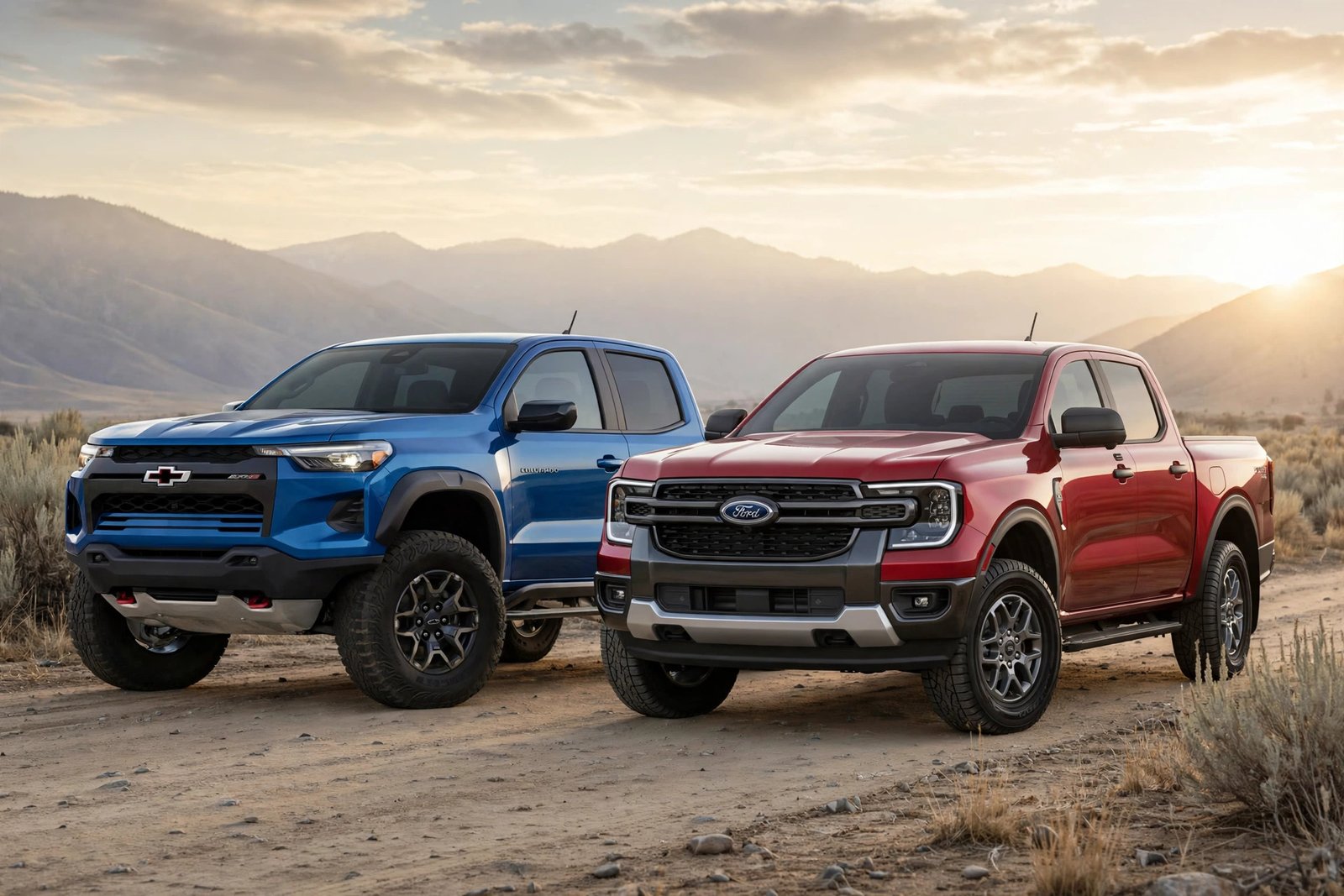
Quick answer: The Colorado gives you more power for less money — 310 hp in every trim from $32,400. The Ranger gives you better fuel economy, three engine choices, and the best ride in the class (Edmunds ranks it #1 of 7 midsize trucks). Towing is a near-tie at 7,700 vs 7,500 lbs. Pick the Colorado for value and muscle, the Ranger for efficiency and comfort — and the Raptor if desert speed is the point.
Verdict
Winner: split — the Chevrolet Colorado wins on value and muscle; the Ford Ranger wins on efficiency and comfort. The Colorado puts 310 hp in every trim from $32,400, against 270 hp from $33,550, and tows a touch more (7,700 vs. 7,500 lbs). The Ranger counters with better fuel economy (23 vs. 21 mpg combined), three engine choices and the best ride in the class — Edmunds ranks it #1 of 7 midsize trucks. Pick the Raptor if desert speed is the point.
Quick read: Colorado for the most power for the least money; Ranger for efficiency, choice and comfort. Towing and payload are near-ties.
Scored comparison
| Category | 2026 Chevrolet Colorado | 2026 Ford Ranger | Edge |
|---|---|---|---|
| Price (starting MSRP) | 9 — $32,400 | 8 — $33,550 | Colorado |
| Base power | 9 — 310 hp / 430 lb-ft | 7 — 270 hp / 310 lb-ft | Colorado |
| Strongest powertrain | 7 — 310 hp (all trims) | 9 — 405 hp / 430 lb-ft (Raptor) | Ranger |
| Towing (max) | 8 — 7,700 lbs | 8 — 7,500 lbs | Tie |
| Payload (max) | 8 — ~1,710–1,833 lbs | 8 — ~1,767–1,788 lbs | Tie |
| Fuel economy (best, combined) | 7 — 21 mpg | 9 — 23 mpg | Ranger |
| Safety (NHTSA overall) | 8 — 4/5 stars | 8 — 4/5 stars | Tie |
| Edmunds rating | 7 — 6.5/10 | 9 — 7.1/10, #1 of 7 | Ranger |
| Warranty | 9 — 3 yr / 36k, 5 yr / 60k powertrain | 9 — 3 yr / 36k, 5 yr / 60k powertrain | Tie |
Scores are our 1–10 reading of the figures already in this article; they are not separate test results.
How we rank / Sources & method
We compare manufacturer figures from Chevrolet and Ford (chevrolet.com and ford.com), official EPA fuel-economy ratings at fueleconomy.gov, NHTSA and IIHS safety information, and Edmunds ratings. Prices are starting MSRP excluding destination unless stated. Figures are typical 2026 US model-year ratings and vary by trim, cab and drivetrain.
Data as of: November 2026 (published November 5, 2026).
Quick Specs Head-to-Head
| Spec | 2026 Chevrolet Colorado | 2026 Ford Ranger |
|---|---|---|
| Starting price | $32,400 (WT 2WD) | $33,550 (XL 4×2) |
| Destination charge | $2,095 | ~$1,895 |
| Base engine | 2.7L TurboMax I-4 | 2.3L EcoBoost I-4 |
| Base horsepower / torque | 310 hp / 430 lb-ft | 270 hp / 310 lb-ft |
| Strongest powertrain | Same 310 hp (all trims) | Raptor 3.0L V6, 405 hp / 430 lb-ft |
| Transmission | 8-speed automatic | 10-speed automatic |
| Max towing | 7,700 lbs | 7,500 lbs |
| Max payload | ~1,710–1,833 lbs (config-dependent) | ~1,767–1,788 lbs (config-dependent) |
| Best fuel economy | 19 city / 24 hwy / 21 combined (2WD) | 21 city / 25 hwy / 23 combined (2WD) |
| Cab / bed | Crew cab only; ~5-ft bed | SuperCrew only; 5-ft bed |
| Hybrid available | No | No (US market) |
| Off-road flagship | ZR2, $50,700 | Raptor, $57,270 |
| NHTSA overall safety | 4/5 stars | 4/5 stars |
| Basic warranty | 3 yr / 36,000 mi | 3 yr / 36,000 mi |
| Powertrain warranty | 5 yr / 60,000 mi | 5 yr / 60,000 mi |
| Edmunds rating | 6.5/10 | 7.1/10 (#1 of 7) |
Prices exclude destination. Figures are typical 2026 US model-year ratings and vary by trim, cab, drivetrain, and options. Towing and payload maximums apply only to specific configurations — confirm exact ratings with your dealer before buying.
Price: Colorado Starts Cheaper, Ranger Charges for the Extras
The Colorado wins the sticker-price round. It starts at $32,400 for the WT 2WD work truck, about $1,150 less than the Ranger XL 4×2 at $33,550. And that price gap understates the value difference: every Colorado, even the cheapest WT, comes with the full 310-hp engine. The Ranger’s base 2.3L makes 270 hp — to get close to the Chevy’s power you need the optional 2.7L V6, which is only available on XLT and Lariat with four-wheel drive.
The Ranger also charges for things the Colorado includes or bundles differently. Four-wheel drive costs $3,500 extra on the Ranger below the Raptor, while the Colorado includes 4WD as standard on Trail Boss, Z71, and ZR2. Ford’s Co-Pilot360 driver-assist suite is a $625 option on the base XL — on the Colorado, the equivalent safety tech comes standard.
At the top end, the gap flips: the off-road ZR2 runs about $50,700, while the Ranger Raptor is roughly $57,270. The Raptor is the more extreme machine, so the price is not directly comparable — but if your budget tops out near $50,000, the ZR2 is the only flagship you can afford.
Want to play with the numbers yourself? Our car comparison tool lets you line up any two vehicles side by side on the specs that matter to you.
Engines and Performance: One Great Engine vs Three Good Ones
Chevrolet’s approach is simple: one engine, everywhere. The 2.7L TurboMax turbo four-cylinder makes 310 hp and 430 lb-ft of torque in every Colorado, from the $32,400 WT to the $50,700 ZR2, paired to an 8-speed automatic. It is a genuinely strong engine — more torque than any non-Raptor Ranger — and it means there is no wrong choice in the Colorado lineup.
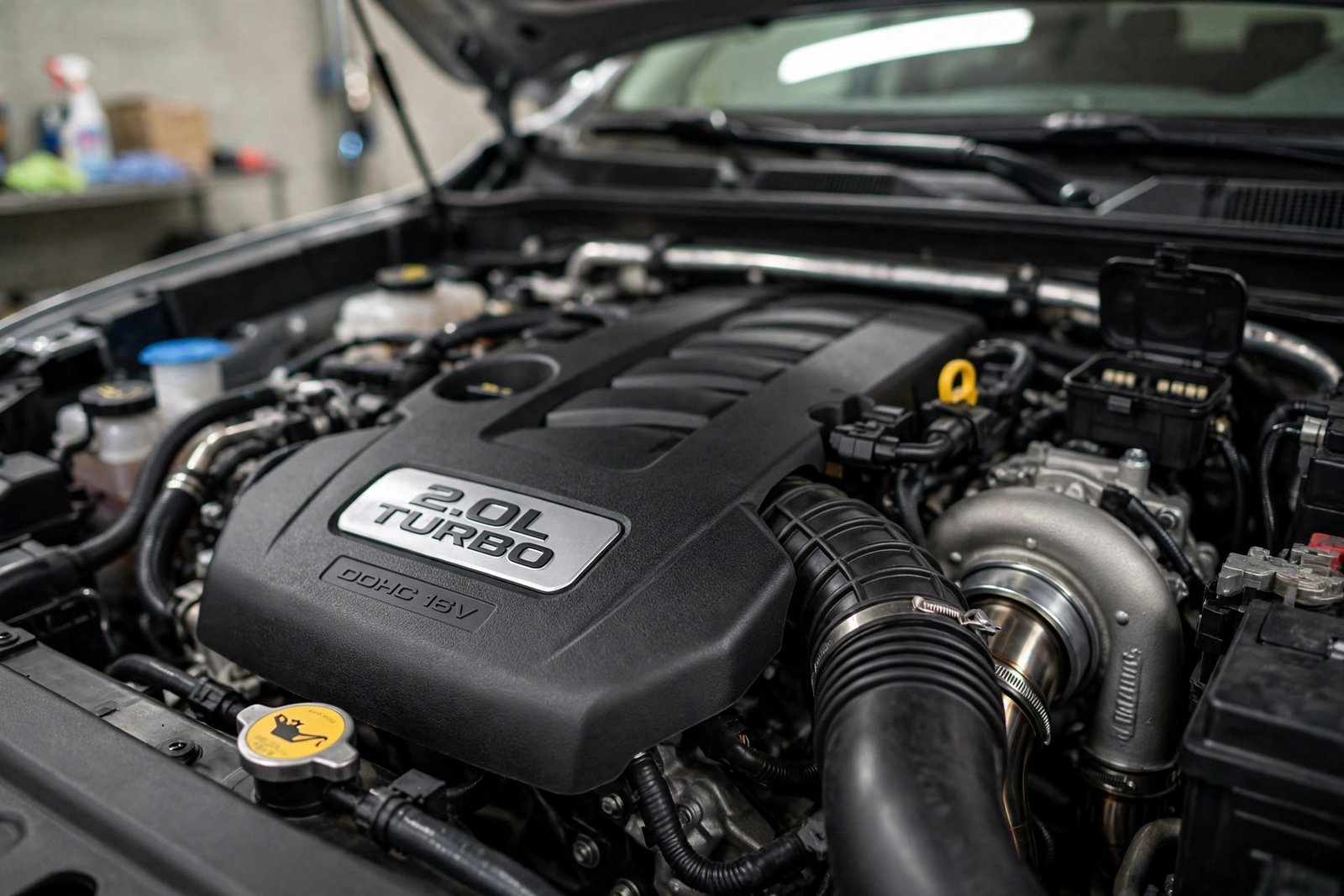
Ford gives you a ladder. The standard 2.3L EcoBoost four makes 270 hp and 310 lb-ft. The optional 2.7L twin-turbo V6 (XLT and Lariat, 4WD only) makes 315 hp and 400 lb-ft. The Raptor’s 3.0L twin-turbo V6 makes 405 hp and 430 lb-ft. All three use a 10-speed automatic.
In independent testing, the Ranger is the quicker truck in everyday driving — Edmunds clocked the 2.3L 4WD at 0–60 mph in 6.7 seconds and the 2.7L V6 at 6.2 seconds. But the Colorado’s 430 lb-ft of torque is available from just 3,000 rpm, which gives it the strongest low-end pull of any non-Raptor truck here and makes it feel effortless when towing or climbing. If you want maximum power per dollar, the Colorado is unbeatable. If you want the widest choice — or the 405-hp Raptor — only Ford has it.
Towing and Payload: A Near-Tie (Read the Fine Print)
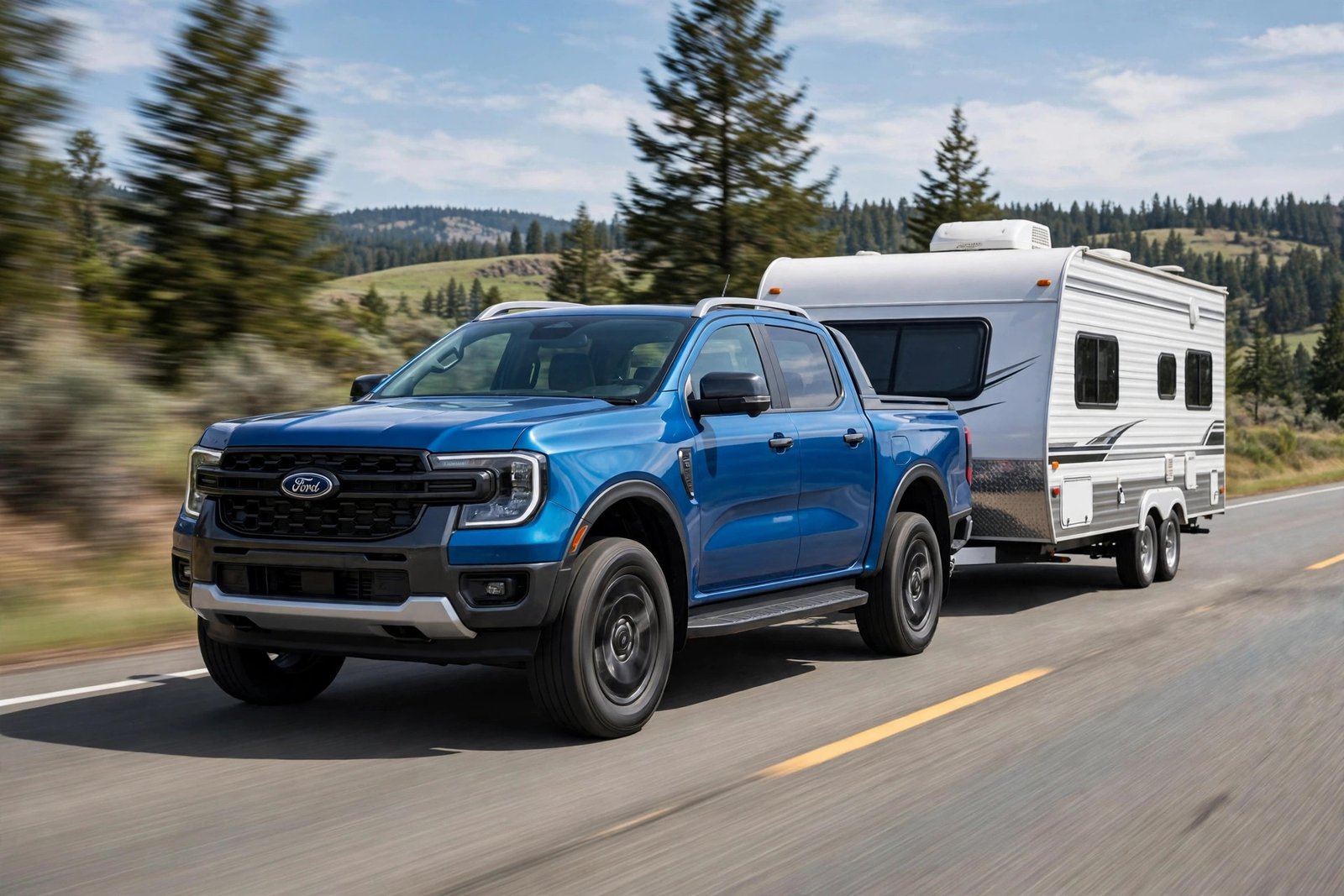
The headline numbers look close because they are: the Colorado tows up to 7,700 lbs with the Advanced Trailering Package; the Ranger tows up to 7,500 lbs with the Trailer Tow Package. That 200-lb gap will not decide a purchase. Both trucks start at a 3,500-lb base tow rating, and both need the right package and configuration to reach their maximums.
Payload is where the numbers get messy — and worth a warning. Published maximums disagree across sources: the Colorado is listed anywhere from 1,710 to 2,046 lbs depending on configuration and source, and the Ranger from 1,767 to 1,847 lbs. Like-for-like 4×4 figures land within about 50 lbs of each other. Treat any single payload number you see online with suspicion unless it names the exact trim and drivetrain.
The off-road flagships tow less than the work trucks, as usual: the ZR2 is rated at 6,000 lbs (5,500 for the Bison), while the Raptor is rated at 5,510 lbs. If you tow heavy and wheel hard, the ZR2 has a small edge here.
Fuel Economy: Ranger Wins by About 2 MPG
The Ranger is the more efficient truck. The 2.3L 2WD Ranger is EPA-rated at 21 city / 25 highway / 23 combined mpg, versus 19/24/21 for the 2WD Colorado. In four-wheel drive, the gap is 21 combined for the Ranger versus 19 for the Colorado. Over five years at 12,000 miles a year and $3.50 a gallon, that is roughly $870 in the Ranger’s favour on two-wheel-drive models.
The gap narrows in four-wheel drive and disappears entirely on the off-road flagships — both the ZR2 and the Raptor are rated at 17 mpg combined. The Colorado’s 2WD highway figure did improve by 1 mpg for 2026, but it is not enough to close the gap.
Check any configuration’s official ratings at fueleconomy.gov before you buy — the spread between a 2WD work truck and a ZR2 or Raptor is enormous.
Still comparing? See the Toyota Corolla vs Honda Civic matchup for a sedan take on this kind of head-to-head, the Toyota Tacoma vs Ford Ranger comparison for another midsize truck, the Honda Pilot vs Toyota Highlander guide for a three-row family SUV, or the Toyota RAV4 vs Mazda CX-5 comparison for a compact SUV.
Cabs, Beds, and Everyday Usability
Both trucks keep it simple: one crew cab, five seats, one bed length. The Colorado’s bed is about 61.7 inches long with 41.9 cubic feet of volume; the Ranger’s is 59.6 inches with 43.5 cubic feet. The number that matters most for real work is the width between the wheel housings: the Ranger’s 48.2 inches lets you lay a sheet of plywood flat, while the Colorado’s 45.5 inches does not.
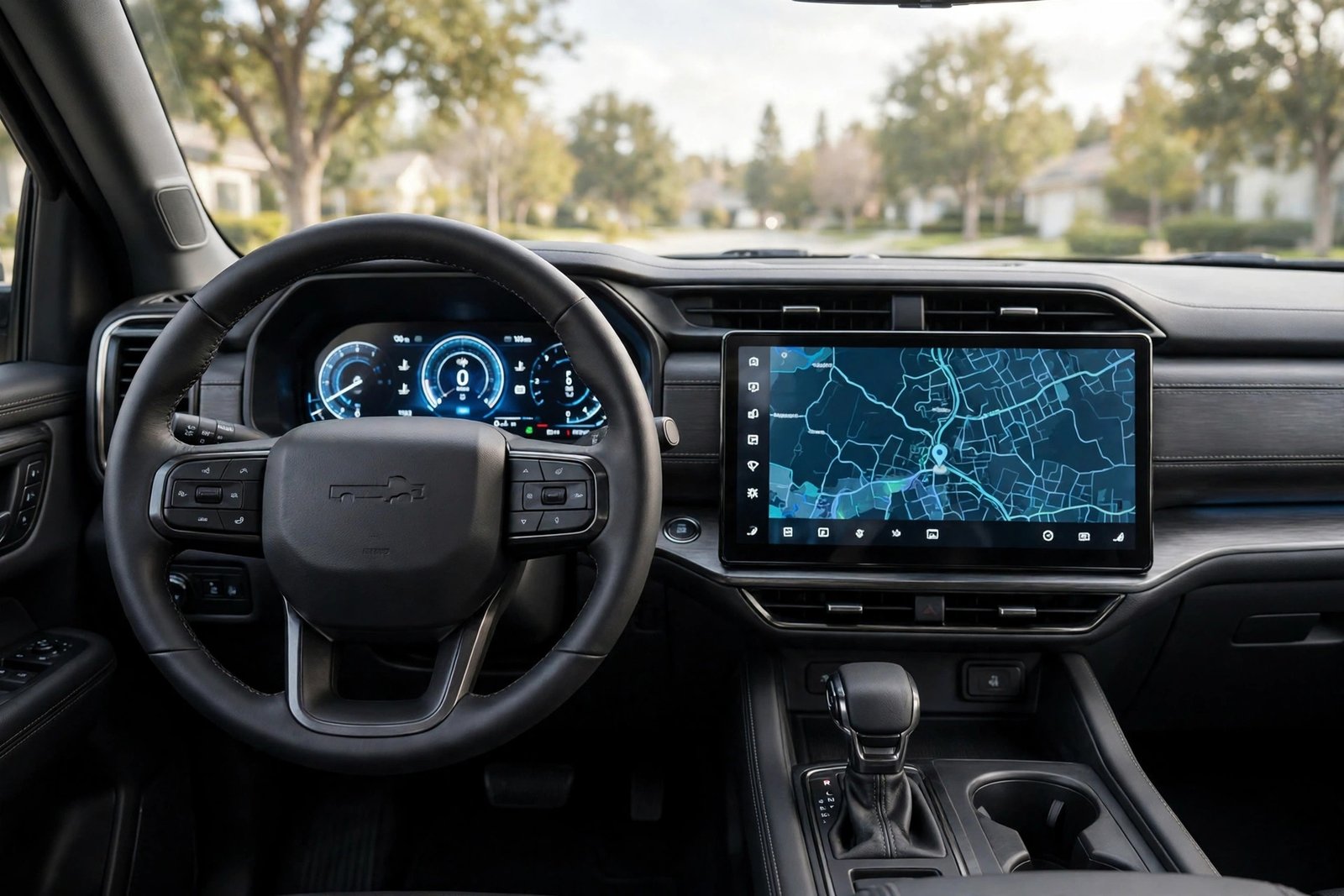
Inside, both offer modern cabins with wireless Apple CarPlay and Android Auto. The Colorado gives you an 11.3-inch touchscreen and an 11-inch digital instrument display as standard on every trim — genuinely generous at this price. The Ranger’s standard 10-inch screen is smaller, though Lariat and Raptor get dual 12-inch displays.
Edmunds rates the Ranger’s ride as smoother than the Colorado’s and the Tacoma’s, and its 7.1/10 overall score puts it first among seven midsize trucks. The Colorado scores 6.5/10, with its lowest mark for fuel economy. If you commute in your truck every day, the Ranger’s comfort edge is worth a test drive.
Off-Road Trims: ZR2 vs Raptor — Different Missions
This is the most fun part of the comparison, and the two flagships are built for different kinds of dirt.
The Ranger Raptor ($57,270) is a desert runner: 405 hp, FOX Live Valve 2.5-inch shocks, a Watts-link coil rear suspension, front and rear lockers, and seven drive modes including Baja. It is the fastest truck in the class by a wide margin and a Car and Driver 10Best winner.

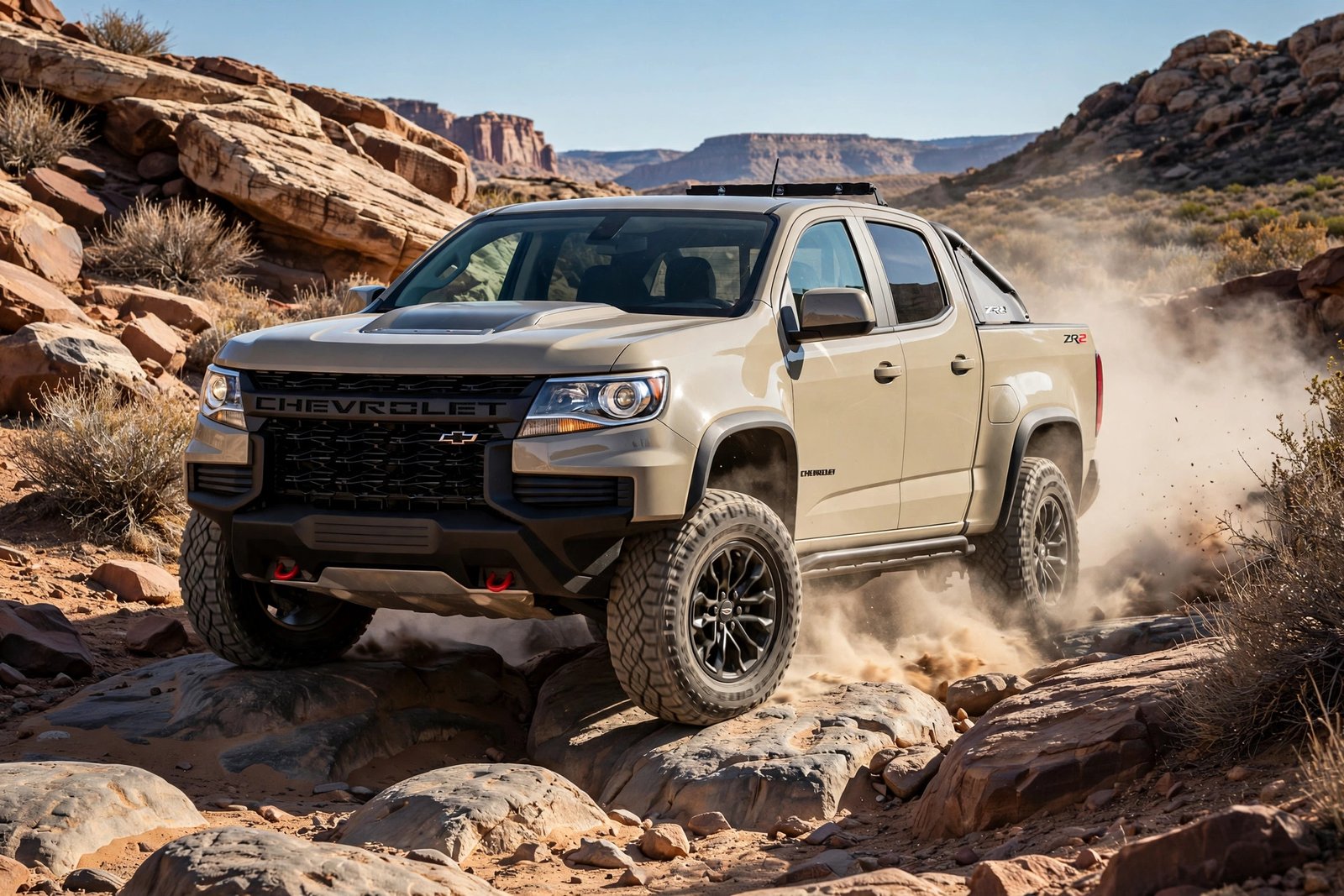
The Colorado ZR2 ($50,700) is a rock-crawler: 3-inch lift, Multimatic DSSV dampers, front and rear lockers, and 10.7 inches of ground clearance. The ZR2 Bison package adds 35-inch mud-terrain tires, boron-steel skid plates, and 12.2 inches of clearance — the most capable crawler of the pair, though the package pushes the price past the Raptor’s.
New for 2026, Ford offers the FX4 Off-Road Package on the base XL for $1,195 — the cheapest factory off-road entry in either lineup, and a smart buy if you want trail capability without flagship money.
Safety: Both Well-Equipped, Neither Perfect
Both trucks earn 4 out of 5 stars overall from NHTSA. The Colorado scores 4 stars frontal, 5 stars side, and 3 stars rollover; the Ranger scores 5 stars frontal and 3 stars rollover. Neither truck has earned an IIHS Top Safety Pick award, and both received a Marginal rating in the IIHS updated moderate-overlap front test (2023 testing, with rear-seat protection the weak point — no small pickup earned a Good rating).
Standard driver assists are comprehensive on both: automatic emergency braking, lane keeping, blind-spot monitoring, and adaptive cruise are available across the lineups. Remember the Ranger’s Co-Pilot360 is a $625 option on the base XL, so price it into any base-model comparison. You can look up the full crash-test details at iihs.org and nhtsa.gov.
Neither truck includes complimentary scheduled maintenance — Toyota is the only brand in the segment that does.
Reliability and Resale: A Split Decision
The 2026 reliability picture favours the Colorado slightly on paper: one reliability index scores the 2026 Colorado 88/100 versus 83/100 for the Ranger, with both trucks showing zero owner complaints on file for the 2026 model year. Lifetime recalls tell a different story — 9 for the Colorado versus 52 for the Ranger across all model years — though that figure is heavily weighted by older generations. Annual repair costs are nearly identical at roughly $600 for either truck.
On resale, the Ranger has a small edge: iSeeCars rates the Ranger slightly ahead on overall quality (7.9 vs 7.8 out of 10) and retained value. Neither truck holds value like a Tacoma — midsize pickups from Ford and Chevrolet both depreciate faster than Toyota’s — so factor that into your five-year math. Our most reliable cars roundup has more on which brands hold up best.
Which One Should You Buy?
Buy the Chevrolet Colorado if: you want the most power for the least money (310 hp from $32,400), you tow regularly and want the 7,700-lb maximum, you prefer one great engine with no decisions to make, or you want the best rock-crawler in the class in the ZR2.
Buy the Ford Ranger if: fuel economy matters (23 vs 21 mpg combined), you want three engine choices including the 405-hp Raptor, you value the smoothest ride in the class and the highest Edmunds score, or you need a bed that fits plywood flat.
Either way: drive both back to back, price them with your local dealers, and confirm the exact tow rating, payload, and MPG of the configuration you are actually buying — the headline numbers only apply to specific builds. Full specs live on chevrolet.com and ford.com.
Frequently Asked Questions
Which is better, the 2026 Chevrolet Colorado or the Ford Ranger?
It depends on your priorities. The Colorado wins on standard power (310 hp in every trim) and price (from $32,400). The Ranger wins on fuel economy (23 mpg combined vs 21), engine choice, and ride comfort — Edmunds rates it 7.1/10 and ranks it #1 of 7 midsize trucks. Towing is nearly tied: 7,700 lbs for the Colorado vs 7,500 for the Ranger.
Which tows more, the Colorado or the Ranger?
The Colorado tows slightly more: 7,700 lbs maximum with the Advanced Trailering Package versus 7,500 lbs for the Ranger with the Trailer Tow Package. The 200-lb gap is too small to decide the purchase — check the rating for the exact configuration you buy, since maximums only apply to certain builds.
Does the 2026 Ford Ranger or Chevrolet Colorado get better gas mileage?
The Ranger. The 2.3L 4×2 Ranger is EPA-rated at 21 city / 25 highway / 23 combined mpg, versus 19/24/21 for the 2WD Colorado. In 4WD the gap is 21 vs 19 mpg combined. Off-road trims are tied at 17 mpg combined.
Is there a hybrid Colorado or Ranger for 2026?
No. Neither the 2026 Chevrolet Colorado nor the 2026 Ford Ranger offers a hybrid in the US. The Toyota Tacoma is the only hybrid midsize pickup. The Ranger does have a plug-in hybrid in Europe, but it is not sold in the US.
Which is better off-road, the Colorado ZR2 or the Ranger Raptor?
Different missions. The 405-hp Ranger Raptor ($57,270) is built for high-speed desert running with FOX Live Valve shocks. The Colorado ZR2 ($50,700) is built for slow technical rock-crawling with Multimatic DSSV dampers and front and rear lockers. The ZR2 Bison adds 35-inch tires and 12.2 inches of clearance.
How much does a 2026 Colorado vs Ranger cost?
The 2026 Chevrolet Colorado starts at $32,400 (WT 2WD, before destination) and the 2026 Ford Ranger starts at $33,550 (XL 4×2, before destination). The Colorado tops out around $50,700 for the ZR2, while the Ranger Raptor runs about $57,270.
More head-to-heads on the site: Jeep Wrangler vs Ford Bronco, Hyundai Tucson vs Kia Sportage and Kia Telluride vs Hyundai Palisade.
