
Quick answer: Self-inflating tires are real, but you cannot buy a set for your car. The technology exists in three forms — Goodyear’s in-tire pump (AMT), military central inflation (CTIS), and Meritor’s freight-trailer system (MTIS) — and all three live in commercial or military fleets, not at your local tire shop. As of 2026, the honest substitute is a working TPMS plus a monthly pressure check.
The self-inflating tires you read about in headlines are not one invention. They are three different answers to the same problem: tires slowly lose air, drivers rarely check, and underinflation quietly costs fuel, tread life, and safety. One answer puts a tiny pump inside the tire itself. Another runs air lines through the axles of a military truck. A third keeps a freight trailer’s tires topped up from its own brake-air supply. Each one works, each has a specific home, and none of them is sitting on a shelf waiting for your sedan.
What “self-inflating” actually means
Every tire-inflation system has to do three jobs: detect when pressure in a tire has dropped, tell the driver, and inflate the tire back to the right level — which means it needs an air supply and a valve that opens only when needed. That sounds simple until you remember the tire is spinning, flexing, and heating up, and the air has to get from somewhere stationary into something rotating.
That last problem is where the designs split. One family puts the pump inside the tire, so nothing has to cross from the stationary vehicle to the spinning wheel. The other uses hardware at the hub: rotary unions, sealed axles, and hoses carrying air from an onboard compressor. Both are legitimate engineering. They just belong on very different vehicles.
These systems maintain pressure against slow loss — the gradual seepage every tire suffers, plus small leaks. They are not a fix for a flat. If your tire keeps losing air, our guide to a tire that keeps losing air with no puncture covers the causes an inflation system would only mask.
The three systems at a glance
| System | Where the air comes from | Where it lives | Who uses it |
|---|---|---|---|
| Goodyear AMT | Peristaltic tube inside the tire, powered by rolling | Inside the tire itself | Commercial truck fleets (testing) |
| CTIS | Onboard compressor, via axle and hub | Military and heavy vehicles | Military (Humvee), some heavy trucks |
| Meritor MTIS | Trailer air supply, via axle and rotary union | Freight trailers | Freight fleets, over 1 million trailers |
| CODA SIT (concept) | Peristaltic tube chamber in the tire wall | Inside the tire | Nobody — licensed technology, no production vehicle |
The table tells the story in one line: the only system shipping at real scale is built for trailers, and the only system designed to need no vehicle hardware at all never reached a showroom.
Goodyear AMT: the pump inside the tire
Goodyear’s Air Maintenance Technology, usually shortened to AMT, is the cleverest of the three designs and the one most people picture when they hear “self-inflating tire.” There is no compressor, no air line, and no electronics bolted to the vehicle. Everything is contained within the tire, and the tire powers the system itself as it rolls.
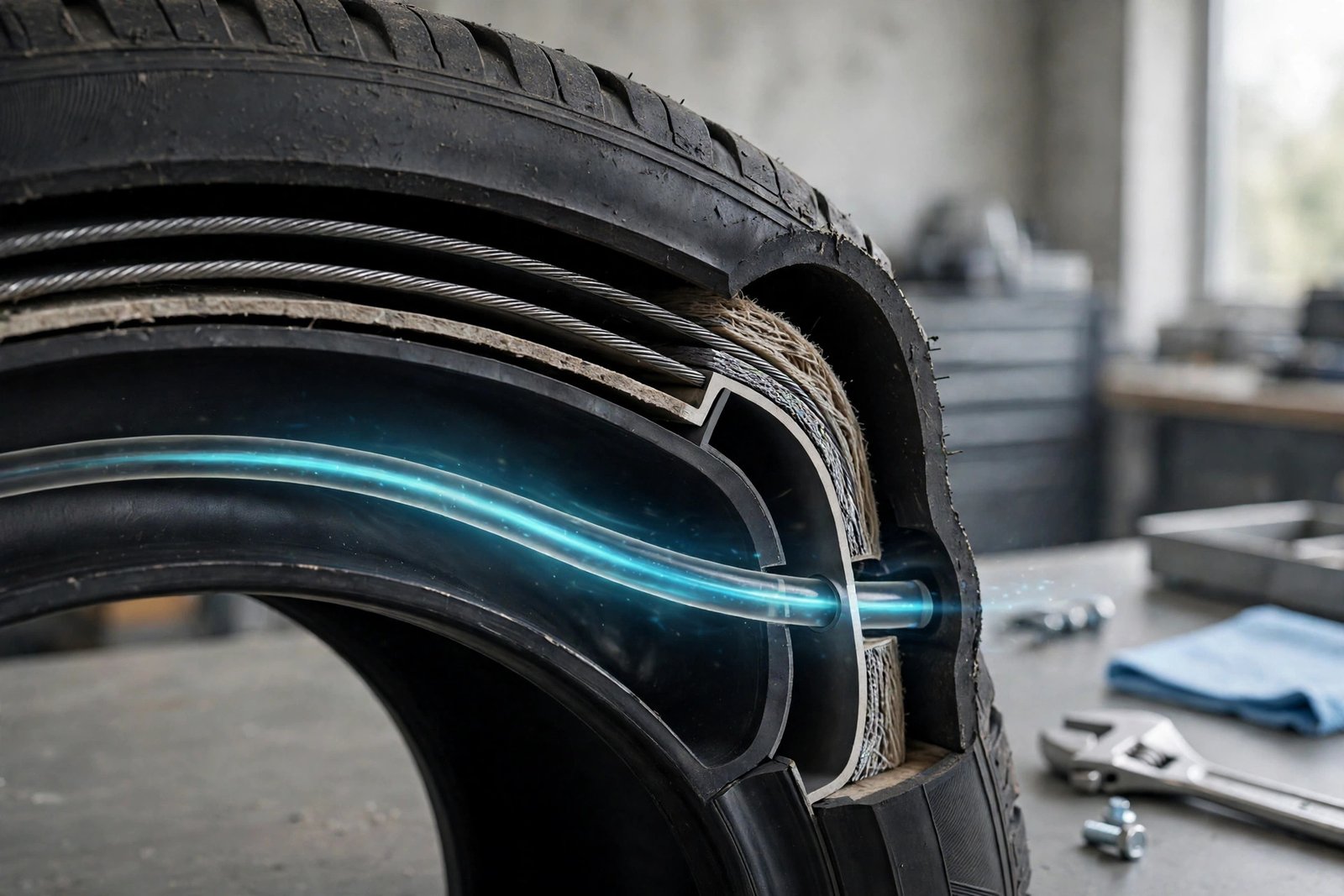
The mechanism is a peristaltic pump — the same squeezing principle your digestive tract uses to move food along. A tube is mounted inside the tire. When an internal sensor detects that pressure has dropped, a valve opens and lets outside air into the tube. As the tire rolls, the vehicle’s weight flattens the contact patch and squeezes the tube, pushing air along it and into the tire cavity. Once the tire is back at its target pressure, the valve closes. Goodyear’s project presentation to the US Department of Energy confirms that AMT “utilizes peristaltic pump technology to automatically maintain tire pressure at the optimum level.”
Development began in 2011, led by senior R&D associate Robert Benedict, who had led the project from its inception in 2009. The Department of Energy’s Office of Vehicle Technology provided a $1.5 million grant to support research, development, and demonstration of the commercial-vehicle version. In October 2014, Goodyear announced testing on North American trucking fleets, with multiple US and Canadian fleets running the system in normal daily operations over the following 18 months.
Note what kind of tire that was: a commercial truck tire, designed to survive multiple retreads and hold a specified cold inflation pressure chosen by the fleet. Goodyear showed a passenger-car version early on, but it has never gone on sale — no retail launch, no price, no fitment list. The DOE noted that proper inflation can improve gas mileage by up to 3%, which explains the appeal, but the business case pointed at fleets first, where a few percent across hundreds of trailers is real money.
CTIS: central inflation, from the battlefield
The central tire inflation system, or CTIS, is the oldest of the three ideas and the one with the most dramatic heritage. It is the system on the original Hummer H1, the civilian version of the military Humvee, and on a long line of military trucks before it. General Motors offered CTIS on its CUCV Blazers and pickups as early as 1984, and the technology was already decades old when MotorTrend tested it on an M939A2 5-ton military truck in 1991.
CTIS differs from AMT in one fundamental way: the driver is in charge. The point is not just to maintain one pressure, but to change pressure to suit the ground. Lower pressure spreads the tire over a bigger contact patch, which is what you want on sand, mud, or soft soil. Higher pressure is what you want on the highway, where a soft tire would overheat and wear fast. CTIS lets the driver pick a mode from the cab and have the system inflate or deflate the tires to match, without stopping.
The hardware is substantial: a wheel valve at each wheel for on-demand inflation and deflation, an electronic control unit — mounted behind the passenger seat in the Hummer — that processes commands and checks pressures every 10 minutes, a pneumatic control unit operating the valves, an operator panel for mode choices, and a speed sensor that airs the tires back up automatically if the driver forgets after leaving soft ground. Air comes from the brake compressor, with a pressure switch giving the brakes priority, and travels through the axle and hub to each tire.
In the 1991 MotorTrend test, settings ran from 80 psi for highway to 35 psi cross-country, 25 psi on sand, and 12–15 psi for emergencies, and reinflating back to highway pressure took 3 to 10 minutes — while the truck kept moving.
The key point for a car driver is what CTIS needs: an onboard air compressor, air lines through the axles, wheel valves, and a control system. That hardware makes sense on a military truck and has never been offered as standard equipment on a regular passenger car. The Hummer H1 was the exception that proves the rule, and it has been out of production for years.

Meritor MTIS: the one that actually ships
If AMT is the clever prototype and CTIS is the military specialist, Meritor’s Tire Inflation System — MTIS — is the workhorse. It is the only self-inflating system operating at genuine scale, and it does so by aiming at the simplest possible job: hold a freight trailer’s tires at one correct pressure, all the time, with no driver involvement.
MTIS harnesses the trailer’s existing air supply. Air is routed to a central control box, then into each axle, which acts as a conduit carrying air through a rotary union assembly to the tires. When a tire’s pressure drops, the system feeds it air until it is back at the set pressure. There is no pump inside the tire and no driver selecting modes. The trailer already has compressed air for its brakes; MTIS borrows it.
The scale is real. Cummins, which now owns the Meritor business, says MTIS is equipped on more than 1 million trailers, has been in service for more than 20 years, and fits all major trailer axle models in North America. A Federal Motor Carrier Safety Administration study quoted by Cummins found that maintaining tire pressure extends tire life by 10% and increases fuel economy by an average of 1.4%. MTIS also carries ThermALERT, a standard wheel-end heat sensor that alerts the driver to overheating before damage occurs.
Why has MTIS succeeded where AMT has not reached your car? A trailer is the perfect host: it already has an air supply, runs long distances at steady loads, and its tires are expensive and numerous. A passenger car has no onboard air compressor, no air-brake reservoir, and an owner who would have to pay for hardware to solve a problem a $15 gauge and five minutes a month already solves.

CODA SIT and the aftermarket dream
The fourth name you will meet in this space is SIT — Self Inflating Tire — from CODA Development, a Czech company. SIT predates Goodyear’s public AMT work. CODA engineers showed the system at the SAE World Congress in Detroit in 2008, where it won an Automotive Engineering Tech Award. Like AMT, it uses a peristaltic principle: a small cavity or tube chamber in the tire wall, plus an inexpensive managing valve that rotates with the tire and refills on every revolution. When tire pressure falls below the pressure in the cavity, the intake opens and delivers air; when the two equalize, refilling stops. CODA said the system needed no electronic controllers, pumps, or motors, and estimated the intake was open only 1% to 3% of the time under normal conditions.
That 2008 report carried a telling line: the system “has not yet been incorporated in any production vehicles.” CODA’s model was licensing, not manufacturing, and a later patent dispute with Goodyear — in which the Federal Circuit revived CODA’s inventorship claims in 2019 — changed nothing for drivers: no SIT-equipped tire has ever been sold at retail, and we found no retail product, price, or fitment offering for SIT in 2026.
That matters because aftermarket “self-inflating” claims still circulate online, often attached to old articles describing SIT as if it were something you can order. Treat any such listing with skepticism. A genuine self-inflating tire would be built into the tire during manufacturing — it is not a valve cap, a sealant, or an accessory you screw on.
Can you buy self-inflating tires for your car in 2026?
No. That is the honest answer, and it is worth stating plainly because so much content on this topic implies otherwise. As of 2026:
- Goodyear AMT has been fleet-tested on commercial trucks but has no passenger-car retail product, price, or launch date.
- CTIS is military and heavy-vehicle equipment. The one civilian vehicle famous for it, the Hummer H1, is long out of production.
- Meritor MTIS is a trailer system. It needs a trailer air supply and trailer axles, and it is sold to fleets, not to car owners.
- CODA SIT is a licensed patent portfolio, not a product on sale.
What you can buy is the next best thing. Every car sold new in the US since the 2008 model year has TPMS fitted by law, warning you when a tire drops significantly below its recommended pressure. TPMS does not add air, but it removes the main reason tires stay underinflated: nobody notices. If your TPMS light misbehaves, see our guides on how to tell if a TPMS sensor is bad, tire pressure light still on after filling tires, and service tire monitor system meaning.
The other half of the substitute costs very little: a decent gauge, a monthly check when the tires are cold, and a portable 12-volt inflator in the trunk. That combination gives you the two things a self-inflating tire promises — knowing your pressure and fixing it — for the price of a tank of gas.

What self-inflating tires cannot do
Even the real systems have limits worth knowing:
- They cannot fix a flat. A blowout or large puncture overwhelms any inflation system. CTIS can compensate for a slow leak for a while; nothing compensates for a tire that will not hold air.
- They cannot replace inspection. A tire can hold perfect pressure and still be worn out, cracked, or damaged. Our guide to how to check tire tread depth covers the checks no inflation system performs.
- They cannot set the right pressure by themselves. Every system works to a target pressure that has to be correct for the vehicle and load. The placard on your driver’s door jamb is still the authority.
- They add failure points. Air lines, rotary unions, valves, and in-tire pumps can all leak, clog, or wear. Fleets measure that trade-off and accept it. On a passenger car, it has never clearly paid.
The verdict
Self-inflating tires are real technology with a 40-year history. Military trucks have adjusted pressure from the cab since the 1980s, more than a million freight trailers inflate automatically today, and an in-tire pump powered by rolling has been fleet-tested. What has not happened is a version you can buy for a regular car. Keep your TPMS healthy, check pressures monthly, and keep a portable inflator handy. Until a retail self-inflating tire arrives with a price, a warranty, and a fitment list, the five-minute monthly check remains the most reliable self-inflation system ever fitted to a passenger car: you.

Frequently asked questions
Can you buy self-inflating tires for a regular car?
No. As of 2026, no self-inflating tire is sold at retail for passenger cars in the United States. Goodyear’s Air Maintenance Technology stayed in commercial fleet testing, CODA Development’s SIT system never reached a production vehicle, and central inflation and fleet systems are built for military and freight vehicles with onboard air supplies. The practical substitute is a working TPMS, a monthly gauge check, and a portable inflator.
How do self-inflating tires work?
It depends on the system. Goodyear’s AMT uses a peristaltic tube inside the tire: as the tire rolls, the vehicle’s weight squeezes the tube and pushes outside air into the tire until a regulator closes the valve. Central tire inflation systems (CTIS) and Meritor’s MTIS draw on the vehicle’s onboard compressed-air supply and route air through the axle and hub into the tire.
Do self-inflating tires fix a flat tire?
No. Self-inflating systems top up slow, everyday pressure loss and small leaks; they cannot keep a tire going after a blowout or a large puncture. A tire that will no longer hold air needs repair or replacement, and a central inflation system can only buy time on a slow leak.
What is Goodyear Air Maintenance Technology (AMT)?
Air Maintenance Technology is Goodyear’s in-tire self-inflation system, developed with a $1.5 million US Department of Energy grant. It uses peristaltic pump technology fully contained within the tire to hold a specified cold inflation pressure without external pumps or electronics. Goodyear began testing AMT on North American trucking fleets in 2014, and no passenger-car version has gone on sale.
What is the difference between CTIS and MTIS?
CTIS (central tire inflation system) lets the driver change tire pressure from the cab to suit the terrain — lower for sand or mud, higher for the highway — and is best known from military vehicles such as the Humvee. MTIS (Meritor Tire Inflation System) is an automatic system for freight trailers that holds one set pressure using the trailer’s existing air supply, with no driver input.
Do self-inflating tires replace TPMS?
No. A tire pressure monitoring system warns you when pressure has dropped; a self-inflating system adds air to bring it back up. They solve different halves of the problem. Every new light vehicle sold in the US since the 2008 model year has TPMS fitted by law, and that requirement stands whether or not the tire can inflate itself.