
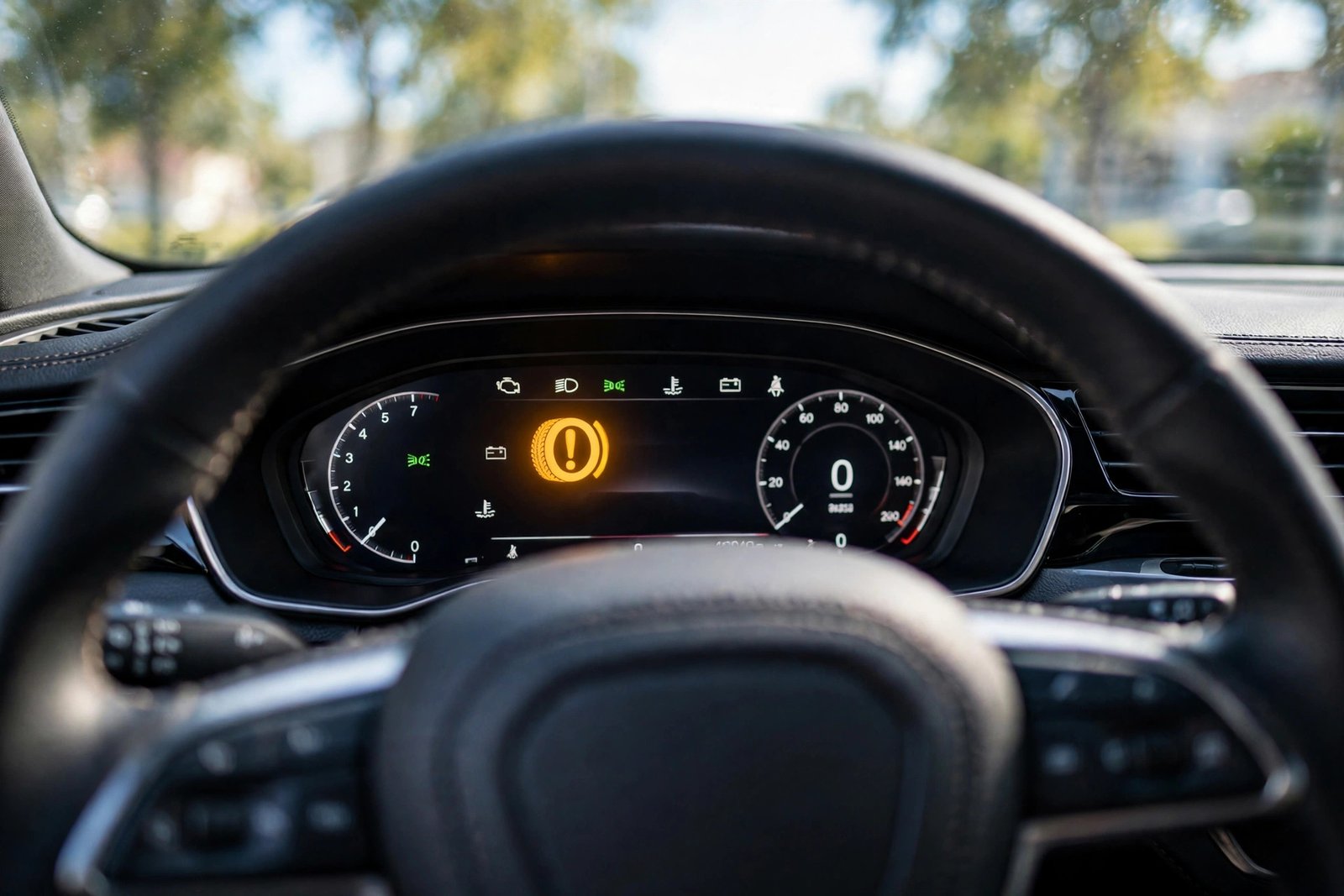
Quick answer: Yes — most cars let you reset TPMS without any tool. First, inflate every tire (including the spare, if monitored) to the pressure on the driver’s door-jamb placard. Then try, in order: (1) a 10–20 minute drive at steady speed, (2) the TPMS reset button under the dash, held until the light blinks, or (3) the tire-pressure calibration setting in your dashboard or infotainment menu. One of those three clears the light on most cars. The other methods below cover GM’s horn-chirp relearn without a tool and two last-resort tricks.
That glowing tire-pressure light is annoying — especially when you have already added air and the tires look fine. The good news is that a basic TPMS reset is a free, do-it-yourself job on most cars. You do not need a scan tool, a relearn tool, or a shop visit just to clear the warning.
This guide covers only the no-tool methods: the ones you can do from the driver’s seat with nothing more than a tire pressure gauge and your owner’s manual. If your car needs a sensor relearn with a tool, or you just had new sensors installed, that is a different job — our full guide to how to reset TPMS explains when a tool is genuinely needed, and our guide to how to program TPMS sensors covers the three relearn methods.
Before You Touch Anything: Set the Pressures First

Every method below assumes the tires are already at the right pressure. This step is not optional, and skipping it is the number one reason resets “don’t work.”
A TPMS reset does not measure anything. It tells the car: “whatever the tires are right now is the new normal.” Reset with a tire still low and you have just taught the car that underinflated is fine — the warning that was supposed to protect you is gone, and the tire is still low.
- Check cold. Parked at least three hours, or driven less than a mile. Pressure rises as tires warm up, so a warm reading misleads you. Pressure also drops about 1 PSI for every 10°F drop in temperature, which is why the light loves cold mornings.
- Use a gauge, not the dashboard. A few PSI of error is all it takes to keep the light on.
- Use the door-jamb placard, not the sidewall. The number molded into the tire sidewall is the tire’s maximum pressure, not your target. The right number is on the sticker inside the driver’s door frame or in the owner’s manual — front and rear sometimes differ.
- Check all four tires — and the spare. Some cars monitor the spare, and a low spare keeps the light on even when the four road tires are perfect.
- Be precise. If the placard says 35 PSI, set 35. Some systems stay lit over a 2–3 PSI shortfall.
Know Which System You Have: Direct vs Indirect
Your car has one of two TPMS designs, and the right no-tool method depends on which one:
- Direct TPMS has a small battery-powered pressure sensor inside each wheel. It measures actual pressure and radios the readings to the car. Most Toyota, Ford, GM, Nissan, Hyundai, Tesla, and BMW models use it. On these cars, fixing the pressure and driving is often enough — the light clears itself.
- Indirect TPMS has no sensors in the wheels. It watches wheel speed through the ABS system: an underinflated tire rolls slightly faster. Most Honda, Volkswagen, and Audi models use it. These systems almost always need a manual reset (called calibration or initialization) after every pressure change, because they cannot sense pressure directly.
Your owner’s manual says which system you have. One more distinction matters before you start: a steady light means low pressure or an unfinished calibration, while a light that flashes for 60–90 seconds at startup and then stays solid means the monitoring system itself has a fault — a dead sensor or a module problem no reset will fix. If yours flashes, read our flashing tire pressure light guide before going further.
Method 1: The Drive Cycle (Auto Reset)

Best for: most direct-TPMS cars — Nissan, Hyundai, Kia, Tesla, Ford, and many others. Try this first: it costs nothing and works more often than people expect.
- Confirm all four tires (and the spare, if monitored) are at placard pressure, checked cold with a gauge.
- Start the engine and drive at a steady 30–50 mph for 10–20 minutes. Highway driving in a straight line works best; constant stop-and-go traffic is less effective.
- Watch the dashboard. The light should go out during or shortly after the drive.
Why it works: the wheel sensors only transmit when spinning, which is why a parked reset attempt fails on these cars. Once they wake up at speed and report correct pressures, the computer clears the warning by itself.
If the light is still on after a proper 20-minute drive with verified pressures, your car likely needs a manual method below — or the problem is not the procedure. Skip to the troubleshooting section.
Method 2: The TPMS Reset Button
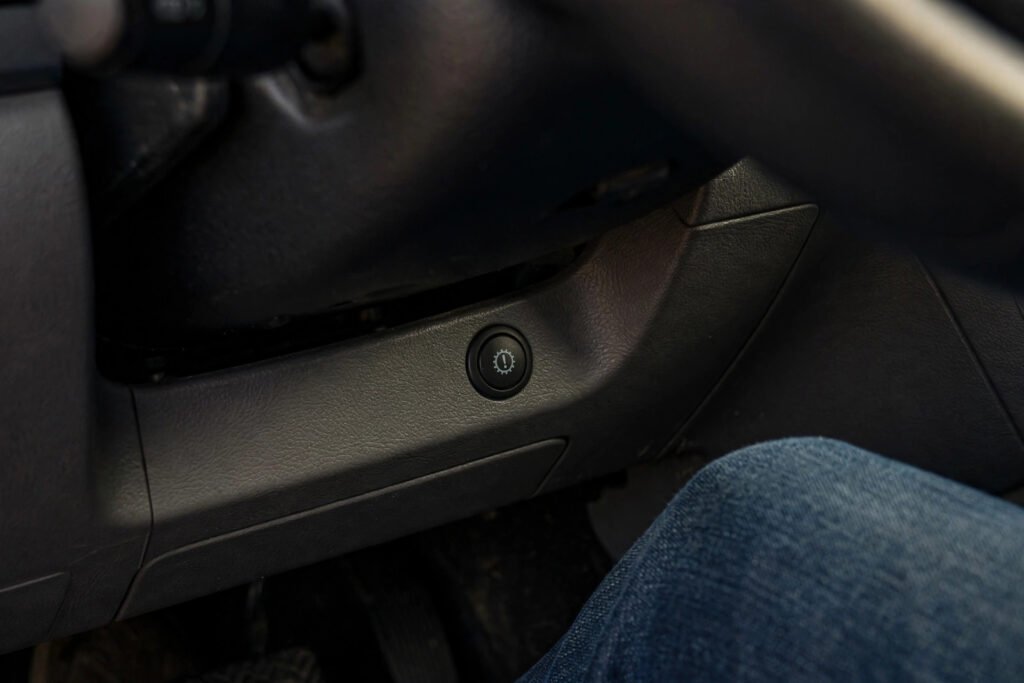
Best for: Toyota, Lexus, older Honda models, and some others with a physical button.
- With tires at the correct pressure, park the car and turn the ignition to ON without starting the engine. On a push-button start car, press the start button twice without touching the brake.
- Find the button. Look low on the dashboard under or to the left of the steering column, inside the glove box, or near the center console. It is marked with the tire-pressure symbol (a horseshoe-shaped tire cross-section with an exclamation mark) or the letters TPMS or SET. Your manual’s instrument-panel illustration pinpoints it.
- Press and hold the button until the TPMS light blinks — commonly three slow flashes — then release.
- Start the engine and drive for 10–20 minutes at normal road speeds to finish the calibration.
The blinking light means the reset has started, not finished. Driving off too soon or skipping the drive is the most common reason this method appears to fail — the system needs rolling data to store the new baseline.
Method 3: The Dashboard or Infotainment Menu

Best for: newer cars with no physical button, especially Honda, Volkswagen, Audi, and newer Toyota models.
- With tires at the correct pressure, park the car and switch the power on as your manual instructs (engine running or accessory mode).
- Open the vehicle settings — look under Settings → Vehicle → Tire Pressure, or in the instrument-cluster menu — for an option named TPMS Calibration, Calibrate, Initialize, or Store Pressures. On many Hondas the path is Settings → Vehicle → TPMS Calibration → Calibrate.
- Select it, confirm, and wait for the message that the system has been reset.
- Complete the drive your manual specifies. On indirect systems this calibration drive is mandatory — commonly around 30 minutes of cumulative driving at moderate speeds on Hondas — because the car needs rolling data to learn the new baseline.
No TPMS option in your menus? Your car either updates automatically (Method 1) or needs a relearn tool — see the full how to reset TPMS guide for the tool method.
Method 4: GM Horn-Chirp Relearn Without a Tool
Best for: many Chevrolet, GMC, Buick, and Cadillac models. This is the one no-tool method that actually teaches the car the sensor positions — but it only works when the sensors are already known to the car (for example, after a tire rotation), not after installing brand-new sensors.
- Set the parking brake and inflate all tires to placard pressure.
- Turn the ignition to ON with the engine off.
- Enter learn mode: on many GM vehicles, press and hold the LOCK and UNLOCK buttons on the key fob at the same time for about 5 seconds. The horn sounds twice and the Driver Information Center shows “TIRE LEARNING ACTIVE.” Without a fob, use the DIC buttons or the trip odometer reset stem — your manual gives the exact sequence.
- Starting with the driver-side front tire, let air out of the valve stem until the horn chirps once. That chirp confirms the sensor is matched. Stop letting air out immediately.
- Repeat in order: passenger-side front, passenger-side rear, driver-side rear. The order is always front left → front right → rear right → rear left.
- Two horn chirps after the last tire mean the process is complete.
- Go back around all four tires and re-inflate each one to the placard pressure, then turn the car off and back on. The TPMS light should be out.
Watch the clock: on GM vehicles you typically have 2 minutes to match the first tire and 5 minutes total for all four. If you run out of time, the process stops and you must start over. Know the order and have a gauge ready before you enter learn mode. And be honest with yourself: letting air out of four tires one by one is slow and messy, and a cheap TPMS trigger tool does the same job in seconds — but if you have no tool, this method works.
Method 5: The Overinflate-and-Deflate Trick (Unofficial)
Best for: a stubborn system that stays lit even though pressures are verified correct. This is not a manufacturer procedure — it is a workaround drivers report using — so try the methods above first.
- Inflate all four tires to about 3–5 PSI above the door-jamb pressure.
- Drive for 5–10 minutes.
- Park, then set all four tires back to the exact placard pressure.
- Drive again for 10–15 minutes.
The idea is to force the sensors to detect a clear pressure change, which can wake up a system that is slow to recognize small corrections. Do not exceed the tire’s maximum pressure printed on the sidewall, and do not use this trick if your pressures are already close to that maximum.
Method 6: Battery Disconnect (Last Resort Only)
Disconnecting the battery can sometimes clear a TPMS warning by wiping the system’s stored memory — but treat this as the last thing you try, not the first.
- Turn the engine off and remove the key.
- Disconnect the negative (black) battery terminal.
- Wait 10–15 minutes.
- Reconnect the negative terminal, start the engine, and drive for a few miles.
Be clear about the trade-offs before you do this: it does not fix low pressure, does not register new sensors, and does not repair a faulty sensor — so if the underlying problem is real, the light will simply come back. It also wipes your radio presets, clock, and learned engine settings, and on some cars it can trigger other warning lights that need a drive to clear. Our main how to reset TPMS guide advises against it for exactly these reasons. If Methods 1–5 have all failed, a shop scan is usually the better next step than a battery reset.
Which Method Fits Your Car?
| Brand | Most likely no-tool method | Notes |
|---|---|---|
| Toyota / Lexus | Reset button, or menu on newer models | Hold button until light blinks 3 times, then drive |
| Honda / Acura | Menu calibration (TPMS Calibration) | Needs ~30 min cumulative drive to finish |
| GM (Chevy, GMC, Buick, Cadillac) | Horn-chirp relearn (Method 4) or drive cycle | Air-bleed method works without a tool |
| Ford / Lincoln | Drive cycle | Some trucks monitor the spare — check it |
| Nissan / Hyundai / Kia / Tesla | Drive cycle only | No reset button on most models |
| BMW / Mercedes / VW / Audi | Menu calibration or drive cycle | Check iDrive/MMI/vehicle settings |
Procedures differ by model year, so treat this table as a starting point and confirm the exact sequence in your owner’s manual. Two cars from the same brand, three years apart, can use completely different methods.
When No-Tool Methods Won’t Work
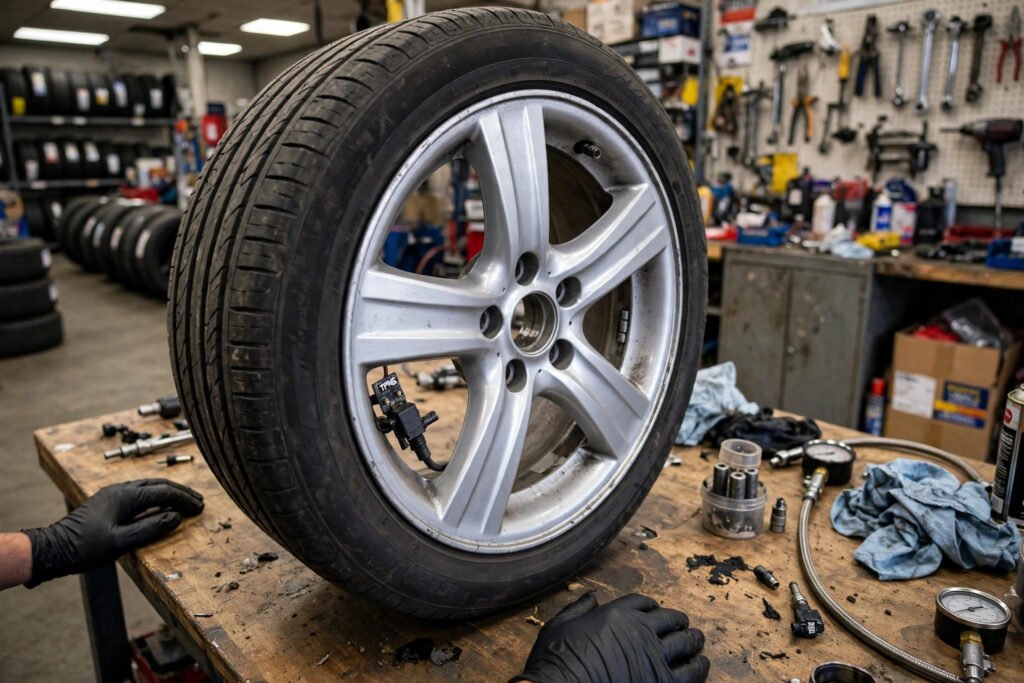
If you have set the pressures cold, tried the right method for your car, and completed the drive — and the light is still on — the problem is usually one of these:
- A tire keeps losing air. A nail, a bad valve stem, or a bead leak means no reset will hold. Find the leak first.
- The light flashes at startup. A flashing-then-solid light means a system fault. See our flashing tire pressure light guide.
- A sensor battery is dead. Direct-TPMS sensors run on sealed batteries lasting roughly 5–10 years; on a 7+ year-old car, a silent sensor usually means replacement. Our TPMS sensor replacement cost guide puts it at typically $50–$250 per wheel, parts and labor included.
- New sensors were installed. A reset only re-checks pressures against sensors the car already knows. New sensors have new IDs, so the car needs a relearn — see how to program TPMS sensors.
- A “Service Tire Monitor System” message appears. That is a system message, not a low-pressure warning. Our guide to the service tire monitor system meaning explains what it means and what to do.
- Mismatched tire sizes. On indirect systems, different-sized tires confuse the wheel-speed comparison. All four tires should match the manufacturer’s specification.
If the light flashes at every startup, the tires hold pressure, and nothing above helped, get a TPMS scan at a tire shop. Their tool reads each sensor’s ID, battery status, and signal strength — it finds the failed part in minutes, which beats replacing good sensors by guesswork. Under U.S. federal standard FMVSS No. 138, TPMS has been required on new passenger vehicles since the 2008 model year, and the system must warn when a tire drops 25% or more below the recommended cold pressure — so the light is a safety backstop, not a decoration. Tire Rack’s TPMS guide is a useful reference for how the sensors themselves work.
The Verdict
Resetting TPMS without a tool is a 10-minute job on most cars: set the pressures cold, then drive, press the button, or run the menu calibration — whichever your car uses. The drive cycle alone fixes it more often than people expect, and the reset button and menu methods cover nearly everything else.
The honest limit is this: no-tool methods reset the system, they do not repair it. If the light flashes, if a sensor is dead, or if new sensors were just installed, no amount of button-pressing will help — that is when a shop scan or a proper relearn earns its money. But for the everyday case — you topped up the air and the light will not go away — you now have every free method worth trying, in the order worth trying them.
Frequently Asked Questions
Can you reset TPMS without a tool?
Yes, on most cars. Inflate all tires to the door-jamb placard pressure, then use the drive cycle, the TPMS reset button, or the tire-pressure calibration setting in your dashboard or infotainment menu. No scan tool or relearn tool is needed for a basic reset on most vehicles.
How long do you have to drive to reset TPMS?
Usually 10 to 20 minutes of steady driving at 30 to 50 mph or higher. Some Hondas need around 30 minutes of cumulative driving to finish calibration. If the light is still on after a proper drive with correct pressures, try a manual reset method or check for a fault.
Where is the TPMS reset button?
On cars that have one, it is usually low on the dashboard under or to the left of the steering column, inside the glove box, or near the center console. It is marked with the tire-pressure symbol or the letters TPMS or SET. Many newer cars have no button and use a menu setting instead.
Will disconnecting the battery reset TPMS?
Sometimes it clears the warning temporarily, but it does not fix low pressure, register new sensors, or repair a faulty sensor, and it wipes your radio presets, clock, and learned engine settings. Treat it as a last resort only, after the drive cycle, button, and menu methods have failed.
Why won’t my TPMS light go off after filling the tires?
The most common reasons are a pressure still a few PSI below the placard spec, a low spare tire that the system monitors, an unfinished calibration drive, or a sensor fault. A light that flashes for 60 to 90 seconds at startup, then stays solid, means a system fault, not low pressure.
Do I need a tool to reset TPMS after new sensors?
Often, yes. A reset only re-checks pressures against sensors the car already knows. New sensors have new IDs the car has never seen, so they usually need a relearn with a TPMS tool or a shop visit. See our guide to how to program TPMS sensors for the three relearn methods.