
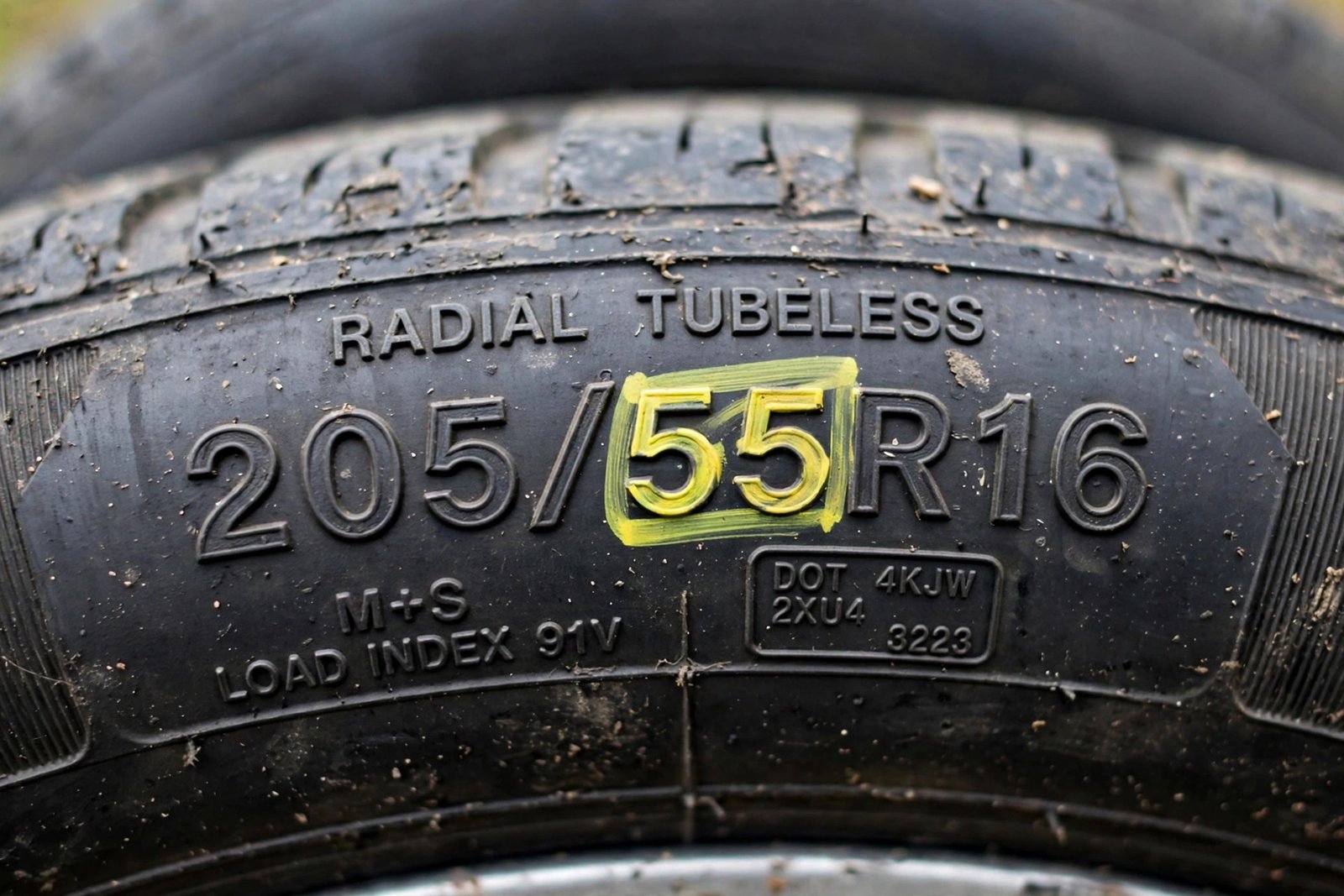
Every tire has a code stamped on its sidewall, and one number in that code quietly decides how your car rides, how it handles corners, and how much punishment your wheels can take from a pothole. That number is the aspect ratio — and once you know how to read it, you will never look at a tire the same way again.
Quick Answer: Tire aspect ratio is the height of a tire’s sidewall expressed as a percentage of the tire’s width. In the size 205/55R16, the aspect ratio is 55 — meaning the sidewall is 55% as tall as the tire is wide. A higher number means a taller, softer sidewall; a lower number means a shorter, stiffer "low profile" sidewall.
Decoding the Sidewall Code: 205/55R16
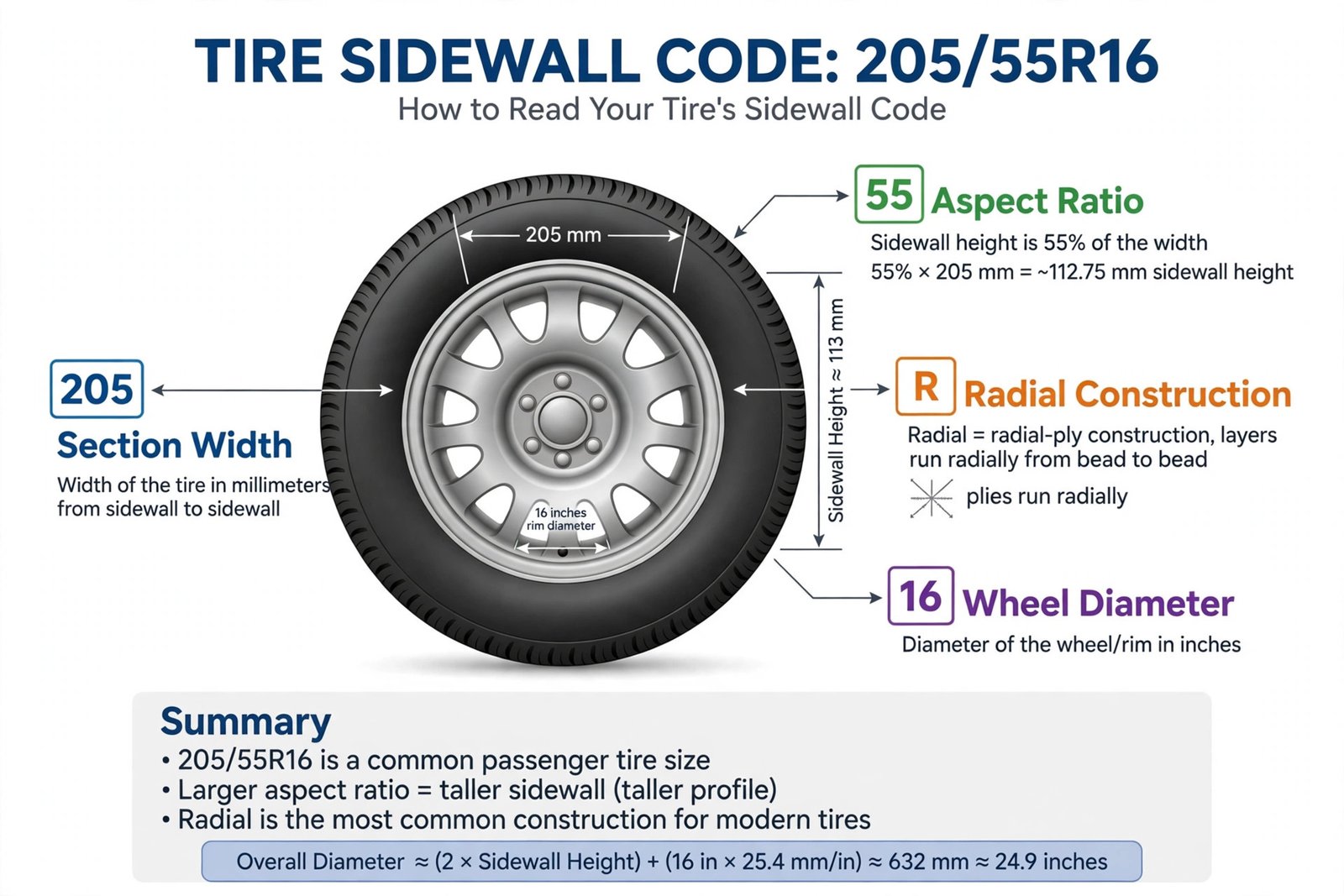
The aspect ratio does not sit on the sidewall alone. It is the middle piece of a standardized code that describes the whole tire. Here is what each part of 205/55R16 means:
| Code Part | Value | What It Means |
|---|---|---|
| 205 | Tire width | Section width in millimeters, measured sidewall to sidewall |
| 55 | Aspect ratio | Sidewall height as a percentage of the width (55%) |
| R | Construction | Radial construction — the industry standard for passenger tires |
| 16 | Wheel diameter | Rim diameter in inches |
A leading letter sometimes appears before the width — P for passenger vehicle tires and LT for light truck tires — and load index and speed rating numbers follow the size. But for everyday drivers, those three numbers are the ones that matter most.
The key point beginners miss: the aspect ratio is a percentage, not a measurement. A "55" does not mean 55 millimeters or 55 inches. It means the sidewall height equals 55% of whatever the tire’s width is. That is why the same aspect ratio can produce very different sidewall heights on tires of different widths — a 55 on a 205 mm tire is shorter than a 55 on a 265 mm tire.
How to Calculate Sidewall Height (With Real Examples)
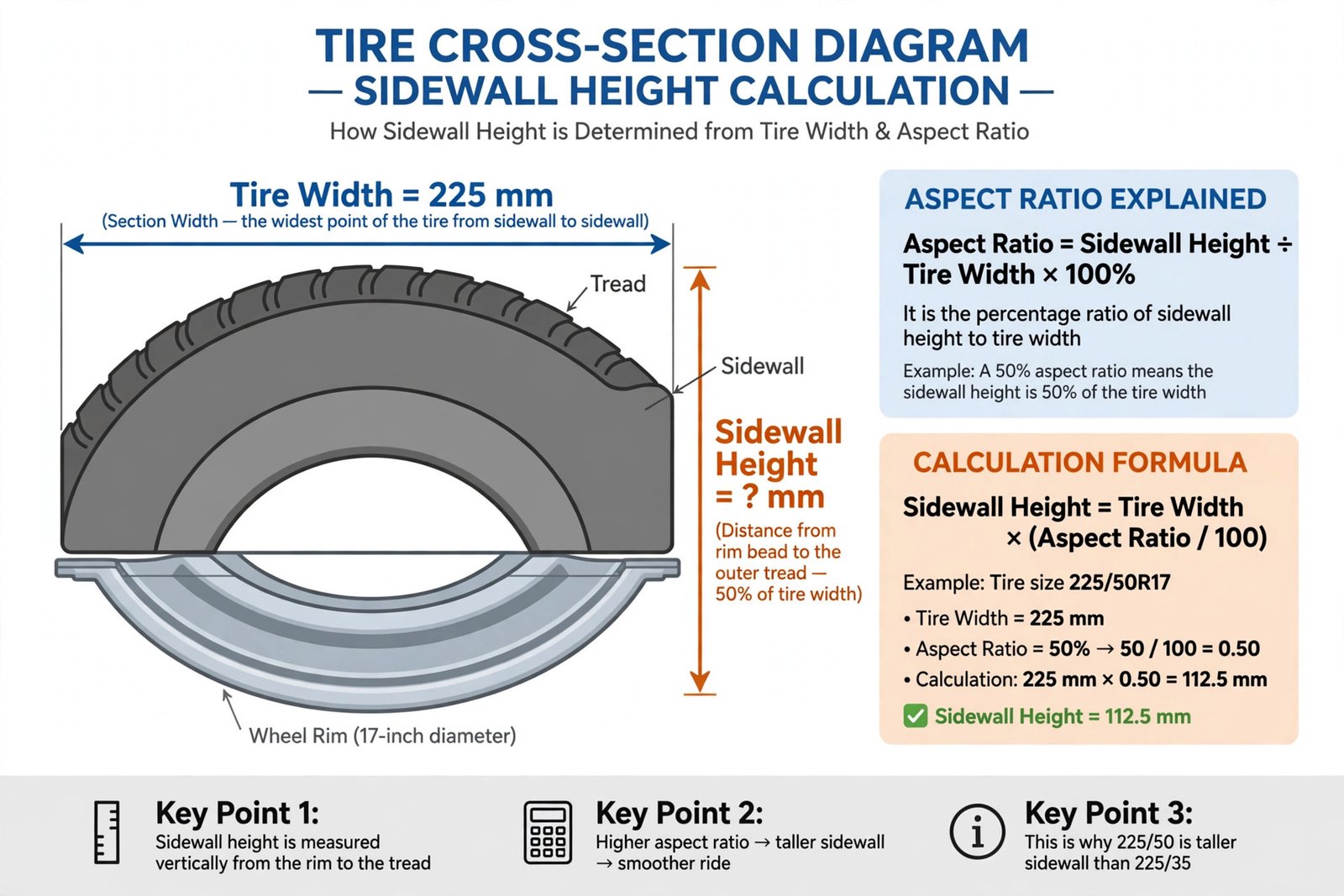
The formula is simple:
Sidewall height = tire width × aspect ratio (as a decimal)
To get the overall tire diameter — the number that actually matters for fitment and your speedometer — add the sidewall height twice (once for the top, once for the bottom) to the wheel diameter:
Overall diameter = wheel diameter + (2 × sidewall height)
Let’s work through three real tire sizes, step by step.
Example 1: 205/55R16 — a common sedan size
- Sidewall height: 205 × 0.55 = 112.75 mm
- In inches: 112.75 ÷ 25.4 = 4.44 inches
- Overall diameter: 16 + (2 × 4.44) = 24.88 inches
Example 2: 215/65R15 — a common crossover size
- Sidewall height: 215 × 0.65 = 139.75 mm
- In inches: 139.75 ÷ 25.4 = 5.50 inches
- Overall diameter: 15 + (2 × 5.50) = 26.00 inches
Example 3: 265/70R17 — a common pickup truck size
- Sidewall height: 265 × 0.70 = 185.50 mm
- In inches: 185.50 ÷ 25.4 = 7.30 inches
- Overall diameter: 17 + (2 × 7.30) = 31.61 inches
Notice what the math reveals: the truck tire’s sidewall is nearly 3 inches taller than the sedan tire’s (7.30 vs. 4.44 inches). That extra rubber is doing real work — absorbing bumps, protecting the wheel, and smoothing out rough roads. Here are a few more common sizes for comparison:
| Tire Size | Sidewall Height | Overall Diameter | Typical Use |
|---|---|---|---|
| 235/45R18 | 105.75 mm (4.16 in) | 26.33 in | Sports sedans |
| 205/55R16 | 112.75 mm (4.44 in) | 24.88 in | Compact sedans |
| 225/60R16 | 135.00 mm (5.31 in) | 26.63 in | Crossovers, minivans |
| 215/65R15 | 139.75 mm (5.50 in) | 26.00 in | Crossovers, small SUVs |
| 265/70R17 | 185.50 mm (7.30 in) | 31.61 in | Pickup trucks, off-road SUVs |
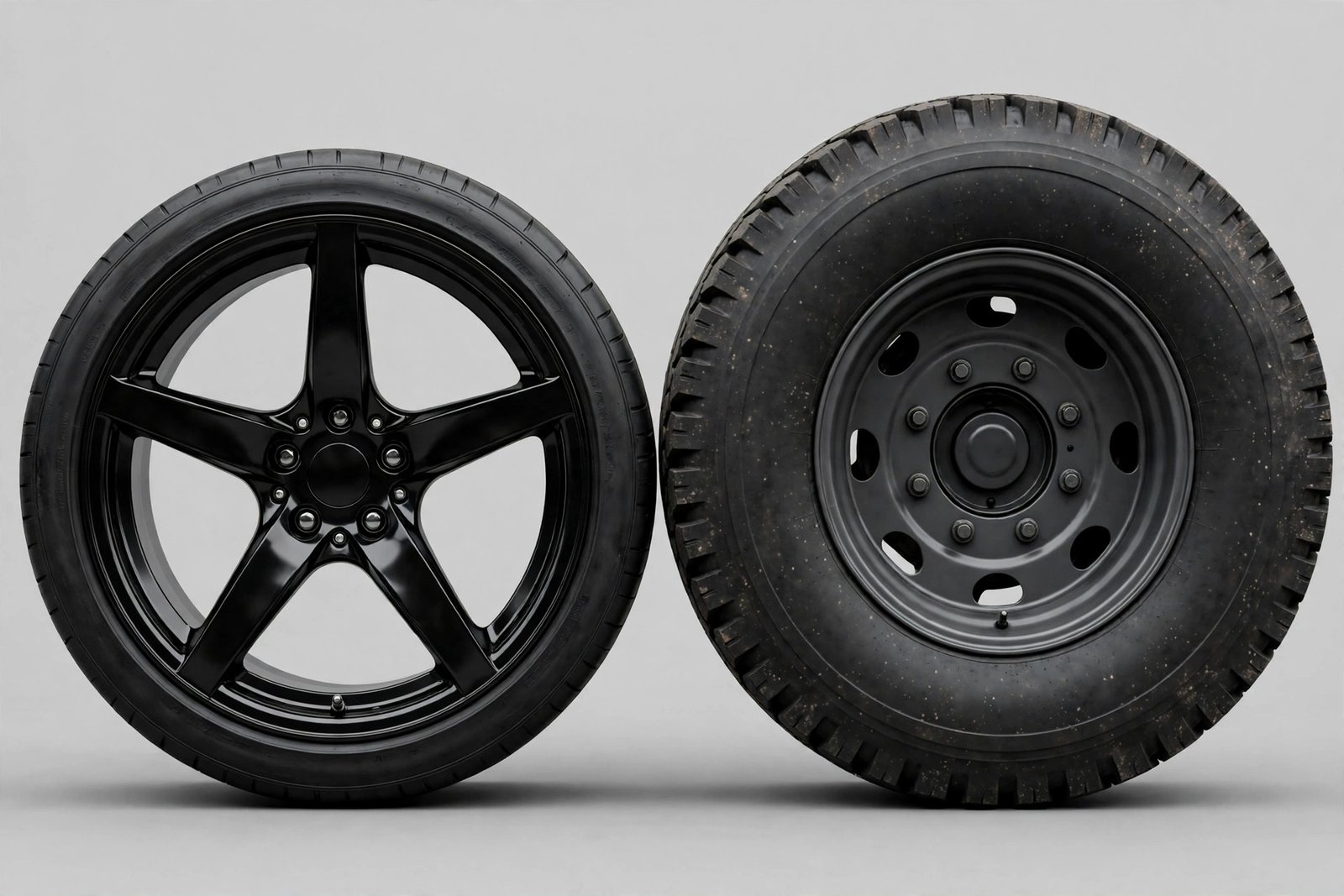
Low Profile vs. High Profile: What the Numbers Feel Like on the Road
Tires are generally grouped into three profile bands:
- Low profile (30–45): short, stiff sidewalls. Common on sports cars and performance sedans.
- Standard profile (50–65): the balanced middle ground. Most sedans, crossovers, and family cars live here.
- High profile (70–85): tall, flexible sidewalls. Standard on trucks, off-road SUVs, and vehicles built for rough roads.
The sidewall is basically a spring. A tall one flexes and absorbs; a short one stays rigid and transmits. That single difference drives a whole set of trade-offs:
| Factor | Low Aspect Ratio (30–45) | High Aspect Ratio (70–85) |
|---|---|---|
| Ride comfort | Firmer — you feel more of the road | Softer — bumps are absorbed before they reach you |
| Handling & steering | Sharper, more direct response | Slightly slower, more body roll in corners |
| Pothole protection | Less cushion — wheels bend or crack more easily | More rubber to absorb impacts |
| Road noise | Often a bit louder | Usually quieter |
| Looks | Sporty, aggressive stance | Practical, rugged look |
| Winter traction | Taller sidewalls generally bite better in snow | Better — more flex helps the tread conform to uneven surfaces |
There is no "best" aspect ratio — only the right one for the job. A sports car with 75-profile tires would feel vague and sloppy in corners. A pickup truck with 35-profile tires would ride like a go-kart and destroy its wheels on the first bad road. Your car’s engineers picked the factory ratio to balance comfort, handling, load capacity, and clearance for that specific vehicle.
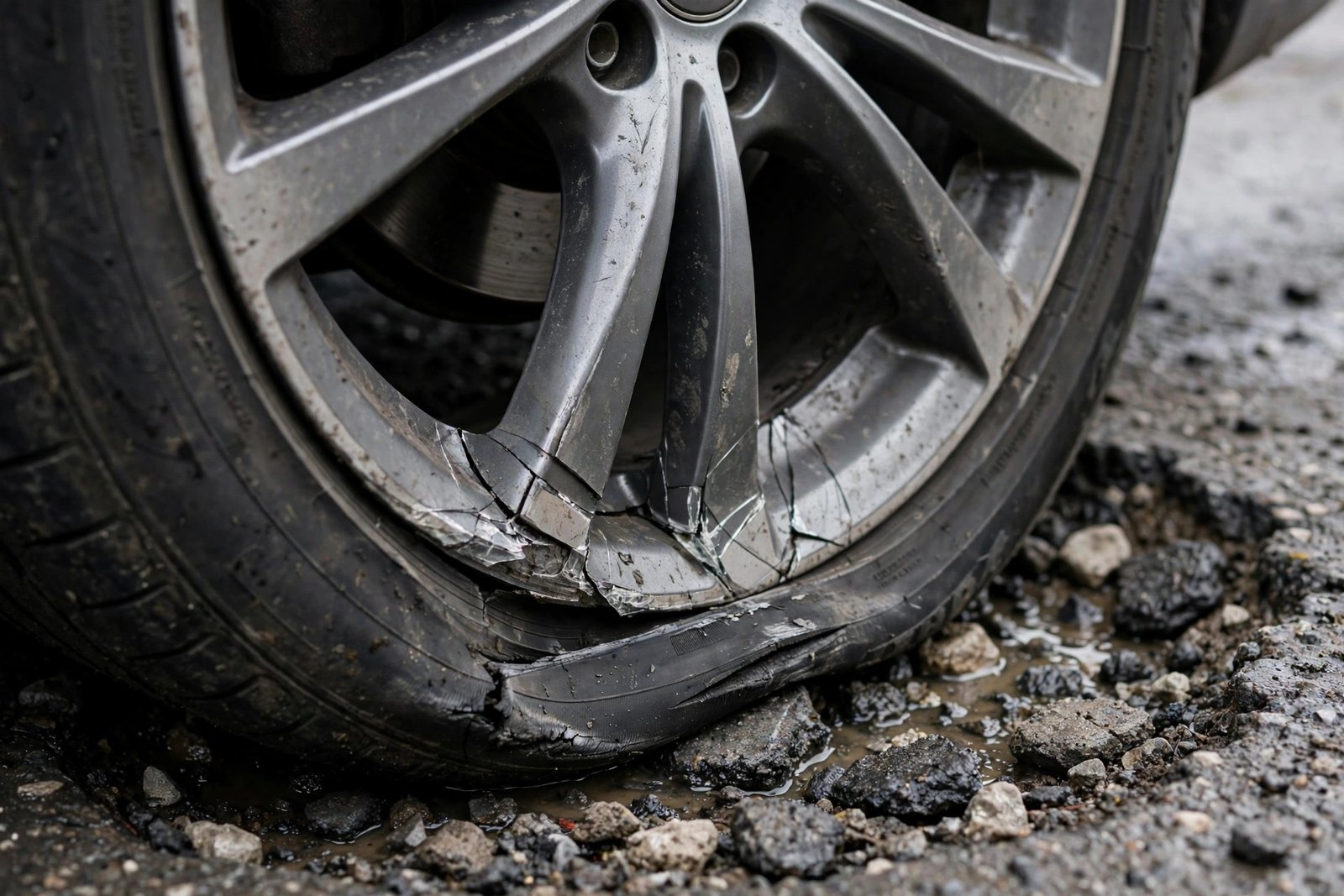
One trade-off that surprises people: low-profile tires are more vulnerable to pothole damage. With only about 4 inches of sidewall between the rim and the road (like our 235/45R18 example), a sharp-edged pothole can pinch the tire against the wheel and crack the rim. If your local roads are rough, that is a genuine reason to think twice before going lower.
Common Aspect Ratios by Vehicle Type
If you are shopping for tires and wondering what is normal for your kind of vehicle, this table is a good starting point:
| Vehicle Type | Common Aspect Ratios | Why |
|---|---|---|
| Sports cars & performance sedans | 30–45 | Maximum steering precision and grip |
| Compact & midsize sedans | 50–60 | Balance of comfort and handling |
| Crossovers & family SUVs | 55–65 | Comfort-first with decent handling |
| Minivans | 60–65 | Soft ride for passengers and cargo |
| Pickup trucks | 65–75 | Load carrying and rough-road durability |
| Off-road SUVs & 4x4s | 70–85 | Maximum cushioning and sidewall flex on trails |
These are typical ranges, not rules. Always check the size your vehicle was designed for before buying — it is printed on the driver’s door-jamb sticker and in your owner’s manual.
What Happens If You Change the Aspect Ratio?
Changing the aspect ratio is possible, and people do it all the time — usually to get a sportier look or a softer ride. But because the ratio changes the tire’s overall diameter, it has consequences you need to understand first.
Your speedometer and odometer will read wrong
Your speedometer is calibrated to your factory tire diameter. A larger-diameter tire covers more ground per revolution, so the car travels faster than the speedometer shows.
Take a real example: switching from 205/55R16 (24.88 in diameter) to 205/60R16 (25.69 in diameter) makes the tire 3.3% larger. At an indicated 60 mph, you would actually be traveling about 62 mph. Your odometer would also under-report mileage, which can quietly affect warranty and service intervals.
The 3% rule of thumb
Tire professionals generally recommend keeping the overall diameter within about 3% of the original size. Stay inside that window and the speedometer error, gearing, and clearance changes stay small. Go beyond it and you risk rubbing against the wheel wells, confusing the ABS and traction control systems, and throwing off the speedometer by a margin that matters. Note that our 205/55R16 → 205/60R16 example above is already at 3.3% — just past the line.
How to change ratio safely: the "plus sizing" trick
The safe way to go lower profile is plus sizing — increase the wheel diameter at the same time so the overall diameter stays nearly the same. For example, moving from 205/55R16 to 225/45R17 keeps the overall diameter close (24.88 in vs. about 24.97 in) while giving you a sportier, lower-profile look. A tire size calculator can check the math before you spend money, and your tire shop should confirm the fit.
Other things to check before changing
- Clearance: wider or taller tires can rub on suspension parts or fender liners, especially at full steering lock.
- Load capacity: the new tire must carry at least as much weight as the original — check the load index.
- TPMS: your tire pressure monitoring system still works, but pressure recommendations are set for the factory size, so confirm the right inflation pressure for the new size. If your TPMS light ever starts acting up, see our guide on the flashing tire pressure light.
- Seasonal needs: if you are changing sizes for winter, remember that taller sidewalls generally handle snow better — see our all-season vs. winter tires guide before deciding.
How to Find Your Tire’s Aspect Ratio
You do not need any tools — just look in one of these three places:
- The tire sidewall. The size code is molded into the rubber, for example P215/65R15. The number right after the slash is your aspect ratio.
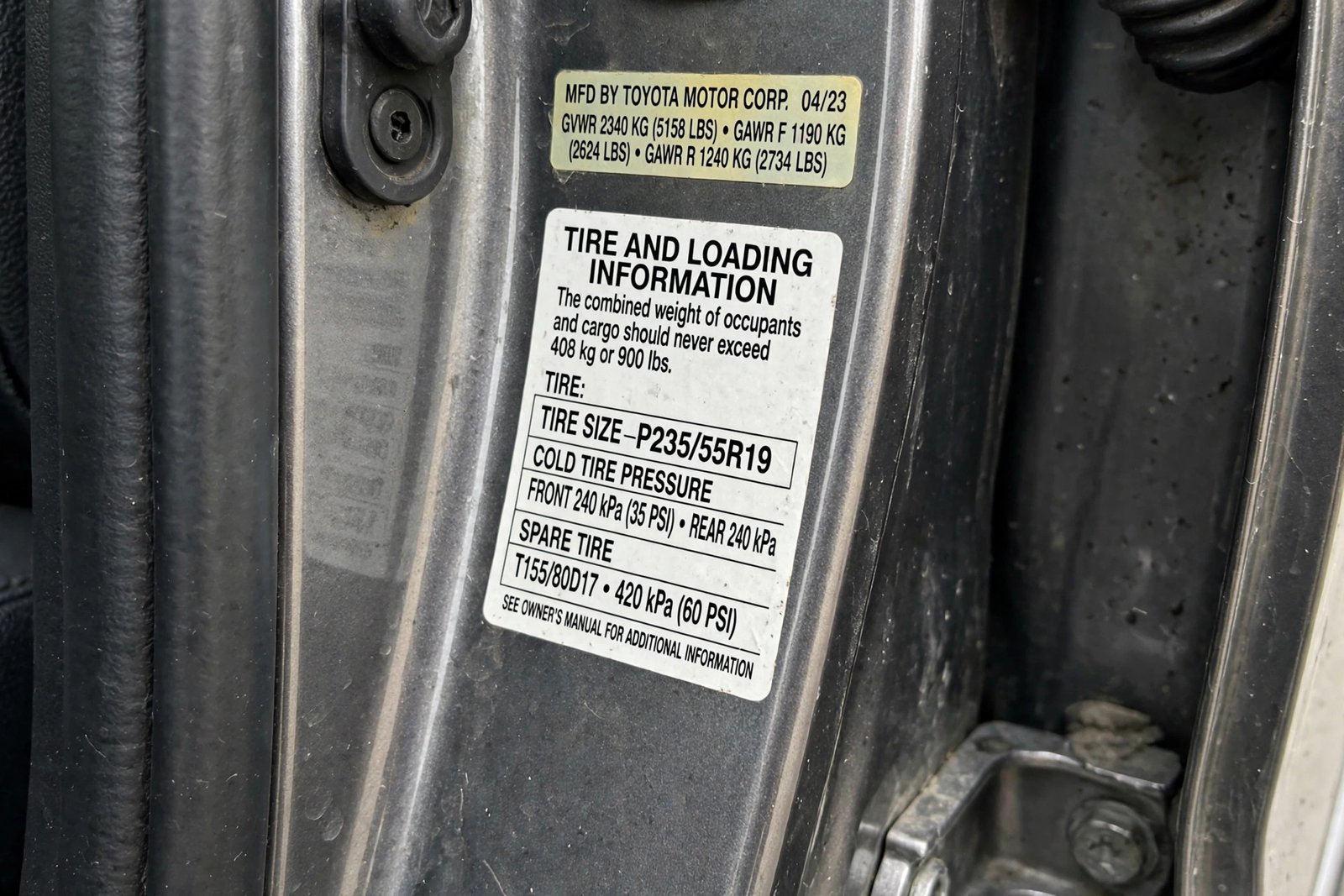
- The driver’s door-jamb sticker. Open the driver’s door and look for the placard on the frame. It lists the factory tire size and recommended pressure.
- Your owner’s manual. The specifications section lists the original tire size for your exact trim level.
Use the door-jamb sticker, not just the tire currently on the car — a previous owner may have fitted a different size. The sticker shows what the vehicle was engineered for.
The Bottom Line
Tire aspect ratio is simply the sidewall height as a percentage of tire width — the "55" in 205/55R16. Higher ratios mean taller sidewalls, a softer ride, and better pothole protection. Lower ratios mean shorter sidewalls, sharper handling, and a firmer ride. Neither is better in general; the right choice depends on your vehicle and your roads.
Before you buy your next set, check the door-jamb sticker, run the sidewall-height math with the formula above, and keep the overall diameter within about 3% of stock. Get that right and your tires will ride, handle, and last the way your car was designed to. And once your new tires are on, keep them wearing evenly — our guide on how often to rotate tires covers the intervals that protect your investment, and if you want to know the signs it’s time to change tires altogether, that guide walks through them.
Frequently Asked Questions
What is tire aspect ratio?
Tire aspect ratio is the height of a tire’s sidewall expressed as a percentage of the tire’s width. In the size 205/55R16, the aspect ratio is 55, which means the sidewall height is 55% of the 205 mm width — about 112.75 mm (4.44 inches).
How do you calculate sidewall height from the aspect ratio?
Multiply the tire width in millimeters by the aspect ratio as a decimal. For a 205/55R16 tire: 205 × 0.55 = 112.75 mm of sidewall height. Divide by 25.4 to convert to inches (4.44 inches). Overall tire diameter is the wheel diameter plus twice the sidewall height.
Is a higher or lower aspect ratio better?
Neither is universally better. A higher aspect ratio (65–85) gives a taller sidewall, a softer ride, and better pothole protection, which suits trucks, SUVs, and daily drivers. A lower aspect ratio (30–45) gives a shorter, stiffer sidewall with sharper steering response, which suits sports cars — but the ride is firmer and wheels are more vulnerable to pothole damage.
Can I change the aspect ratio of my tires?
Yes, but only within limits. Keep the overall tire diameter within about 3% of the original size or your speedometer, odometer, and clearance will be affected. For example, switching a 205/55R16 (24.88 in diameter) to a 205/60R16 (25.69 in) makes the tire 3.3% larger, so at an indicated 60 mph you would actually be traveling about 62 mph. Always check your owner’s manual and door-jamb sticker first.
Where do I find my tire’s aspect ratio?
It is molded into the tire sidewall as the number after the slash in the size code — the 55 in 205/55R16. The same size is also printed on the driver’s door-jamb sticker and in your owner’s manual, which list the size your vehicle was designed for.
Sources
- Les Schwab, "Tire Size Explained: What the Numbers Mean" — sidewall code breakdown and the 215/65R15 worked example (215 mm × 65% = 5.5 in sidewall)
- Tire Agent, "What Does Tire Aspect Ratio Mean? And Why Does It Matter?" — aspect ratio definition and ride/handling effects
