
Quick answer: Before you buy a used car, check the VIN, title and open recalls, inspect tires, brakes, fluids and rust, take a 20–30 minute test drive, and pay for an independent inspection before you pay. History report: ~$30–$45. Inspection: ~$100–$250.
A used car can be the smartest purchase you ever make, or the most expensive lesson you ever learn. The difference is rarely luck — it is the hour spent checking first.
Photos hide worn tires. A friendly seller hides a salvage title. A five-minute drive hides a slipping transmission. This guide follows a mechanic’s order: paperwork, tires, brakes and fluids, rust, engine, test drive, then a professional inspection.
Before You Go: What to Bring and Ask
Inspect in daylight, on dry, level ground. Night, rain and a dark lot hide paint mismatch, worn tires, leaks and rust.
Bring a flashlight, a penny, a paper towel, your phone and a notebook. Ask for the VIN before you drive over. A seller who will not share it, will not allow an independent inspection, or says "someone else is coming with cash today" is telling you everything you need to know.
Ask first: Why are you selling it, and how long have you owned it? Is the title clean, in your name, and lien-free? Any accidents, floods or open recalls? Do you have service records? Can my mechanic inspect it? Vague or rushed answers mean stay cautious.
1. Check the VIN, Title and Recalls First
Do this before you fall in love with the car — paperwork problems are hardest to fix after you pay.
Match the VIN in three places. The 17-character VIN on the dashboard, the driver’s door jamb sticker, and the title must all match exactly. A mismatch is a hard stop.
Check the title. A clean title means no salvage, rebuilt, flood or lemon brand. A branded title lowers the value and can cause registration and insurance problems. The seller’s name must match the title — "selling it for a friend" with no clear paperwork is a classic red flag.
Check open recalls for free. Enter the VIN in the free NHTSA recall lookup at nhtsa.gov/recalls. Recall repairs are free at a franchised dealer, but an open recall on airbags, brakes, steering or fuel should be fixed before you drive home. The free NICB VINCheck also flags stolen and salvage vehicles.
2. Get the Vehicle History Report
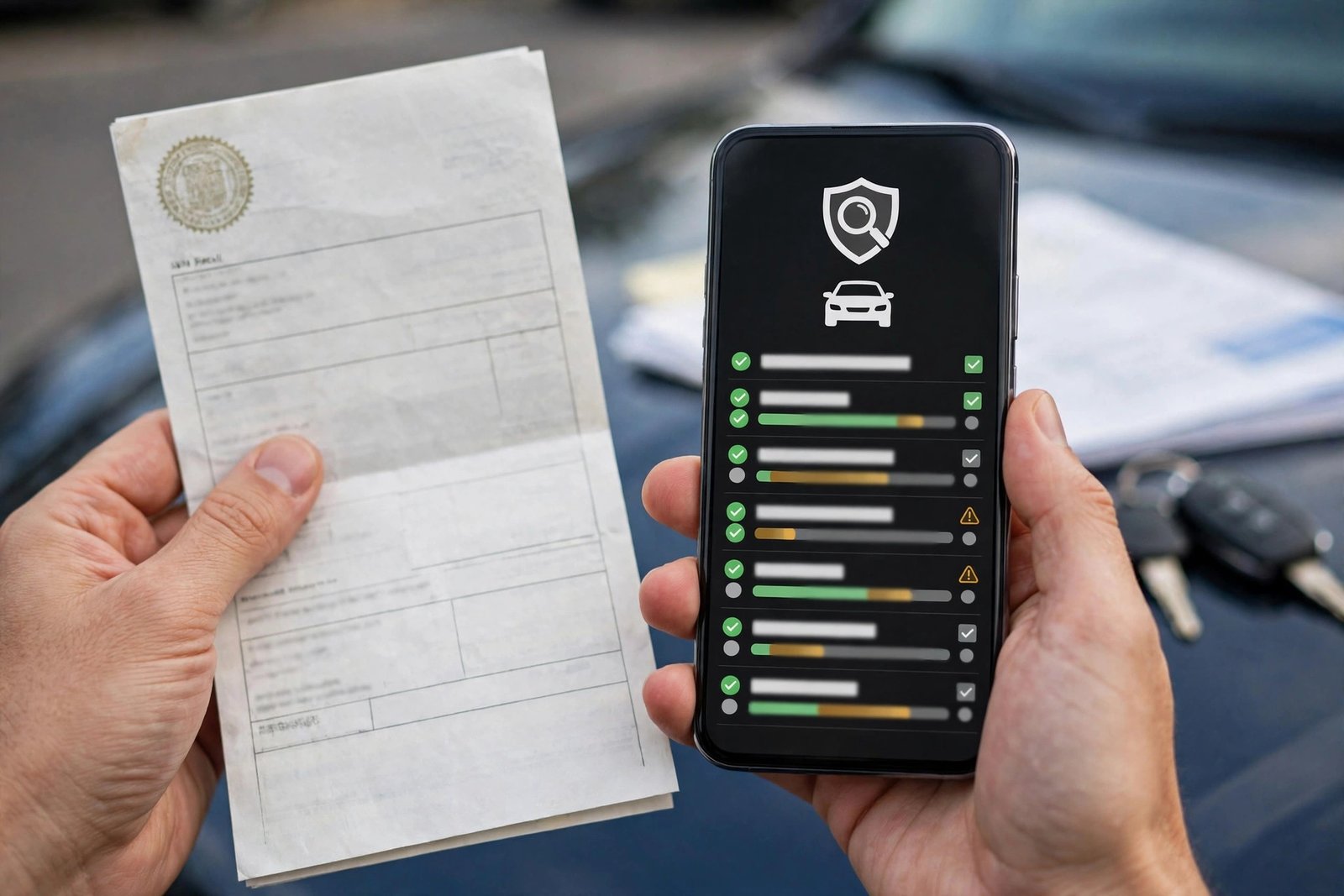
A vehicle history report is the car’s biography: title brands, reported accidents, odometer readings, service entries, registration states, and whether it was a rental or fleet vehicle.
What it costs: expect about $30 to $45 for a comprehensive report, according to NerdWallet. Carfax lists a single report at $44.99 as of October 2026 — and many dealers provide one free, so ask first.
What it cannot do: a history report is not a substitute for a physical inspection. The FTC is direct: a report typically will not list mechanical problems, and not every crash or repair is ever reported. If the report says "no accidents" but the paint and panel gaps disagree, trust the physical car.
Mileage check: most cars cover roughly 12,000 to 14,000 miles a year. A 6-year-old car with 45,000 miles is unusually low — verify it against service records. A reading that goes down between records is odometer rollback: walk away.
3. Tires First: The Check Most Buyers Rush
Tires tell the truth about a car: uneven wear points to alignment problems, worn suspension, crash damage or neglected rotation. Old tires can look fine and still be unsafe, because rubber hardens with age. A new set of four is a major cost — build it into your offer if the tires are due. Check all four, not just the visible one.
Tread depth: the 2/32 and 4/32 rules
New tires start at about 10/32 or 11/32 of an inch. The numbers that matter:
| Tread depth | What it means | What to do |
|---|---|---|
| 4/32" | Safety replacement point | Plan on new tires soon; wet grip drops sharply |
| 2/32" | Legal minimum in most US states | Replace now — legally worn out |
| Below 2/32" | Bald and illegal | Do not drive it home on these; negotiate a full set |
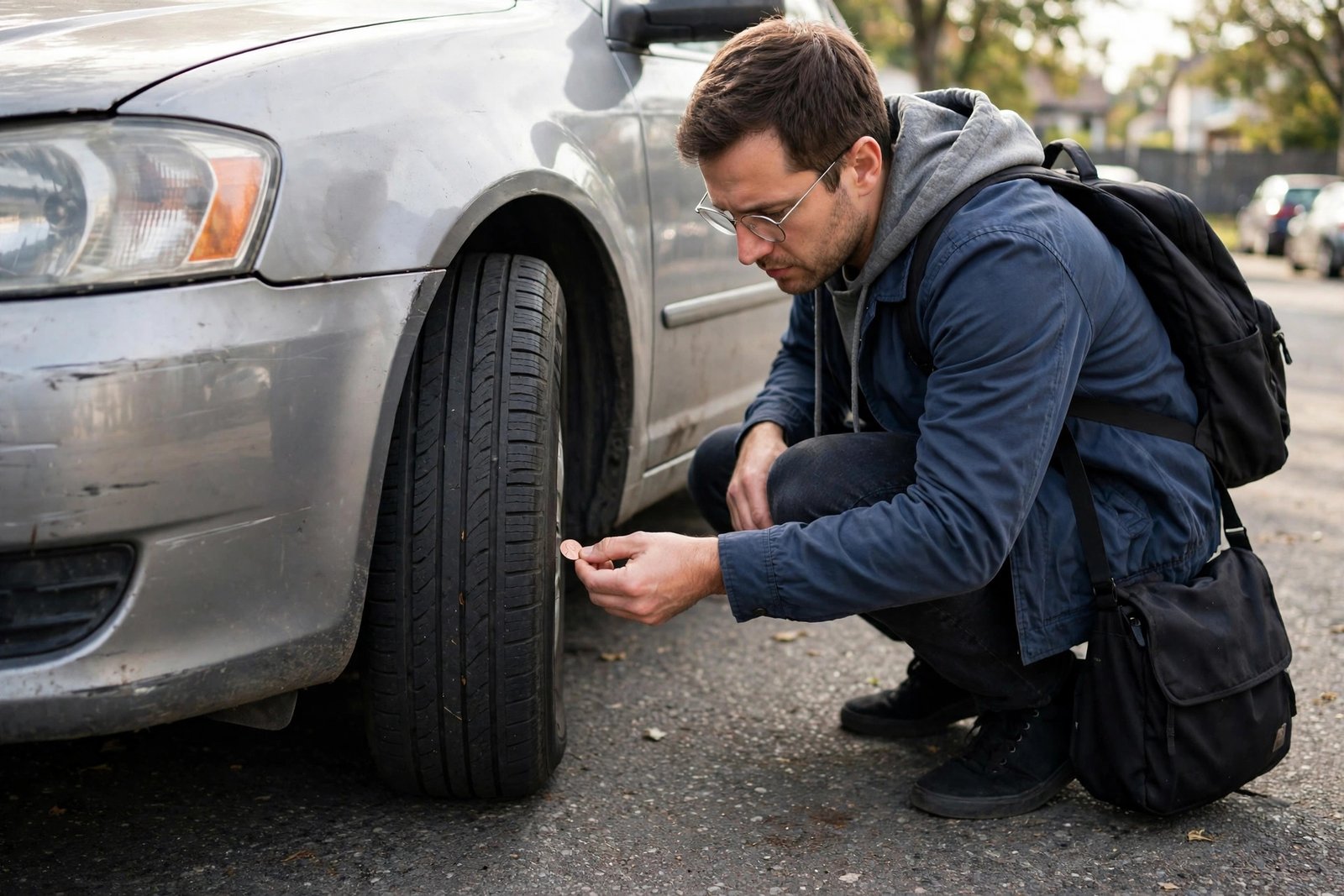
The penny test: push a penny into a tread groove, Lincoln’s head upside down and facing you. If you can see the top of his head, tread is at 2/32 of an inch or less — NHTSA endorses this test. A quarter is stricter: seeing the top of Washington’s head means about 4/32, the safer replacement point. Tread flush with the built-in wear bars also means 2/32 and done.
Tire age: read the DOT date code
Tread is only half the story. Tires age out even with healthy tread: most manufacturers recommend replacing them at 6 to 10 years of age regardless of tread, and never running one past 10 years, per NHTSA guidance.
Find DOT on the sidewall: the last four digits are the birth date — first two the production week (01–53), last two the year. 3420 means the 34th week of 2020; 2319 means the 23rd week of 2019 — over 7 years old in 2026, inside the replacement window even if the tread looks deep. Check all four tires plus the spare. A three-digit code means the tire was made before 2000 — recycle it, don’t drive on it.
Matching set, wear pattern and damage
- All four tires should match in brand, size and roughly age. A mismatched set signals corner-cutting, and on an all-wheel-drive car it can stress the drivetrain. Wear should be even — worn edges, center, or a bald patch point to inflation, alignment or suspension trouble.
- Reject any tire with sidewall cracks, bulges, cuts, exposed cords, or a sidewall plug. Sidewall damage cannot be safely repaired.
- Check the spare — present, inflated, with a jack and lug wrench.
If the tires need replacing now, get a quote and deduct it from your offer. See when to change tires. If the tire pressure light is on, read how long TPMS sensors last — a dead sensor is a common fix, but still a negotiating point.

4. Brakes: Look, Listen and Feel
Brakes are a safety system, not a cosmetic one. New pads and rotors are a real first-month cost, and a car with a soft pedal or grinding brakes is not safe to drive home.
During the test drive, glance through the wheels for thin pads or grooved rotors, then brake gently and firmly from about 40 mph on a clear road. The car should stop straight, without shaking or pulling. The pedal should feel firm, not spongy or sinking. If the ABS light stays on, or the parking brake does not hold, get a mechanic’s opinion. Light surface rust after rain is normal; grooves you can feel, pedal pulsing, or grinding are not.
5. Under the Hood: Fluids, Belts and Leaks
You do not need to be a mechanic to read fluids — just a paper towel and five minutes.
- Engine oil: pull the dipstick, wipe it, reinsert it, and pull it again. Oil should be amber and smooth — not dark, gooey, or metallic-flecked. Milky, grey or foamy oil can mean coolant mixing with oil, a serious engine problem.
- Coolant: should be green, orange or pink — not milky, rusty or oily. Never open a hot radiator cap.
- Transmission fluid (if it has a dipstick): red or pink is good; burned-smelling, dark brown fluid points to transmission wear.
- Brake and power steering fluid: both should be near the full mark and not dark and dirty. Low levels can mean a leak.
- Belts and hoses: look for cracks, fraying or stiffness. A cool radiator hose should feel firm but flexible, not brittle or mushy.
- Battery: terminals should be clean, not crusted with corrosion. Ask its age.
- Leaks: look at the ground where the car was parked and at the bottom of the engine. Fresh oil, coolant, transmission fluid or fuel is a red flag; active dripping needs a mechanic’s verdict before you pay.

6. Underbody and Rust: The Expensive Surprise
Rust separates a good used car from a money pit, especially in the salt belt — Michigan, Ohio, Pennsylvania, New York, New England, Wisconsin and Minnesota. Surface rust on a small bracket is normal; heavy rust on frame rails, suspension mounts, brake lines, rocker panels or subframes is structural — it can fail a state inspection and cost thousands to repair.
Get on the ground with a flashlight: frame rails, floor pans, rocker panels, suspension mounts, brake and fuel lines, exhaust. Fresh undercoating can hide rust — if the underbody looks suspiciously freshly painted, ask why. Check the trunk floor and spare tire well for water stains or dampness — a sign of a leak, a bad seal, or flood history.

7. Body, Glass and Interior
Walk around in daylight and look down each side from different angles.
- Paint, glass and lights: colors should match, gaps should be even, with no overspray on trim or glass. Mismatched paint, uneven gaps, rippled panels, or a magnet that will not stick to a steel panel can point to accident repair. The windshield should be free of cracks and chips, headlights not cloudy or fogged, and every light working.
- Interior: sit in every seat and test seatbelts, windows, locks, mirrors, heater, A/C, defroster, infotainment, Bluetooth, charging ports and backup camera. A musty smell, damp carpets, or water stains under the mats can mean leaks or flood damage; heavy air freshener can mean the seller is hiding one.
- Warning lights: turn the key: every dashboard light should come on, then go off once the engine starts. A light that never comes on may have been removed to hide a fault. A check engine, airbag, ABS or oil light that stays on is a real problem, not "just a sensor."
8. The Test Drive: 20–30 Minutes, Not 5
A five-minute loop proves nothing. A proper test drive takes 20–30 minutes — city streets, rough pavement, parking, reversing, and highway speed.
Cold start first. Ask the seller not to warm it up first. A cold engine reveals rattles, knocking, rough idle and smoke that a warm engine hides. Blue smoke means oil burning; white smoke after warm-up can mean coolant trouble; black smoke a fuel mixture problem. Knocking or major smoke needs a mechanic before you buy.
On the drive, check:
- Steering is smooth and returns to center; no pulling, no vibration at highway speed.
- Shifts are smooth and predictable, with no clunking, slipping or hard jerks.
- The temperature gauge stays in the middle, no warning lights appear, and the A/C stays cold at idle and while driving.
- No squeaks, rattles or clunks. Turn the music off and listen.

9. The Pre-Purchase Inspection: Do Not Skip This
Your checklist decides whether a car deserves more time; a professional inspection decides whether to buy it. Use both.
A pre-purchase inspection (PPI) is a thorough check by an independent mechanic — not the seller’s or the dealer’s. On a lift, the mechanic scans for trouble codes (including hidden ones), inspects brakes, tires, suspension, steering, frame, exhaust and leaks, and road-tests the car.
What it costs: a PPI typically costs $100 to $250 at most independent shops in the US, per multiple 2025–2026 pricing guides. Luxury or specialty vehicles can cost $300 or more; mobile inspections usually fall in the same $125–$250 range, and RepairPal’s labor estimate is roughly $180 to $320. Get the report in writing, with photos and estimates.
What it takes: usually 1–2 hours. If the seller will not give you that time, do not buy the car — AAA: if the seller won’t let you take the car in for an inspection, don’t buy the car.
Use the report in negotiation. Skip the tiny flaws — focus on real cost: tires, brakes, battery, fluids, leaks, recalls, warning lights and safety repairs. If needed repairs reach 15–20% of the car’s value, reconsider the purchase.
10. The Printable Checklist
| # | Check | Pass? |
|---|---|---|
| 1 | VIN matches in all 3 places | ☐ |
| 2 | Title clean, seller matches, no lien | ☐ |
| 3 | NHTSA recall lookup — no open recalls | ☐ |
| 4 | History report reviewed ($30–$45); no salvage, flood or rollback | ☐ |
| 5 | All 4 tires match; tread above 4/32", DOT age under 6 years | ☐ |
| 6 | No sidewall cracks, bulges, cuts, exposed cords | ☐ |
| 7 | Spare, jack and lug wrench present | ☐ |
| 8 | Brakes stop straight, firm pedal, no grinding | ☐ |
| 9 | Oil amber, coolant clean, transmission fluid not burned | ☐ |
| 10 | No active leaks under car/engine | ☐ |
| 11 | No heavy rust on frame, rockers, brake lines, subframe | ☐ |
| 12 | Paint matches, gaps even, no overspray | ☐ |
| 13 | All lights, wipers, horn, windows, A/C, heater work | ☐ |
| 14 | No warning lights stay on after startup | ☐ |
| 15 | Cold start clean — no knocking or smoke | ☐ |
| 16 | Test drive 20–30 min: city + highway, smooth shifts, no pull | ☐ |
| 17 | Service records seen; mileage matches | ☐ |
| 18 | Pre-purchase inspection booked ($100–$250) | ☐ |
When to Walk Away
Some problems are not worth negotiating — walk away if the seller refuses an inspection or hides the VIN; the title is salvage, flood or rebuilt without full documentation; the seller’s name does not match the title; you find heavy frame rust, engine knocking, overheating, or a slipping transmission; the airbag light is on, or the car smells of flood and mildew; the price is far below market with no clear reason; or the seller pressures you to pay immediately, in cash, today.
After You Buy: The First Week
Even a car that passed deserves a fresh start. In the first week, change the oil if its date is unknown, check tire pressures against the door placard, and confirm the rotation schedule with our tire rotation pattern guide. In a cold climate, our all-season vs winter tires guide explains when a second set is worth the money. Still deciding between finalists? Run them through our Compare Cars tool or check the most reliable cars for 2026 and the best cars for college students.
The Bottom Line
Check the paperwork, tires, brakes and fluids, and rust; drive it properly; and pay a mechanic $100–$250 to check what you cannot see. That is the whole secret. Buyers who regret their purchase almost never inspected too carefully — they trusted a clean photo and a friendly seller.
Take the checklist, take your time — let the car earn your money.
Frequently Asked Questions
What is the most important thing to check when buying a used car?
Title, VIN and open recalls come first — paperwork problems can make a car impossible to register. Then check tires, brakes, fluids and rust, test-drive it properly, and finish with an independent inspection.
How much does a pre-purchase inspection cost in 2026?
Typically $100 to $250 at most independent shops; luxury or specialty vehicles can cost $300 or more. It takes 1 to 2 hours — far cheaper than a major repair discovered after buying.
What tire tread depth is too low on a used car?
The legal minimum in most US states is 2/32 of an inch; experts recommend replacing at 4/32, because wet grip drops sharply below that point. If a penny test shows the top of Lincoln’s head, the tire is at or below the limit.
How old is too old for tires on a used car?
Most manufacturers recommend replacing tires at 6 to 10 years, regardless of tread, and never using one past 10 years. In the DOT code’s last four digits, the first two digits are the production week, the last two the year.
Should I buy a vehicle history report before buying a used car?
Yes. A comprehensive report typically costs $30 to $45 and can reveal title brands, reported accidents, odometer problems and service entries — but it is not a substitute for a physical inspection.