
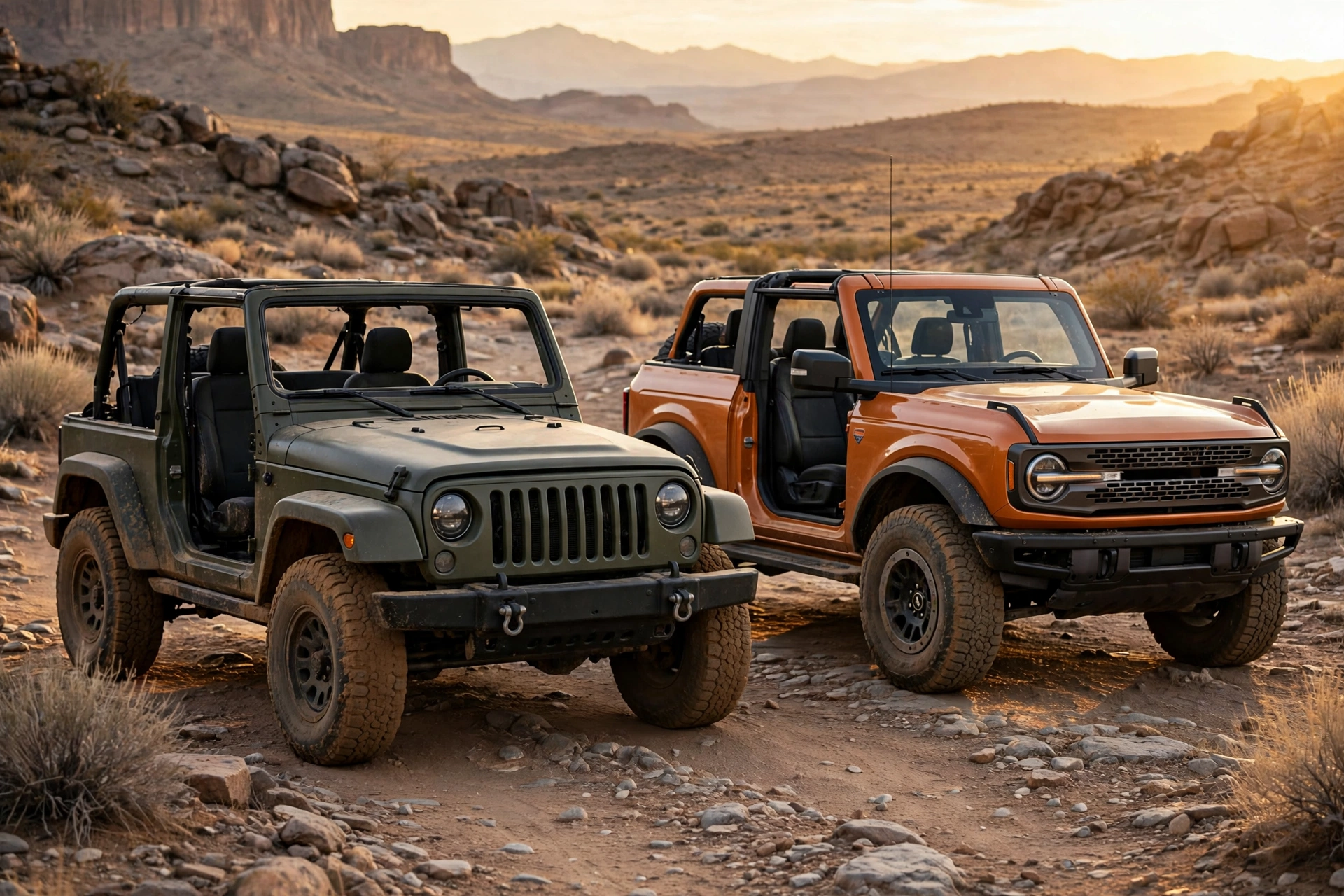
Jeep Wrangler vs Ford Bronco: Which Off-Roader Wins?
The short answer: Pick the Jeep Wrangler for the purest rock-crawling machine — solid axles front and rear, the deepest crawl ratio in the class, up to 5,000 lb of towing, and the biggest aftermarket in the business. Pick the Ford Bronco for an off-roader you can happily live with every day — a smoother, quieter ride, a stronger turbo base engine, more cargo room, and clever trail tech. No universal winner here — only the right answer for how you drive.
Verdict
Winner: split — the Jeep Wrangler wins on rock crawling, towing and resale; the Ford Bronco wins on daily driving, power and practicality. The Wrangler’s solid axles, roughly 100:1 crawl ratio and up to 5,000 lb of towing make it the purest rock-crawling machine, while the Bronco is the off-roader you can happily live with every day — smoother, quieter, with a stronger turbo base engine and more cargo room. This article says there is no universal winner here, only the right answer for how you drive.
Scored comparison
| Category | Jeep Wrangler | Ford Bronco | Winner |
|---|---|---|---|
| Price (starting) | 9 – from $36,035 (Sport 2-door); $39,040 (4-door) | 8 – from $41,295 (Base 2-door) | Wrangler |
| Power (base engine) | 7 – 3.6L V6, about 285 hp / 260 lb-ft | 9 – 2.3L turbo four, about 300 hp / 325 lb-ft | Bronco |
| Rock crawling | 10 – solid axles front and rear; about 100:1 crawl ratio (manual Rubicon) | 8 – about 94.75:1 crawl ratio (manual, Advanced 4×4) | Wrangler |
| Daily driving and comfort | 7 – charmingly raw; solid axle can wander, more wind and tire noise | 9 – smoother, quieter, better-tracking on the highway | Bronco |
| Towing | 9 – up to 5,000 lb (4-door Rubicon) | 7 – 3,500 lb (4,500 lb Raptor) | Wrangler |
| Cargo space (4-door) | 7 – about 72 cu ft max | 9 – about 77–83 cu ft max | Bronco |
| Fuel economy | 8 – about 19–22 mpg combined | 7 – about 19–20 mpg combined | Wrangler |
| Ground clearance | 9 – up to about 12.9 in (35s) | 9 – up to 13.1 in (Raptor); 11.6 in (Sasquatch) | Tie |
| Resale value | 9 – among America’s best | 8 – held value well since launch | Wrangler |
Scores are our 1–10 reading of the figures already in this article; they are not separate test results.
How we rank / Sources & method
We ranked the two off-roaders only on the figures in this article: starting MSRP and specifications from the manufacturers’ sites (Jeep and Ford), EPA fuel economy via fueleconomy.gov, and Consumer Reports’ 2026 brand rankings. Prices are starting MSRP excluding destination unless stated. Figures change by model year and trim, so check the manufacturer’s site before you buy.
Data as of / Prices as of: October 31, 2026 (published October 31, 2026).
This is the rivalry that revived the off-road wars. The Wrangler has been the benchmark for generations, tracing back to the military Willys of World War II. Ford brought the Bronco back in 2021 after a 25-year absence with one goal: dethrone Jeep. Both come as 2-doors and 4-doors, both take their doors and roofs off, and both run standard 4×4 — but they tackle trails in completely different ways. As a tire-focused site, we also judge them where it matters most off-road: stock tire size, sidewall strength, and how each handles 35-inch upgrades — the details most comparisons skip.
Spec note: All figures below are typical 2026 US versions. Horsepower, MPG, prices and dimensions vary by trim, options and model year, so always confirm the exact numbers with your dealer before buying.
Head-to-Head Spec Comparison
| Feature | Jeep Wrangler (typical) | Ford Bronco (typical) |
|---|---|---|
| Starting price | $36,035 (Sport 2-door; $39,040 for the 4-door) | $41,295 (Base 2-door) |
| Base engine | 3.6L V6, ~285 hp / 260 lb-ft | 2.3L turbo four, ~300 hp / 325 lb-ft |
| Optional engines | 2.0L turbo four (~270 hp); 6.4L V8 in the Moab 392 and Willys 392 (~470 hp) | 2.7L twin-turbo V6 (~330 hp); Raptor 3.0L (~418 hp) |
| Transmissions | 6-speed manual or 8-speed auto | 7-speed manual (crawler gear) or 10-speed auto |
| Front suspension | Solid axle | Independent |
| Best crawl ratio | ~100:1 (manual Rubicon) | ~94.75:1 (manual, Advanced 4×4) |
| Ground clearance | ~9.7 in base; up to ~12.9 in (35s) | ~8.3 in base; up to ~11.6 in (Sasquatch); 13.1 in (Raptor) |
| Max approach angle | ~47° (35-in tires) | ~43° (Sasquatch) |
| Water fording | ~30–34 in by trim | ~33.5 in (Sasquatch) |
| Max towing | Up to 5,000 lb (4-door Rubicon) | 3,500 lb (4,500 lb Raptor) |
| EPA combined MPG | ~19–22 by trim/engine | ~19–20 by trim/engine |
| Max cargo (4-door) | ~72 cu ft | ~77–83 cu ft |
| Basic warranty | 3 yr / 36,000 mi | 3 yr / 36,000 mi |
| Best for | Hardcore trails, rock crawling, towing | Daily driving, fast dirt, comfort |
Engines and Powertrains
The Wrangler starts with Jeep’s long-running 3.6-liter Pentastar V6 — roughly 285 horsepower and 260 lb-ft of torque. Not the newest or strongest, but simple and proven, with millions of miles of history behind it. A 2.0-liter turbo four (around 270 hp) is the efficiency-minded alternative, and the V8 option survives in the Willys 392 and the range-topping Moab 392, with 470 horsepower from a 6.4-liter V8.
The Bronco starts with a 2.3-liter turbo four making about 300 horsepower and 325 lb-ft — more power and far more torque than the Wrangler’s base V6, right out of the gate. The available 2.7-liter twin-turbo V6 (around 330 hp) pulls further ahead, and the Raptor tops out near 418 horsepower. Turbos deliver torque low in the rev range — handy for daily driving and slow hill climbs.
Both still offer a proper manual: a 6-speed in the Wrangler, a 7-speed with a dedicated crawler gear in the Bronco. That crawler gear gives the Bronco a crawl ratio of about 94.75:1 — close to the Wrangler Rubicon manual’s roughly 100:1, the deepest in the class.
Verdict on power: The Bronco wins for most buyers — stronger base engine, more torque everywhere. The Wrangler wins on character: the V8 and old-school charm.
Off-Road Capability: Solid Axles vs. Smart Tech
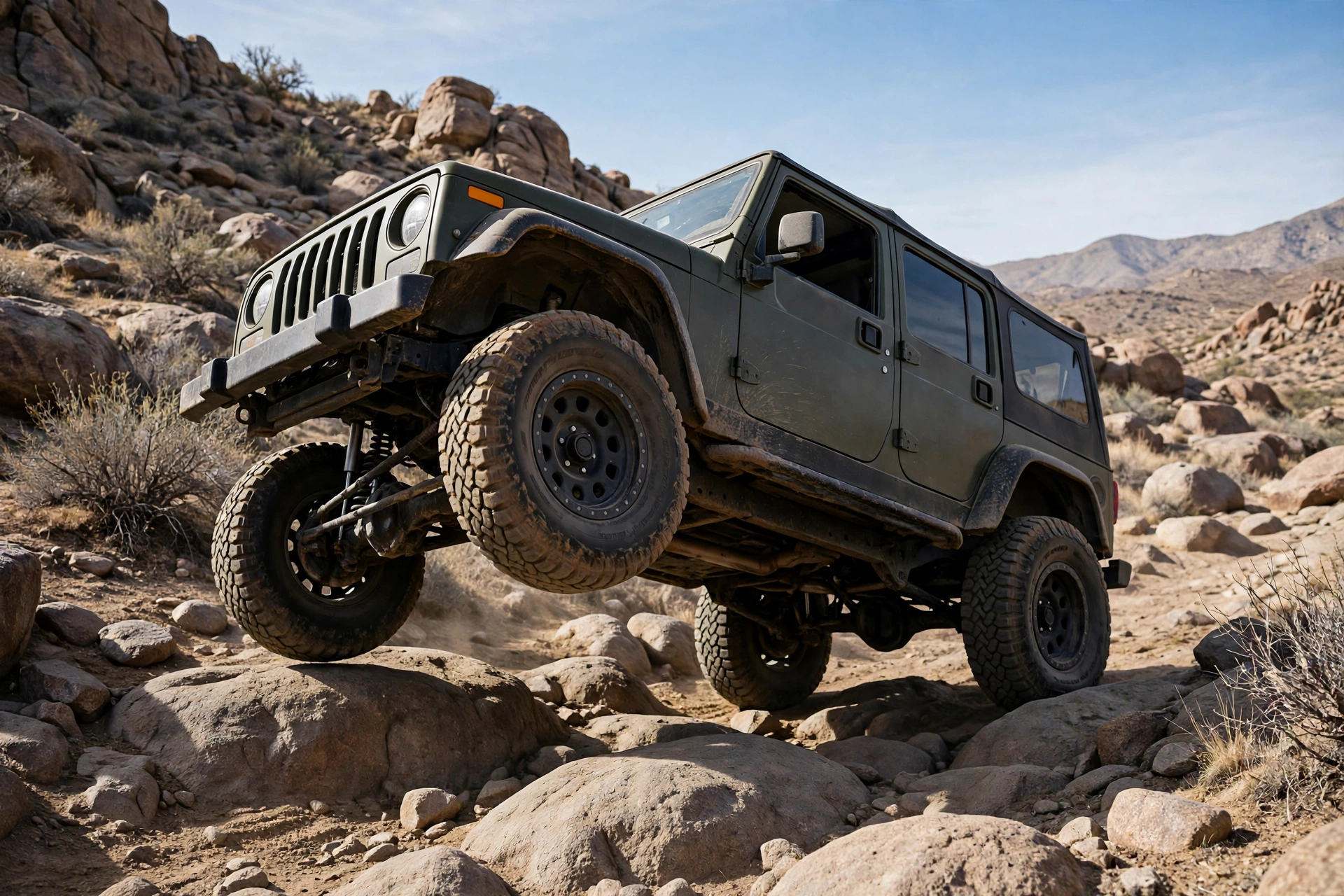
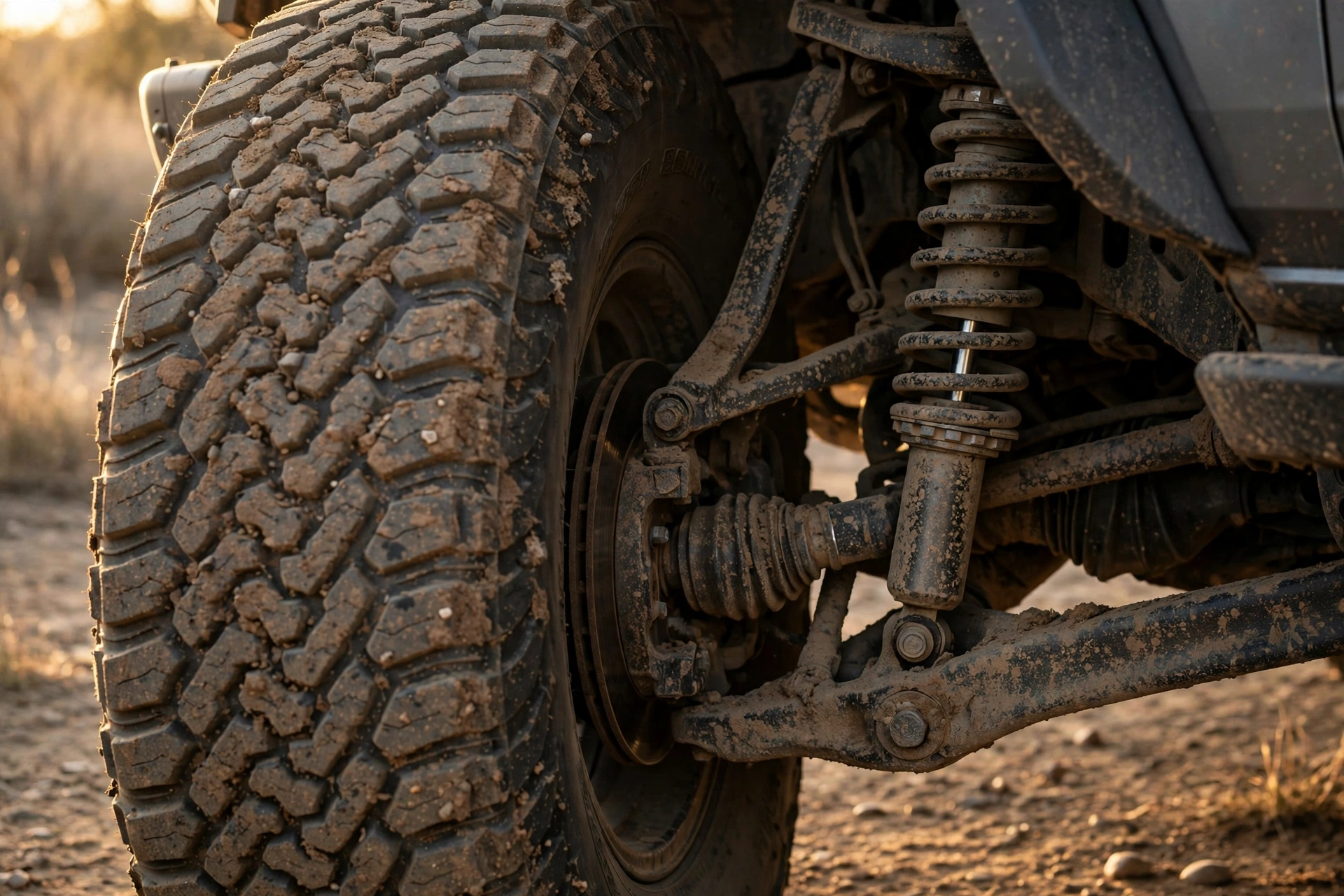
This is where the real argument lives, and it comes down to one engineering choice: what connects the front wheels to the ground.
The Wrangler uses solid axles front and rear. When one wheel climbs a rock, the other stays planted — that is articulation, and on slow, technical terrain it is everything. The Rubicon is the factory benchmark: a Rock-Trac transfer case with a 4:1 low-range ratio, Tru-Lock electronic lockers front and rear, an electronic sway-bar disconnect for huge wheel travel at the push of a button, and heavy-duty Dana 44 axles. With available 35-inch tires you get approach angles around 47 degrees and clearance approaching 13 inches. Nothing else new climbs rocks quite like it.
The Bronco uses an independent front suspension with a solid rear axle. It cannot match the Wrangler’s ultimate articulation, but on fast dirt roads, washboard and desert trails it is genuinely more composed. The Sasquatch package — 35-inch tires, lockers, upgraded dampers, high-clearance flares — closes much of the gap, and trail tech like G.O.A.T. Modes (terrain-tuned drive settings), Trail Control (off-road cruise control) and Trail Turn Assist makes tricky terrain less intimidating for newer drivers. The Badlands trim is Ford’s Rubicon answer: lockers, sway-bar disconnect and 33-inch tires standard. The Raptor goes further still, with 13.1 inches of ground clearance on 37-inch tires.
Verdict on trails: For pure rock crawling, the Wrangler Rubicon is still the benchmark. For fast dirt, overlanding and mixed trails, the Bronco is easier and more comfortable.
Removable Tops and Doors
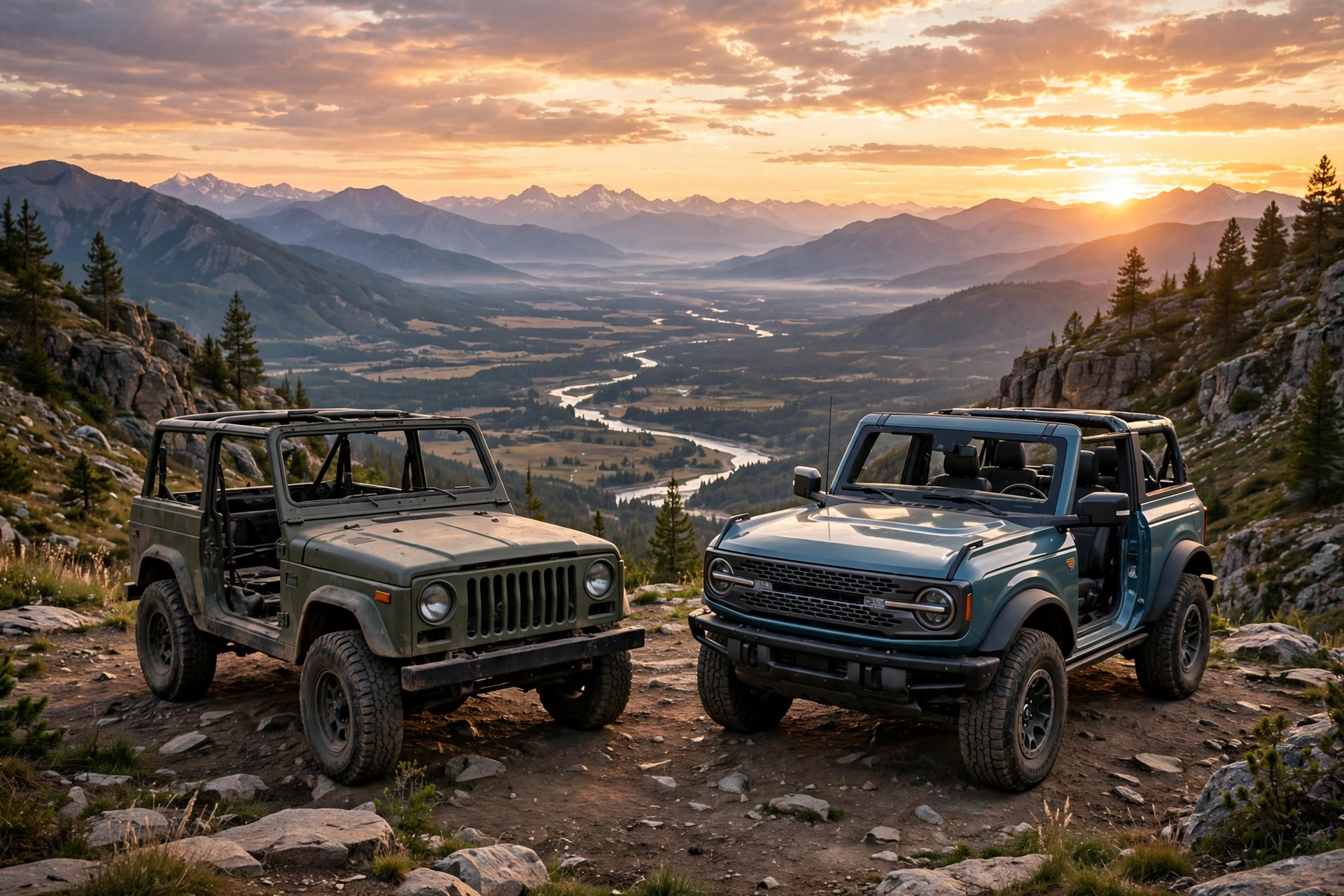
Both deliver the open-air experience properly. The Wrangler’s roof panels and doors come off, and it adds one trick the Bronco cannot match: a fold-down windshield, a nod to its military heritage. After decades of refinement, owners can strip a Wrangler down in minutes.
The Bronco answers with removable roof panels and lighter frameless doors — Ford even publishes their weights (roughly 55 lb front, 44 lb rear on the 4-door). The clever touch is cowl-mounted mirrors that stay put when the doors come off, plus factory mounting points for accessories like roof racks.
Verdict: A wash. The Wrangler’s fold-down windshield is the cooler party trick; the Bronco’s doors are easier to remove and store.
Daily Driving and Comfort
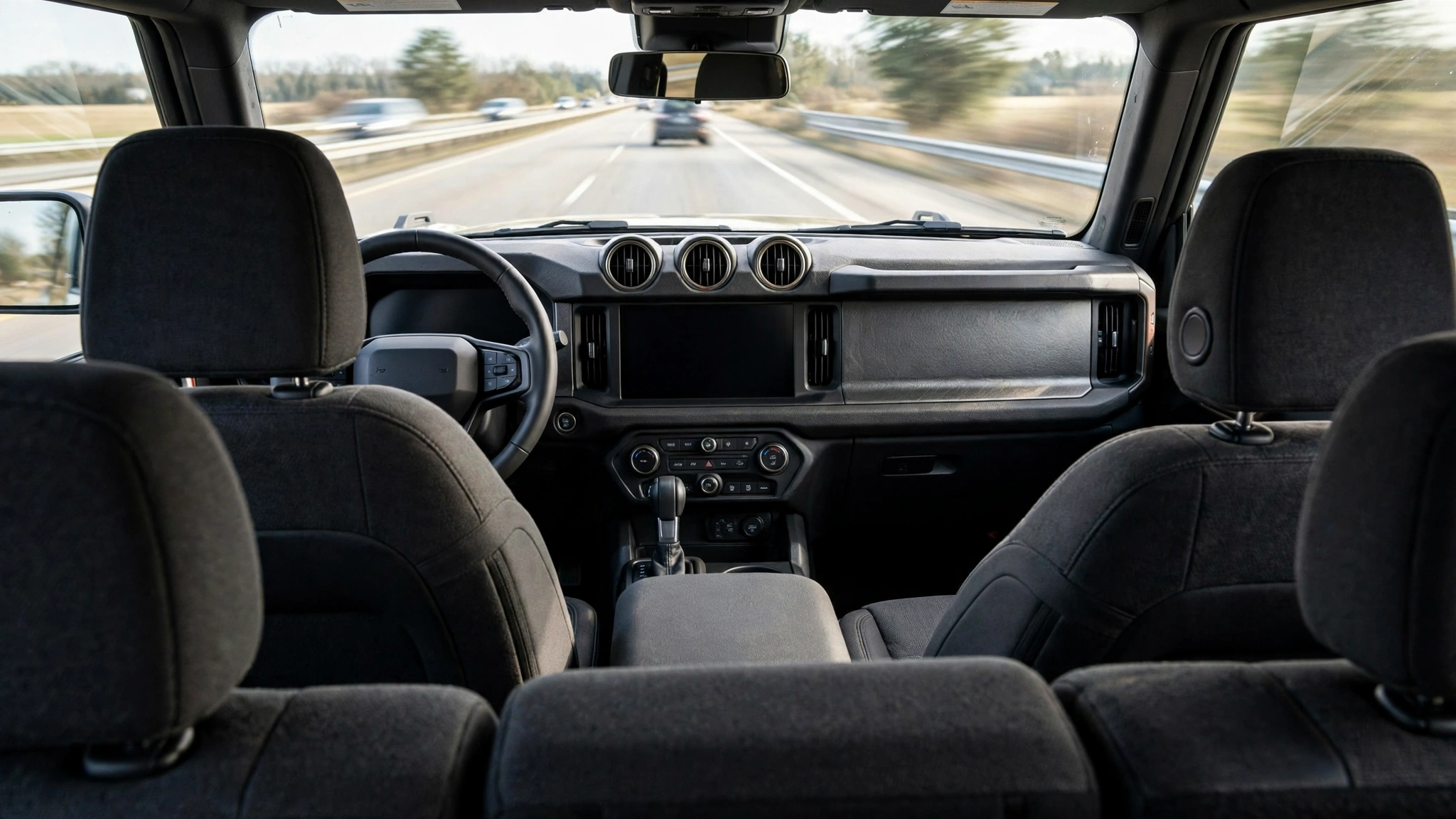
Here the rivalry stops being close. The Bronco’s independent front suspension pays off every day: smoother ride, straighter highway tracking, more precise steering and noticeably less noise — even with the top off. Reviewers call it the off-roader you can commute in without compromise.
The Wrangler is charmingly raw. The solid front axle can wander on the highway, wind and tire noise are ever-present, and the driving experience is an acquired taste. Owners love it; passengers sometimes need convincing. The 4-door is far more livable than the bouncy short 2-door.
Cabin tech is competitive on both: big touchscreens, CarPlay and Android Auto, washable interiors with drain plugs on trail trims. The Bronco’s cabin feels a touch more modern; the Wrangler’s more utilitarian.
Verdict: The Bronco wins daily driving by a clear margin. If this is your only vehicle, that matters more than you think.
Cargo Space and Practicality
The Bronco is the more practical hauler. The 4-door offers up to roughly 77–83 cubic feet of maximum cargo (depending on top) versus around 72 in the 4-door Wrangler — and the gap is far bigger in 2-door form. For overlanding or family road trips, that extra room is a genuine advantage.
Fuel Economy
Neither will win efficiency awards — heavy, boxy 4x4s with the aerodynamics of a garden shed. Expect roughly 19–22 mpg combined from the Wrangler (the 2.0L turbo does best) and roughly 19–20 mpg combined from the Bronco. The Wrangler’s plug-in hybrid 4xe (about 20 miles of electric range) was discontinued for 2026. Bigger tires and roof racks drag real-world mileage down fast — look up official EPA figures for your exact build at fueleconomy.gov.
Still comparing? See our Toyota Corolla vs Honda Civic compact-car comparison, the Toyota RAV4 vs Mazda CX-5 compact-SUV comparison, the Toyota Tacoma vs Ford Ranger midsize-truck comparison, and the Honda Pilot vs Toyota Highlander three-row SUV comparison.
Pricing and Trims
Pricing is broadly comparable, and both climb steeply with options. As a rough guide to typical starting prices:
- Wrangler: opens at $36,035 (Sport 2-door; $39,040 for the 4-door); the Rubicon 4-door starts at $50,535, and the V8 Moab 392 tops the range at $79,995.
- Bronco: opens at $41,295 (Base 2-door); the Badlands starts at $48,890; the Raptor tops the range at $79,995.
The Wrangler opens about $5,000 lower, but the Bronco includes more standard content. Incentives move constantly, so compare like-for-like equipped builds and confirm pricing with your dealer. Starting MSRPs from jeep.com and ford.com for 2026 models, checked November 10, 2026; they exclude the destination charge.
Tires: What They Ship With and What to Know
Base models ship with street-oriented all-seasons — typically around 245/75R17 on the Wrangler and 255/70R16 on the Bronco — fine for pavement and mild dirt, but the first upgrade any serious trail driver makes. The factory off-road packages are where it gets interesting: the Bronco Sasquatch and the Wrangler’s Xtreme 35 both bring 35-inch all-terrain tires (typically LT315/70R17), which transform capability more than almost any other single option.
Two practical notes: 35s cost far more to replace than stock sizes and shave a couple of MPG off fuel economy. Buying used? Check the tire size against the door placard — oversized tires without a proper lift and re-gear are a red flag, not a bonus.
Reliability and Ownership Costs
Honesty time: neither is a Toyota. In Consumer Reports’ 2026 brand rankings, Jeep sits near the bottom — 24th — with below-average reliability, the lowest average road-test score in CR’s testing and the lowest owner-satisfaction score of any brand, and the Wrangler’s many removable panels plus hard off-road use mean more rattles, leaks and wear. The upside: the Pentastar V6 is a known quantity with a huge parts network, and Wrangler resale is among America’s best.
The Bronco is newer, so long-term data is thinner, but its turbo engines are shared with other Ford trucks. Warranty coverage is identical: 3 yr / 36,000 mi basic and 5 yr / 60,000 mi powertrain on both. Budget for tires and brakes on either — heavy off-roaders eat consumables.
The Verdict: Which One Should You Buy?
Buy the Jeep Wrangler if you:
- Live for rock crawling — solid axles, ~100:1 crawl ratio and Rubicon lockers are unmatched
- Want to tow more (up to ~5,000 lb)
- Want the biggest aftermarket on earth and top-tier resale
- Love the heritage, the fold-down windshield and the Jeep community
Buy the Ford Bronco if you:
- Need a daily driver that also wheels on weekends — ride, steering and noise are in another league
- Want stronger, more modern turbo power from the base engine
- Need more cargo space for family trips and overlanding
- Prefer trail tech (G.O.A.T. Modes, Trail Control) over old-school hardware
Still torn? Compare any two cars side by side with our free tool, or browse more head-to-head car comparisons. For official specs, see the Jeep Wrangler page and Ford Bronco page, plus reliability data at Consumer Reports.
Frequently Asked Questions
Is the Jeep Wrangler better off-road than the Ford Bronco?
For slow, technical rock crawling — yes. Solid axles, standard Rubicon lockers, a deeper crawl ratio and better approach angles give the Wrangler the edge at the extreme end. For fast dirt roads and general trail driving, the Bronco is at least as capable and more comfortable.
Which is better for daily driving?
The Bronco, clearly — smoother, quieter, better-tracking on the highway, while the Wrangler’s solid axle feels raw and wanders more at speed.
Which is cheaper?
The Wrangler typically starts about $5,000 lower ($36,035 vs. $41,295 for base 2-doors), but the Bronco includes more standard equipment. Both top out at $79,995 — the Wrangler Moab 392 and the Bronco Raptor. Compare equipped builds, not base prices.
Can the Bronco tow as much as the Wrangler?
No. A properly equipped 4-door Rubicon tows up to about 5,000 lb, versus about 3,500 lb for most Bronco trims (4,500 lb for the Raptor).
Do both have removable doors and roofs?
Yes — both come as 2-doors and 4-doors with removable roofs and doors. The Wrangler adds a fold-down windshield; the Bronco counters with lighter frameless doors and mirrors that stay mounted with the doors off.
Which holds its value better?
Historically, the Wrangler — its resale ranks among America’s best. The Bronco has held value well since 2021, but it lacks the Jeep’s decades-long track record.
More head-to-heads on the site: Hyundai Tucson vs Kia Sportage and Kia Telluride vs Hyundai Palisade.
