

Tire Rotation Pattern: Which One Your Car Actually Needs
Short answer: the right pattern depends on two things — your car’s drivetrain (front-wheel, rear-wheel, or all-wheel drive) and whether your tires are directional. Most cars use a simple cross pattern that takes a mechanic about 20 minutes. Use the wrong pattern, or skip rotations entirely, and your tires wear out thousands of miles early.
If you’ve ever watched a tire shop shuffle your wheels around and wondered what the logic is, this guide explains every standard pattern in plain words — no engineering degree required.
This guide shows you exactly which pattern your car needs — with diagrams.
Why the Pattern Matters at All
Your four tires don’t share the work equally. On a front-wheel-drive car, the front tires do the steering, most of the braking, and all of the accelerating. They wear noticeably faster than the rears. On a rear-wheel-drive car, the rear tires take the acceleration load. Even on all-wheel drive, weight distribution and cornering forces wear tires unevenly.
A rotation pattern is just a planned seating chart: it moves each tire to a new position on a schedule so that every tire spends time in the high-wear spots and the low-wear spots. Done regularly, all four tires reach the end of their life together — which is safer, handles better, and saves you from buying tires two at a time.
Find Your Pattern in 30 Seconds
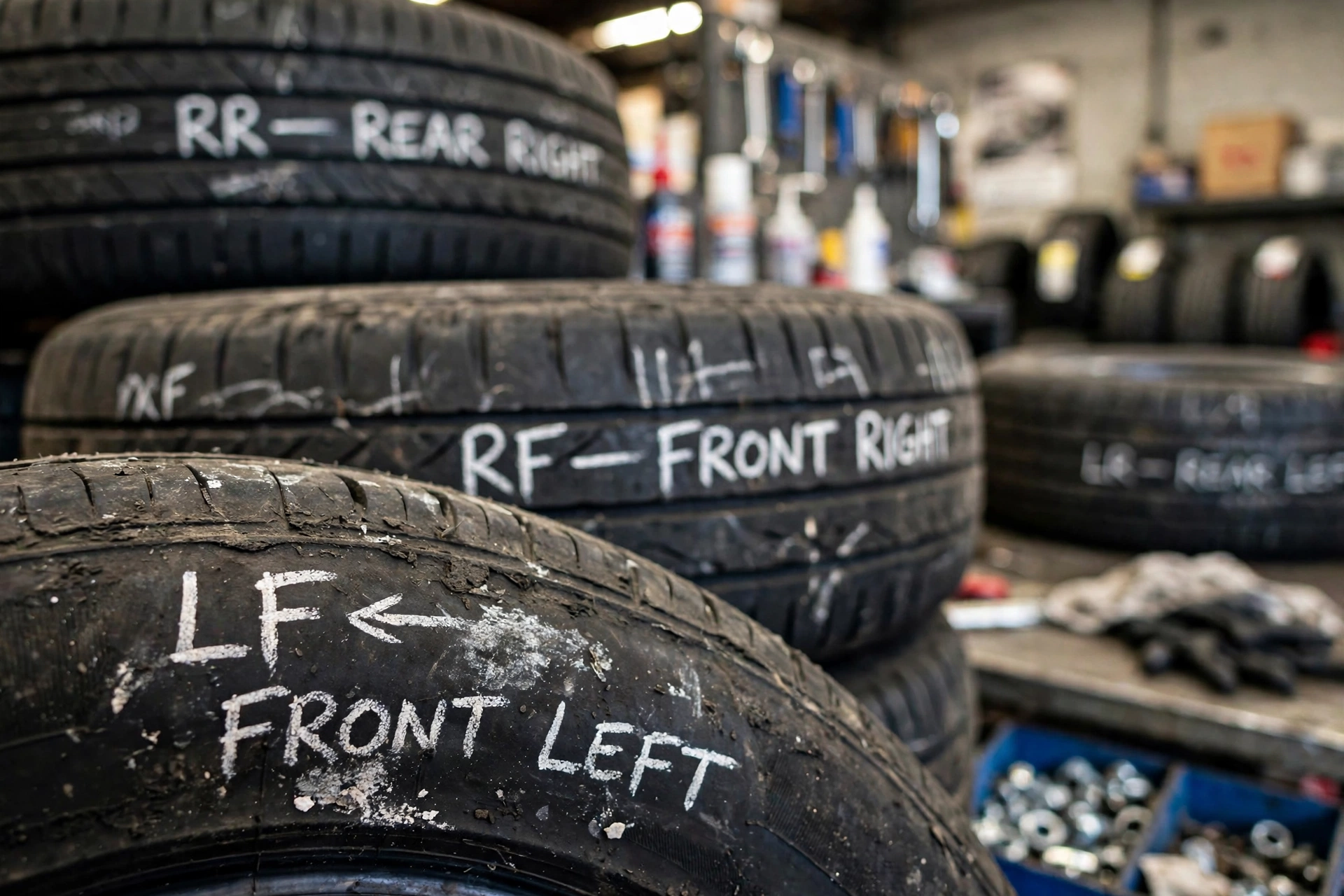
Answer two questions:
- What’s your drivetrain? Check your owner’s manual or the badge on your car: FWD (front-wheel drive), RWD (rear-wheel drive), or AWD/4WD (all-wheel/four-wheel drive).
- Are your tires directional? Look at the sidewall. If you see an arrow with the word “Rotation,” your tires are directional — they must roll in one direction only. No arrow means non-directional, and you can use any cross pattern.
Now find your row below.
The Five Standard Patterns, Explained in Words
1. Forward Cross — for front-wheel drive (most common)

This is the pattern most cars on the road use, since most everyday cars are front-wheel drive with non-directional tires.
- The two front tires move straight back to the rear axle, staying on the same side. Left front goes to left rear; right front goes to right rear.
- The two rear tires move forward and cross sides. Left rear goes to right front; right rear goes to left front.
Think of it this way: the hard-working front tires get a rest at the back, and the fresher rear tires move up front where the work is — crossing sides so each tire also flips the direction its tread has been running.
2. Rearward Cross — for rear-wheel drive

The mirror image of forward cross, because on a rear-wheel-drive car it’s the rear tires doing the heavy pulling.
- The two rear tires move straight forward to the front axle, staying on the same side. Left rear goes to left front; right rear goes to right front.
- The two front tires move back and cross sides. Left front goes to right rear; right front goes to left rear.
3. X-Pattern — for all-wheel drive and 4WD

On AWD and 4WD vehicles, power goes to all four wheels, so the standard practice is to cross everything: every tire moves diagonally to the opposite corner.
- Left front goes to right rear.
- Right front goes to left rear.
- Left rear goes to right front.
- Right rear goes to left front.
One caution for AWD owners: these drivetrains are sensitive to differences in tire circumference. That makes regular rotation more important for AWD, not less — unevenly worn tires can strain the drivetrain. And always check your owner’s manual first, because some AWD systems specify their own pattern. (NHTSA gives the same advice: check your manual for the right rotation interval and pattern for your vehicle.)
4. Front-to-Back (Straight Rotation) — for directional tires


Directional tires have a tread designed to roll one way only — common on performance tires and many winter tires. You can spot them by the arrow molded into the sidewall. These tires can never switch sides, because that would make them roll backward.
- Left front swaps with left rear.
- Right front swaps with right rear.
Same side, front to back, that’s it. Simple — but easy to get wrong if a shop isn’t paying attention, so it’s worth knowing what to expect.
5. Side-to-Side — for staggered setups (different front/rear sizes)
Some sports cars and performance vehicles run wider tires on the rear axle than the front — a “staggered” setup. These tires can’t move between axles at all.
- Left front swaps with right front.
- Left rear swaps with right rear.
This only works with non-directional tires. If your staggered tires are also directional, they can’t be rotated at all — each tire stays exactly where it is.
Bonus: Five-Tire Rotation (with a full-size matching spare)

If your vehicle carries a full-size spare that matches your other four tires (same size, same type), you can rotate all five so they wear evenly. This is especially worthwhile on AWD and 4WD vehicles.
- On FWD: the spare takes the right rear position; the right rear moves to right front; right front crosses to left rear; left rear moves to left front; left front becomes the new spare.
- On RWD/4WD: same idea in reverse — the spare takes the right rear position, and the rotation follows the rearward-cross logic with the spare included.
Don’t try this with a temporary “donut” spare — those are emergency-only tires and don’t belong in a rotation.
How Often Should You Rotate?
The standard industry guidance is every 5,000 to 7,500 miles — roughly every six months for most drivers, and many shops pair it with an oil change so you don’t have to make a separate trip. The U.S. Tire Manufacturers Association recommends a similar schedule.
We’ve also put together a full guide to how often to rotate your tires by vehicle type and driving style — worth a read if you’re setting up your maintenance schedule.
Towing, hauling heavy loads, or lots of rough-road driving wears the drive tires faster, so rotate toward the shorter end of that range. And if you notice uneven wear when you check, don’t wait for the schedule — rotate now and get an alignment check, because rotation evens out wear but doesn’t fix whatever caused it. For AWD and 4WD vehicles, rotate every 3,000–5,000 miles — keeping tread depths matched protects the drivetrain.
A tire rotation typically costs $20–$50 at most US shops — and many shops do it free with a tire purchase or oil change.
5 Mistakes That Ruin a Good Rotation
1. Rotating directional tires across sides. This is the big one. A directional tire mounted to roll backward can’t channel water properly, which hurts wet grip. Always check the sidewall arrow first.
2. Mixing the spare in when it doesn’t match. A donut spare or a different-size spare must never join the rotation. Only a full-size, matching spare qualifies.
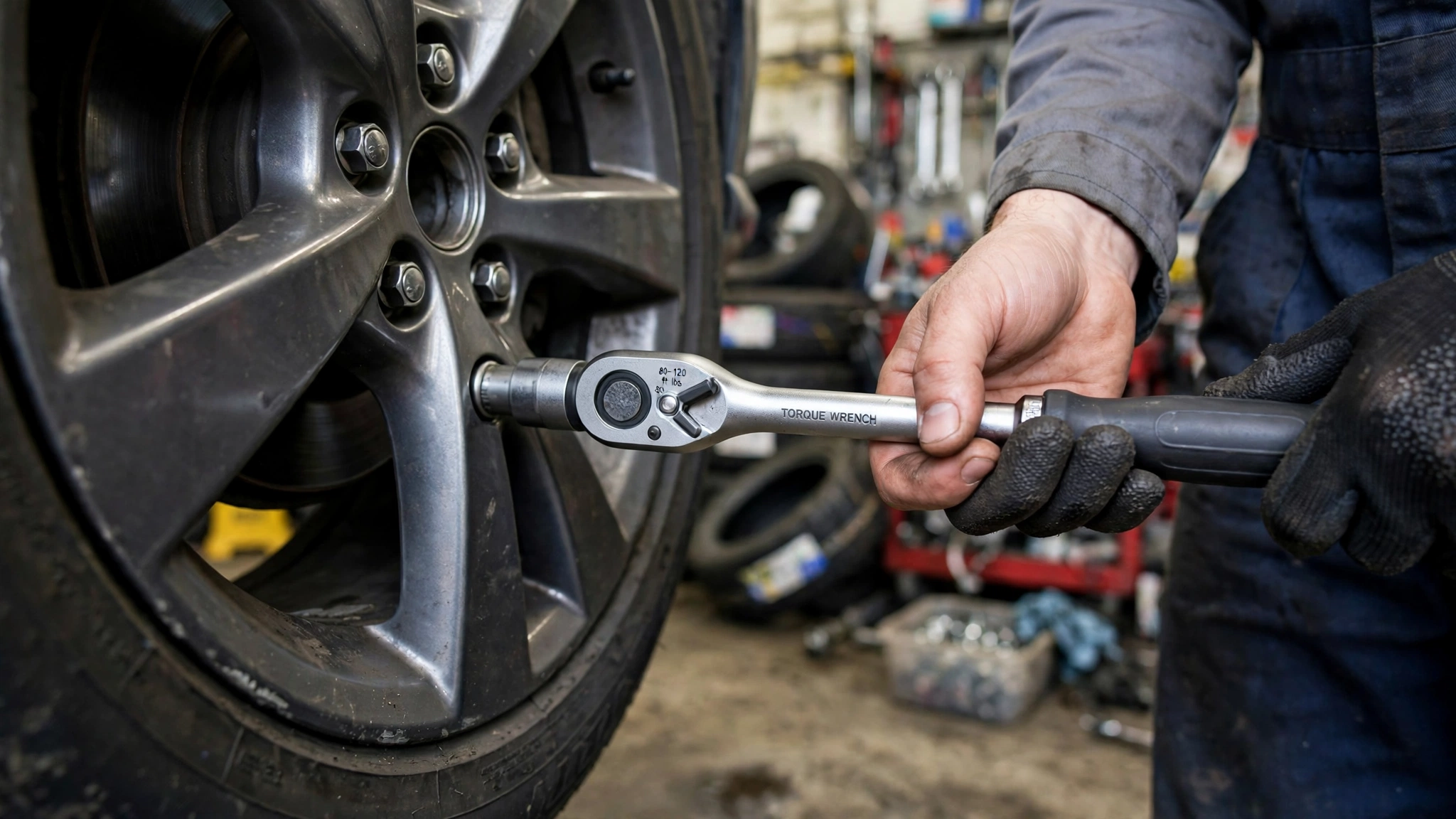
3. Skipping the torque wrench. Lug nuts tightened by feel — or worse, with an impact wrench cranked to maximum — can warp brake rotors or work loose. Every wheel should be torqued to your vehicle’s spec, tightened in a star pattern. (Our flat-tire guide walks through the star pattern step by step.)
4. Forgetting tire pressure. Set all four tires to the pressure on your door-jamb label after a rotation, not the number on the tire sidewall. Underinflated tires wear the edges; overinflated ones wear the center.
5. Ignoring the TPMS light afterward. On many cars the tire pressure monitoring system needs to relearn which sensor is at which corner after a rotation. If your TPMS light starts flashing after a rotation, it usually just needs a relearn procedure — your owner’s manual explains it, and many cars do it automatically after a short drive.
What to Check While the Wheels Are Off

A rotation is the perfect moment for a quick health check, since every tire is in your hands anyway:
- Tread depth: use the penny test or a gauge. Uneven wear between tires tells you something about alignment or inflation.
- Sidewall damage: cuts, bulges, or cracking mean the tire needs replacing regardless of tread.
- Valve stems and TPMS sensors: look for cracked rubber or corrosion.
- Brake inspection: with the wheels off, you can see pad thickness — a free bonus check.
If any tire is showing the wear bars or failing these checks, see our guide to when tires need replacing before you put it back on.
FAQ
Can I rotate my tires myself?
Yes, with a jack, jack stands, and a lug wrench — but torque the lug nuts to spec and re-check them after 50 miles.
Do I need an alignment with every rotation?
No. Rotation and alignment are different jobs. Rotate on schedule; get an alignment when you notice uneven wear, pulling to one side, or after hitting a major pothole or curb.
What happens if I never rotate my tires?
The drive-axle tires wear out much earlier than the others. You’ll end up replacing tires in pairs instead of a full set, spend more money over the life of the car, and drive on uneven grip — which means longer stopping distances and worse wet-weather handling.
Can you rotate tires with different tread depths?
You can, but put the deeper-tread tires on the rear axle. If the back end loses grip before the front (oversteer), it’s much harder for an average driver to control than the front losing grip first.
Does tire rotation affect AWD systems?
It protects them. AWD drivetrains expect all four tires to be close in circumference. Regular rotation keeps wear even, which avoids stressing the center differential. This is one case where skipping rotations can cause expensive damage beyond the tires themselves.
How long does a tire rotation take?
At a shop, typically 20–30 minutes. DIY in your driveway, plan for 45 minutes to an hour your first time, faster once you’ve done it.
How often should I rotate my tires? Every 5,000–7,500 miles — check your owner’s manual for your car’s exact interval.