
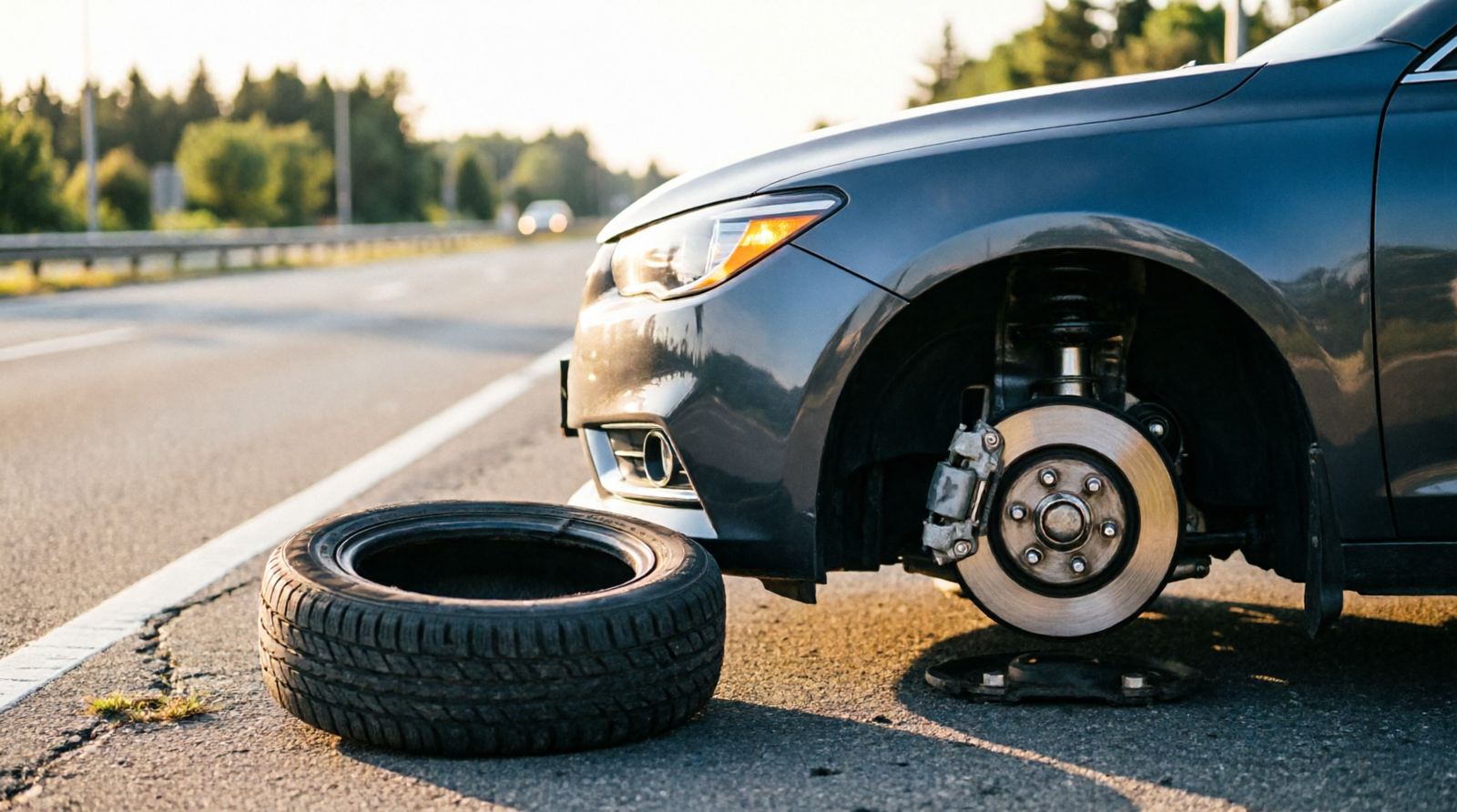
A tire coming off the rim while driving is a serious situation that demands quick, careful action. Don’t try to force the tire back onto the wheel or assume that adding air has fixed the problem.
A tire that has lost its bead or most of its air can affect steering and handling. The tire, bead, and wheel should be inspected to find out what caused the problem and whether they can safely be reused.
What to Do If Your Tire Comes Off the Rim While Driving
If this happens while you’re moving, your first priority is getting away from traffic safely.
1. Slow Down Smoothly
Take your foot off the accelerator and allow the vehicle to slow down gradually.
Avoid sudden braking or aggressive steering. A severely deflated or partially unseated tire may not respond normally, especially while turning. You may notice flapping, thumping, pulling, vibration, or a sudden change in steering feel.
2. Move Away From Traffic
If possible, move toward the shoulder, an emergency pull-off, or another safe location away from moving traffic.
Turn on your hazard lights and pay attention to surrounding vehicles. On a busy highway, standing beside the vehicle to inspect the tire can put you in greater danger.
Once you’re safely stopped, assess the situation from a safe position.
3. Don’t Drive on the Tire
A vehicle may still move even when a tire is badly damaged or has lost most of its air. That doesn’t mean it’s safe to continue driving.
Severe underinflation increases sidewall flex and heat buildup and can affect handling and tire durability. If the tire is visibly off the rim, severely deflated, damaged, or rubbing against the vehicle, arrange roadside assistance or have the vehicle transported to a qualified tire shop.
4. Don’t Try to Force the Tire Back Onto the Rim
Don’t try to reseat the tire using improvised tools or methods.
A tire-and-wheel assembly can store significant energy when inflated. Proper tire mounting and inflation require appropriate equipment and procedures.
5. Have Both the Tire and Wheel Inspected
Don’t simply ask a tire shop to “put the tire back on.”
The important question is why the tire came off in the first place.
The technician should inspect the tire, bead, wheel, valve components, and other relevant parts. If the incident followed a pothole or curb strike, the wheel and tire deserve particular attention.
Why Does a Tire Come Off the Rim While Driving?
A properly fitted and inflated tire should remain seated on its wheel during normal driving. When a tire comes off the rim, something has usually affected its pressure, bead seating, wheel condition, or fitment.
Common causes include:
- Severe underinflation
- A pothole or curb impact
- A bent or damaged wheel
- Tire or bead damage
- Improper mounting
- Incorrect tire and wheel fitment
- An air leak that went unnoticed
The exact cause can only be determined by inspecting the tire and wheel.
Severe Low Tire Pressure
Low pressure is one of the first things worth investigating.
As tire pressure falls, the tire can flex more than intended while driving. Severe underinflation can increase heat buildup and affect handling and tire durability.
A tire doesn’t have to be completely flat for low pressure to become a problem. A slow leak can gradually reduce pressure until the tire becomes significantly underinflated.
In some situations, severe pressure loss can contribute to the bead becoming unseated, but low pressure isn’t necessarily the original cause. The source of the pressure loss should also be investigated.
Potholes and Curbs
A hard impact can damage both the tire and wheel.
A deep pothole can deform the wheel or damage the tire. A hard curb strike can cause similar problems.
The damage isn’t always obvious immediately. You may notice a new vibration, steering change, or gradual pressure loss instead.
If the tire came off shortly after a significant impact, don’t assume that only the tire was damaged.
Bent or Damaged Wheel
The tire bead sits against the wheel and helps create the air seal.
If the bead-seating area is bent, cracked, heavily corroded, or otherwise damaged, the tire may not seat or seal correctly. A damaged wheel can also contribute to air loss.
A wheel that looks only slightly bent shouldn’t automatically be considered safe based on appearance alone. It needs proper inspection.
Tire or Bead Damage
The tire itself may be the problem.
A damaged bead may not maintain a proper seal against the wheel. Serious sidewall damage, cuts, cracks, bulges, or other defects can also make a tire unsuitable for continued use.
If the tire was recently mounted or serviced, tell the technician. Bead damage can sometimes occur during mounting or handling, and the service history may help identify what happened.
Improper Mounting or Fitment
The tire and wheel need to be compatible, and the bead must be seated correctly during mounting.
Incorrect tire-and-wheel dimensions, damaged components, improper installation, or contamination around the mating surfaces can interfere with proper seating.
This is especially relevant if you recently installed new tires, replaced a wheel, changed tire sizes, or installed aftermarket wheels.
Can You Drive After a Tire Comes Off the Rim?
No. You should not continue normal driving after a tire has come off the rim.
There’s an important difference between a tire that is slightly low and one that has lost its bead or become severely deflated.
Once the tire is visibly off the rim, continuing to drive can increase damage to the tire and wheel and make vehicle handling less predictable.
The fact that the vehicle still moves doesn’t mean the tire is safe to drive on.
If you only have a TPMS warning and the tire still appears properly seated, that’s a different situation. But if the tire has actually come off the rim, stop driving and arrange an inspection.
Is the Tire or Rim Damaged?
A tire coming off the rim doesn’t automatically mean that both the tire and wheel need replacement.
The outcome depends on why the tire came off, how much pressure it lost, and whether the vehicle continued moving afterward.
Check the Tire
After the vehicle is safely stopped, you can look for obvious signs of damage. A visual inspection, however, isn’t a final diagnosis.
Look for:
- Deep cuts
- Cracks
- Bulges or bubbles
- Severe abrasions
- Exposed cords
- Distorted sections
- Unusual marks
- Bead damage
The bead should also be checked for cuts, tears, distortion, damaged bead wires, uneven seating marks, rubber damage, or foreign material.
If the tire was driven for any distance while severely underinflated, tell the technician. A tire can look reasonably normal from the outside and still require closer examination.
Check the Wheel
The wheel deserves the same attention.
Possible signs of wheel damage include:
- A visible bend
- Cracks
- Dents around the rim edge
- Severe corrosion
- Air leaking around the bead
- Difficulty seating the tire
- New vibration after an impact
- Repeated pressure loss
Some damage isn’t easy to see while the tire is mounted, so a proper inspection may require removing the tire.
Tire vs. Rim Damage: What Needs to Be Replaced?
There isn’t an automatic answer. The damaged component determines the repair.
| Problem found | Possible outcome |
| Tire and bead are undamaged; wheel is sound | Professional reseating may be possible |
| Damaged or torn bead | Tire replacement may be necessary |
| Serious sidewall damage | Tire replacement |
| Significant internal damage | Tire replacement |
| Wheel has minor serviceable damage | Professional assessment needed |
| Wheel is bent or defective | Repair or replacement may be necessary |
| Wheel is cracked or seriously damaged | Wheel replacement |
| Tire and wheel are both damaged | Both may need replacement |
This is a general guide, not a diagnosis. The actual tire and wheel need to be examined.
Can a Tire Be Put Back on the Rim?
Sometimes.
If the tire has no unacceptable damage, the bead is in good condition, and the wheel is suitable for use, a qualified tire technician may be able to reseat the tire.
But reseating the tire isn’t the same as fixing the original problem.
For example, if a damaged wheel caused the tire to lose air, simply reseating the tire won’t solve the wheel problem. The same applies if the bead itself is damaged or the tire was damaged while being driven severely underinflated.
Why You Shouldn’t Reseat It Yourself
Tire mounting and inflation involve stored energy and require appropriate equipment.
If the bead doesn’t seat correctly, don’t keep adding air in an attempt to force it into place. A tire that has already come off the rim while driving should be handled by a qualified tire professional.
What Will a Tire Shop Check?
When you take the vehicle to a tire shop, explain exactly what happened.
Instead of simply saying:
“I have a flat.”
Tell them:
“The tire lost air and came off the rim while I was driving.”
Also mention anything that happened immediately beforehand.
A useful inspection may include:
- Removing the tire from the wheel
- Inspecting the inside and outside of the tire
- Checking the bead for damage
- Inspecting the wheel and bead seat
- Checking for air leaks
- Inspecting the valve and related components
- Checking the TPMS component when applicable
- Determining whether the tire can be reused
- Determining whether the wheel can be reused
- Identifying the original cause
Tell the technician if you hit a pothole or curb, noticed the TPMS warning first, had been losing air slowly, recently installed tires or wheels, changed tire sizes, or drove for several miles after the tire became flat.
What Happens If You Keep Driving on a Tire That Came Off the Rim?
Continuing to drive can turn a manageable repair into a more expensive problem.
The Tire Can Suffer More Damage
A severely underinflated tire experiences increased sidewall flex and heat buildup. If the tire is already damaged, additional driving can make the condition worse.
The Wheel Can Be Damaged
If the original problem involved the wheel, continued driving can expose it to additional forces and contact.
A damaged wheel should be inspected before the tire is mounted again.
Vehicle Handling Can Change
A severely deflated tire can cause:
- Pulling
- Vibration
- Heavy or unusual steering
- Flapping or thumping
- Instability
- Reduced control during turns
The symptoms vary between vehicles, so don’t wait for an extreme warning before stopping.
When Should You Replace the Tire?
Not every tire that comes off a rim needs to be replaced.
Replacement becomes more likely when inspection finds:
- Serious sidewall damage
- A damaged bead
- Exposed internal material
- Deep cuts
- Bulges
- Severe abrasion
- Significant internal damage
- Damage associated with severe underinflation
- Another defect that makes the tire unsuitable for service
The tire’s age can also matter, so tell the technician how old it is.
When Should You Replace the Rim?
A wheel may need replacement if structural damage prevents it from properly supporting the tire or maintaining the bead seal.
Possible reasons include:
- Cracks
- Significant bends
- Severe corrosion
- Damaged bead-seating surfaces
- Deformation that prevents proper seating
- Damage that causes repeated air leakage
Not every cosmetic mark makes a wheel unusable. The important question is whether the wheel remains structurally sound and compatible with the tire.
How to Prevent a Tire From Coming Off the Rim
You can’t eliminate every road hazard, but you can reduce the chances of a tire problem developing unnoticed.
Maintain the Correct Tire Pressure
Use the vehicle manufacturer’s recommended cold tire pressure rather than the maximum pressure printed on the tire sidewall.
The recommended pressure is normally found on the driver’s door-jamb label or in the owner’s manual.
Don’t Ignore TPMS Warnings
A TPMS warning means you should check the tire pressure and investigate the cause.
TPMS is useful for detecting significant underinflation, but it doesn’t replace regular pressure checks.
Inspect the Tire After a Hard Impact
After a major pothole or curb strike, look for:
- Pressure loss
- Sidewall damage
- Wheel damage
- New vibration
- Steering changes
If something feels different afterward, have the tire and wheel checked.
Use the Correct Tire and Wheel Combination
The tire must match the wheel correctly, especially when installing aftermarket wheels, changing tire sizes, or replacing individual wheels.
Quick Reference: What to Do After a Tire Comes Off the Rim
| Situation | Best response |
| Tire suddenly loses pressure | Slow down and move to a safe location |
| Tire is visibly off the rim | Don’t continue normal driving |
| Tire was driven while severely underinflated | Have it professionally inspected |
| Rim appears bent or cracked | Don’t use it until properly assessed |
| Bead looks damaged | Have the tire evaluated |
| Tire is reseated but loses air again | Find and repair the source of the leak |
| Problem followed a pothole or curb impact | Inspect both tire and wheel |
| TPMS warning remains on | Check pressure and investigate the cause |
The goal isn’t simply to get the tire back onto the wheel. The tire, bead, wheel, and inflation system all need to be suitable for continued use, and the original cause should be addressed.
Frequently Asked Questions
Can a tire come off the rim while driving?
Yes. Severe pressure loss, impact damage, a damaged wheel, tire or bead damage, and improper installation or fitment can contribute to a tire becoming unseated. The exact cause needs to be identified before the tire is returned to service.
Is it safe to drive with a tire off the rim?
No. A tire that has come off the rim shouldn’t be treated like an ordinary low-pressure tire. Stop driving and arrange professional assistance.
Can a tire be reused after coming off the rim?
Sometimes. If the tire has no unacceptable damage and the bead and wheel are in good condition, a qualified tire professional may be able to reseat it.
Can a bent rim cause a tire to come off?
A damaged or bent wheel can interfere with proper bead seating and contribute to air loss. If the problem happened after a pothole or curb strike, both the tire and wheel should be inspected.
Does a tire always need to be replaced after coming off the rim?
No. The incident itself doesn’t automatically make the tire unusable. Replacement may be necessary if inspection finds bead damage, serious sidewall damage, internal damage, or another defect that makes the tire unsuitable for continued service.
Should I just add air if the tire comes off the rim?
No, not if the tire is visibly off the rim or has been driven severely underinflated. The tire and wheel should be inspected before the assembly is returned to service.
How can I prevent a tire from coming off the rim?
Keep the tires at the vehicle manufacturer’s recommended pressure, respond to TPMS warnings, inspect tires and wheels after significant impacts, and use compatible tire and wheel sizes. Proper tire service and equipment are also important.
Related Guides
- Spare tire guide: types, speed limits, and pressure
- How to use a jack safely
- Changing a tire without a jack
- Changing a tire on an incline
- Flat tire and no spare: what to do
- Roadside tire change service: what it covers
- What to do if a tire comes off the rim
Conclusion
If your tire came off the rim while driving, slow down, get to a safe location, and stop driving. Don’t assume that adding air or reseating the tire has solved the problem.
The tire may be reusable, but that depends on its actual condition. A proper inspection should consider the bead, sidewall, internal condition, wheel, inflation system, and the cause of the original failure.