
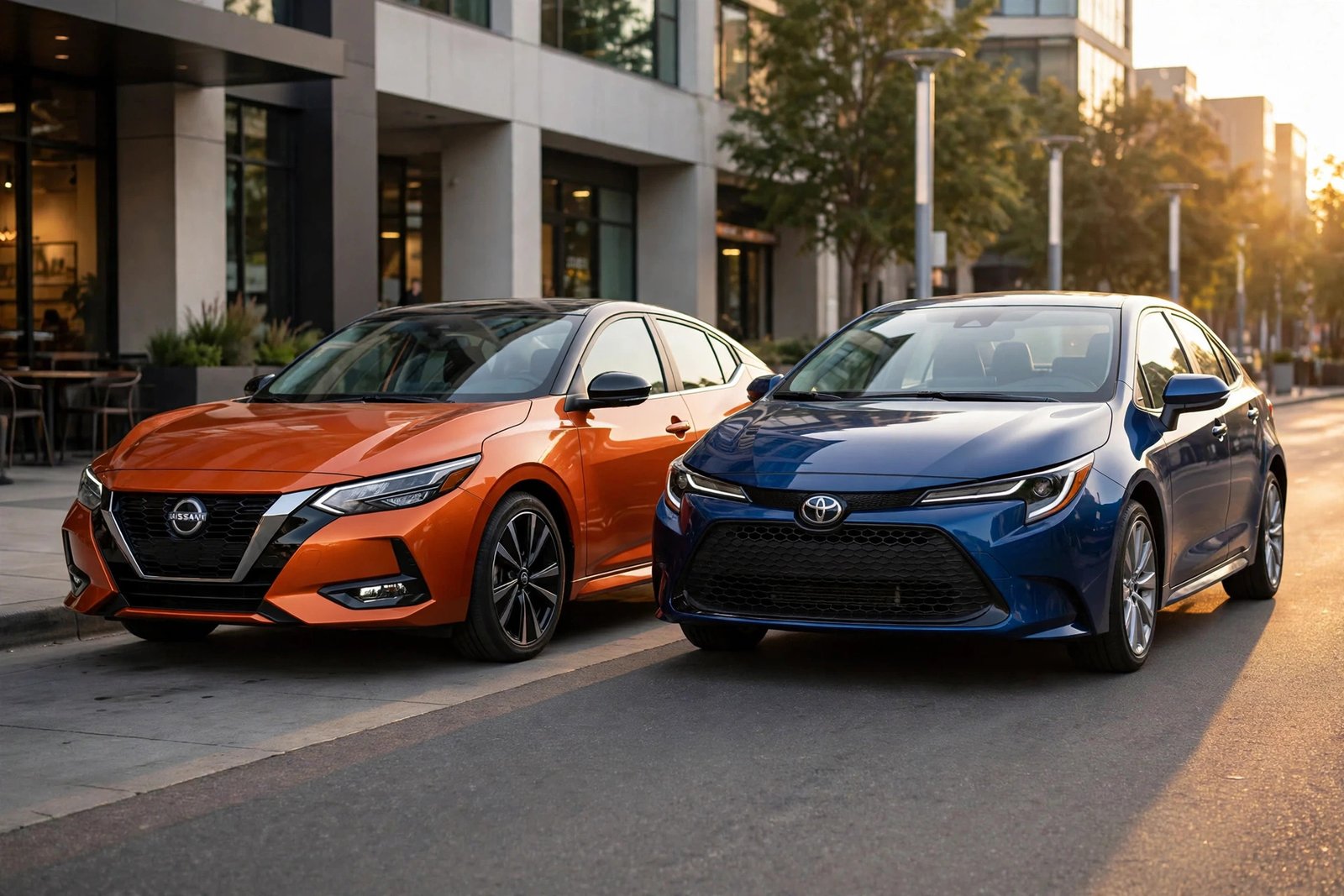
Quick answer: The 2026 Toyota Corolla wins for most buyers. It is quicker, more fuel-efficient at every trim, and the only one of the two that offers a hybrid (up to 50 mpg combined) and available all-wheel drive — plus it has the stronger long-term reliability record. The 2026 Nissan Sentra is the better buy if you want the lowest starting price, the biggest screens, more passenger and trunk space, and the 2026 IIHS Top Safety Pick+ award, which the Corolla did not earn.
Two of America’s longest-running compact sedan nameplates are fighting over the same buyer in 2026: someone who wants an affordable new car that sips fuel, holds its value, and does not feel like a penalty box. The Corolla has been the default answer to that brief for decades. The Sentra, though, is not the car it was five years ago — Nissan completely redesigned it for 2026, with a bolder look, a genuinely premium-feeling cabin, and the largest screens in the segment.
We compared the two on price, performance, fuel economy, space, technology, safety, and ownership costs, using manufacturer figures, EPA ratings, IIHS results, and independent testing from Edmunds and J.D. Power.
Nissan Sentra vs Toyota Corolla at a Glance
| 2026 Nissan Sentra | 2026 Toyota Corolla | |
|---|---|---|
| Starting price (before destination) | $22,600 (S) | $23,125 (LE sedan) |
| Starting price (incl. destination) | $23,845 | $24,420 |
| Top trim price (before destination) | $27,990 (SL) | $28,840 (XSE gas) / $29,340 (Hybrid XLE) |
| Trims | S, SV, SR, SL | LE, SE, XSE; Hybrid LE, SE, XLE |
| Engine | 2.0L 4-cylinder, 149 hp / 146 lb-ft | 2.0L 4-cylinder, 169 hp / 151 lb-ft; Hybrid: 1.8L + electric motor, 138 hp combined |
| Transmission | Xtronic CVT | CVT (gas) / ECVT (hybrid) |
| Combined MPG | 33–34 | 34–35 gas; 47–50 hybrid |
| Trunk space | 14.3 cu. ft. | 13.1 cu. ft. (sedan) |
| Passenger volume | 96.1 cu. ft. | 88.6 cu. ft. |
| Drivetrain | Front-wheel drive only | Front-wheel drive; AWD available on Hybrid LE and SE |
| Hybrid available | No | Yes |
| Standard touchscreen | 12.3 inches | 8 inches |
| Airbags | 8 | 10 |
| IIHS award (2026) | Top Safety Pick+ | None |
| Basic / powertrain warranty | 3 yr / 36,000 mi; 5 yr / 60,000 mi | 3 yr / 36,000 mi; 5 yr / 60,000 mi |
Price and Trims: The Sentra Starts Cheaper, but Barely
The Sentra is the cheaper car, and after the Versa was discontinued it is now Nissan’s least expensive car in America. The 2026 Sentra S starts at $22,600 before the $1,245 destination charge — $23,845 all in. The Corolla LE sedan starts at $23,125 before destination, or $24,420 including destination according to J.D. Power. That is a difference of $575 — real money, but not the kind of gap that should decide the purchase on its own.
The lineups are structured very differently. Nissan keeps it simple: four trims — S, SV, SR, and SL — all with the same engine, priced from $22,600 to $27,990 before destination. The SV costs $23,370, the sportier-looking SR is $25,000, and the loaded SL tops the range at $27,990. Every step up buys features and comfort, not more power.
Toyota gives you six sedan configurations: three gas trims (LE $23,125, SE $25,565, XSE $28,840) and three hybrids (Hybrid LE $24,975, Hybrid SE $27,415, Hybrid XLE $29,340), all before destination. That breadth is a genuine advantage. If you want a hybrid for under $25,000 before destination, the Corolla Hybrid LE is one of the cheapest hybrids on sale in America. The Sentra has no answer to that — one powertrain, one body style, take it or leave it.
The Sentra SV is the value sweet spot of its range: at $24,615 including destination, it costs only about $200 more than the base Corolla LE, yet adds the dual 12.3-inch displays and more standard equipment.

Engine, Performance, and Fuel Economy: The Corolla Is Quicker and Thriftier
Both cars use a 2.0-liter four-cylinder engine and a CVT, but the Corolla’s engine is simply stronger. Its 2.0-liter Dynamic Force four makes 169 horsepower and 151 lb-ft of torque, against 149 horsepower and 146 lb-ft for the Sentra. In Edmunds testing, the Corolla reached 60 mph in 8.8 seconds — nearly a full second quicker than the Sentra they tested. Neither car is fast, but that gap shows up when merging or passing.
Fuel economy favors the Corolla at every level. The gas Corolla LE is EPA-rated at 32 city / 41 highway / 35 combined mpg, while the Sentra S manages 31 city / 39 highway / 34 combined. The Sentra SR and SL drop to 33 mpg combined, while the Corolla SE and XSE hold 34.
The hybrid is where the comparison stops being close. The Corolla Hybrid LE and Hybrid XLE return an EPA-estimated 53 city / 46 highway / 50 combined mpg, and the Hybrid SE manages 47 combined. All-wheel-drive hybrids still return 48 combined on the LE and 44 on the SE — roughly 50 percent better than anything in the Sentra lineup, which has no hybrid at all.
In dollars: at 12,000 miles a year and $3.50 a gallon, a Sentra at 34 mpg costs roughly $1,235 a year in fuel, while a Corolla Hybrid at 50 mpg costs roughly $840 — close to $400 a year saved, or about $2,000 over five years. The gas Corolla’s edge over the Sentra is only about $35 a year, so do not let a single mpg decide between the two gas cars.
There is one more drivetrain difference that matters for a large part of the country: all-wheel drive. It is available on the Corolla Hybrid LE and Hybrid SE (a $1,400 option, according to Toyota dealer pricing), and it does not exist anywhere in the Sentra lineup.

Interior Space and Comfort: The Sentra Is Roomier
This is the Sentra’s strongest category, and it is not close. The redesigned Sentra is slightly longer, wider, and taller than the Corolla, and the extra size goes where passengers can feel it. Passenger volume is 96.1 cubic feet in the Sentra against 88.6 in the Corolla sedan, and the Sentra has more front legroom and elbow room. Edmunds’ testers praised the Sentra’s front seats as among the best in any compact car for long-drive comfort, and upper trims — quilted leatherette on the SL, soft-touch materials — feel like they belong in a pricier car.
The trunk tells the same story: 14.3 cubic feet in the Sentra versus 13.1 in the Corolla sedan. The one caveat is rear headroom — the Sentra’s sleeker roofline pinches it slightly, so very tall rear passengers may notice.
The Corolla’s cabin is not bad; it is just more conservative. It is practical and well put together, but it feels like a car designed in 2019 — because, fundamentally, it was. The current Corolla generation dates back to 2019, while the Sentra is a fresh 2026 redesign. On space and perceived quality, the Sentra wins.

Technology: The Sentra’s Screens Embarrass the Corolla’s
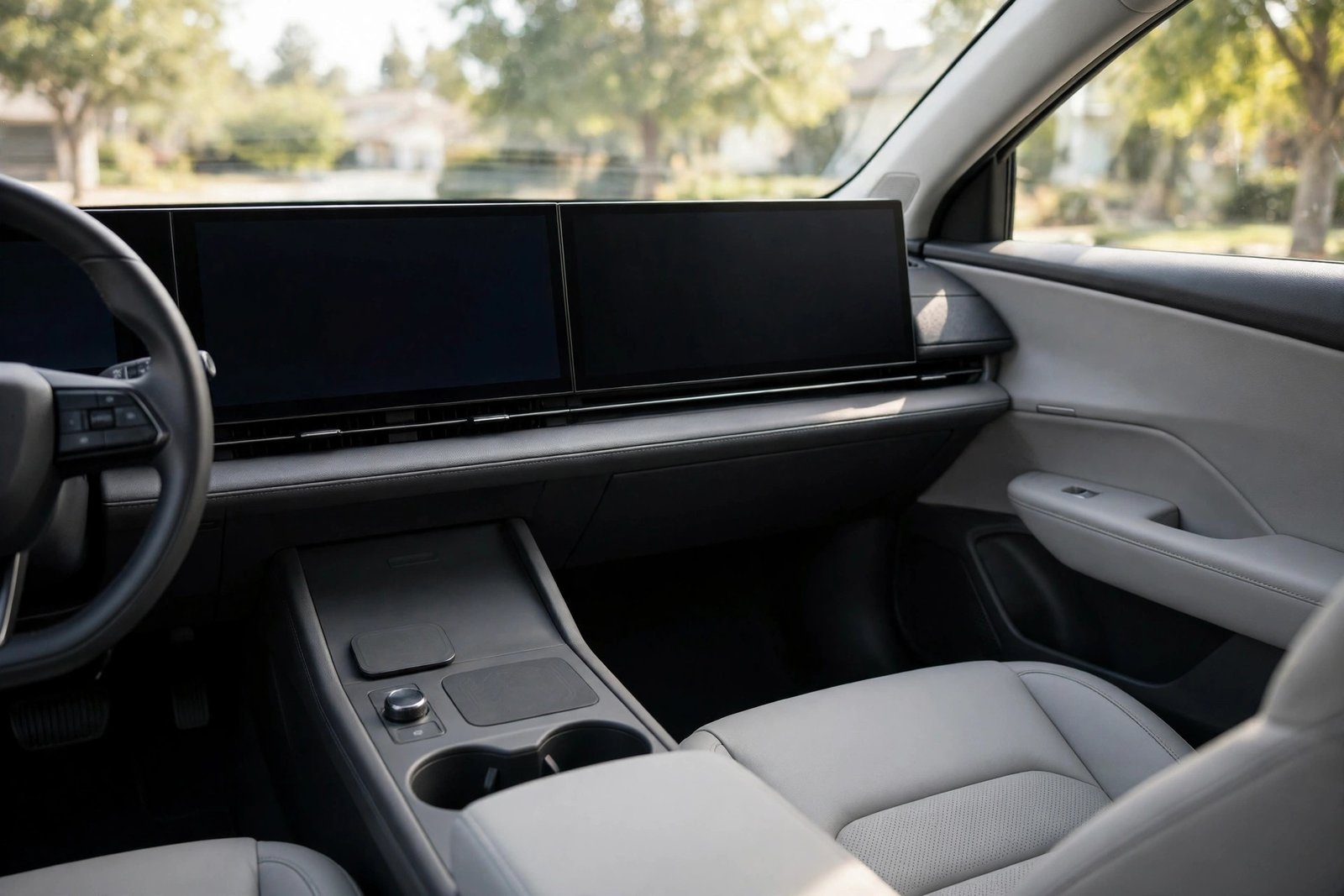
If you judge a car by its dashboard, the Sentra wins this comparison by a wide margin. Every 2026 Sentra comes standard with a 12.3-inch touchscreen, and every trim except the base S adds a matching 12.3-inch digital gauge cluster, creating a wide dual-screen display. Wireless Apple CarPlay and Android Auto are standard across the range, and higher trims add an eight-speaker Bose premium audio system, wireless phone charging, a Wi-Fi hotspot, and a touch-controlled climate panel.
The Corolla, by contrast, starts with an 8-inch touchscreen and a 7-inch digital instrument cluster on LE and SE grades. A 10.5-inch touchscreen and a 12.3-inch digital cluster are available, but only on higher trims. Wireless Apple CarPlay and Android Auto are standard, and a JBL premium audio system is available, so the Corolla is not short on features. It is short on screen.
The Sentra also offers driver-assistance tech the Corolla does not. ProPILOT Assist — Nissan’s system combining adaptive cruise control with lane centering and stop-and-go capability — is available on the SR and standard on the SL. The SL also gets a standard surround-view camera with moving-object detection, and rear automatic braking is available on upper trims.
Safety: A Split Decision — the Sentra Has the Award, the Corolla Has the Airbags
Here is the twist: the cheaper, redesigned car holds the top safety award, and the reliability champion does not.
The 2026 Nissan Sentra earned the IIHS Top Safety Pick+ award — the Insurance Institute for Highway Safety’s highest honor. It is one of only a handful of compact cars to do so under the institute’s tougher 2026 criteria, which demand Good ratings in the small-overlap front, updated moderate-overlap front, and updated side tests, plus acceptable-or-better headlights and pedestrian crash prevention. Every Sentra also comes standard with Nissan Safety Shield 360, including automatic emergency braking with pedestrian and cyclist detection, blind-spot warning with intervention, lane departure prevention, rear cross-traffic alert, high-beam assist, and intelligent forward collision warning.
The 2026 Toyota Corolla did not earn an IIHS Top Safety Pick or Top Safety Pick+ award. It scored Good in the small-overlap front test, but a Marginal rating in the updated moderate-overlap front test — specifically for rear-passenger protection — kept it out of the awards. That is worth understanding properly: the Corolla is not an unsafe car. The IIHS test that tripped it up measures how well rear-seat passengers are protected, and the standard is deliberately stricter than federal requirements. The Corolla Hatchback did earn a five-star overall rating from NHTSA, though NHTSA had not rated the sedan version at the time of writing. The Corolla counters with more passive protection: ten standard airbags, including a front passenger seat cushion airbag, against eight in the Sentra, and Toyota Safety Sense 3.0 is standard on every grade.
Reliability, Warranty, and Ownership Costs: The Corolla’s Home Turf
Toyota’s reputation is not marketing fluff — it shows up in the data. The Toyota Corolla ranked highest in the Compact Car segment in the J.D. Power 2026 U.S. Vehicle Dependability Study, which measures problems reported by owners after three years of ownership. The Corolla also holds its value better than most compact sedans.
The Sentra’s story is more nuanced. The redesigned model ranked highest in its segment in the J.D. Power 2025 Initial Quality Study, which tracks problems in the first 90 days of ownership — a strong start, but a measure of factory quality rather than long-term durability. Long-term dependability data for the redesigned Sentra does not exist yet, because the car is new. RepairPal rates the Sentra 4.0 out of 5.0 for reliability, with an average annual repair cost of $491, against around $362 a year for the Corolla. Those are estimates, not guarantees, but the direction is consistent: the Corolla is likely to cost less to keep running.
The factory warranties are identical: 3 years or 36,000 miles basic coverage and 5 years or 60,000 miles powertrain coverage on both cars. The difference is in the extras. Toyota includes ToyotaCare — free factory-scheduled maintenance for 2 years or 25,000 miles, plus 2 years of roadside assistance with no mileage limit. Nissan does not include free scheduled maintenance, though it does provide 3 years or 36,000 miles of roadside assistance. Corolla Hybrid buyers also get a 10-year or 150,000-mile warranty on the hybrid battery, which removes the biggest long-term worry about owning a hybrid.
For a first-time buyer or a student shopping on a tight budget, it is also worth thinking about total cost rather than sticker price. Our guide to the best cars for college students makes the same point: the cheapest car to buy is not always the cheapest car to own. The Sentra’s lower purchase price is real, but the Corolla’s better fuel economy (especially the hybrid), free maintenance, and stronger resale value close much of that gap over five years. If you want the fullest picture of how the Corolla holds up over time, our roundup of the most reliable cars explains why Toyota’s dependability record matters.
Which One Should You Buy?
Buy the 2026 Toyota Corolla if: you want the lowest running costs, the strongest reliability record, a hybrid, or all-wheel drive. The Corolla Hybrid LE — from $24,975 before destination, with 50 mpg combined — is the smartest buy in this comparison for anyone who drives a lot. The gas LE is the right pick if you want the cheapest Corolla and do not need a hybrid. And if you cross-shop the Civic as well, our Toyota Corolla vs Honda Civic comparison covers that rivalry in detail.
Buy the 2026 Nissan Sentra if: you want the most car for the least money right now, the biggest screens, the roomiest cabin, the larger trunk, and the IIHS Top Safety Pick+ award. The SV is the value pick of the range — it adds the dual 12.3-inch displays and more standard equipment for only a few hundred dollars over a base Corolla. The SL is the one to get if you want the near-luxury feel: quilted seats, Bose audio, ProPILOT Assist, and the surround-view camera.
Either way, test-drive both. The spec sheet says the Corolla wins on efficiency and reliability and the Sentra wins on space, tech, and safety awards — and both of those things are true. What the spec sheet cannot tell you is which cabin you prefer sitting in, which seats fit your back on a 45-minute commute, and which car you actually enjoy driving. If you want to compare them side by side against other models too, try our Compare Cars tool before you visit a dealer.
Verdict: Corolla Wins — but the Sentra Makes It Work for the Decision
The 2026 Toyota Corolla is the better car for most buyers. It is quicker, more efficient in every form, available as a genuinely affordable hybrid and with all-wheel drive, and it carries the strongest long-term reliability record in the segment.
But this is not a blowout, and the Sentra deserves more credit than the Corolla’s reputation might suggest. Nissan’s redesign is a serious effort: the Sentra is cheaper, roomier, better equipped, more modern inside, and it holds the IIHS Top Safety Pick+ award that the Corolla could not earn for 2026. Edmunds’ experts scored the Sentra slightly higher than the Corolla overall.
Our verdict: buy the Corolla Hybrid LE if you can stretch to $24,975 before destination — it is the best compact sedan value in America right now. Buy the Sentra SV if you want the most features and space for the least money, and you do not need a hybrid or all-wheel drive. Either way, you are getting one of the two best affordable sedans on sale in 2026, and neither choice is a mistake.
Frequently Asked Questions
Which is better, the 2026 Nissan Sentra or the Toyota Corolla?
For most buyers, the Toyota Corolla. It is quicker (169 hp vs 149 hp), more fuel-efficient (35 mpg combined gas, up to 50 mpg hybrid, vs 33–34 mpg for the Sentra), offers a hybrid and available all-wheel drive, and has the stronger long-term reliability record. The Sentra is the better pick if you want the lowest price, the biggest screens, more passenger and trunk space, and the 2026 IIHS Top Safety Pick+ award.
How much does a 2026 Nissan Sentra vs Toyota Corolla cost?
The 2026 Nissan Sentra starts at $22,600 before destination ($23,845 including the $1,245 destination charge). The 2026 Toyota Corolla sedan starts at $23,125 before destination ($24,420 including destination). The Corolla Hybrid starts at $24,975 before destination. The Sentra tops out at $27,990 before destination for the SL; the Corolla XSE is $28,840 and the Hybrid XLE is $29,340 before destination.
Which gets better gas mileage, the Sentra or the Corolla?
The Corolla, at every level. The gas Corolla LE manages 32 city / 41 highway / 35 combined mpg, against 31 / 39 / 34 for the Sentra S. The Corolla Hybrid LE reaches 53 city / 46 highway / 50 combined mpg — roughly 50 percent better than any Sentra, which has no hybrid option.
Is the 2026 Nissan Sentra more reliable than the Toyota Corolla?
No — the Corolla has the stronger long-term record. It ranked highest in the Compact Car segment in the J.D. Power 2026 U.S. Vehicle Dependability Study, which measures problems after three years of ownership. The redesigned Sentra did rank highest in its segment in the J.D. Power 2025 Initial Quality Study, which covers the first 90 days, and RepairPal rates the Sentra 4.0 out of 5.0 for reliability. Both cars carry identical 3-year/36,000-mile basic and 5-year/60,000-mile powertrain warranties.
Does the 2026 Sentra or Corolla have better safety ratings?
The Sentra wins on crash-test awards: the 2026 Nissan Sentra earned the IIHS Top Safety Pick+ award, the institute’s highest honor. The 2026 Toyota Corolla earned no IIHS award after a Marginal rating in the updated moderate-overlap front test for rear-passenger protection. Both cars come standard with a full driver-assistance suite, and the Corolla counters with ten standard airbags to the Sentra’s eight.
Does the Nissan Sentra have a hybrid or all-wheel drive?
No. The 2026 Sentra is gas-only and front-wheel drive only, with a single 2.0-liter engine across all four trims. The 2026 Corolla offers a hybrid powertrain (138 hp combined, up to 50 mpg combined) and available all-wheel drive on Hybrid LE and Hybrid SE grades — the only way to get either feature in this comparison.
