
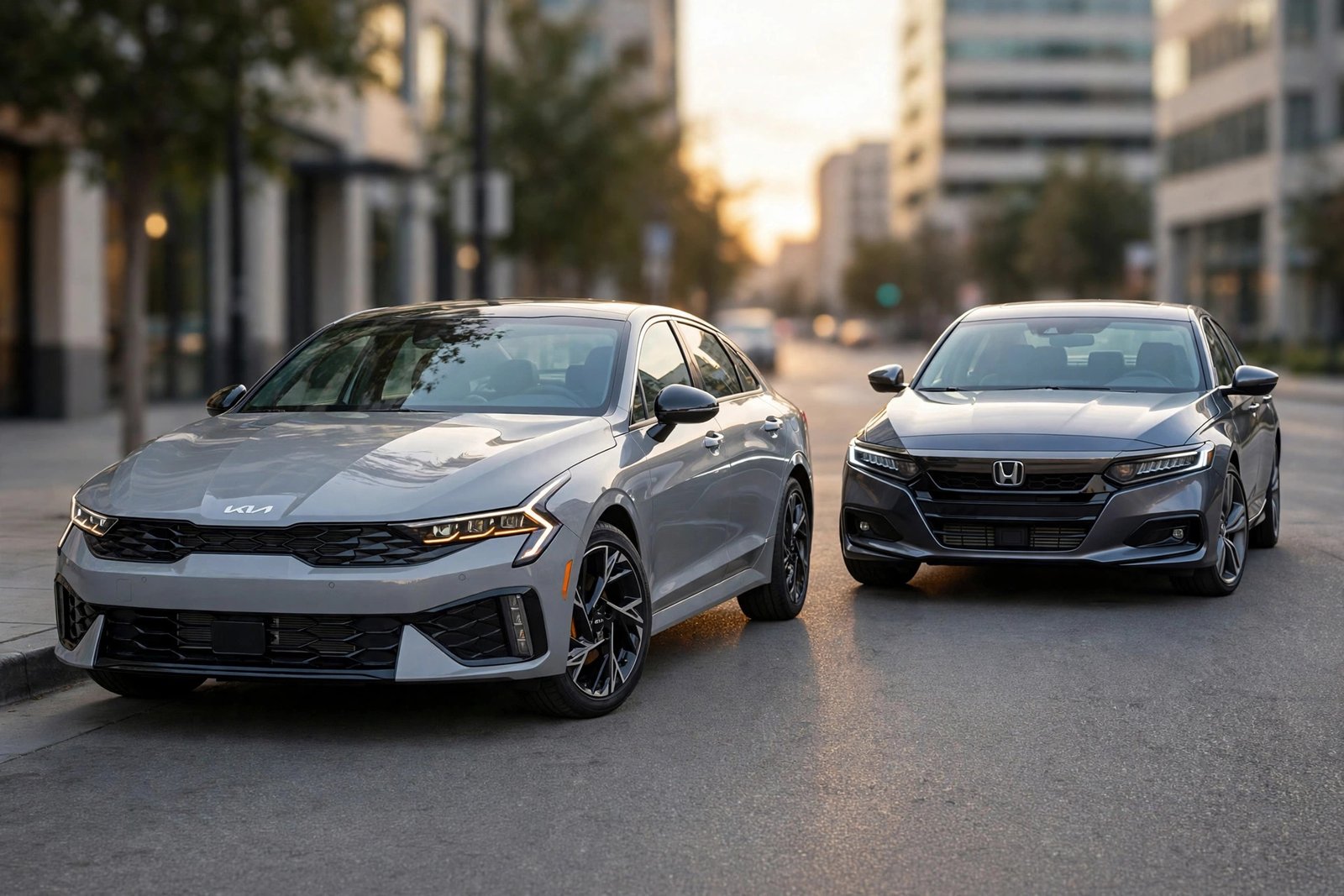
Quick answer: The Honda Accord is the better midsize sedan for most buyers in 2026. It is safer, with a 2026 IIHS Top Safety Pick award the K5 did not earn; it is more fuel-efficient, at 32 mpg combined on the base engine and up to 48 mpg as a hybrid; and it holds its value far better, making it cheaper to own over five years even though it costs about $905 more to buy. The Kia K5 is the better pick if you want real performance — its 290-hp GT has no Accord equivalent — if you need all-wheel drive in a sedan, or if you plan to keep the car for a decade and want Kia’s 10-year powertrain warranty.
Quick Specs Head-to-Head
| Spec | 2026 Kia K5 | 2026 Honda Accord |
|---|---|---|
| Starting price (excl. destination) | $27,490 (LXS) | $28,395 (LX) |
| Destination charge | $1,245 | $1,195 |
| Top trim price (excl. destination) | $34,990 (EX) | $39,495 (Touring Hybrid) |
| Trims | LXS, GT-Line, GT, EX (4) | LX, SE, Sport, EX-L, Sport-L, Touring (6) |
| Base engine | 2.5L 4-cylinder, 191 hp / 181 lb-ft | 1.5L turbo 4-cylinder, 192 hp / 192 lb-ft |
| Performance / hybrid engine | 2.5L turbo (GT), 290 hp / 311 lb-ft | 2.0L hybrid, 204 hp / 247 lb-ft |
| Transmission | 8-speed automatic (8-speed dual-clutch on GT) | CVT (e-CVT on hybrid) |
| Drivetrain | FWD standard, AWD on GT-Line | FWD only |
| Base fuel economy | 26 city / 37 hwy / 30 combined mpg | 29 city / 37 hwy / 32 combined mpg |
| Best fuel economy | 30 mpg combined (no hybrid offered) | Up to 48 mpg combined (hybrid) |
| 0–60 mph | ~5.4 seconds (GT, independent testing) | ~6.7 seconds (hybrid), ~7.3 seconds (gas) |
| Passenger volume | 105.3 cu ft | 105.7 cu ft |
| Trunk space | 15.6 cu ft | 16.7 cu ft |
| Length / wheelbase | 193.1 in / 112.2 in | 195.7 in / 111.4 in |
| Base touchscreen | 12.3 inches (every trim) | 9 inches (12.3 inches on upper trims) |
| IIHS | No award; Poor in updated moderate-overlap test | 2026 Top Safety Pick award |
| NHTSA overall | 4 stars | 5 stars |
| Basic warranty | 5 yr / 60,000 mi | 3 yr / 36,000 mi |
| Powertrain warranty | 10 yr / 100,000 mi | 5 yr / 60,000 mi |
Prices are base MSRP before destination, taxes, and fees. Fuel economy figures are EPA estimates and vary by trim. Confirm exact specs with your dealer before buying.
Price: The K5 Is Cheaper to Buy — By About $905
The K5 opens at $27,490 for the LXS, against $28,395 for the Accord LX — a $905 gap before destination charges. Add destination ($1,245 for Kia, $1,195 for Honda) and the two land at roughly $28,735 and $29,590.
The trim lineups tell you something about each car’s character. Kia keeps it simple with four trims: the value LXS, the sporty GT-Line (the only one with all-wheel drive), the 290-hp GT, and the luxury-focused EX. Honda offers six, because the Accord splits into two cars in one lineup — gas LX and SE trims, then four hybrid trims (Sport, EX-L, Sport-L, and Touring) that cost more but return far better mileage.
Here is the catch, and it matters more than the sticker gap: the cheaper car to buy is not the cheaper car to own. The Accord’s slower depreciation and better fuel economy wipe out the K5’s $905 head start several times over, as the ownership section below shows. So treat the K5’s price advantage as a genuine but modest win — roughly the cost of a set of good tires — not the deciding factor.
Want to run your own numbers? Our car comparison tool lets you line up any two vehicles side by side on the specs that matter to you.
Engines and Performance: Two Nearly Identical Base Engines, Then a Blowout
The base engines are a dead heat on paper. The Accord’s turbocharged 1.5-liter four makes 192 hp and 192 lb-ft; the K5’s naturally aspirated 2.5-liter four makes 191 hp and 181 lb-ft. In everyday driving they feel closer still. Honda’s engine makes 11 more lb-ft of torque and delivers it from low revs, so the Accord feels a little stronger pulling away from a stop. Kia answers with a conventional 8-speed automatic that shifts with defined steps, which many drivers find more engaging than Honda’s continuously variable transmission (CVT), tuned for smoothness and efficiency.
Then the two lineups split completely. Kia offers the GT: a turbocharged 2.5-liter making 290 hp and 311 lb-ft through an 8-speed wet dual-clutch transmission, good for about 5.4 seconds to 60 mph in independent testing. Nothing in the Accord range comes close. The quickest Accord, the hybrid, makes 204 hp combined and takes roughly 6.7 seconds to 60; the gas Accord takes about 7.3 seconds. The GT is 86 hp stronger than the best Accord and nearly a full second quicker to 60 than the hybrid. If acceleration is your priority, this comparison is not close — the K5 GT is the most enjoyable car here by a wide margin, and it is a real production trim you can actually buy, not a limited halo model.
Honda’s split goes the other way: efficiency instead of speed. The Accord Hybrid pairs a 2.0-liter four with two electric motors for 204 hp and 247 lb-ft of combined torque, and it is actually the quicker Accord despite the mileage gains. So the choice is clean. Kia sells you speed. Honda sells you savings at the pump. Neither is wrong — it depends entirely on what you enjoy about driving.

Fuel Economy: The Accord Wins, and the Hybrid Widens the Gap
Honda wins on fuel economy with both powertrains. The base Accord returns 29 mpg city, 37 highway, and 32 combined, against the base K5’s 26 city, 37 highway, and 30 combined. They tie on the highway; the Accord leads by 3 mpg in town and 2 mpg combined. Over 60,000 miles at $4 a gallon, that 2–3 mpg edge is worth roughly $700 in the Accord’s favor — real money, but smaller than the resale gap below.
The hybrid is where the gap becomes serious. The Accord Hybrid reaches up to 48 mpg combined, with the EX-L trim rated at 51 mpg city and 44 highway on its smaller 17-inch wheels. The Sport, Sport-L, and Touring hybrids, on larger 19-inch wheels, return 46 city and 41 highway for 44 combined — still far ahead of anything Kia offers. The K5 has no hybrid at all, making it one of only two midsize sedans without one for 2026, alongside the Nissan Altima. Its best figure is 30 mpg combined, and choosing the all-wheel-drive GT-Line or the GT drops that to 27 combined.
If you drive 15,000 miles a year or more, the hybrid alone can justify the Accord’s higher price. Check any configuration’s official ratings at fueleconomy.gov before you buy, since wheel size and trim change the hybrid’s numbers.
All-Wheel Drive: The K5’s Exclusive Advantage
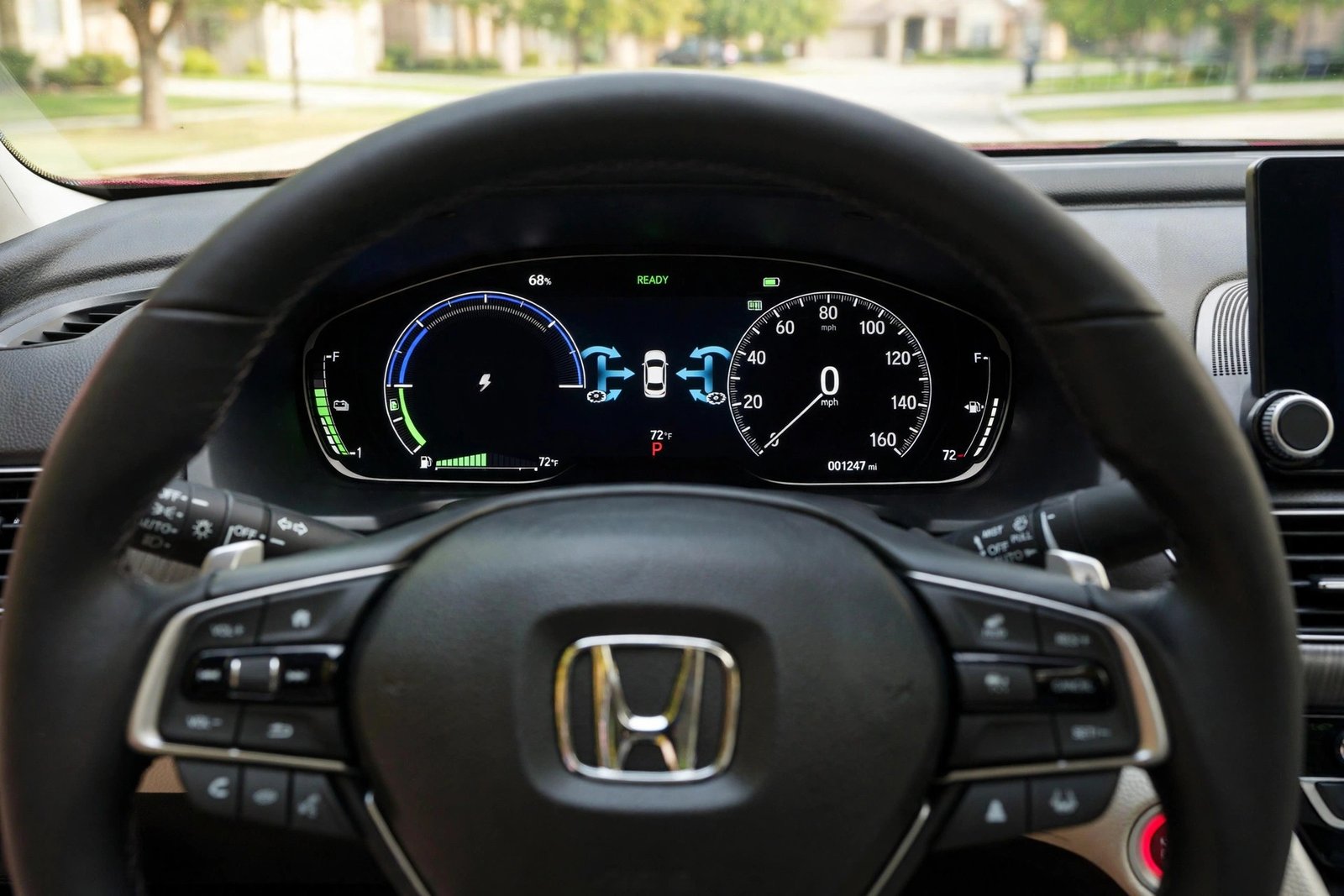
This is the one practical advantage that can settle the whole comparison on its own. Kia offers all-wheel drive on the K5 GT-Line, with a Snow Mode drive setting and a heated steering wheel — a genuinely useful combination if you live where winter is serious. The Accord offers no all-wheel drive on any trim, at any price. Every 2026 Accord is front-wheel drive only.
The trade-off is modest: the all-wheel-drive GT-Line is rated at 24 city, 33 highway, and 27 combined mpg, against 30 combined for the front-wheel-drive K5. That is the price of traction. For buyers in snowy states, it is a price worth paying, and it is the single strongest reason to pick the K5 over the Accord regardless of anything else in this article. If you never see snow, it is irrelevant — but if you do, no safety award or fuel-economy figure in the Accord’s column can replace driven rear wheels.
Interior and Technology: Kia Wins the Screen, Honda Wins the Back Seat
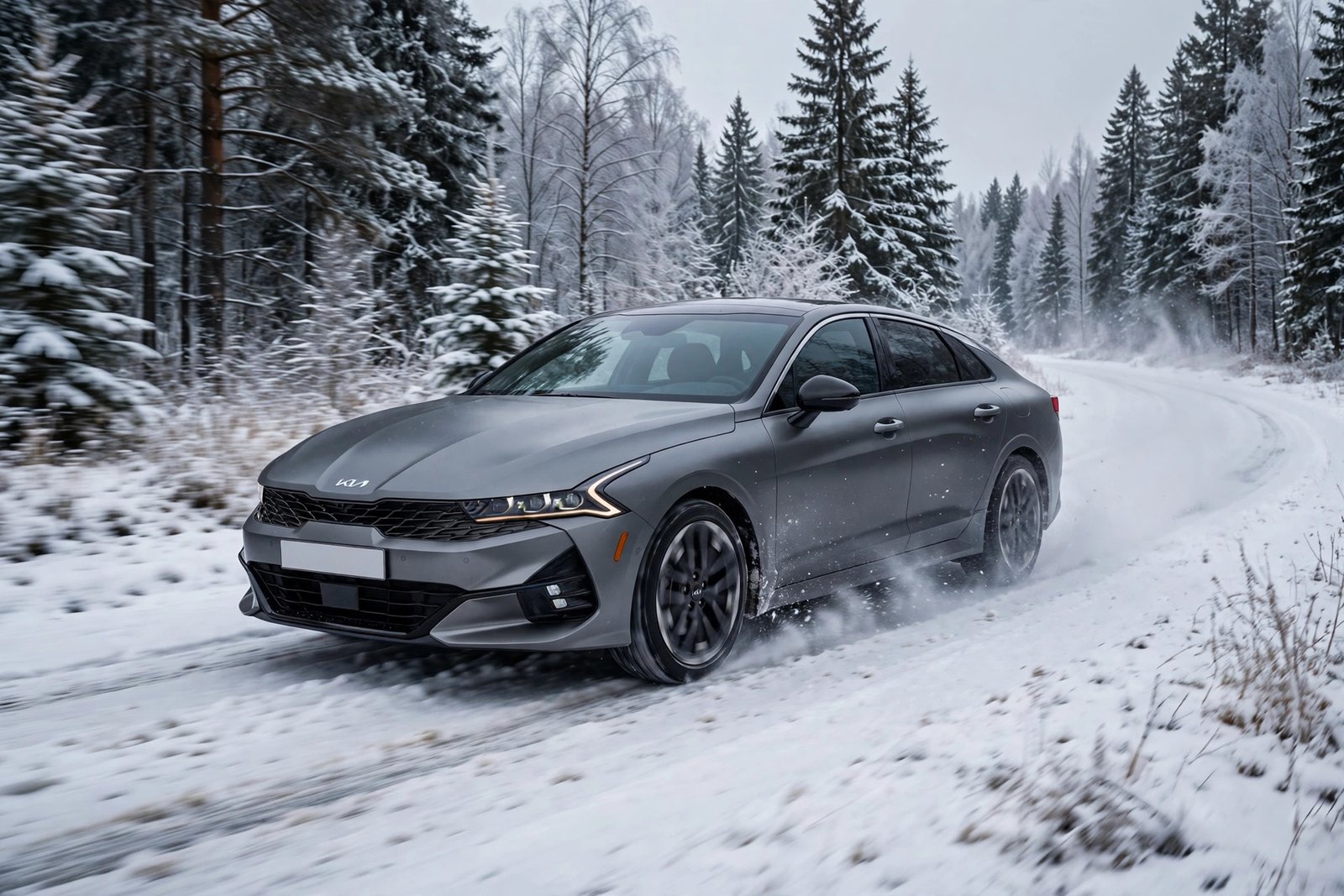
Step inside and the K5 feels like the more expensive car. Every trim, including the base LXS, gets a 12.3-inch touchscreen with wireless Apple CarPlay and Android Auto. The Accord starts with a 9-inch screen on the LX and SE; you need an upper trim for the 12.3-inch display, wireless connectivity, and Google built-in. Kia also offers a blind-spot camera view that appears in the instrument cluster when you signal, plus an available 360-degree surround-view monitor and dual panoramic displays on the EX — features Honda does not match in this class.
Space is effectively a tie with one important split. Total passenger volume differs by just 0.4 cubic feet — 105.7 for the Accord against 105.3 for the K5 — and both seat five. But the legroom is distributed very differently. The K5 gives front passengers a stretch-out 46.1 inches of legroom, against 42.3 in the Accord. The Accord gives rear passengers 40.8 inches, against just 35.2 in the K5. So the driver and front passenger are roomier in the Kia, while adults in the back are far more comfortable in the Honda. If you regularly carry adults in the rear seats, that 5.6-inch rear-legroom gap matters more than any screen size.
For luggage, the Accord wins outright: 16.7 cubic feet of trunk space against 15.6 in the K5. Both trunks take a family’s weekly shopping and a couple of suitcases, and both have folding rear seats — but the Accord’s extra cubic foot and its wider opening make it the easier car to load. The K5’s sloping fastback roofline looks sharp from outside and costs a little rear headroom and easy entry inside; the Accord’s more upright shape is the practical one.


Safety: The Widest Gap Between These Two Cars
This is where the comparison stops being close. The 2026 Accord earned a 2026 IIHS Top Safety Pick award — some Honda and dealer sources list it as Top Safety Pick+, the institute’s highest tier — while this generation of K5 earned no IIHS award at all. The reason is specific and serious: the K5 rated Poor, the lowest of the four IIHS ratings, in the updated moderate-overlap front test, which adds a dummy in the rear seat to measure how well a car protects back-seat passengers. No trim level changes that result.
Federal testing points the same way. The Accord carries a 5-star NHTSA overall rating; the K5 earns 4 out of 5 stars overall. Both cars fit comprehensive driver-assist suites as standard — Honda Sensing on every Accord, Kia Drive Wise on every K5, with forward collision avoidance, lane-keeping assist, adaptive cruise control, and blind-spot monitoring — so the gap is in crash protection, not in the systems designed to prevent a crash. Both cars will warn you and brake for you. Only one has proven it protects rear passengers well in a crash.
If you regularly carry children or adults in the back seat, weigh this result heavily. It is the single most important difference in this whole comparison for family buyers, and it is the main reason our verdict lands where it does. You can look up the full crash-test details for either car at iihs.org.
Ownership Costs: The Accord’s Quiet Victory
The K5 is cheaper to buy. The Accord is cheaper to own. That is the honest summary, and the numbers are not close.
Start with resale. One published five-year estimate puts the Accord’s depreciation at 34.9% against 46.9% for the K5 — the Accord keeps 12 more points of its value. Applied to what buyers actually pay, the K5 loses about $13,205 over five years and the Accord about $10,160, a difference of $3,045. That alone is more than three times the $957 the K5 saves you at purchase (on that estimate’s transaction prices).
Fuel adds roughly $727 in Honda’s favor over 60,000 miles on the base engines, and more if you buy the hybrid. Estimated repair costs run the same direction, at about $400 a year for the Accord against $474 for the K5. Add it all up and the same estimate puts the Accord at $19,433 over five years against $23,575 for the K5 — the Accord costs $4,142 less to own despite costing more to buy. Those are one publisher’s modeled figures, not a guarantee, and your own mileage and local prices will move them. But every column — depreciation, fuel, repairs — points the same way, which is why the direction is trustworthy even if the exact dollars are not.
Kia has one real financial counterargument: the warranty. The K5’s powertrain is covered for 10 years or 100,000 miles, double Honda’s 5 years or 60,000, and its basic coverage runs 5 years or 60,000 miles against Honda’s 3 years or 36,000. If you keep cars for a decade, that is worth real peace of mind. For more on which brands hold up best, see our most reliable cars roundup.
Which Trim Should You Buy?
On the Honda side, the LX is the value choice: the 192-hp turbo, 32 mpg combined, and the full Honda Sensing suite for the lowest price in the lineup. The hybrid is worth pricing if you drive a lot — the EX-L Hybrid is the sweet spot, with the best EPA rating in the range (51 mpg city, 48 combined) and leather-trimmed comfort without the Touring’s top price. There is no drivetrain decision to make: every Accord is front-wheel drive.
On the Kia side, the LXS is the value entry, and the GT is the reason many people choose a K5 in the first place — 290 hp for about $33,590 before destination is genuine performance-sedan value. The GT-Line is the pick if you need all-wheel drive, and the EX is the comfort choice, with dual panoramic displays, a Bose premium audio system, and heated and ventilated front seats. Just remember the safety result before you decide: no K5 trim changes the Poor rear-seat crash rating.
If you are cross-shopping other sedans in this class, our Toyota Corolla vs Honda Civic comparison covers the smaller end of the market, and our Kia Sorento vs Hyundai Santa Fe comparison covers Kia’s SUV side. If the sedan is for a student, our best cars for college students roundup is worth a read first.
Verdict: Buy the Accord — Unless You Want Speed or Snow
Buy the Honda Accord if: you want the safest car in this comparison, with a 2026 IIHS Top Safety Pick award and a 5-star NHTSA rating; you drive enough miles for the hybrid’s up-to-48-mpg economy to matter; you regularly carry adults in the back seat; or you want the lowest five-year ownership cost and the strongest resale value. For most buyers, most of the time, the Accord is the right answer.
Buy the Kia K5 if: you want real performance — the 290-hp GT has no Accord equivalent at any price; you need all-wheel drive in a sedan, which only the K5 offers here; you love the bigger standard screen and the bolder fastback styling; or you keep cars for ten years and value the 10-year/100,000-mile powertrain warranty above resale value.
Either way: drive both back to back, and drive the exact trims you would buy — a base K5 feels nothing like a GT, and a gas Accord feels nothing like a hybrid. Price the hybrid Accord against the K5 GT, not the base K5, since those are the trims most buyers actually end up comparing. Full specs live on kia.com and automobiles.honda.com.
Frequently Asked Questions
Which is better, the 2026 Kia K5 or the Honda Accord?
For most buyers, the Accord. It is safer (a 2026 IIHS Top Safety Pick award the K5 did not earn), more fuel-efficient (32 mpg combined base, up to 48 mpg as a hybrid), and cheaper to own over five years despite costing about $905 more up front. The K5 is the better pick if you want the 290-hp GT, available all-wheel drive, or Kia’s 10-year powertrain warranty.
How much does a 2026 Kia K5 vs Honda Accord cost?
The 2026 Kia K5 starts at $27,490 and the 2026 Honda Accord starts at $28,395, both before destination charges ($1,245 for the K5, $1,195 for the Accord). The K5 tops out at $34,990 for the EX, while the Accord Touring Hybrid reaches $39,495.
Which is more powerful, the Kia K5 or the Honda Accord?
The Kia K5, by a wide margin at the top end. The K5 GT makes 290 hp and 311 lb-ft from a turbocharged 2.5-liter engine, against 204 hp for the quickest Accord, the hybrid. The base engines are nearly identical: 191 hp for the K5 and 192 hp for the Accord.
Does the 2026 Kia K5 have a hybrid?
No. Kia does not offer a hybrid K5 for 2026, so its best fuel economy is 30 mpg combined. The Accord Hybrid reaches up to 48 mpg combined (51 mpg city in EX-L trim), which is the single biggest running-cost advantage Honda holds.
Is the 2026 Honda Accord safer than the Kia K5?
Yes, on the official crash-test record. The 2026 Accord earned a 2026 IIHS Top Safety Pick award, while the K5 rated Poor in the IIHS updated moderate-overlap front test, which measures rear-seat protection, and earned no award. Both cars come with a full standard driver-assist suite.
Does the Kia K5 offer all-wheel drive?
Yes, on the GT-Line trim, which is the K5’s biggest practical advantage over the Accord. Every 2026 Honda Accord is front-wheel drive only — there is no all-wheel-drive Accord at any price.