
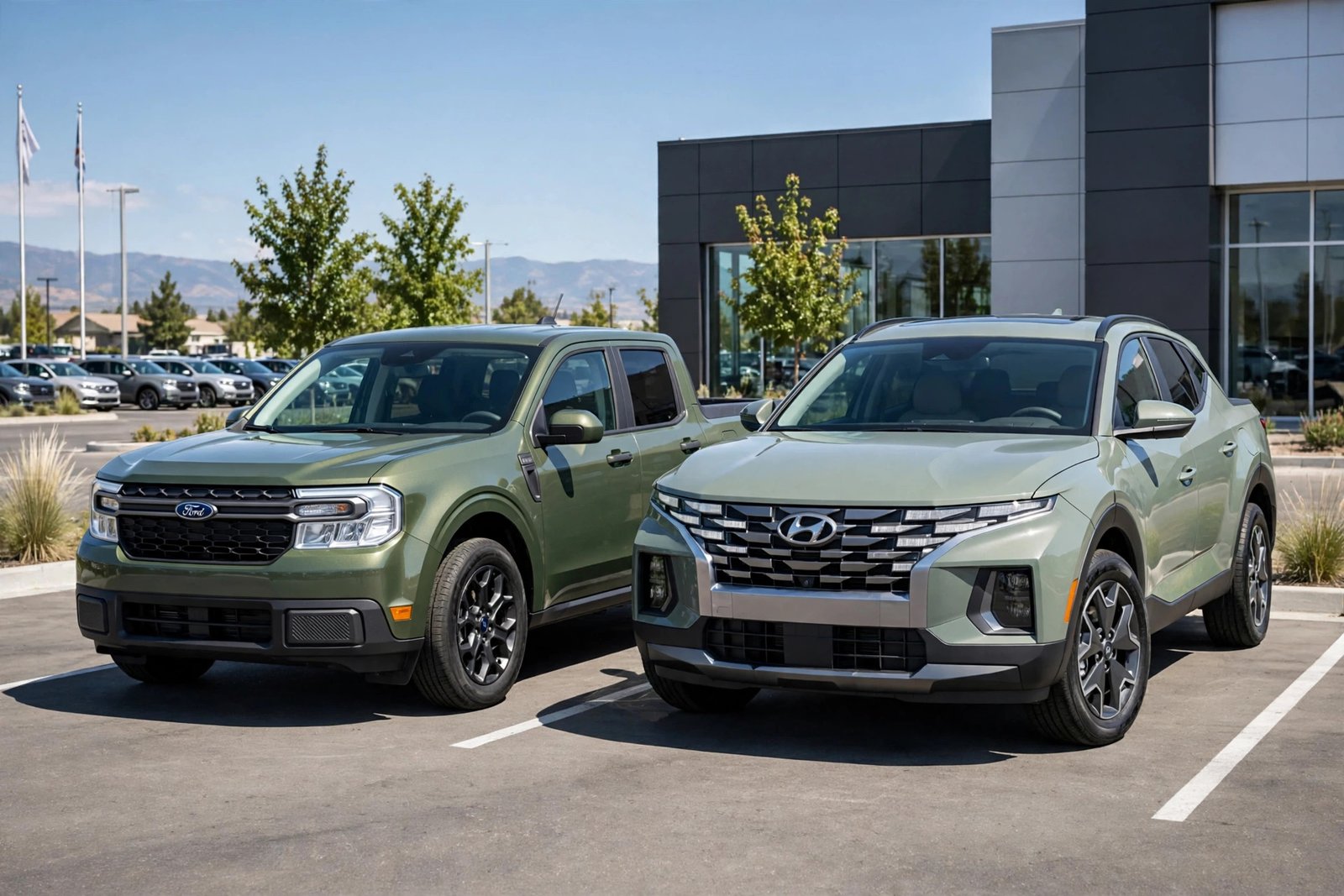
Quick answer: The Ford Maverick wins for most buyers. Its standard hybrid gets 38 mpg combined — the best fuel economy of any pickup in America — against 25 mpg for the Santa Cruz, it starts about $1,600 cheaper, and it has the bigger bed and stronger resale value. The Santa Cruz fights back where it counts for some buyers: up to 5,000 lbs of towing with the turbo engine (the Maverick tops out at 4,000), a much longer warranty, and a clever lockable in-bed trunk. But there is a cloud over the Hyundai: production is reported to be winding down, with no second generation coming. If you tow heavy trailers or want the longest warranty, the Santa Cruz still deserves a look — preferably at a discount. Everyone else should buy the Maverick.
The only two compact pickups in America
The Maverick and the Santa Cruz are the only two compact pickups on sale in the United States, and they are built on the same idea: a truck for people who do not really want a truck. Both are unibody vehicles — car-based, not body-on-frame like a Tacoma or Colorado — so they ride, park and handle much more like an SUV than a traditional pickup. Both are about 200 inches long, roughly 20 inches shorter than a midsize truck, which makes them genuinely easy to live with in a city.
But they aim at different buyers. The Maverick is the practical one: a work truck that happens to be a hybrid, priced like a compact car. The Santa Cruz is the lifestyle one: Hyundai calls it a “sport adventure vehicle,” and it leans into style, comfort and clever storage rather than raw value. That difference runs through everything that follows — price, fuel economy, towing, and even whether the truck will still exist in a few years.
One more thing before the numbers: the sales gap between these two is enormous. Ford sold more than 155,000 Mavericks in the United States in 2025. Hyundai sold 25,499 Santa Cruz pickups — the Maverick outsold it by more than six to one. That gap is the reason the Santa Cruz’s future is in doubt, and it is also the reason the Maverick holds its value so much better. Keep it in mind as you read.
The two trucks at a glance
| 2026 Ford Maverick | 2026 Hyundai Santa Cruz | |
|---|---|---|
| Starting MSRP | $28,145 (XL) | $29,750 (SE) |
| Destination charge | $1,845 | Not separately confirmed |
| Popular mid trim | XLT: $30,645 ($32,490 incl. destination) | SEL: $31,400 ($33,000 incl. destination) |
| Standard engine | 2.5L hybrid, 191 hp | 2.5L four-cylinder, 191 hp |
| Optional engine | 2.0L EcoBoost turbo, 250 hp | 2.5L turbo, 281 hp |
| Best fuel economy | 42 city / 35 hwy / 38 combined mpg | 22 city / 30 hwy / 25 combined mpg |
| Max towing | 4,000 lbs (with 4K Tow Package) | 5,000 lbs (turbo) |
| Max payload | 1,500 lbs | 1,411 lbs |
| Bed length / volume | 54.4 in / 33.3 cu. ft. | 52.1 in / 27 cu. ft. |
| Warranty | 3 yr / 36,000 mi bumper-to-bumper; 5 yr / 60,000 mi powertrain | 5 yr / 60,000 mi bumper-to-bumper; 10 yr / 100,000 mi powertrain |
| Production status | Ongoing | Reported to be winding down; no second generation planned |
Prices are manufacturer starting MSRPs before destination, taxes, title and dealer fees unless noted.
Price: the Maverick is cheaper at every step
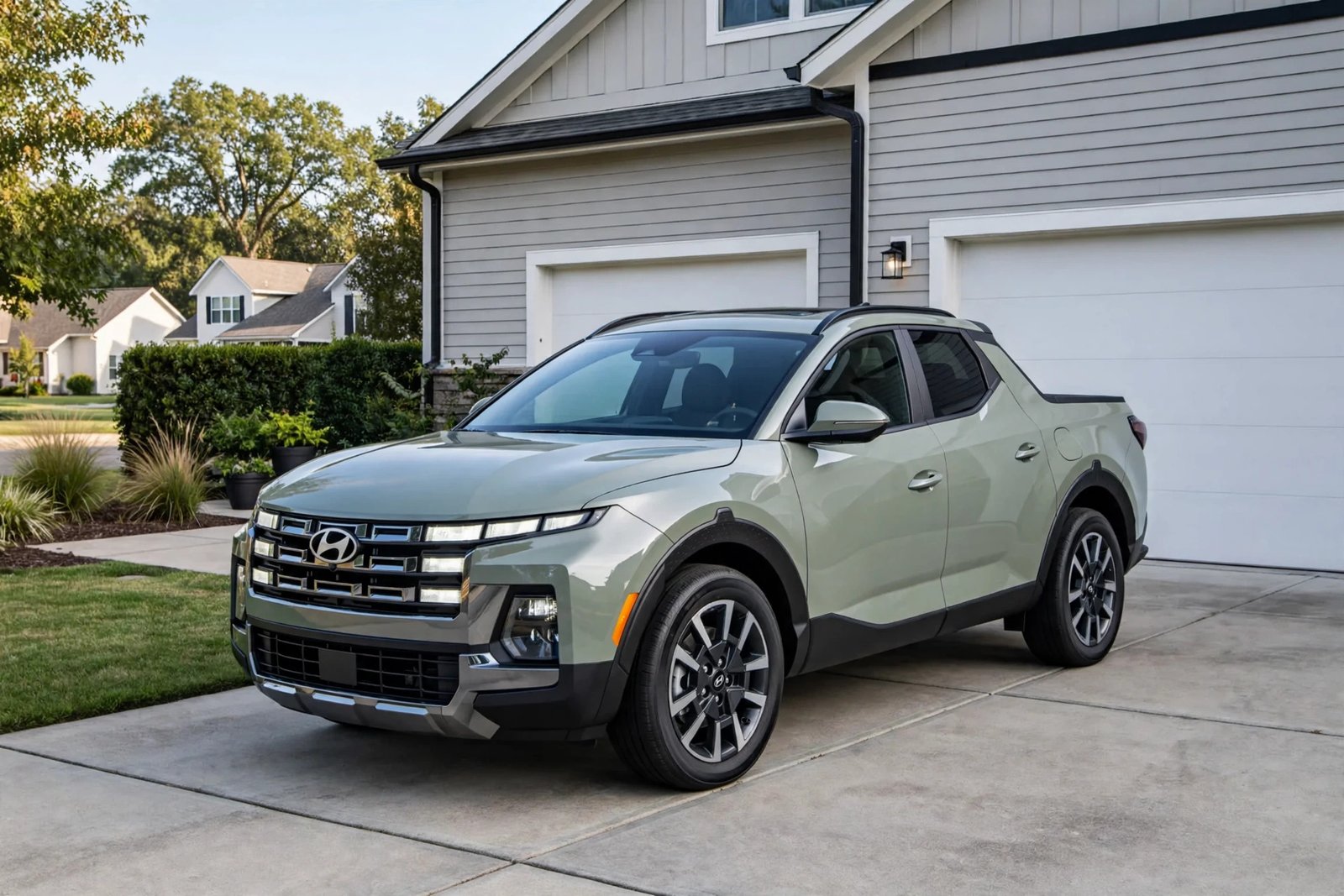
The Maverick starts at $28,145 for the XL, and the Santa Cruz at $29,750 for the SE — a gap of $1,605 before destination. The gap holds as you climb the trims. The popular Maverick XLT is $30,645, or $32,490 with destination included. The comparable Santa Cruz SEL is $31,400, or $33,000 with destination. At these mid trims the two trucks cost almost the same, which is exactly why the comparison gets interesting: for roughly the same money, you are choosing between hybrid fuel economy and turbo towing power.
Step up further and the pattern continues. The Maverick’s range tops out well below the Santa Cruz’s most expensive trims in most comparisons, and the Maverick is the only one of the two that gives you its best powertrain — the hybrid — as standard equipment on the cheapest trim. With the Santa Cruz, the engine you probably want, the 281-horsepower turbo, only comes on higher trims, which pushes the real-world price further up.
One honest caveat: because Santa Cruz sales are weak and dealers finished 2025 with nearly five months of unsold inventory, real-world discounts on the Hyundai can be substantial. A Santa Cruz bought at a steep discount changes the value math. But on sticker price alone, the Maverick is the cheaper truck.
Powertrains: hybrid efficiency vs turbo muscle
Every 2026 Maverick comes standard with the same hybrid system: a 2.5-liter four-cylinder paired with an electric motor, making 191 horsepower through a continuously variable transmission. Front-wheel drive is standard and all-wheel drive is available. The hybrid is not an expensive option or a special trim — it is simply what a Maverick is.
The alternative is the 2.0-liter EcoBoost turbo four-cylinder, making 250 horsepower and 277 lb-ft of torque. It is the quicker engine and the one you want if you tow near the Maverick’s limits, but it gives up the hybrid’s remarkable fuel economy and costs extra.
The Santa Cruz takes the opposite approach. Its standard engine is a 2.5-liter four-cylinder making 191 horsepower and 181 lb-ft of torque, paired with an eight-speed automatic — the same horsepower as the Maverick hybrid, but without any electric help and with far worse fuel economy. The engine worth having is the turbocharged 2.5-liter, making 281 horsepower and 311 lb-ft. It is genuinely quick — independent tests put it at about 6.0 seconds to 60 mph, essentially tied with the EcoBoost Maverick’s 5.8 — and it is the engine that unlocks the Santa Cruz’s 5,000-lb towing rating.
So the choice is philosophical as much as mechanical. Ford gives you efficiency by default and makes you pay for power. Hyundai gives you adequate power by default and makes you pay for the strong engine. For a daily driver that mostly hauls people and weekend gear, Ford’s approach is the better one.
Fuel economy: the Maverick’s biggest win
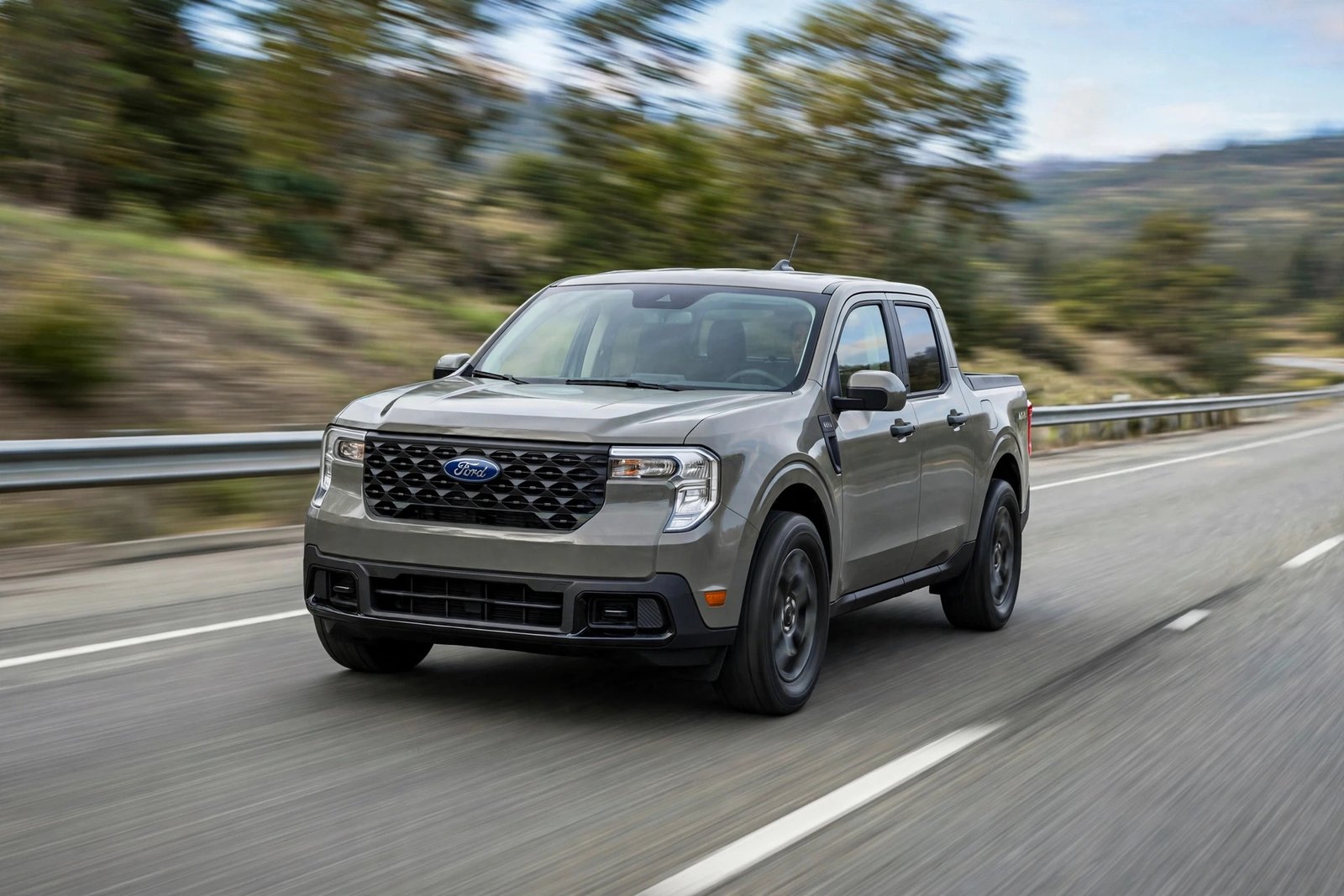
This is not close, and it is the single biggest reason to buy the Maverick. The hybrid Maverick is EPA-rated at 42 mpg city, 35 highway and 38 combined with front-wheel drive — the best fuel economy of any pickup truck sold in America, by a wide margin. Even the all-wheel-drive hybrid is rated at 37 mpg combined.
The Santa Cruz, with its base engine, is rated at 22 mpg city, 30 highway and 25 combined. The turbo is thirstier still. There is no hybrid Santa Cruz, no efficient option, no way to close a 13-mpg gap.
What does that mean in dollars? At 12,000 miles a year and $3.50 a gallon, the Maverick hybrid uses about 316 gallons a year, costing roughly $1,105. The Santa Cruz uses 480 gallons, costing about $1,680. That is a difference of roughly $575 a year, or nearly $2,900 over five years — enough to cover a large part of the price difference between the two trucks all by itself. One independent comparison put the Maverick’s five-year ownership cost $7,263 lower than the Santa Cruz’s, with fuel economy and resale value doing most of the work.
If you drive mostly in the city, the gap gets even bigger, because the hybrid’s advantage is largest in stop-and-go traffic — 42 mpg city against 22. If your truck mostly does highway miles, the gap narrows but never closes.
Towing and payload: the Santa Cruz strikes back
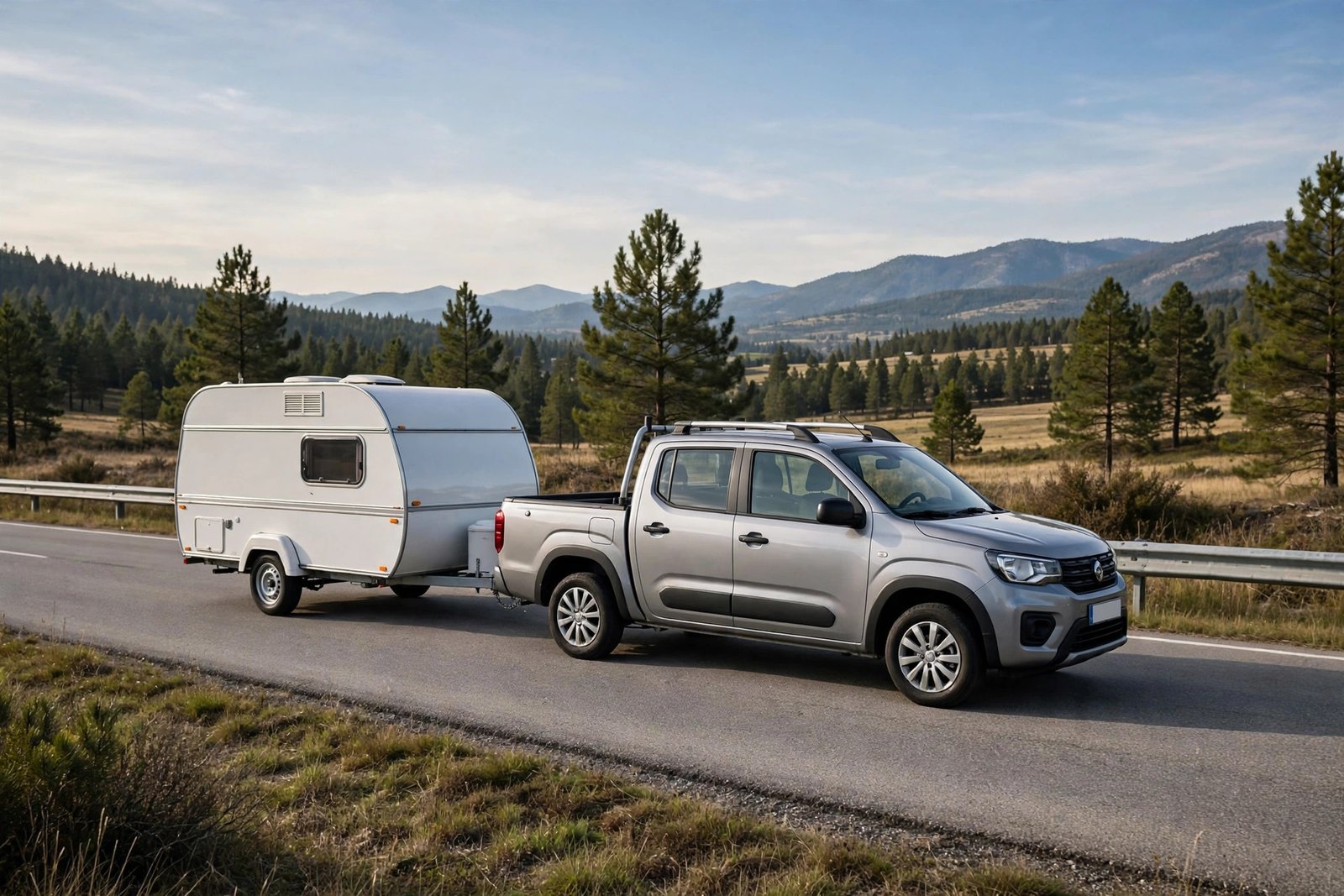
Towing is where the Santa Cruz earns its keep. With the turbocharged engine, it tows up to 5,000 lbs — a full 1,000 lbs more than the Maverick’s maximum. With the base engine it tows 3,500 lbs, which is still more than a standard Maverick’s 2,000 lbs.
The Maverick needs its optional 4K Tow Package to reach 4,000 lbs, and the package also adds a trailer brake controller. Without it, the Maverick is rated at just 2,000 lbs — enough for a small utility trailer or a pair of jet skis, but not for a camper or a boat of any real size. So the practical rule is simple: if you tow more than 4,000 lbs, the Santa Cruz is the only compact truck that can do the job, and if you tow between 3,500 and 5,000 lbs regularly, it is the comfortable choice.
Payload is closer, and the numbers need a careful note. Ford rates the Maverick at up to 1,500 lbs of payload. Most sources rate the Santa Cruz at up to 1,411 lbs — but Edmunds lists a maximum Santa Cruz payload of 1,753 lbs, which conflicts with the 1,411-lb figure quoted by most dealer and comparison sources. We have used the widely quoted 1,411-lb figure in the table above and flagged the conflict in the sources section. Either way, the practical difference is small: both trucks carry roughly 1,400 to 1,500 lbs, which covers a bed full of mulch, a couple of dirt bikes, or a weekend of camping gear plus passengers. Neither is a work truck in the full-size sense, and neither pretends to be.
Beds and cargo: bigger box vs smarter box
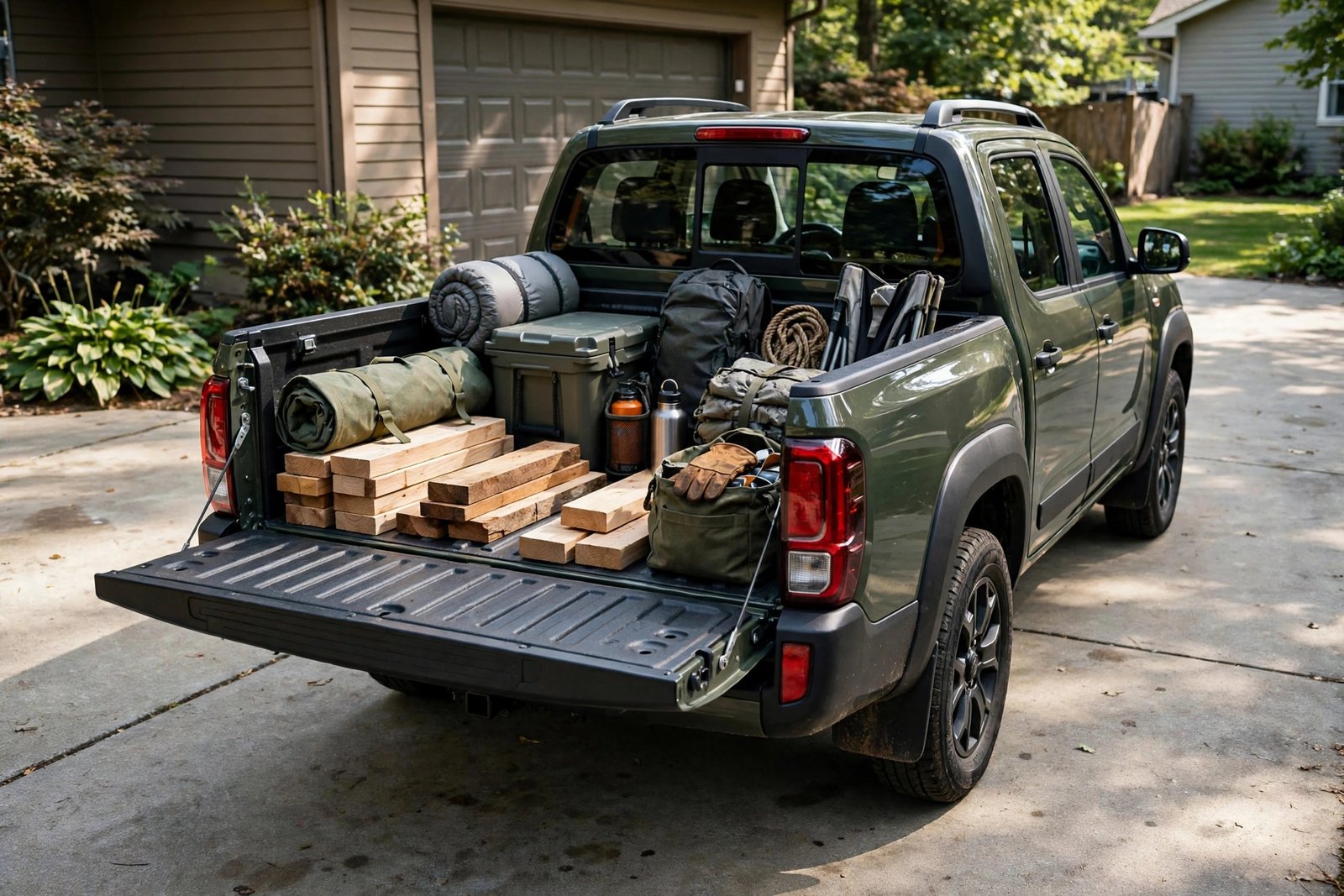
The Maverick has the bigger bed: 54.4 inches long at the floor, 53.3 inches wide, 20.3 inches deep, for 33.3 cubic feet of cargo volume. The Santa Cruz bed is 52.1 inches long, 53.9 inches wide and 19.2 inches deep, for 27 cubic feet. The Maverick’s bed is 2.3 inches longer and holds about 6 cubic feet more — a real difference when you are loading lumber, a lawn mower or a stack of boxes.
But the Santa Cruz bed is the cleverer one. Under the bed floor sits a lockable, drainable in-bed trunk — a hidden compartment roughly 7 inches deep that swallows muddy boots, a cooler or valuables you would rather not leave visible at a trailhead. It also offers an available sliding tonneau cover and sidewall cubbies. Ford’s answer is the FlexBed system: molded slots in the bed walls sized for 2×4 and 2×6 lumber, so you can build your own dividers, a two-tier load floor or a sleeping platform with a trip to the hardware store.
Neither bed fits a six-foot adult lying flat — the Maverick’s 54.4 inches and the Santa Cruz’s 52.1 inches are both about 18 inches short — though dropping the Santa Cruz tailgate stretches its load floor to about 74.8 inches. If you camp in your truck, both need a platform build; the Maverick’s DIY slots make that easier, and the Santa Cruz’s trunk keeps your gear secure.
Interior, tech and everyday comfort
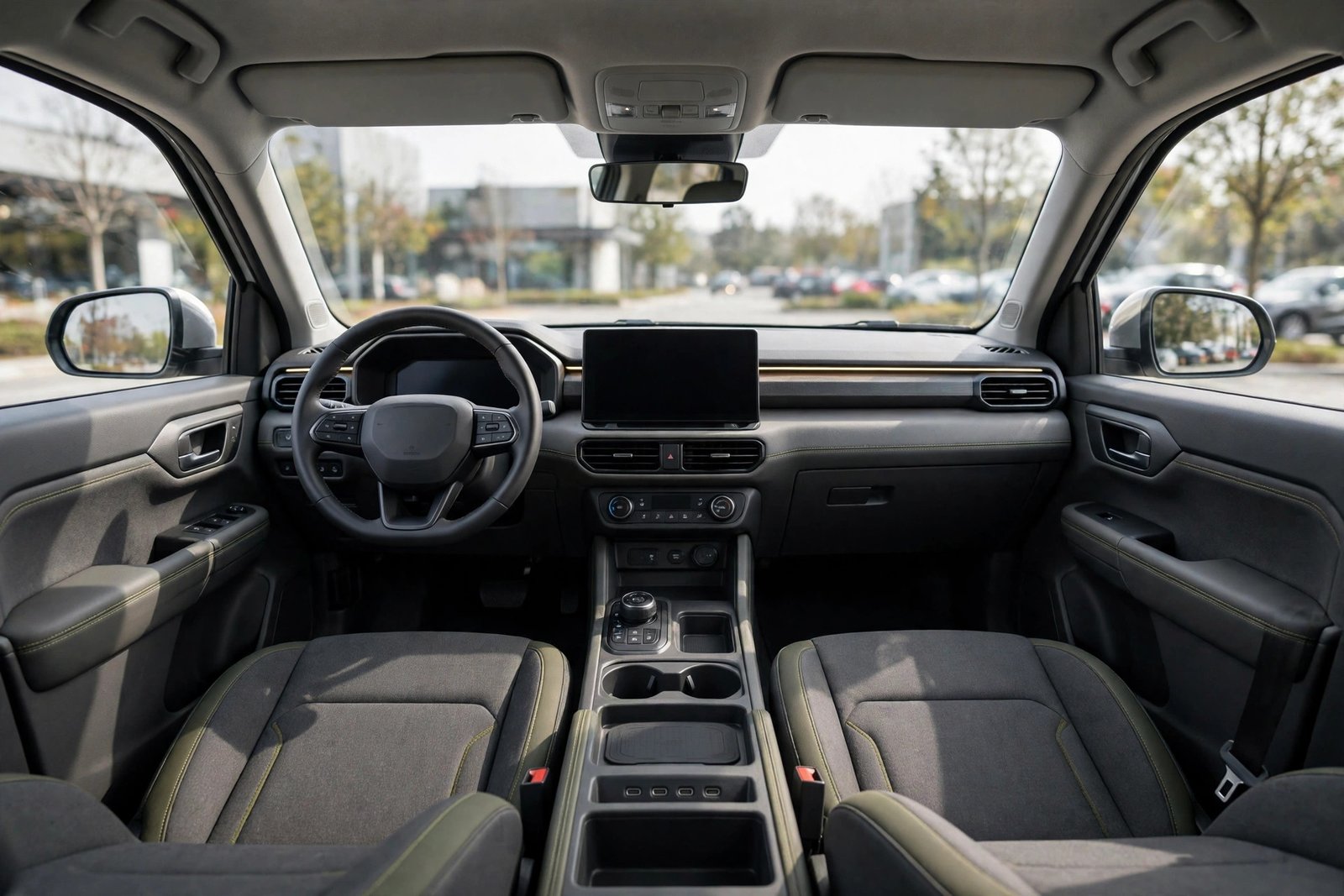
Inside, both trucks feel like the SUVs they are based on — the Maverick shares its bones with the Ford Escape and Bronco Sport, the Santa Cruz with the Hyundai Tucson. Both seat five, both offer large touchscreens with wireless smartphone integration, and both come with a full suite of driver-assistance features.
The Maverick has a small edge in room: 42.8 inches of front legroom against the Santa Cruz’s 41.4, and slightly more hip room front and rear. The Santa Cruz counters with a more polished, quieter cabin and a more car-like driving feel — reviewers consistently describe it as the more refined of the two, with nicer materials and a smoother ride on the highway. The Maverick feels more like a truck: upright, practical, a little louder, with clever storage bins and a dashboard designed to be used with work gloves on.
Tech is close to a draw. The Santa Cruz’s infotainment and digital displays feel a generation newer, while the Maverick’s physical controls and simpler layout are easier to use on the move. Neither truck will embarrass you on equipment; this is a matter of taste, and a test drive will tell you more than any spec sheet.
Warranty and the discontinuation question
Here the Santa Cruz has its clearest win: Hyundai’s warranty is the best in the business — 5 years or 60,000 miles bumper-to-bumper and 10 years or 100,000 miles on the powertrain, plus three years of complimentary maintenance. Ford offers 3 years or 36,000 miles bumper-to-bumper and 5 years or 60,000 miles on the powertrain. Over a long ownership, the Hyundai warranty is worth real money and real peace of mind.
But the warranty advantage comes with a shadow: the Santa Cruz’s future. Here is what is actually known, stated plainly. In January 2026, Automotive News reported, citing sources familiar with the plan, that Hyundai will end Santa Cruz production ahead of its originally scheduled second-quarter 2027 conclusion, with production cuts of nearly half in the first quarter of 2026 and dealers sitting on nearly five months of inventory. Hyundai has not confirmed it: a spokesperson said only that lifecycle plans remain unchanged, and a separate statement described the Santa Cruz as a valued ongoing member of the product portfolio. The 2027 Santa Cruz is on sale now, starting at $30,300 for the SE. Hyundai’s CEO has confirmed the company is preparing a larger body-on-frame midsize pickup for the United States by 2030, with production reportedly beginning in summer 2029.
What does that mean for a buyer? Parts and warranty service will continue — Hyundai is legally and practically committed to supporting the truck for years — but resale value is likely to suffer, because used buyers shy away from discontinued models. The Maverick, by contrast, is Ford’s runaway hit and the only compact pickup with a secure future; when the Santa Cruz is gone, the Maverick will be the only truck in its class. If you keep a vehicle for ten years, that matters less. If you trade in after three or four, it matters a lot.
Reliability and resale value
The Maverick’s sales dominance is itself a reliability signal of sorts: more than 155,000 buyers chose it in 2025, and high-volume vehicles get their problems found and fixed fast. The Santa Cruz’s low volume cuts the other way — fewer owners means fewer data points, and a model near the end of its life rarely gets meaningful updates.
On resale value, the Maverick is the clear winner. One head-to-head comparison found the Maverick holds its value far better than the Santa Cruz, and that advantage, combined with fuel savings, produced a five-year ownership cost $7,263 lower for the Maverick. A discontinued model almost always depreciates faster, so the Santa Cruz’s reported wind-down is likely to widen that gap rather than narrow it.
Neither truck has a standout reliability scandal attached to its 2026 model, and both are built on proven SUV platforms. But if resale value is part of your math — and for most buyers it should be — the Maverick is the safer place to put your money.
Which compact truck should you buy?
Buy the Ford Maverick if: you want the lowest fuel bills of any pickup, the lowest purchase price, the bigger bed, the strongest resale value, or the only compact truck with a secure future. It is the right choice for commuters, homeowners, weekend DIYers and anyone who wants truck usefulness without truck running costs. The hybrid XLT is the sweet spot: about $32,490 with destination, with the equipment most buyers actually want.
Buy the Hyundai Santa Cruz if: you regularly tow between 4,000 and 5,000 lbs, you want the longest warranty in the business, you love the in-bed trunk and the more refined cabin, or you find a heavily discounted one on a dealer lot — weak sales mean real bargaining room. Just go in with your eyes open about resale value and the model’s reported wind-down, and negotiate the price accordingly.
Our pick: the Ford Maverick XLT Hybrid. It is cheaper to buy, dramatically cheaper to run, holds its value better, and it will still have a model line — and a parts and service network built around a current product — in five years. The Santa Cruz is a good truck with a bad future, and that is a hard thing to recommend at full price.
Pros and cons
Ford Maverick — pros: standard hybrid with 38 mpg combined; lowest starting price; bigger bed (33.3 cu. ft.); strongest resale value; the only compact truck with a secure future. Cons: towing tops out at 4,000 lbs and needs the optional tow package; shorter warranty; cabin is more utilitarian than the Hyundai’s; EcoBoost engine costs extra.
Hyundai Santa Cruz — pros: tows up to 5,000 lbs with the turbo; 281-hp turbo is genuinely quick; best-in-class warranty (10 yr / 100,000 mi powertrain); lockable in-bed trunk; quieter, more refined cabin. Cons: production reported to be winding down with no second generation; poor fuel economy (25 mpg combined); higher starting price; weaker resale value; no hybrid option.
Related reads
- Compare Cars tool — compare any two cars side by side
- Chevrolet Colorado vs Ford Ranger
- Toyota Tacoma vs Ford Ranger: Which Midsize Truck Wins?
- Ford F-150 vs Chevy Silverado Reliability
- Car Comparisons — all comparison articles
Sources
- 2026 Ford Maverick — Ford official site
- 2026 Hyundai Santa Cruz — Hyundai official site
- We Compared the 2026 Ford Maverick XLT and Hyundai Santa Cruz SEL — Road Ethos
- The Santa Cruz Is Ending, And Its Replacement Is Five Years Away — Road Ethos
- Hyundai To Pull the Plug on Santa Cruz — Automotive Addicts