
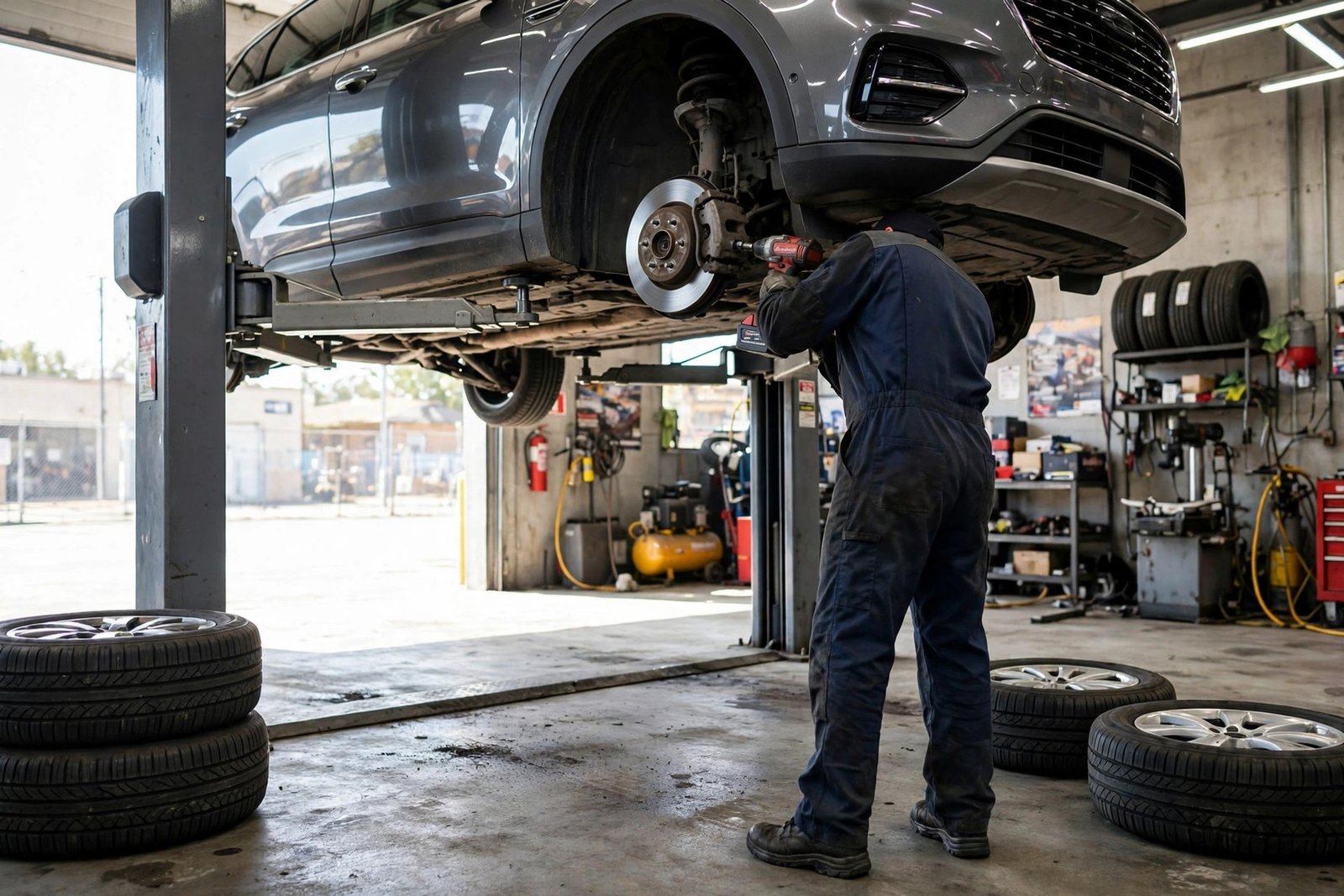
Quick answer: A tire rotation costs $15 to $75 in the US in 2026. The national average for a standalone rotation is about $49 to $72 in labor, according to RepairPal’s September 2026 estimate. But many drivers pay nothing at all: Costco, Discount Tire and similar retailers rotate tires free for life if you bought the tires there. Dealerships charge the most ($40 to $75), Walmart the least among paid options (about $20), and a rotation plus wheel balancing runs $50 to $85 bundled. Rotate every 5,000 to 8,000 miles and the service pays for itself by making your tires last longer.
What a tire rotation actually is
A tire rotation is exactly what it sounds like: the tires are moved from one wheel position to another so they all wear down evenly. On most cars the front tires do far more work than the rears — they steer, they carry more of the engine’s weight, and on a front-wheel-drive car they also put the power down. Left in place, the front tires can wear out thousands of miles before the rears.
Rotation fixes that by spreading the wear around. Each tire spends time in the hard-working front positions and time in the easier rear ones, so the whole set reaches the end of its life together. It is one of the cheapest maintenance jobs on a car, it takes about 20 to 30 minutes, and it is also the job most often skipped — which is a shame, because skipping it is what makes tires expensive.
A rotation is not the same as a wheel balance or a wheel alignment, and shops sometimes blur the three together on a quote. A rotation moves the tires around. A balance adds small weights to each wheel so it spins without vibration. An alignment adjusts the angles of the suspension so the tires point straight. You need a rotation regularly; you need balancing when you feel a vibration or fit new tires; you need an alignment when the car pulls to one side or the tires wear in a strange pattern.

Tire rotation cost by shop type
Where you go matters more than almost anything else. The same 30-minute job can cost nothing or $75 depending on the shop, so the table below is the heart of this article. These are typical US prices for a standalone four-tire rotation in 2026, gathered from published shop prices and national cost estimators.
| Where you go | Typical price | Notes |
|---|---|---|
| Warehouse clubs (Costco, Sam’s Club, BJ’s) | Free | Free for life on tires bought there; membership required |
| Discount Tire / America’s Tire | Free | Free rotations and rebalancing on tires bought there |
| Walmart Auto Care | About $20 | $5 per tire, the lowest published flat rate; walk-in |
| Full-service chains (Firestone, Pep Boys, Midas, Big O) | $15–$50 | Often free with tires bought there or with an oil change |
| Independent mechanic | $15–$40 | Usually the best paid option if you have no free entitlement |
| Dealership | $40–$75 | Most expensive; convenient if the car is already in for service |
| DIY at home | $0 | About 30 minutes with a floor jack, jack stands and a torque wrench |
Two things stand out. First, the gap between the cheapest paid option and the dealership is more than threefold — $20 at Walmart against up to $75 at a dealer. Second, the single best way to never pay for a rotation is to buy your tires from a retailer that includes free rotations for life. If you bought four tires at Costco or Discount Tire, you have already paid for every rotation you will ever need.
National estimators tell a similar story from a different angle. RepairPal’s September 2026 estimate puts a standalone rotation at $49 to $72, all of it labor — there are no parts to replace. Kelley Blue Book reports a similar $60 to $72. A crawl of 116 independent shops that publish their prices found a median of $30, with most charging between $24 and $49 — a useful reminder that the national averages are pulled up by dealership and big-city pricing, and that a good local independent shop is often the cheapest paid option of all.
What makes the price go up
A basic rotation on a normal sedan is the cheapest version of this job. A few things push the bill higher, and it helps to know them before you agree to a price.
Vehicle size and type. Big trucks, SUVs and EVs cost more. Larger, heavier wheels take longer to handle, and some EVs and trucks need special lifting points or higher torque settings. Expect $50 to $90 at a dealership for a large truck or an EV, especially if the shop has to work around a frunk, a battery pack or a staggered setup.
Directional and staggered tires. Directional tires can only roll one way, so they can only be swapped front to back on the same side — that limits the rotation pattern but does not usually add much cost. Staggered setups, where the rear tires are wider than the fronts, are different: the tires cannot move side to side at all, and the shop may need to demount and remount the tires on the wheels to rotate them. That turns a 30-minute job into a much longer one and can roughly double or triple the price.
Balancing added on. This is the most common upsell, and sometimes it is genuinely needed. A four-wheel balance adds roughly $40 to $100 — about $10 to $25 per wheel. Bundled with a rotation, the combined job usually runs $50 to $85 at chain shops, or $109 to $160 by RepairPal’s estimate. If your steering wheel shakes at highway speed, balancing is worth paying for. If the car drives smoothly, you can say no and just get the rotation.
TPMS relearn. Many cars with tire pressure monitoring need the system to relearn which sensor is at which corner after a rotation. Some cars do this automatically after a short drive; others need a scan tool. A few shops charge extra for the relearn, so ask whether it is included before you approve the work.
Where you live. Labor rates drive this job, because it is almost pure labor. Independent shops in the US charge a median of about $129 an hour, with the middle half of shops charging $100 to $165 an hour, and California shops posting a median of $160. A rotation takes roughly half an hour of shop time, so the local labor rate shows up directly in your bill.
Rotation plus balancing, alignment, or oil change
Shops love to bundle, and sometimes bundling genuinely saves you money. Here is how the common combinations compare.
| Service combination | Typical price | When it makes sense |
|---|---|---|
| Rotation only | $15–$75 | Your car drives smoothly and you just need even wear |
| Rotation + four-wheel balance | $50–$85 bundled ($60–$130 separate) | You feel a vibration, or it has been years since a balance |
| Rotation + oil change | Often $20–$40 extra, sometimes free | The car is already in the shop — the cheapest time to rotate |
| Rotation + alignment | $100–$200+ combined | The car pulls to one side or tires wear unevenly |
The oil-change bundle is the best deal in car maintenance that nobody talks about. The car is already on the lift, the wheels are already coming off for the inspection anyway, and many shops will rotate the tires for a small add-on fee or nothing at all. If you get your oil changed every 5,000 to 7,500 miles, ask for a rotation at the same visit and you will never fall behind schedule.
An alignment is a different matter. A rotation will not fix a car that pulls to one side, and an alignment will not fix uneven wear that has already happened. If your tires are wearing on one edge, or the steering wheel sits crooked when you drive straight, get the alignment checked — rotating the tires without fixing the alignment just moves the problem to a different corner.
How often to rotate — and what it costs over the life of your tires
The US Tire Manufacturers Association recommends rotating tires every 5,000 to 8,000 miles when your carmaker does not specify an interval, and most carmakers land in the same range. At 12,000 miles a year, that is about two rotations a year.
Do the math over the life of a set of tires and the cost looks very different depending on where you go:
| Where you go | Per rotation | 2 per year | Over 5 years (10 rotations) |
|---|---|---|---|
| Free (tires bought there) | $0 | $0 | $0 |
| Walmart / independent shop | $20–$40 | $40–$80 | $200–$400 |
| RepairPal average | $49–$72 | $98–$144 | $490–$720 |
| Dealership | $40–$75 | $80–$150 | $400–$750 |
At the RepairPal average, six rotations over a typical tire life cost $294 to $432. That sounds like a lot until you compare it with the alternative: a set of tires that wears out 10,000 miles early because the fronts were never rotated costs far more. Rotation is also a warranty issue — most tire makers require proof of regular rotation to honor a treadwear warranty, so skipping rotations can cost you a free replacement tire as well.
One more practical point: rotation intervals and oil-change intervals line up nicely on most cars. If your oil change is due every 5,000 to 7,500 miles, rotating at the same visit means you never have to remember a separate schedule.

DIY rotation: free, but only if you do it safely
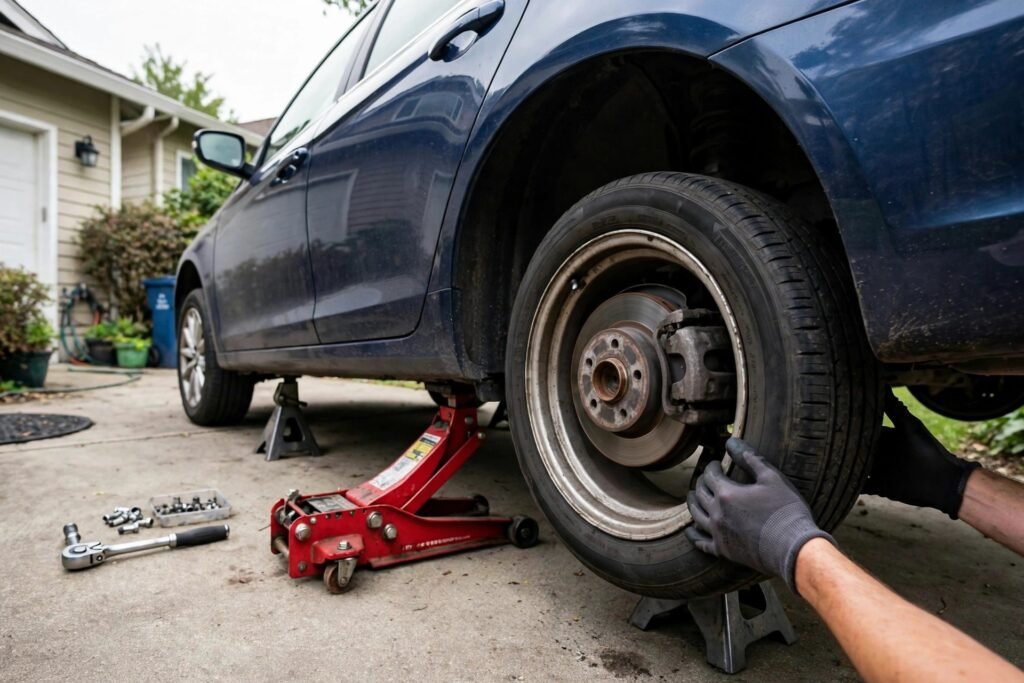
A do-it-yourself rotation costs nothing but about 30 minutes, and it is one of the more approachable jobs for a home mechanic. You need a floor jack, two jack stands, a torque wrench, wheel chocks and your car’s rotation pattern — which is in the owner’s manual and depends on whether your car is front-wheel-drive, rear-wheel-drive or all-wheel-drive, and whether the tires are directional.
The safety rules are non-negotiable. Never work under a car supported only by a jack — a jack can slip, and a car falling off a jack is how people get killed. Always use jack stands on solid, level ground, chock the wheels that stay on the ground, and tighten the lug nuts to the torque figure in your owner’s manual, in a star pattern, with a torque wrench rather than by feel. Too loose and a wheel can come off; too tight and you can stretch or snap a stud.
There are also jobs where DIY is the wrong call. If your tires are directional or staggered, the rotation pattern is restricted and a mistake is easy. If your car needs a TPMS relearn with a scan tool, a shop can do it in minutes. And if you do not already own the tools, a basic set — jack, stands and torque wrench — costs roughly $80 to $200, or $150 to $300 for good-quality equipment, which wipes out several years of savings from free rotations. Buy the tools because you enjoy working on your car, not to save money on this one job.
How to get the best price
A few habits will keep your rotation bill at the low end for the life of the car.
Buy tires where rotations are free. When you compare tire prices, ask about free lifetime rotation and balancing. A tire that costs $10 more per tire but includes free rotations for life is cheaper within two years.
Bundle with the oil change. The car is already on the lift. Ask for the rotation when you book the oil change, not as an afterthought, and ask the price up front.
Call the independent shop first. A good local independent is usually the cheapest paid option, and many will match a chain’s price if you ask. Get a quote that says exactly what is included — rotation only, or rotation plus balance, plus any TPMS relearn fee.
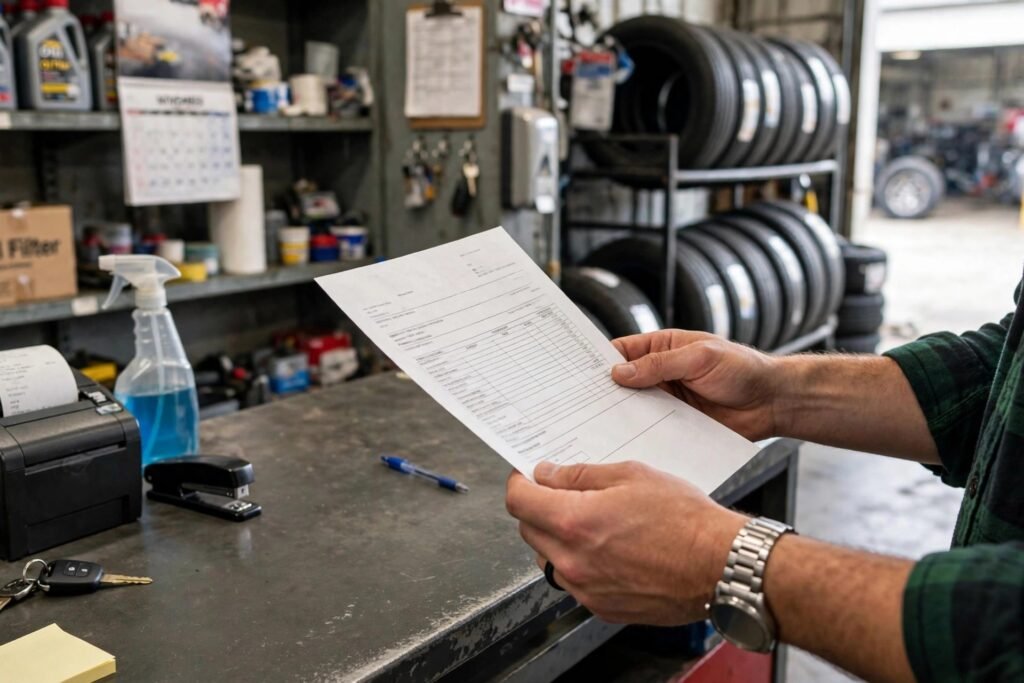
Ask what is included before you approve. The most common surprise on a rotation bill is a balance or a TPMS relearn that was never discussed. A simple “is this rotation only, and is the TPMS relearn included?” before the work starts prevents it.
Keep the receipts. Tire makers ask for rotation records when you claim a treadwear warranty. A folder of receipts — or a note of the date and mileage in your phone — is the difference between a warranty claim that pays and one that does not.

Is a tire rotation worth it?
Yes, and it is not close. A rotation costs $15 to $75, or nothing at all if you bought your tires from the right retailer, and it is the single cheapest way to make a set of tires last its full rated life. The alternatives — replacing front tires early, losing a treadwear warranty claim, or driving on unevenly worn tires that brake and handle worse — all cost far more than the rotation ever will.
The smartest version of this job is the free one: buy your tires from a retailer that includes lifetime rotations, then actually show up every 5,000 to 8,000 miles. The second-smartest is the bundled one: rotate at every oil change at an independent shop. Either way, the cost of rotating is small, the cost of not rotating is not, and the tires you already own are the cheapest tires you will ever buy.
Related reads
- Compare Cars tool — compare any two cars side by side
- How Much Does Tire Balancing Cost?
- Tire Balancing vs Alignment: What’s the Difference?
- How to Check Tire Tread Depth
- Tire Rotation Pattern: The Right Pattern for Your Car
- Best Budget Tires