
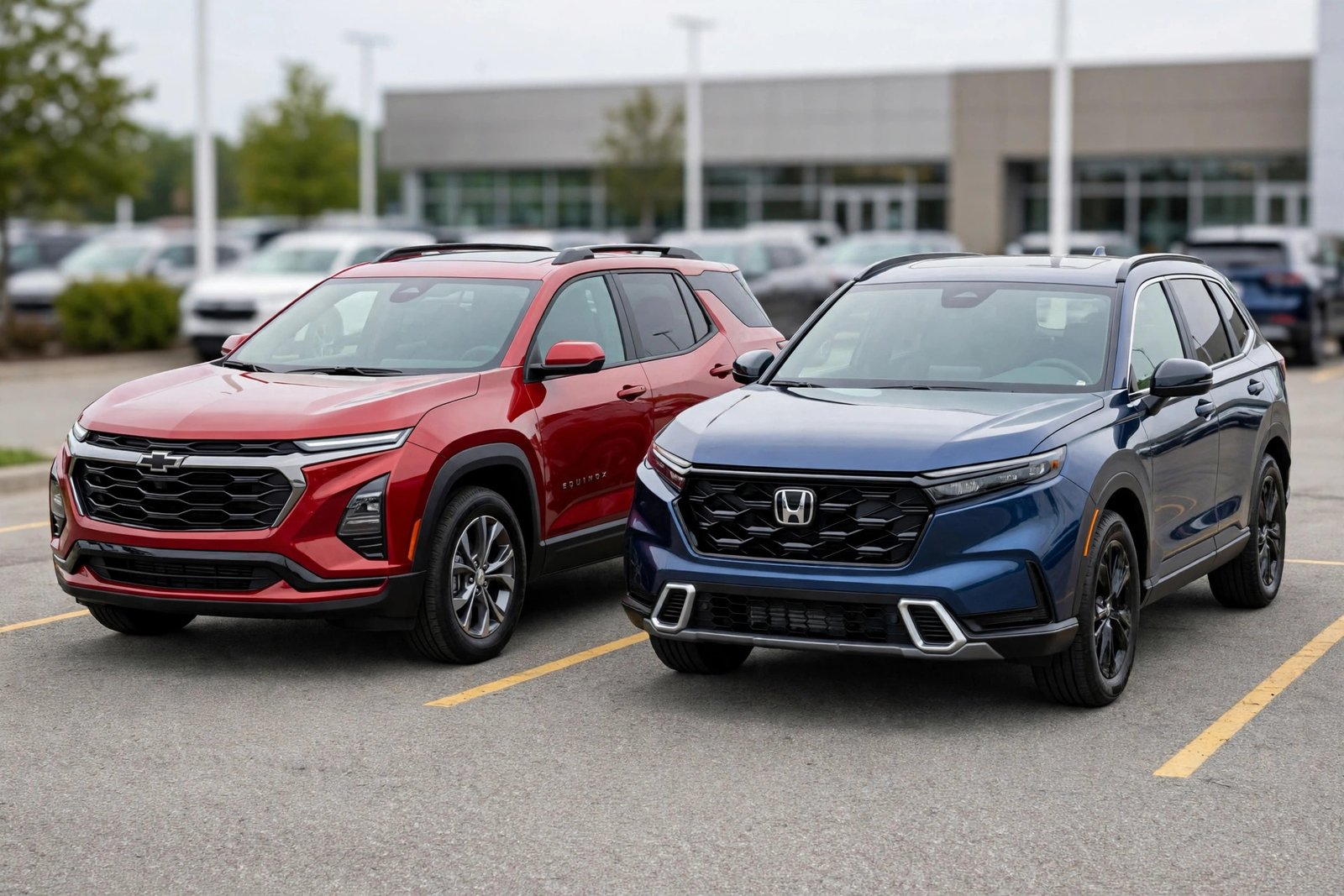
Quick answer: The 2026 Honda CR-V is the better SUV overall: it has more power, more cargo space (76.5 vs 63.5 cubic feet), better gas mileage, and the one thing the Equinox cannot offer — a 204-horsepower hybrid rated up to 40 mpg. The 2026 Chevrolet Equinox is the better deal: it starts at $28,800, about $2,120 less, and every trim gets an 11.3-inch touchscreen, heated front seats, and a heated steering wheel as standard. Buy the CR-V if you haul a lot or drive a lot; buy the Equinox if you want the most features for the least money.
If you search for “chevrolet equinox vs honda cr v” — the way most people actually type it — you will find two compact SUVs that look like twins on paper and feel very different in real life. Both start around $30,000, both use a turbocharged four-cylinder engine, and both are built for the same job: school runs, commuting, road trips, and the weekly grocery load. The differences are in the details: cargo space, fuel economy, standard equipment, and what happens to your money five years later.
This comparison uses 2026 model-year figures from the manufacturers and published specifications. Prices are MSRP before destination charges, taxes, and dealer fees.
Chevrolet Equinox vs Honda CR-V at a Glance
| Spec | 2026 Chevrolet Equinox | 2026 Honda CR-V |
|---|---|---|
| Starting MSRP | $28,800 (LT, before destination) | $30,920 (LX, before destination) |
| Engine | 1.5L turbo I4 | 1.5L turbo I4; 2.0L two-motor hybrid |
| Horsepower | 175 hp | 190 hp (gas); 204 hp (hybrid) |
| Torque | 184 lb-ft (FWD); 203 lb-ft (AWD) | 179 lb-ft (gas) |
| Fuel economy | 26 city / 29 hwy / 27 combined (FWD) | 28 / 33 / 30 (gas FWD); up to 40 combined (hybrid) |
| Transmission | CVT (FWD); 8-speed automatic (AWD) | CVT |
| Max cargo | 63.5 cu ft | 76.5 cu ft |
| Cargo behind rear seats | 29.8 cu ft | 39.3 cu ft |
| Passenger volume | 104.3 cu ft | 106.0 cu ft |
| Max towing | 1,500 lbs | 1,000 lbs |
| Hybrid available | No | Yes (4 trims) |
| Standard touchscreen | 11.3-inch | 7-inch (9-inch on higher trims) |
| Basic warranty | 3 yr / 36,000 miles | 3 yr / 36,000 miles |
| Powertrain warranty | 5 yr / 60,000 miles | 5 yr / 60,000 miles |
Price: The Equinox Starts $2,120 Cheaper
The Equinox wins the price argument, and Chevrolet makes it easy to understand why. The 2026 Equinox LT starts at $28,800 before destination (about $29,995 with the roughly $1,195 destination charge). All-wheel drive adds $2,000 on every trim. The lineup is refreshingly simple — just three trims: the LT, the sporty RS, and the rugged ACTIV, with the RS and ACTIV both starting around $33,600.
The CR-V LX starts at $30,920, about $2,120 more. Its lineup is wider and more expensive at the top: gas trims run from the LX through EX and EX-L (the EX starts at $33,150), while the hybrid trims — Sport Hybrid, TrailSport Hybrid, Sport-L Hybrid, and Sport Touring Hybrid — start around $35,630 and climb from there. A well-equipped CR-V hybrid costs more than a fully loaded Equinox RS or ACTIV.
But the sticker price only tells half the story. The Equinox includes more equipment at its base price: an 11.3-inch touchscreen with Google built-in, an 11-inch digital driver display, heated front seats, and a heated steering wheel come standard on every single trim. On the CR-V, you climb trims to get the bigger screen and the heated seats. So the real-world gap is bigger than $2,120 — a comparably equipped CR-V costs several thousand more than the Equinox.
For shoppers comparing three-row options as well, our Kia Sorento vs Hyundai Santa Fe comparison covers two bigger family SUVs, and our most reliable cars for 2026 list puts both of these brands in perspective.
Powertrains and Fuel Economy: The CR-V Hybrid Is the Deciding Factor

Both SUVs use a 1.5-liter turbocharged four-cylinder as their base engine, but the Honda’s is the stronger one. The CR-V’s gas engine makes 190 horsepower and 179 lb-ft of torque, against 175 horsepower for the Equinox. The Equinox fights back on torque with all-wheel drive — 203 lb-ft with the AWD model’s eight-speed automatic, versus 184 lb-ft in front-wheel-drive form with the CVT. In daily driving the difference is small: the CR-V feels a touch quicker off the line, the Equinox feels a touch stronger in mid-range passing with AWD.
Fuel economy favors Honda even before the hybrid enters the picture. The gas CR-V is rated at 28 city / 33 highway / 30 combined mpg in front-wheel-drive form, against 26 / 29 / 27 for the Equinox FWD (25 / 29 / 26 with AWD). That is about 3 mpg combined — worth roughly $150 a year at typical driving distances and gas prices.
Then there is the hybrid, and this is where the comparison tilts. The CR-V Hybrid uses a 2.0-liter two-motor system making 204 horsepower and rated at up to 40 mpg combined — 40 city / 34 highway on the most efficient trims, per Honda. Chevrolet offers no hybrid Equinox at all, in any trim, at any price. (There is a separate Equinox EV, which is a different vehicle entirely.) If you drive 15,000 miles a year, the CR-V Hybrid burns roughly 375 gallons to the Equinox’s roughly 555 — a saving of about 180 gallons a year, every year you own it.
The one towing note worth making: the Equinox is rated to tow up to 1,500 pounds, which covers a small utility trailer or a pair of jet skis. The CR-V is not built with towing as a strength, so if you tow even occasionally, the Equinox has a small but real edge.
Space and Cargo: The CR-V Is Simply Bigger Inside

This is the CR-V’s clearest win, and it matters every single day you own the car. Behind the rear seats, the CR-V holds 39.3 cubic feet against the Equinox’s 29.8 — nearly 10 cubic feet more for groceries, sports gear, or a stroller without folding anything. With the rear seats down, the gap grows: 76.5 cubic feet in the CR-V versus 63.5 in the Equinox. That is about 13 cubic feet, roughly the size of a large trunk’s worth of extra space.
Passenger volume tells the same story on a smaller scale: 106.0 cubic feet in the CR-V against 104.3 in the Equinox. Rear legroom is generous in both, but the CR-V’s wider, boxier cargo area swallows bulky items — a folded stroller, a large dog crate, flat-pack furniture — that the Equinox makes you wrestle with.
The Equinox is not cramped; it is a comfortable five-seater with a well-shaped cargo floor and a hands-free liftgate on higher trims. But families who regularly load up the back will feel the difference within the first week. If cargo space is anywhere near the top of your list, the cr v wins this category before you even drive it.
Technology and Safety: Screens vs Substance
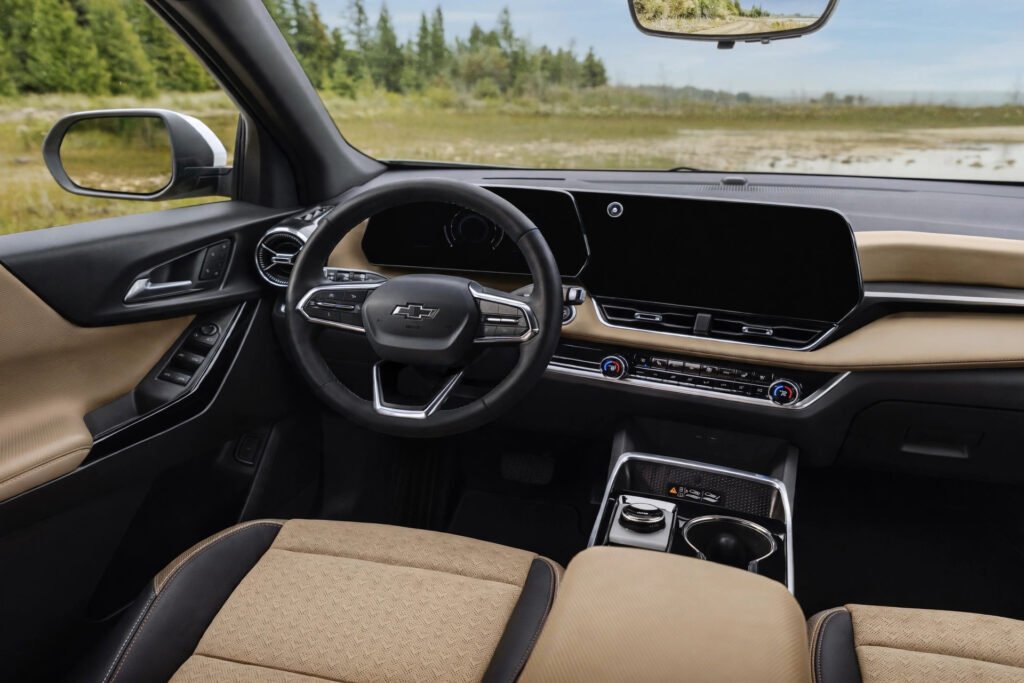
Here the Equinox punches above its price. Its 11.3-inch touchscreen is standard on every trim, with Google built-in (Maps, Assistant, and the Play Store), wireless Apple CarPlay and Android Auto, a Wi-Fi hotspot, and an 11-inch digital driver display. No other compact SUV gives you this much screen at this price.
The CR-V takes the opposite approach. The base LX makes do with a 7-inch screen, with a 9-inch screen on higher trims. For 2026, Honda did close one gap: wireless Apple CarPlay, Android Auto, and a wireless phone charger now come standard on every CR-V trim. But the screen-size difference is visible the moment you sit in both cars back to back, and it favors the Chevrolet.
Safety is a tie on paper and close in practice. Both come standard with full driver-assistance suites: Chevy Safety Assist on the Equinox and Honda Sensing on the CR-V, each including automatic emergency braking, lane-keeping assist, adaptive cruise control, and blind-spot monitoring. Honda Sensing has a slightly stronger reputation in independent testing, but both systems cover the features that prevent real crashes. Neither SUV charges extra for the safety equipment that matters most.
One area where the CR-V pulls ahead is its TrailSport Hybrid trim, new to the lineup, which adds all-wheel drive, all-terrain tires, more ground clearance, and a rugged look — a direct answer to the Equinox ACTIV. Between the two adventure trims, the TrailSport’s hybrid powertrain gives it the efficiency edge, while the ACTIV’s lower price and simpler gas engine appeal to buyers who want rugged looks without hybrid complexity.
Tires and Running Costs: Sizes, Replacement, and Resale

Tires are where a compact SUV’s true running costs hide, and the two SUVs differ here as well.
| Model | Common factory tire sizes | Wheel sizes |
|---|---|---|
| Honda CR-V LX | 235/65R17 | 17-inch |
| Honda CR-V EX / EX-L / Sport Hybrid | 235/60R18 | 18-inch |
| Honda CR-V Sport Touring | 235/55R19 | 19-inch |
| Chevrolet Equinox LT | 17-inch wheels | 17-inch |
| Chevrolet Equinox RS | 19-inch wheels (20-inch available) | 19 / 20-inch |
The CR-V’s tire sizes are well documented: 235/65R17 on the base LX, 235/60R18 on most mid trims, and 235/55R19 on the top Sport Touring. Replacement all-season tires in these sizes are widely available and competitively priced. The Equinox starts on 17-inch wheels and climbs to 19-inch on the RS, with 20-inch wheels available — and those 20-inch tires cost noticeably more to replace. If you are buying the sporty RS, budget for pricier rubber. Always confirm your exact size on the driver’s door placard; our guide to what tire numbers mean shows how to read it.
Resale value is the CR-V’s quiet superpower. Independent analysis puts five-year depreciation at roughly 34.5% for the CR-V against about 49.6% for the Equinox — a gap worth thousands of dollars when you sell or trade in. Some of that reflects Honda’s reliability reputation; some reflects the simple fact that used-car buyers pay more for a CR-V. The Equinox was fully redesigned for 2025, so its long-term record is still being written, but the current resale gap is real and should be part of your math. A cheaper purchase price that evaporates at trade-in time is not actually cheaper.
Warranty coverage is identical on paper — 3 years / 36,000 miles bumper-to-bumper and 5 years / 60,000 miles powertrain for both. Chevrolet adds one complimentary maintenance visit in the first year, including an oil change and tire rotation. If you are cross-shopping Toyota’s compact SUV too, our Toyota RAV4 vs Mazda CX-5 comparison covers the CR-V’s toughest rival.
Pros and Cons
2026 Chevrolet Equinox
Pros:
- Lowest starting price at $28,800 — about $2,120 under the CR-V
- 11.3-inch touchscreen, heated seats, and heated steering wheel standard on every trim
- Simple three-trim lineup (LT, RS, ACTIV) that is easy to shop
- Fresh 2025 redesign with bold styling and Google built-in tech
- Tows up to 1,500 pounds
Cons:
- No hybrid option at any price
- Much less cargo space (63.5 vs 76.5 cu ft maximum)
- Less horsepower and worse fuel economy than the gas CR-V
- Weaker resale value and a shorter reliability track record
- 20-inch RS tires cost more to replace
2026 Honda CR-V
Pros:
- Hybrid with 204 horsepower and up to 40 mpg combined
- Class-leading cargo space: 39.3 cu ft behind the seats, 76.5 maximum
- Stronger gas engine (190 hp) and better fuel economy
- Best-in-class resale value and long reliability record
- New TrailSport Hybrid trim for light off-road use
Cons:
- Starts $2,120 higher, and hybrid trims cost much more
- Small 7-inch touchscreen on the base LX
- Heated seats and larger screen require climbing trims
- Not a strong tow vehicle
The Verdict

The Honda CR-V is the better SUV for most buyers. It wins on power, cargo space, fuel economy, resale value, and the hybrid option that the Equinox simply cannot match. If you haul kids and gear every day, drive 12,000-plus miles a year, or plan to keep the car five years or more, the CR-V’s higher purchase price pays you back in fuel savings and trade-in value. The cr v hybrid, in particular, is the smartest buy in this comparison — 204 horsepower and up to 40 mpg in a family SUV is a combination nothing else at this price offers.
The Chevrolet Equinox is the better deal if your budget is fixed and your priorities are features per dollar. It costs less, gives you a bigger screen and heated seats from the base trim, and its three-trim lineup makes shopping painless. For a buyer who drives modest miles, rarely fills the cargo area to the roof, and wants the most equipment for the least money, the Equinox is a genuinely good SUV — just not the best one in this pair.
Short version: need space, efficiency, and long-term value — buy the CR-V. Need the lowest payment and the most standard features — buy the Equinox. Either way, drive both on the same day, load something bulky into the cargo area, and sit in the back seat yourself. Those three minutes will tell you more than any spec table.
Frequently Asked Questions
Which is cheaper, the 2026 Chevrolet Equinox or the Honda CR-V?
The Equinox is cheaper. The 2026 Equinox LT starts at $28,800 before destination, while the 2026 CR-V LX starts at $30,920 — a gap of about $2,120. The Equinox also includes more standard equipment at its base price, including an 11.3-inch touchscreen, heated front seats, and a heated steering wheel.
Does the 2026 Chevrolet Equinox have a hybrid?
No. The 2026 Equinox is gas-only, with a single 1.5-liter turbocharged four-cylinder engine making 175 horsepower. The Honda CR-V offers a 204-horsepower two-motor hybrid on four trims, rated up to 40 mpg combined. If you want hybrid fuel economy in this class, the CR-V is the only choice of the two.
Which has more cargo space, the Equinox or the CR-V?
The CR-V, by a clear margin. It offers 39.3 cubic feet behind the rear seats and 76.5 cubic feet maximum, versus 29.8 and 63.5 cubic feet in the Equinox. That is about 13 cubic feet more peak cargo room — roughly the difference between fitting a stroller and a week’s luggage, or not.
Which gets better gas mileage, the Equinox or the CR-V?
The CR-V wins. The gas CR-V is rated at 28 city / 33 highway / 30 combined mpg in front-wheel-drive form, against 26 / 29 / 27 for the Equinox. The CR-V Hybrid stretches the gap further, with up to 40 mpg combined. The Equinox has no hybrid to answer it.
Is the Honda CR-V more reliable than the Chevrolet Equinox?
The CR-V has the stronger long-term record. Honda’s compact SUV has a decades-long reputation for reliability, and independent resale analysis shows the CR-V holding its value far better — roughly 34.5% depreciation over five years against about 49.6% for the Equinox. The Equinox was fully redesigned for 2025, so its long-term record is still being written.
Which is better for families, the Equinox or the CR-V?
The CR-V is the better family hauler thanks to its much larger cargo area and roomier cabin, plus the hybrid option for families who drive a lot. The Equinox is the better value pick: it costs less, includes heated seats and a big touchscreen on every trim, and its simpler three-trim lineup makes shopping easier.