
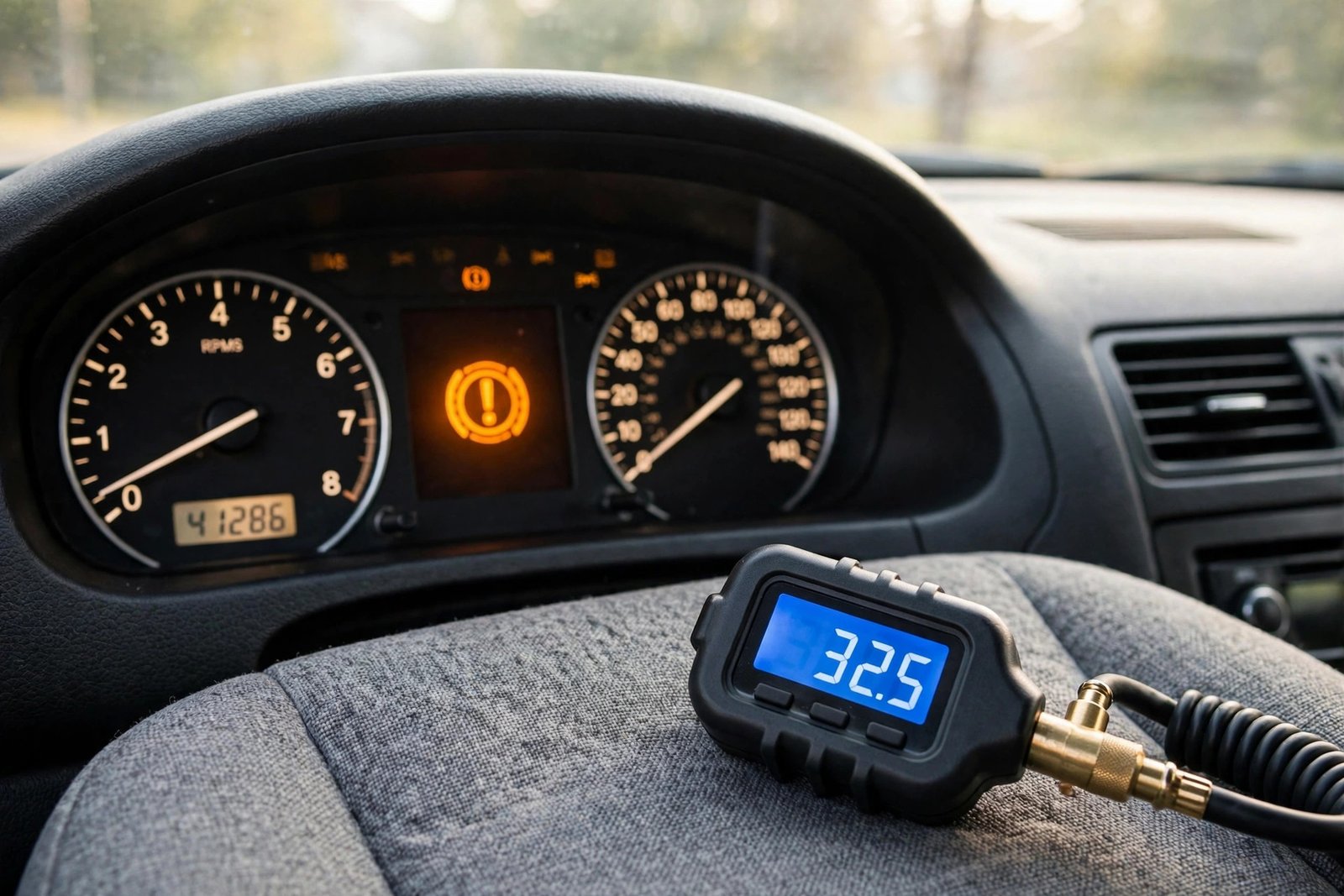
Quick answer: If you have checked all four tires with a gauge and they match the pressure on the driver’s door-jamb placard, the light is not about the air anymore — it is about the monitoring system. The most likely causes are a dead TPMS sensor battery (especially on cars 5 to 10 years old), a reset or relearn the system still needs after tire service, or a low spare tire with its own sensor. Verify the spare, run your car’s reset procedure, and if the light still will not clear, have the sensors scanned — a shop can tell you in minutes which one has stopped talking to the car.
This is the most confusing version of the tire pressure warning. You did everything right: you checked the tires, the gauge says they are fine, the tires look fine — and the light is still on. It feels like the car is lying to you.
It usually is not lying. It is just reporting a different problem than the one you checked for. The TPMS light has two jobs: warn you about low pressure, and warn you when the monitoring system itself cannot do its job. Once you have ruled out low pressure with a gauge, you are in the second category, and the fix is different — more air will not help, because air was never the problem.
First, Make Sure “Fine” Really Means Fine
Before assuming the system is at fault, it is worth double-checking what “fine” means, because this is where most people get tripped up.
Use a gauge, not your eyes. Modern radial tires can look perfectly normal while sitting 5 to 10 PSI low. That is enough to trigger the light and affect safety. If you judged the tires by looking at them, check them properly.
Use the placard, not the sidewall. The correct pressure is on the sticker in your driver’s door jamb, not the maximum pressure molded into the tire sidewall. Filling to the sidewall number overinflates the tire, and some systems warn on that too.
Check cold. NHTSA defines a cold tire as one that has not been driven on for at least three hours. Tires gain roughly 4 to 6 PSI in the first twenty minutes of highway driving, so a tire that reads “fine” at a gas station after a long drive can read low the next morning. Check before driving, or after the car has sat overnight.
Check all four — and compare them. If three tires read 35 PSI and one reads 29, that one tire is your problem, even if it looks fine. One tire several PSI below the rest usually means a slow leak, not a sensor fault.
If all four genuinely match the placard when cold, your tires are fine. The rest of this guide is about the system. (If you only filled the tires and assumed the light would clear, without verifying with a gauge, start with our guide to the tire pressure light still on after filling tires instead — a tire can sit 5 to 10 PSI low without looking flat.)
Solid vs. Flashing: Read the Light Before Anything Else
How the light behaves is the single most useful clue you have, and it costs nothing to check. Watch the dashboard when you start the car:
| What the light does | What it means | What to do |
|---|---|---|
| Solid, stays on from startup | The system believes a tire is low — or is waiting on a reset/relearn | Verify pressure with a gauge, then reset per your manual |
| Flashes 60–90 seconds at startup, then stays solid | System fault — usually a dead sensor battery or a sensor the car cannot read | Pressures are probably fine; get the sensors scanned |
| Comes on cold mornings, goes off after driving | Pressure is marginal — it dips below the threshold overnight and recovers as tires warm | Top up all four tires cold to the full placard pressure |
| Comes on after tire service, rotation, or new wheels | The system needs a relearn or the new sensors were never registered | Run the relearn procedure or have a shop register the sensors |
A flashing-then-solid light is the key distinction. Air will not fix it, because it is not reporting low air. It is reporting that the system itself has failed — and while it is failed, it cannot warn you about a genuinely low tire, so you are back to checking pressures by hand until it is repaired. A clear breakdown of what the TPMS light means and how to fix it draws the same line: a steady light means low pressure, while a light that flashes for about a minute at startup means a sensor or system fault.
1. A Cold Snap Tripped the Light — and Already Passed

This is the most common reason for a light that seems wrong, and the easiest to misunderstand. Tire pressure falls roughly 1 PSI for every 10°F drop in temperature. A tire set correctly on a warm afternoon can drop several PSI overnight in a cold snap, crossing the TPMS threshold and switching the light on.
By the time you check the tires the next afternoon, the temperature has recovered, the pressure has crept back up, and the gauge says everything is fine. The gauge is not wrong — the pressure really did recover. But the light does not always clear itself the moment the pressure recovers. On many cars it stays on until the system is reset or the car is driven long enough for the sensors to report the new readings.
2. The System Needs a Reset or Relearn
Filling tires — or having them serviced — does not automatically update the TPMS. The system has to be told that the new pressure is the baseline, and on many cars that only happens through a deliberate step. There are two different steps, and confusing them is common:
- Reset / calibration. The car re-learns the current pressures as normal. Common on Toyotas (a SET button held until the light blinks three times) and on many Hondas and Volkswagens (a calibration started through the dashboard or infotainment menu). Some Hondas need about 30 minutes of cumulative driving at 30 to 65 mph before calibration completes.
- Relearn. The car re-registers each sensor’s ID and its wheel position. Needed after a tire rotation, a sensor replacement, or fitting new wheels. Some cars do this automatically after driving; others need a relearn sequence or a shop scan tool.
If you recently had a rotation, new tires, or a flat repaired and the light came on right after, a missed relearn is the prime suspect. The tires are fine — the car simply no longer knows which sensor is on which wheel, or does not recognize a new sensor at all. Our guide to how to reset the TPMS covers the reset procedures, and how to program TPMS sensors covers the relearn side.
3. A Dead TPMS Sensor Battery
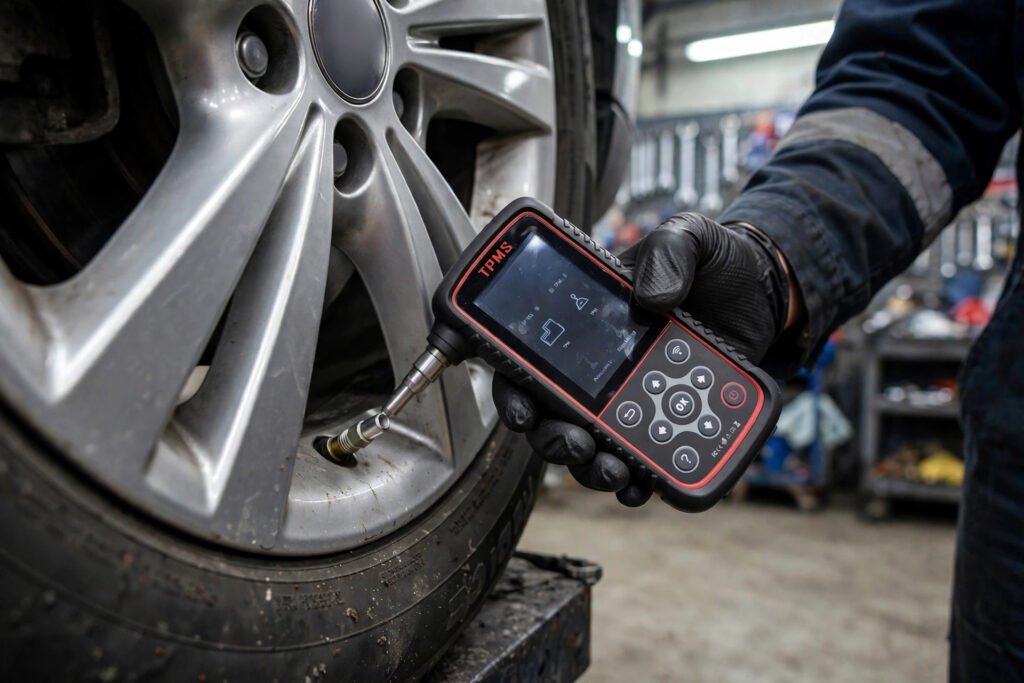
This is the most common cause on older cars, and the one that produces the most confusion, because everything about the tires is genuinely fine.
Each TPMS sensor has a small sealed battery inside it, and that battery lasts roughly 5 to 10 years. When it dies, the sensor stops transmitting — and the car, unable to hear from that wheel, turns the light on. There is no way to swap the battery alone: the sensor is a sealed unit, so the whole sensor has to be replaced. Replacing one is a shop job, because the tire has to come off the wheel to reach it, and the new sensor has to be programmed to the car.
The tell-tale sign is the flashing pattern: a light that flashes for 60 to 90 seconds at every startup and then stays solid almost always means a dead sensor battery or another system fault. If your car is 7 or 8 years old, still on its original sensors, and the light suddenly will not clear, a dead battery is the first thing a shop will check. A TPMS scan tool can ping each sensor and show exactly which one has gone silent. Our guide to TPMS sensor replacement cost explains what the job involves, and a TPMS guide from Christian Brothers Automotive likewise names a dying sensor battery as the most common culprit behind a light that stays on after inflation.
4. A Damaged or Missing Sensor

Sensors live inside the wheel, mounted on the valve stem, which makes them vulnerable every time a tire is changed. A sensor can be cracked by a tire machine during mounting, damaged by a pothole impact hard enough to bend the wheel, or corroded at the valve stem over years of road salt and moisture.
A sensor can also simply be missing. If you fitted winter wheels, aftermarket wheels, or used wheels that never had sensors installed — or had sensors never registered to your car — the system will warn you because it cannot find them. The same thing happens if a tire shop fitted a standard rubber valve stem instead of a sensor during a repair. If the light appeared right after tire work, go back to the shop that did it and ask them to scan the sensors. A missing or damaged sensor shows up immediately on a scan, and a reputable shop will own a sensor they broke during a tire change.
5. The Spare Tire Is Low
The spare is the cause almost everyone forgets, because it is out of sight in the trunk or under the car. On many vehicles — particularly SUVs and trucks — the full-size spare carries its own TPMS sensor. If that spare is low, the light stays on even when all four road tires are exactly at spec.
Check your owner’s manual to see whether your spare is monitored. If it is, check its pressure and inflate it to the figure listed for it — spares often run at a higher pressure than the road tires, so read the placard or the spare’s own label rather than guessing. Most compact temporary spares have no sensor at all, so a low donut cannot trigger the light.
6. Your Gauge or the Dashboard Display Is Misleading You
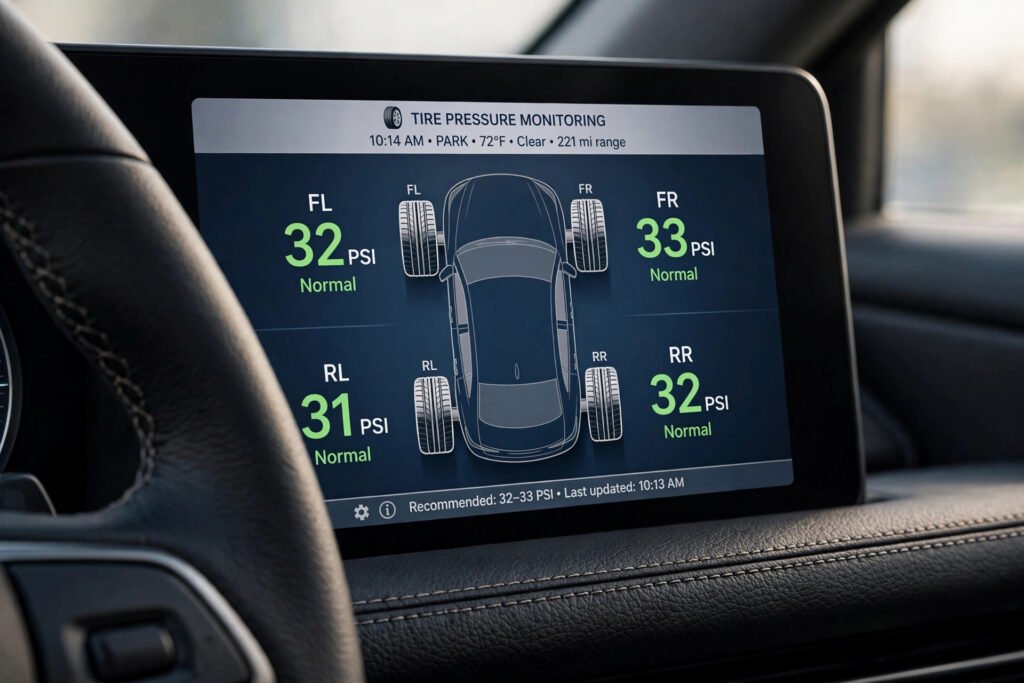
Sometimes the disagreement is not between the tires and the system, but between two different measurements of the same tires. A cheap pencil gauge or a gas station pump gauge can drift several PSI from the truth — enough to make you believe the tires are fine when one is actually low. If your car shows individual tire pressures on the dashboard, compare those readings with your own gauge. If they disagree by more than a couple of PSI on the same tire, trust the gauge you can verify. A decent digital gauge kept in the glove box is a small purchase that removes a whole category of confusion.
7. A System Fault: Receiver, Wiring, or Control Module
If every sensor is alive and reporting and the light is still on, the fault is further up the chain: the receiver antenna that listens for the sensors, the wiring, or the control module itself. This is the least common cause. Symptoms that point here include a light that behaves erratically — on one day, off the next, with no pattern tied to temperature or driving — or a system that reports no sensor data at all on a scan tool. This is a diagnostic job for a mechanic or dealer. Before paying for module diagnostics, though, make sure the simple causes above are genuinely ruled out — most “system faults” turn out to be a dead sensor or a missed relearn once the sensors are actually scanned.
8. Indirect TPMS and the Calibration Trap
Some cars — many Hondas, Volkswagens, and other models — use indirect TPMS, which has no pressure sensors in the wheels at all. Instead, it watches wheel speed through the ABS sensors: an underinflated tire rolls slightly smaller and spins slightly faster, and the system flags the difference.
Indirect systems are fussier about calibration. They must be recalibrated whenever you inflate, rotate, or change tires — and if you skip that step, the light stays on even though the tires are perfect, because the system is still comparing against the old baseline. Worse, if you reset the system while a tire was low, you taught it that the low pressure was normal. If your car uses indirect TPMS, follow the calibration procedure in your owner’s manual every time you touch the tires. The service tire monitor system guide explains the dashboard messages these systems produce.
What to Do, Step by Step

- Confirm the spare. Check the spare’s pressure if it has a sensor — this is the cheapest fix on the list.
- Run the reset. Use your vehicle’s reset button or dashboard calibration, exactly as the owner’s manual describes. Then drive for about 10 minutes at highway speed.
- Check the startup pattern. If the light flashes for 60 to 90 seconds at startup, it is a system fault — skip to step 5.
- Think about recent service. Rotation, new tires, new wheels, or a flat repair since the light appeared points to a missed relearn.
- Get the sensors scanned. A tire shop can ping each sensor and tell you in minutes which one is dead, damaged, or missing. Many shops do this check for free.
- Replace the faulty sensor. If one sensor is dead, replace it — and consider replacing the others at the same time if the car is old, since their batteries are the same age.
Is It Safe to Drive With the Light On?
If you have verified all four tires with a gauge and they match the placard, the car handles normally, and no tire looks damaged, driving is generally fine. The tires themselves are not the problem.
But do not ignore the light permanently. While it is on for a system fault, the TPMS cannot warn you about a genuinely low tire — you have lost the safety net, and you are back to checking pressures by hand. Check your pressures monthly by hand until the system is fixed, and get the diagnosis done rather than driving for months with a warning you have learned to tune out.
The Bottom Line
A TPMS light with good tires is not the car lying to you — it is the car telling you the problem moved from the tires to the system that watches them. Start with the spare and the reset, watch for the flashing pattern that means a dead sensor battery, and think back to any recent tire service that might have skipped a relearn. In most cases one of those three answers it. If none does, a sensor scan at a tire shop will name the faulty part in minutes.
Frequently Asked Questions
Why is my TPMS light on when my tires are fine?
If a gauge confirms all four tires match the door-jamb placard pressure, the problem is in the monitoring system, not the air. The most common causes are a dead TPMS sensor battery, a system that needs a reset or relearn after tire service, a low spare tire with its own sensor, or a cold snap that tripped the light and has since passed.
Can a TPMS light stay on with correct tire pressure?
Yes. Correct pressure and an illuminated light can exist at the same time. The system has to measure the new pressure and, on many vehicles, complete a calibration or relearn before the warning clears. A dead sensor battery or a sensor the car no longer recognizes will also keep the light on indefinitely, no matter how perfect the pressures are.
How do I know if my TPMS sensor battery is dead?
The classic sign is a light that flashes for 60 to 90 seconds at startup and then stays on solid — that pattern means a system fault, most often a dead sensor battery. TPMS sensor batteries typically last 5 to 10 years and cannot be replaced separately, so the sensor itself must be replaced. A tire shop can scan each sensor to confirm which one has stopped transmitting.
Can a spare tire turn the TPMS light on?
Yes, on vehicles where the full-size spare carries its own TPMS sensor. If that spare is low, the light stays on even when all four road tires are at the correct pressure. Many compact temporary spares have no sensor and cannot trigger the light.
Is it safe to drive with the TPMS light on if the tires are fine?
If you have verified all four tires with a gauge and they match the placard, the car handles normally, and no tire looks damaged, driving is generally fine — but you are driving without the low-pressure safety net until the system is fixed. Check pressures by hand regularly and get the system diagnosed rather than ignoring the light permanently.
How do I reset the TPMS light when my tires are already at the right pressure?
First confirm every tire — including the spare if it has a sensor — with a gauge when cold. Then use your vehicle’s reset method: drive for about 10 minutes at highway speed, use the TPMS reset button, or start calibration through the dashboard menu. If the light still will not clear, the car likely needs a sensor relearn or a sensor replacement, which a tire shop can do with a scan tool.
