
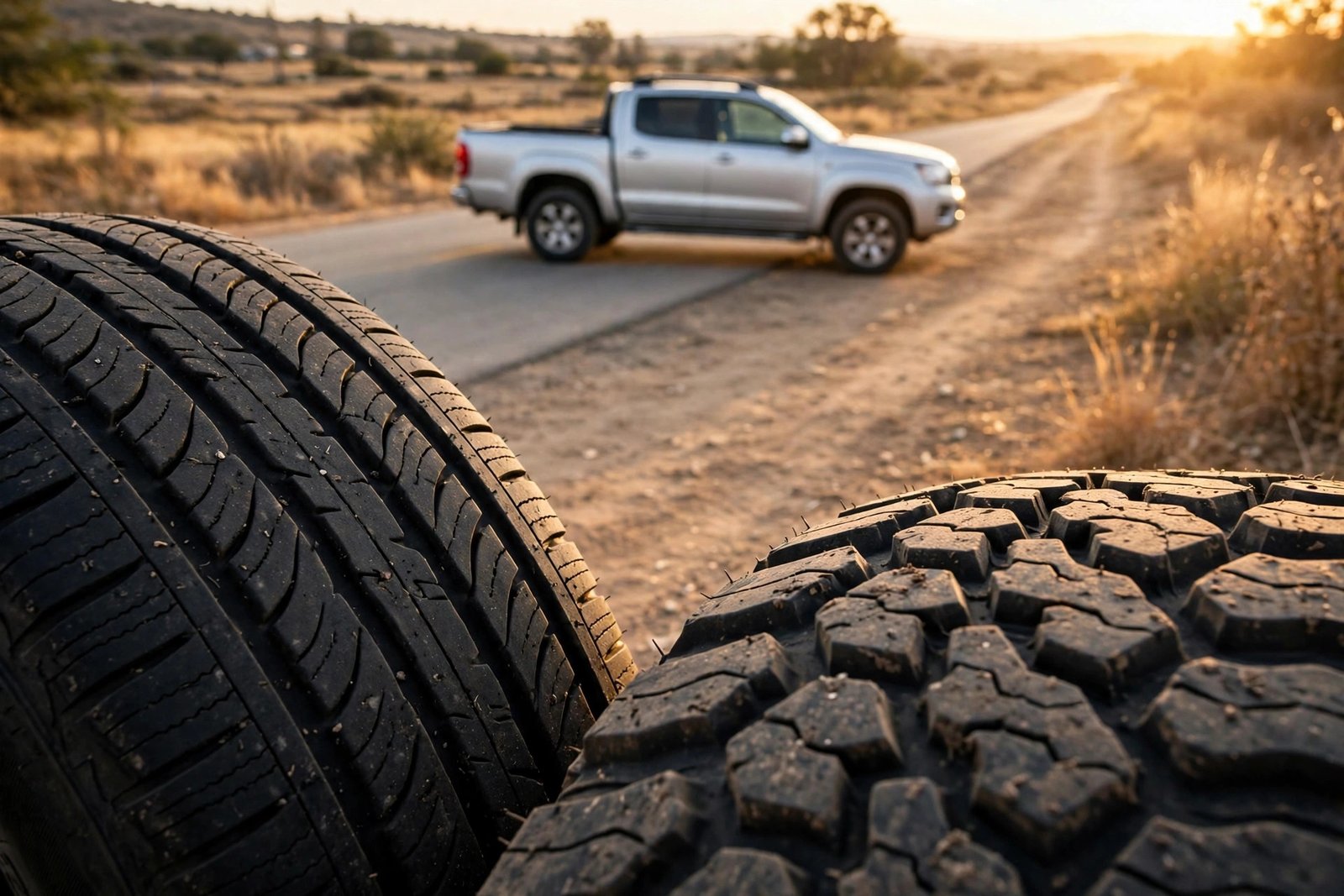
Quick answer: Highway tires are the better buy for most drivers — quieter, smoother, longer-lasting, and more fuel-efficient, because they are built for the paved roads you actually drive on. All-terrain tires are worth it only if you regularly drive on gravel, dirt, mud, or light trails. The deciding question is simple: what percentage of your driving is truly off-road? Close to zero means highway tires; a meaningful share means all-terrain tires.
Walk into any tire shop with a truck or SUV and you will hear the same pitch: all-terrain tires can do everything. They look tougher and promise grip on any surface — an easy sell, and for a lot of buyers, the wrong one.
The truth is simpler. Each tire gives something up to do its job well: a highway tire trades off-road grip for quiet comfort and long life on pavement, while an all-terrain tire trades comfort and fuel economy for grip when the pavement ends. Neither is better across the board — the right tire matches where your vehicle actually spends its miles, not where you imagine it might go one day.
Below is the head-to-head comparison — tread design, comfort, noise, wet and snow grip, tread life, fuel economy, durability, and cost — plus the most common buying mistakes.
All Terrain vs Highway Tires at a Glance
| Feature | Highway (HT) Tires | All-Terrain (AT) Tires |
|---|---|---|
| Best for | Paved roads, daily driving, highway towing | Dirt, gravel, mud, sand, mixed use |
| Tread design | Tight, closed pattern; shallow grooves | Large open blocks; deep grooves |
| Road noise | Very quiet | Moderate to loud hum at highway speed |
| Ride comfort | Smooth and cushioned | Firmer, more road feel |
| Off-road grip | Poor on loose surfaces | Good to very good |
| Wet-road grip | Strong | Good, usually a step behind HT on pavement |
| Snow performance | Moderate in light snow | Moderate to good; many carry the 3PMSF rating |
| Tread life | Typically 60,000–80,000 miles | Typically 45,000–60,000 miles |
| Fuel economy | Better by about 1–3 MPG | Slightly worse |
| Puncture resistance | Standard sidewalls | Reinforced sidewalls, tougher off-road |
| Price | Lower | Higher |
| Look | Traditional | Rugged and aggressive |
What Are Highway Tires?
Highway tires — highway-terrain or HT tires — are built for one job: performing as well as possible on paved roads. Their tread is tight and continuous, with shallow grooves and small blocks, putting more rubber in contact with the asphalt at any moment.

That pays off in three things you notice every day: a quieter cabin, a smoother ride, and better fuel economy. The closed tread barely hums, the softer sidewalls soak up small bumps instead of passing them into the cabin, and low rolling resistance means the engine works less hard.
Most SUVs, crossovers, and half-ton trucks leave the factory on highway tires because they match how most owners actually use their vehicles — mostly paved roads, in all kinds of weather, every day. Well-known examples include the Michelin Defender LTX M/S and the Michelin LTX M/S2.
What highway tires do not do well is loose surfaces. On gravel or a dirt trail, the shallow tread fills with debris quickly, loses grip, and can leave you spinning — or stuck — and the thinner sidewalls are more vulnerable to punctures from rocks. If your off-road driving is limited to the occasional unpaved parking lot or gravel driveway, that weakness will never matter. If it is a weekly reality, it will.
What Are All-Terrain Tires?
All-terrain tires — AT tires — are a deliberate compromise between a street tire and a full off-road tire, built to handle a mix of surfaces: highways, gravel roads, dirt, sand, and light mud.
The tread shows the compromise: larger, more open blocks with deeper grooves and wider voids. On loose ground those blocks dig in and bite, the wide channels throw mud and stones clear, and reinforced sidewalls — some three-ply — resist punctures from rocks and trail debris.
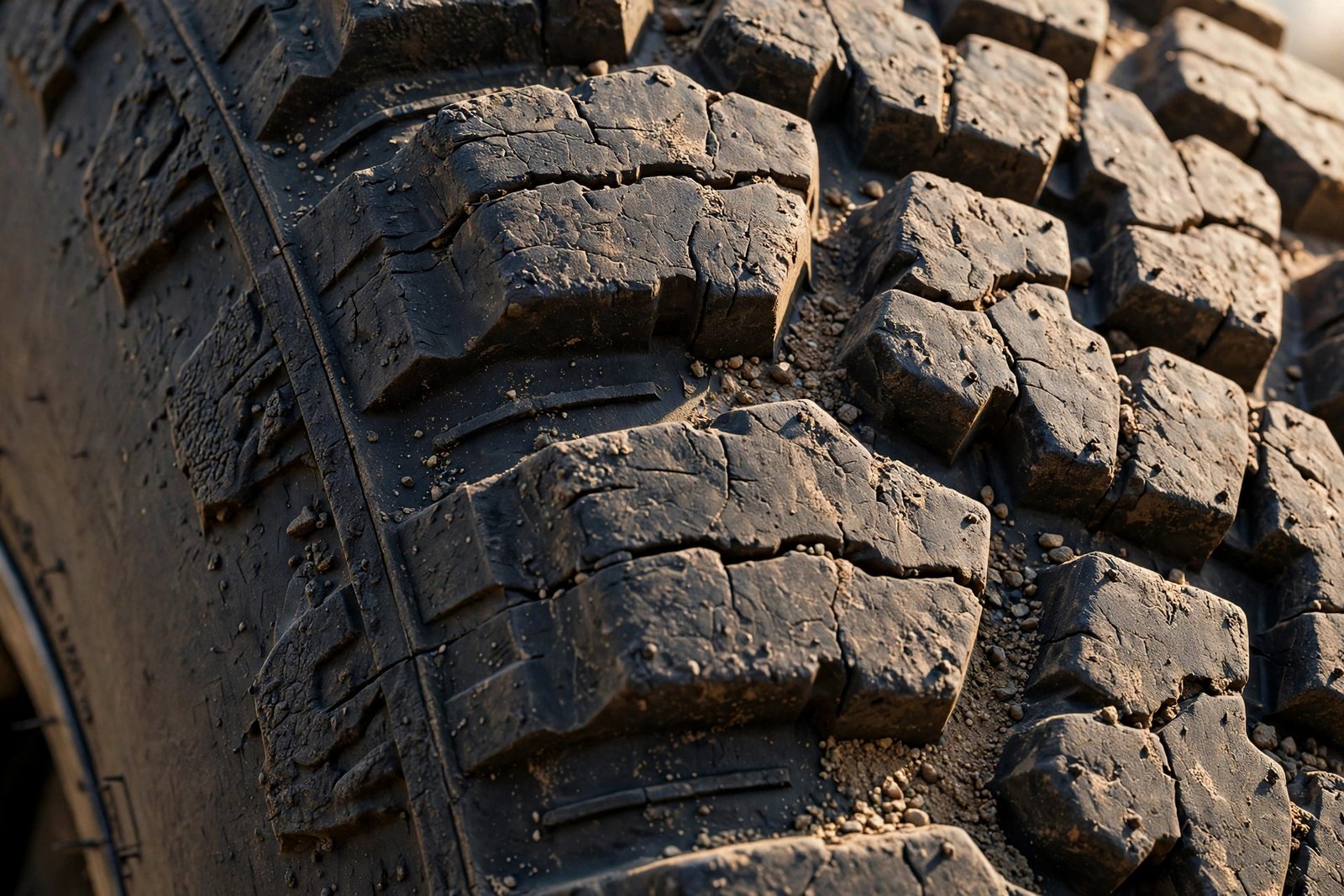
The best-known all-terrain tires are the BFGoodrich All-Terrain T/A KO2 and the Falken Wildpeak A/T3W, joined by newer options like the BFGoodrich All-Terrain T/A KO3, the Falken Wildpeak A/T4W, the Toyo Open Country A/T III, and the Continental TerrainContact A/T. Modern all-terrain tires are far more street-friendly than the ones from a decade ago — but the trade-offs are still real.
The open tread blocks that give an all-terrain tire its grip also create the distinctive hum. The stiffer sidewalls that protect against punctures pass more road harshness into the cabin, and the heavier construction costs fuel. None of this makes all-terrain tires bad — it makes them a tool with a cost, worth paying only if you use what you are paying for.
All Terrain vs Highway Tires: The Key Differences
1. Tread Design
Everything else in this comparison flows from the tread. A highway tire’s closed pattern has a low void ratio — roughly 15 to 20 percent grooves, the rest rubber on the road — while an all-terrain tire’s open pattern runs closer to 25 to 35 percent void. More rubber on the road means better grip, quieter running, and longer wear on pavement; more open space means the tire can bite into loose ground and clear debris.
Tread depth tells the same story: highway tires typically start around 10 to 12/32 inch deep, all-terrain tires around 13 to 16/32 inch. That extra depth keeps an all-terrain tire gripping as it wears on rough ground — and makes it louder and thirstier on the highway. Our guide to what tire numbers mean explains the sidewall markings, and the tire size guide helps you match a size to your vehicle.
2. On-Road Comfort
Highway tires win here, and it is not close. On smooth pavement the difference is obvious: the highway tire’s softer sidewalls absorb small imperfections, and its continuous tread does not squirm through corners.

Switch to all-terrain tires and the truck feels subtly stiffer and less cushioned. It is not jarring, but over a long commute it adds up. The gap narrows on broken pavement, where the stiffer sidewalls absorb some impacts differently — but for the smooth highway miles most people drive, the highway tire is simply more comfortable.
3. Road Noise
This is where a lot of all-terrain buyers have regrets — not because the noise is unbearable, but because it never goes away. The hum is most noticeable between about 55 and 70 mph, right where highway cruising lives, and on a long drive it becomes genuinely fatiguing.
How big is the difference? In a back-to-back test on a Ford F-150, The Tire Reviews measured BFGoodrich KO2 all-terrain tires at a consistent 3 to 4 decibels louder than Michelin LTX M/S2 highway tires on highway stretches. That does not sound like much, but decibels are logarithmic — a few dB is a clearly audible step up, and it is constant. The noise also tends to grow as all-terrain tires wear, because the tread blocks wear unevenly.
Noise is the trade-off buyers underestimate most — test-drive a truck on all-terrain tires before you commit.
4. Off-Road Capability
All-terrain tires win here, significantly. On gravel forest roads, a highway tire spins and slides where an all-terrain tire just digs in and keeps going, and on a wet, muddy two-track trail the difference is just as stark. The deeper voids channel debris away from the contact patch, and the aggressive blocks bite into soft, wet surfaces.

But know the limits: all-terrain tires are not mud-terrain tires. Deep mud, creek crossings, and technical rock crawling are beyond them. Dirt, gravel, sand, and light trails are their zone — go further than that and you need a more specialized tire.
5. Wet-Road Grip
Both perform well in the rain, and on wet pavement they are closer than most people expect. Modern highway tires are engineered for wet grip, and a good one handles heavy rain on the interstate with confidence. All-terrain tires pull ahead on wet unpaved surfaces — wet gravel, wet dirt, wet grass — where their deeper voids clear debris and water and the aggressive blocks bite into soft ground. So the split is simple: rain on pavement favors the highway tire; rain on rural dirt roads favors the all-terrain tire.
6. Snow Performance
All-terrain tires have a meaningful advantage in snow — but neither type replaces a dedicated winter tire. In an inch or two of fresh snow on pavement, the all-terrain tire’s open tread bites in rather than skimming over the surface, and the difference is easy to feel.
Several popular all-terrain tires carry the 3-Peak Mountain Snowflake (3PMSF) rating, meaning they have passed standardized snow-traction testing. The BFGoodrich All-Terrain T/A KO2 and the Falken Wildpeak A/T3W both carry it. Highway tires are competent in light, dry-packed snow but lack the bite when conditions get worse.
If you live somewhere with serious winters, neither tire is the answer on its own — dedicated winter tires are still the safer choice, as our comparison of all-season vs winter tires explains. But as a tiebreaker between highway and all-terrain, the all-terrain wins.
7. Tread Life
Highway tires last longer — often meaningfully longer. Typical tread life runs around 60,000 to 80,000 miles for a highway tire, versus 45,000 to 60,000 miles for an all-terrain tire, because the bigger, softer tread blocks that grip loose surfaces wear down faster on abrasive pavement.
A real-world test makes the gap concrete: after 6,000 miles of similar mixed driving, Michelin highway tires had used about 15 percent of their tread — on track for their 70,000-mile warranty — while BFGoodrich KO2s had used closer to 22 percent, projecting to roughly 55,000 miles total. Not bad, but a real difference.

Tread life varies a lot by model, though — the Toyo Open Country A/T III, for example, carries a treadwear warranty up to 70,000 miles. Check the warranty on the specific tire you buy, keep up with tire rotation using the correct rotation pattern, and watch for the signs your tires need changing.
8. Fuel Economy
Highway tires typically win on fuel economy by about 1 to 3 MPG. The physics are simple: all-terrain tires are heavier, their aggressive tread creates more rolling resistance, and the open blocks add drag — so your engine works harder.
In the F-150 test, the truck averaged 19.2 MPG on highway tires and 17.8 MPG on all-terrain tires — a 1.4 MPG gap. In a controlled Tire Rack test, an all-terrain tire cost 0.7 MPG, or roughly 21 extra gallons of gas over a typical year. Other estimates put the penalty at 3 to 5 percent.
For most drivers that is a cost to weigh, not a dealbreaker. But over the life of a set, the extra fuel plus the shorter tread life plus the higher purchase price add up — one real-world estimate puts the total lifetime premium of all-terrain tires at roughly $400 to $700 over a comparable set of highway tires.
9. Durability and Price
Here the two types trade wins. All-terrain tires are more durable against off-road hazards: their reinforced sidewalls resist punctures from rocks, roots, and trail debris far better, and a highway tire can suffer a sidewall failure on a rocky gravel road where an all-terrain tire would be fine — a real safety consideration if any part of your driving involves rough terrain.
On pavement the story flips: the highway tire lasts longer and costs less, per tire and over the life of the set. If budget matters, our guide to the best budget tires shows how to get solid tires without overspending, and the Goodyear vs Michelin and Michelin vs Bridgestone comparisons break down what premium money actually buys.
Which Tire Should You Choose?
Forget the marketing and answer one question honestly: what percentage of your driving is truly off-road? At 90 percent or more on pavement, buy highway tires — you will not miss grip you never use. With a real mix of gravel, dirt roads, job sites, boat launches, or trails, buy all-terrain tires; even a few weekends a month off the pavement justifies the trade-offs. In between, lean highway.
The daily commuter. Forty miles each way, mostly highway, never off pavement: highway tires, without hesitation. The quiet cabin and fuel savings pay you back every day, and the all-terrain tire’s capability would sit unused for years.
The weekend explorer. You commute during the week but spend weekends on forest service roads, at a hunting camp, or towing a boat down a dirt launch: all-terrain tires earn their trade-offs. The grip and puncture resistance matter exactly when you are far from help.
The work truck. Job sites on unpaved ground, rough access roads, rural property: all-terrain tires again — the reinforced sidewalls alone can save you from a puncture that strands you on a workday. Just budget for the shorter tread life and rotate them on schedule.
The looks-only buyer. You love the rugged look and your truck never leaves the pavement. That is a legitimate choice — just go in knowing the trade-offs: more noise, faster wear, and a small fuel penalty for the appearance. If you would resent the hum six months from now, buy the highway tire.
Common Mistakes Buyers Make
Buying for the 5 percent. The most common mistake is buying all-terrain tires for off-road driving you do once or twice a year — or only imagine doing. You pay the noise, wear, and fuel penalty 100 percent of the time for capability you use 5 percent of the time. Match the tire to your typical week, not your best weekend.
Assuming all-terrain means all-weather. All-terrain is about surface grip — dirt, gravel, mud. All-weather is about temperature and seasons. Some all-terrain tires carry the 3PMSF snow rating, but not all, so check the specific tire. If winter performance is your main concern, read our winter tires guide and the all-season vs winter tires comparison before you decide.
Ignoring the size and load rating. The tread type is only half the decision. The tire still has to fit your vehicle and carry its weight — check the size, load index, and speed rating on your door placard before you buy. The wrong load rating on a truck that tows is a safety problem no tread pattern can fix.
Skipping rotation. All-terrain tires wear unevenly faster than highway tires, and their noise gets worse as they do. Commit to rotation every 5,000 to 8,000 miles, and check alignment too.
Verdict: All Terrain vs Highway Tires
For most drivers, highway tires are the better buy: quieter, smoother, longer-lasting, cheaper, and more fuel-efficient — and better at the job most vehicles actually do, which is driving on paved roads. At 90 percent or more on pavement, a highway tire is not the boring choice. It is the smart one.
All-terrain tires are the better buy when dirt is a real, regular part of your driving — gravel roads, work sites, boat launches, trails, rural property. If that is your week, the grip and toughness are worth every trade-off.
Frequently Asked Questions
What is the difference between all-terrain and highway tires?
Highway tires are built for paved roads: a tight, closed tread that puts more rubber on the asphalt, so they run quieter, ride smoother, last longer, and use less fuel. All-terrain tires use larger, more open tread blocks with deeper grooves and tougher sidewalls, so they grip dirt, gravel, mud, and light trails — at the cost of more noise, a firmer ride, faster wear, and slightly worse fuel economy.
Are all-terrain tires good for daily driving?
Yes, modern all-terrain tires are fine for daily driving, but they are a compromise on pavement. Expect a noticeable hum at highway speed, a firmer ride, and about 1 to 3 MPG less than a comparable highway tire. If your daily drive is almost entirely paved roads, a highway tire is quieter, cheaper to run, and more comfortable.
Do all-terrain tires wear out faster than highway tires?
Generally, yes. Typical tread life for a highway tire is around 60,000 to 80,000 miles, while all-terrain tires usually last around 45,000 to 60,000 miles. The bigger, softer tread blocks that grip loose surfaces wear down faster on abrasive pavement. Actual life varies a lot by model — some all-terrain tires, like the Toyo Open Country A/T III, carry treadwear warranties up to 70,000 miles.
Do all-terrain tires use more gas than highway tires?
Yes, slightly. All-terrain tires are heavier and have more rolling resistance from their aggressive tread, which typically costs 1 to 3 MPG in real-world driving. In one Tire Rack fuel-economy test, an all-terrain tire used 0.7 MPG more than a highway tire, working out to roughly 21 extra gallons of gas over a typical year of driving.
Are all-terrain tires good in snow?
They are better than highway tires in snow, but they are not a replacement for winter tires. The open tread bites into light snow far better than a highway tire’s shallow pattern, and several popular all-terrain tires — including the BFGoodrich All-Terrain T/A KO2 and the Falken Wildpeak A/T3W — carry the 3-Peak Mountain Snowflake (3PMSF) severe-snow rating. For heavy snow or icy winters, dedicated winter tires are still the safer choice.
Should I get all-terrain tires if I never go off-road?
Usually not. If your truck or SUV almost never leaves pavement, all-terrain tires mean paying extra for capability you will not use — more road noise, faster wear, and worse fuel economy. The only good reasons to buy them anyway are the rugged look, which many owners genuinely want, or rough gravel and dirt roads that are part of your regular driving. Otherwise, a good highway tire is the smarter buy.