
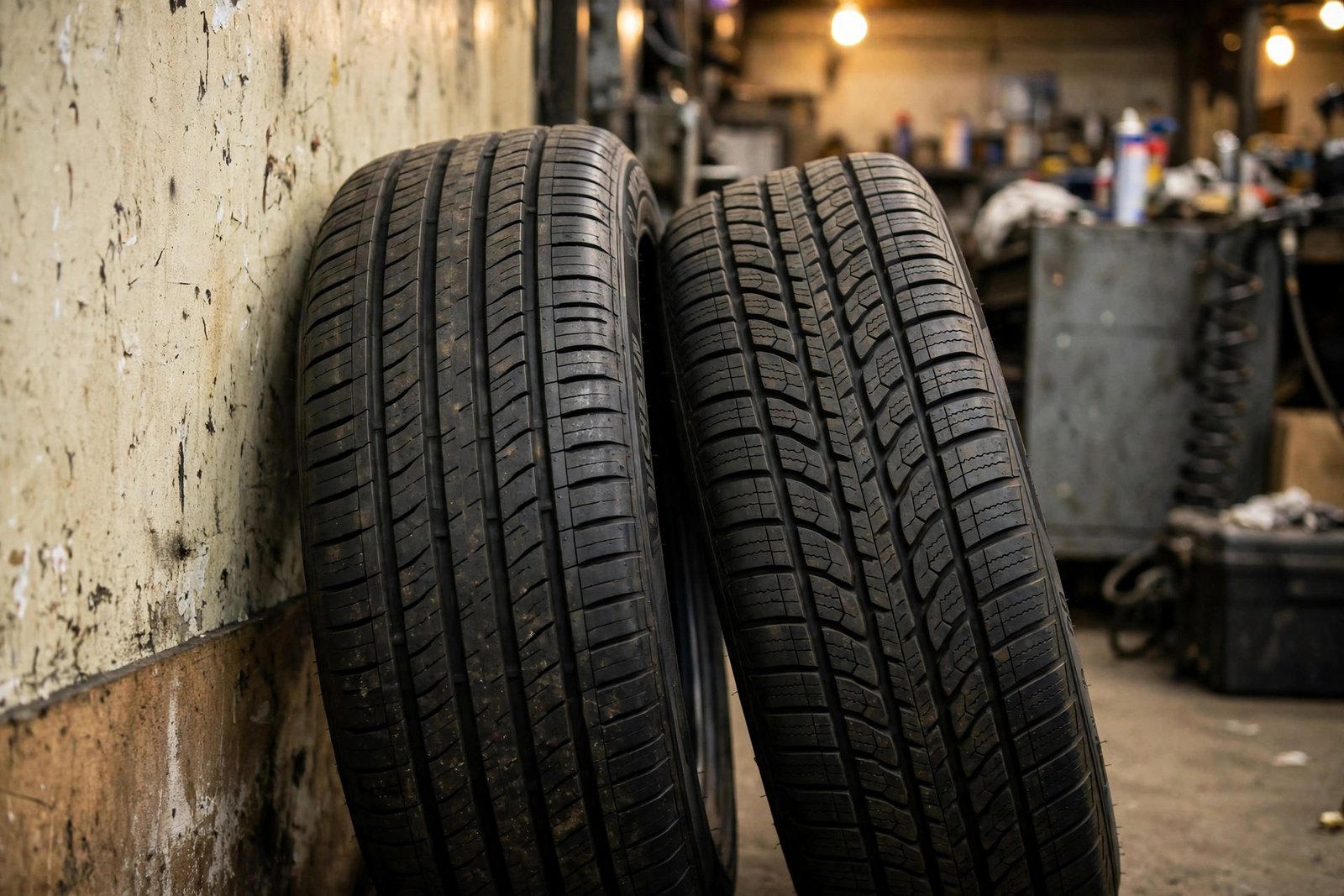
Quick answer: Michelin is the better brand for most drivers — longer tread life, quieter ride, better dry braking, and Consumer Reports’ #1 ranking for 2026. Bridgestone is the better value — about 12% cheaper up front, sharper in the wet, and stronger in snow with its WeatherPeak. If you keep your car for years and hate replacing tires, buy Michelin. If you want the best tire for the least money, or you drive in a lot of rain and snow, buy Bridgestone.
Michelin vs Bridgestone at a Glance
| Bridgestone | Michelin | |
|---|---|---|
| Founded | 1931, Japan (Firestone acquired 1988) | 1889, France (invented the radial tire in 1946) |
| Shared professional tests | 125 wins of 379 | 244 wins, 10 draws |
| Owner rating | 7.1/10 (3,407 reviews) | 8.1/10 (4,098 reviews) |
| Wear-test life (avg) | 25,029 miles | 30,671 miles |
| Price | ~12% cheaper on average | Premium pricing |
| Dry braking (avg) | 127 ft | 125 ft |
| Wet braking (avg) | 129 ft | 130 ft |
| Snow braking (avg) | 78 ft | 77 ft |
| Noise (avg) | 71.65 dB | 70.89 dB |
| Rolling resistance | 7.94 kg/t | 7.79 kg/t (better) |
| Consumer Reports 2026 rank | 10th (score 64) | 1st (score 72) |
| Defect warranty | 5 years | 6 years |
Aggregated test data from tire-reviews.com (379 shared professional tests, updated November 2026). Consumer Reports 2026 brand scores via reporting of the CR Tire Brand Report Card.
The Head-to-Head Record: Michelin Wins More Often — But Not Everywhere
If you only remember one number from this article, make it this one: across 379 professional tests where both brands fielded a tire, Michelin finished ahead 244 times, Bridgestone 125 times, and 10 tests were drawn. Michelin also beats more of the field on average (74.5% vs 60.6%) and leads in every season: summer 120–63, winter 79–42, all-season 41–19.
Recent form tells the same story: in the last five years, Michelin won 107 of 172 shared tests to Bridgestone’s 59. Owners agree — Michelin scores 8.1 out of 10, Bridgestone 7.1 — and the gap is widest on tread life (8.0 vs 6.7) and willingness to buy again (7.7 vs 6.2).
Consumer Reports’ 2026 testing is even clearer: Michelin is the top-ranked brand with a score of 72, and all eight Michelin tires tested earned a CR Recommended badge. Bridgestone ranks 10th at 64, with only six of ten tires recommended. Its best tire, the Potenza Sport, scored well below the equivalent Pilot Sport 4S on both test scores and owner satisfaction.
So is the comparison over? No — the averages hide where Bridgestone genuinely leads: wet-road feel, its snow specialist, and price. The rest of this article is about where each brand actually wins.
Tread Life: Michelin’s Biggest Advantage
Longevity is the single biggest separator between these two brands, and it is the reason most buyers pay Michelin’s premium.
In wear testing, Michelin won 48 of 52 shared tests, averaging 30,671 miles versus 25,029 for Bridgestone — about 22% further, the most lopsided result in this comparison. Owners feel it too, rating Michelin’s wear 8.0 out of 10 against 6.7 for Bridgestone.
That does not mean every Michelin outlasts every Bridgestone. The mileage warranty on the tire matters more than the badge, and here the brands are closer than the reputation suggests:
- Michelin Defender 2: 80,000-mile treadwear warranty
- Bridgestone Turanza QuietTrack: 80,000-mile treadwear warranty
- Bridgestone WeatherPeak: 70,000-mile treadwear warranty
- Michelin CrossClimate 2: 60,000-mile treadwear warranty
Yes — Bridgestone’s best touring tire matches Michelin’s best on paper. The difference is in real use: test and owner data say Michelin tires are more likely to actually reach their warranty miles. If you drive 12,000 miles a year, an 80,000-mile warranty is roughly six and a half years of driving — but only with even wear, which is why rotation and pressure matter. If your tires are wearing unevenly, see our guide to when to change tires and our explainer on what tire numbers mean — the treadwear grade on the sidewall is the quickest way to compare two specific tires.

Wet vs Dry: Bridgestone Owns the Rain, Michelin Owns the Dry
This is the cleanest split in the comparison, and it is the part most roundups get wrong by declaring one overall winner.
Wet: Bridgestone leads, narrowly but consistently. Its average wet-braking distance is 129 feet versus 130 for Michelin, and it won 140 of 232 wet-braking comparisons. Where it really shines is wet handling — steering and braking on a soaked road. It averaged 47.1 mph in wet handling versus 46.6 for Michelin, winning 72 of 104 tests, and it also leads on curved aquaplaning, resistance to sliding when water builds up in a corner. In plain language: in heavy rain, a Bridgestone feels sharper and more planted. Drivers in the Pacific Northwest, the Southeast, or anywhere with regular downpours will notice this.
Dry: Michelin leads. Its average dry stop is 125 feet versus 127 for Bridgestone, winning 135 of 223 dry-braking tests, and it also leads on straight-line aquaplaning speed. The difference is small — two feet in an average stop — but it is consistent across hundreds of tests.
The practical takeaway: if your biggest fear is a rainy highway at night, Bridgestone’s wet edge matters more. If you drive mostly on dry roads, Michelin’s dry edge is the one you will use more often.

Comfort, Noise, and Fuel Efficiency: Michelin, By a Small Margin
Comfort is something you notice every single day, and here Michelin wins — but by less than the marketing suggests.
On noise, Michelin averages 70.89 dB versus 71.65 dB for Bridgestone across shared tests. That is a small gap on paper, but owners rate Michelin’s comfort 8.1 out of 10 versus 6.8 for Bridgestone — a much bigger gap. The Defender and Primacy lines are built for exactly this: a soft, settled highway ride with minimal drone. Bridgestone’s Turanza QuietTrack is no slouch, but across the whole lineup, Michelin is the quieter brand. For the full picture on that tire, see our Bridgestone Turanza QuietTrack review. Michelin also leads slightly on fuel efficiency (7.79 vs 7.94 kg/t rolling resistance) — a small edge that adds up over 50,000 miles, and gives EV drivers a little more range.
All-Weather Showdown: WeatherPeak vs CrossClimate 2 vs Defender 2
Bridgestone WeatherPeak vs Michelin Defender 2: These two met in two Tire Rack tests, and the record is tied 1–1. The WeatherPeak is the snow tire of the pair: it stopped about 28% shorter on snow than the Defender 2 in both tests. The Defender 2 is the dry-road tire: it stopped about 11% shorter in the dry in both tests and was the quietest tire in Tire Rack’s 2026 test. Pick the WeatherPeak if snow is a regular part of your winter; pick the Defender 2 if your winters are mostly cold and dry and you want the longest-lasting, quietest tire.
Bridgestone WeatherPeak vs Michelin CrossClimate 2: This is the bigger test — five shared tests, and the CrossClimate 2 won four of them. It stopped 13.8% shorter in the dry and 9.5% shorter in the wet, sweeping dry braking 4-for-4 and wet braking 4-for-4. The WeatherPeak’s win is snow braking, where it stopped 2.4% shorter on average — including a standout 17.87 meters versus 22.06 meters in Tire Rack’s 2026 winter comparison. Both tires carry the 3PMSF severe-snow rating. The CrossClimate 2 is the more complete all-weather tire; the WeatherPeak is the better pure snow performer. If you are choosing between all-season and dedicated winter tires more broadly, see our all-season vs winter tires guide.
Neither tire is a dedicated winter tire, though — a proper winter tire still wins on ice and in deep snow, so if you live somewhere with months of real winter, a second set is still the safest choice.

Performance Summer: Pilot Sport vs Potenza
For performance driving, Michelin has the stronger reputation — and the test record backs it up, with a caveat.
The Michelin Pilot Sport line, led by the Pilot Sport 4S and the newer Pilot Sport 5, is the benchmark performance tire in test after test. It combines huge dry grip with surprisingly strong wet performance for a summer tire, and owners rate it exceptionally high on satisfaction. Consumer Reports’ data shows the Pilot Sport 4S scoring well above the Bridgestone Potenza Sport, whose owner satisfaction fell below average. For the full picture on Michelin’s newest performance tire, see our Michelin Pilot Sport 5 review.
The Bridgestone Potenza line is the enthusiast’s value pick. The Potenza Sport gives you sharper, more immediate steering response — drivers consistently describe Bridgestone performance tires as feeling more connected and more exciting — at a noticeably lower price than the Pilot Sport 4S. The trade-off is faster wear and a little more road noise. If you want the fastest, most consistent performance tire and you are willing to pay for it, the Pilot Sport is still the one to beat.
One more option if you want a performance all-season tire instead of a summer-only tire: the Continental ExtremeContact DWS06 Plus, covered in our Continental ExtremeContact DWS06 Plus review.

SUVs, Trucks, and Everyday Family Cars
Most buyers are not shopping for a sports car — they are shopping for a sedan, a crossover, or an SUV. Here the matchup is closer, and the right answer depends on the vehicle.
Sedans and crossovers: This is the Defender 2 versus Turanza QuietTrack fight, and it is genuinely close. Both carry 80,000-mile warranties. The Defender 2 wins on tread life and quiet comfort; the Turanza QuietTrack wins on price and wet-road feel. If you commute on the highway every day, the Defender 2 is the pick. If your budget is tight and your commute involves a lot of rain, the Turanza QuietTrack gives you most of the experience for less money.
SUVs and trucks: Bridgestone’s Dueler line, led by the Dueler H/L Alenza Plus, is a strong highway tire for SUVs — comfortable, quiet for its size, and capable on light unpaved surfaces. Michelin’s answer is the Defender LTX M/S, which leans harder into longevity and wet highway grip. Bridgestone also has the edge in sheer range: it lists far more sizes overall (5,685 fitment sizes versus 3,087 for Michelin). Check fitment first — the best tire is useless if it does not come in your size.
Run-flats: if your car has no spare, Bridgestone’s DriveGuard can drive up to 50 miles at 50 mph after a puncture; Michelin has no equivalent push in the US market.
Warranty Fine Print: Read Before You Buy
The mileage numbers on the box are only half the warranty story. The defect warranty — what happens if the tire itself fails — is where the two brands differ in ways that actually matter.
Michelin: defect coverage runs 6 years from purchase, ending at the 2/32-inch wear bars, whichever comes first. The free-replacement window for a defective tire is 12 months (or the first 2/32 inch of wear). After that, replacement is prorated — you pay a share based on how much tread you have used.
Bridgestone: defect coverage runs 5 years from purchase — one year less than Michelin. But the free-replacement window is much longer: 3 years from purchase, versus Michelin’s 12 months. Bridgestone also offers a 90-day Buy and Try guarantee, so you can swap the tires for another set of the same brand if you do not like them. Its mileage warranty has no free-replacement period at all — a worn-out tire gets a prorated credit, never a free tire.
Which warranty is better? If you keep a car for six years, Michelin’s extra year helps. If you worry about an early factory defect, Bridgestone’s three-year free window is genuinely better. And remember what no warranty covers: nails, potholes, curb strikes, and wear from bad alignment or wrong pressure are excluded by both brands. A mileage claim needs paperwork — installation invoice, odometer reading, and rotation records every 5,000 to 8,000 miles — so keep your receipts.
Price and Cost Per Mile: The Math That Decides It
If you only look at the price tag, Bridgestone wins. It was the cheaper tire in 134 of 144 shared test price comparisons, by about 12% on average — typically $20 to $50 less per tire, or $80 to $200 for a set of four. Some examples from US retailer surveys:
| Category | Bridgestone | Price per tire | Michelin | Price per tire |
|---|---|---|---|---|
| All-season touring | Turanza QuietTrack | $140–$200 | Primacy MXM4 | $160–$230 |
| Long-lasting all-season | Ecopia EP422 Plus | $100–$150 | Defender T+H | $130–$180 |
| Performance summer | Potenza Sport | $180–$280 | Pilot Sport 4S | $200–$350 |
| SUV / crossover | Dueler H/L Alenza Plus | $160–$250 | Defender LTX M/S | $180–$280 |
| All-weather | WeatherPeak | $130–$190 | CrossClimate 2 | $150–$220 |
Typical US retailer price ranges reported in 2026 surveys; actual prices vary by size, retailer, and rebates. Both brands frequently run rebates of $70 to $100 on a set of four.
But the sticker price is not the real price. Here is the honest math, using the two verified numbers from this article — Bridgestone costs about 12% less up front, and Michelin lasts about 22% longer in wear testing:
- A Bridgestone set at $800 that lasts 50,000 miles costs about $0.0160 per mile.
- A Michelin set at $896 (12% more) that lasts 22% longer — 61,000 miles — costs about $0.0147 per mile.
That is an illustration, not a promise: your mileage will vary with driving style, climate, and maintenance. But it shows the point clearly. The cheaper tire up front is only cheaper if it lasts — and Michelin’s wear advantage is big enough to flip the math for high-mileage drivers. For a low-mileage driver, the opposite is true: tires age out at around six years regardless of tread, so buy the cheaper Bridgestone — you will never collect Michelin’s longevity bonus.

Which Brand Should You Buy?
Buy Michelin if: you drive high mileage and want tires that last as long as possible, you value a quiet highway ride, you want the best dry braking and fuel efficiency, you drive a performance car, or you want Consumer Reports’ #1-ranked brand with the longer 6-year defect warranty.
Buy Bridgestone if: you want the best tire for the least money up front, you drive in heavy rain and value wet-road confidence, you face real snow and want the WeatherPeak, you need run-flat tires, or you replace tires on a shorter cycle anyway and will never use Michelin’s longevity advantage.
Either way: match the tire to your driving, not just the brand. Check the exact tire’s test results and warranty for your size, compare live prices, and remember the best tire is the one that fits your roads, your weather, and your mileage. If you are still weighing a third option, our Goodyear vs Michelin comparison shows where Goodyear fits into the same fight.
Frequently Asked Questions
Which is better, Michelin or Bridgestone tires?
For most drivers, Michelin. It wins the head-to-head test record (244 wins to Bridgestone’s 125 across 379 shared professional tests), lasts longer in wear testing, and ranks #1 in Consumer Reports’ 2026 brand report card. Bridgestone wins on upfront price — about 12% cheaper on average — and on wet handling feel. Neither brand sweeps every category.
Which tire lasts longer, Michelin or Bridgestone?
Michelin, in most independent testing. Across 52 shared wear tests, Michelin tires averaged 30,671 miles versus 25,029 for Bridgestone, winning 48 of the 52 tests. The Michelin Defender 2 and the Bridgestone Turanza QuietTrack both carry 80,000-mile treadwear warranties, so check the specific tire before you buy.
Are Bridgestone tires cheaper than Michelin?
Yes — about 12% cheaper on average, and the cheaper tire in 134 of 144 shared test price comparisons. Bridgestone typically undercuts Michelin by $20 to $50 per tire, or $80 to $200 for a set of four, though the gap varies by size.
Which is better in the rain, Michelin or Bridgestone?
It is close. Bridgestone leads on wet braking averages (129 feet versus 130 feet) and wins most wet-handling comparisons, so it feels sharper and more confident when the road is soaked. Michelin counters with stronger dry braking and lower rolling resistance. For heavy-rain driving, Bridgestone’s wet-road feel is a real advantage.
Which is better in snow, Michelin or Bridgestone?
It depends on the tire, not the brand. The Bridgestone WeatherPeak is the snow specialist: in two Tire Rack tests it stopped about 28% shorter on snow than the Michelin Defender 2. But the Michelin CrossClimate 2 beat the WeatherPeak in 4 of 5 shared tests overall, with much shorter dry and wet braking, and the same 3PMSF severe-snow rating. For real snow plus year-round use, the CrossClimate 2 is the more complete tire; for maximum snow grip, the WeatherPeak leads.
Do Michelin tires have a better warranty than Bridgestone?
Each brand wins a different part. Michelin covers defects for 6 years from purchase, Bridgestone for 5 years. But Bridgestone offers a longer free-replacement window — 3 years versus Michelin’s 12 months — and a 90-day Buy and Try guarantee. Mileage warranties depend on the model: the Defender 2 and Turanza QuietTrack both offer 80,000 miles, the WeatherPeak 70,000, and the CrossClimate 2 60,000.