
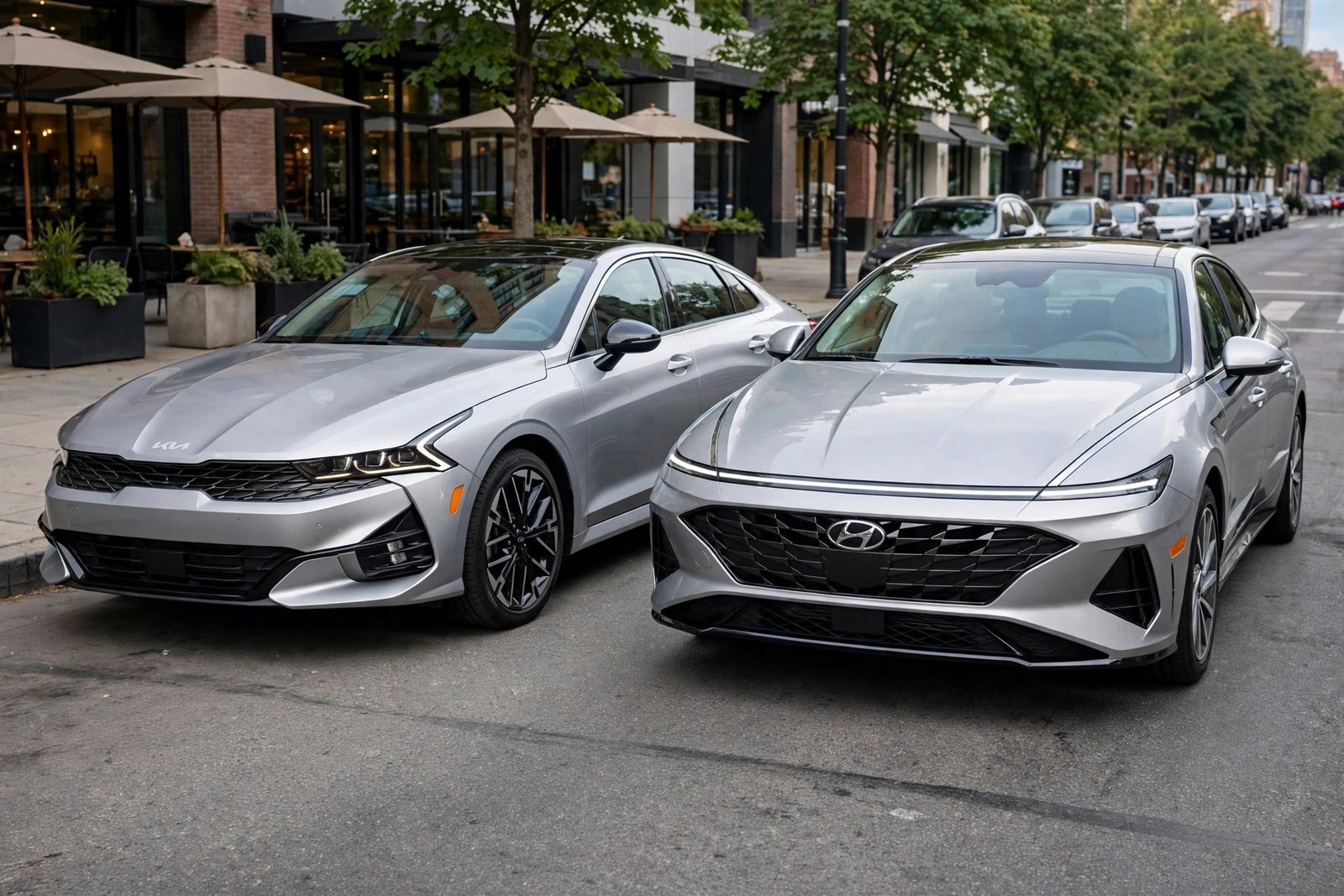
Quick answer: The Hyundai Sonata wins — but only just. The two cars share engines, warranties and nearly identical prices (Sonata SE $27,450 vs K5 LXS $27,490), and their 290-hp performance trims are dead even. The Sonata pulls ahead on three things that matter every day: a hybrid option with up to 47 mpg combined, a 2026 IIHS Top Safety Pick+ award the K5 did not earn, and slightly better gas mileage. The K5 fights back with sportier styling, available all-wheel drive on the GT-Line, and a marginally roomier cabin. Buy the Sonata for efficiency and safety; buy the K5 for looks and AWD.
Same family, different personalities
The first thing to understand about this comparison is that the Kia K5 and Hyundai Sonata are not really rivals from different worlds. They are sister cars. Kia and Hyundai both sit under Hyundai Motor Group, and the two sedans share their core engineering: the same base engine, the same turbo engine, the same 8-speed automatic transmission, and the same warranty.
That shared DNA is why the spec sheets look like mirror images. Both base models make 191 horsepower. Both performance trims make 290. Both have exactly 15.6 cubic feet of trunk space. Both carry the same 10-year/100,000-mile powertrain warranty.
So this comparison is not about which car is better engineered. It is about the differences around the edges — and those differences are real. The Sonata gets a hybrid and a top safety award. The K5 gets all-wheel drive on its most popular trim and a sportier shape. Which of those matters more to you is the whole decision.
Price: a $40 difference
| Trim | 2026 Kia K5 | 2026 Hyundai Sonata |
|---|---|---|
| Base | LXS — $27,490 | SE — $27,450 |
| Mid | GT-Line — $28,490 | SEL Sport — $29,150 |
| Mid AWD | GT-Line AWD — $30,090 | AWD available on higher trims |
| Performance | GT — $33,590 | N Line — $36,050 |
| Top luxury | EX — $34,990 | Hybrid trims from $29,200 (Blue Hybrid) |
At the bottom of the range, the Sonata SE undercuts the K5 LXS by $40. Some earlier 2026 listings showed the Sonata at $27,300, which would make the gap $190 — either way, it is small enough to ignore. A dealer discount, a regional incentive or a difference in destination charges can wipe it out in either direction.
The trim walk is where the two lineups start to diverge. The K5 offers five trims and tops out with the EX at $34,990. The Sonata’s gas lineup is shorter — SE, SEL Sport and N Line — but it adds three hybrid trims, with the Blue Hybrid starting around $29,200. The Sonata N Line is the more expensive performance car at $36,050 against $33,590 for the K5 GT, which is a real $2,460 gap for what is essentially the same engine.
Value verdict: the K5 GT is the performance bargain of the pair, and the Sonata is the value pick at the base and hybrid ends of the range. Neither car is meaningfully cheaper overall.
Engines and performance: a dead heat
| 2026 Kia K5 | 2026 Hyundai Sonata | |
|---|---|---|
| Base engine | 2.5L 4-cylinder, 191 hp / 181 lb-ft | 2.5L 4-cylinder, 191 hp / 181 lb-ft |
| Turbo engine | 2.5L turbo, 290 hp / 311 lb-ft (GT) | 2.5L turbo, 290 hp / 311 lb-ft (N Line) |
| Hybrid | Not offered | 192 hp combined (Hybrid trims) |
| Transmission | 8-speed automatic (GT: 8-speed dual-clutch) | 8-speed automatic (N Line: 8-speed dual-clutch) |
| Drivetrain | FWD standard; AWD on GT-Line | FWD standard; HTRAC AWD on select trims |
| 0–60 mph (performance trim) | 5.4 sec (K5 GT, AMCI testing) | 5.3 sec (Sonata N Line, MotorTrend) |
The base 2.5-liter engine is the same unit in both cars, and it is a good one: 191 horsepower is strong for the class, and the 8-speed automatic shifts smoothly. Neither base car feels slow in normal driving, and both cruise quietly at highway speed.
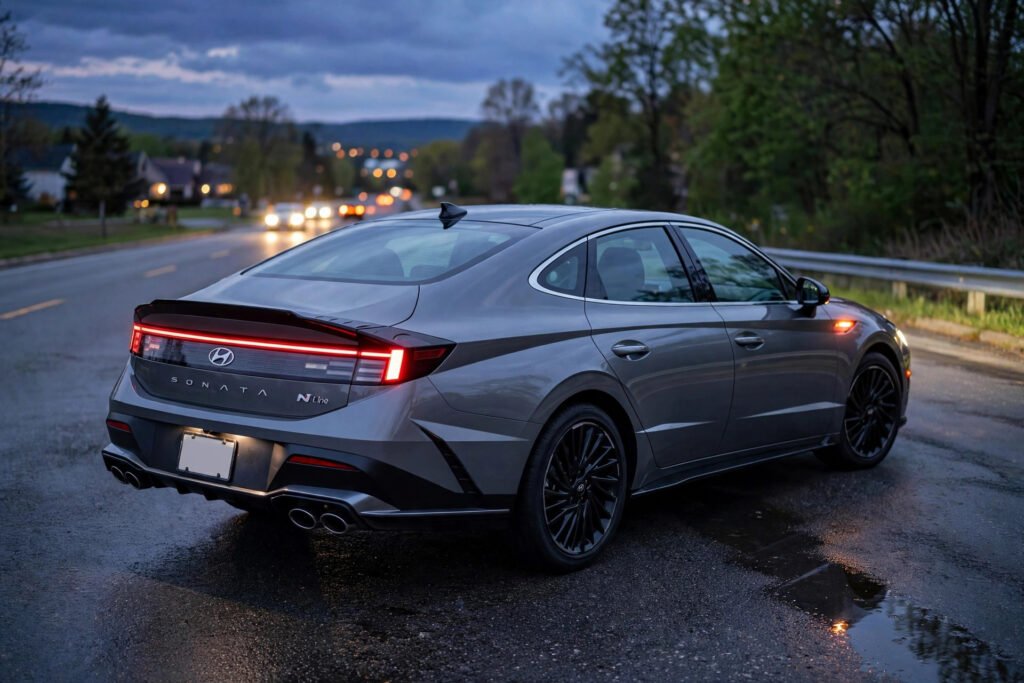
The fun starts at the top. The K5 GT and the Sonata N Line share the turbocharged 2.5-liter making 290 horsepower and 311 lb-ft of torque, both paired with an 8-speed dual-clutch transmission. Independent testing puts them within a tenth of a second of each other to 60 mph — 5.4 seconds for the K5 GT in AMCI testing, 5.3 for the Sonata N Line at MotorTrend. In the real world, that is a tie.
What differs is feel. The K5 is tuned a little sportier — sharper steering, a firmer ride, a more aggressive exhaust note on the GT. The Sonata N Line is tuned a little smoother, with a ride that stays comfortable when you are not pushing it. Neither is wrong; the K5 is the car for the driver who wants to feel the road, and the Sonata is the car for the driver who wants the speed without the edge.
Fuel economy: the Sonata’s biggest win
| Trim | 2026 Kia K5 | 2026 Hyundai Sonata |
|---|---|---|
| Base (city / hwy / combined) | 26 / 37 / 30 mpg (LXS FWD) | 28 / 38 / 32 mpg (SE) |
| Mid gas | ~29–30 mpg combined | 25 / 36 / 29 mpg (SEL Sport FWD) |
| Hybrid | Not available | Up to 47 mpg combined |
| Performance turbo | ~23 / 32 / 27 mpg | 23 / 32 / 27 mpg (N Line) |
The Sonata wins every fuel-economy comparison that matters. Its base SE beats the K5 LXS by 2 mpg combined, and the gap grows with the hybrid: up to 47 mpg combined, which no K5 can touch because Kia does not offer a hybrid K5 at all.
For a driver covering 15,000 miles a year, the Sonata Hybrid uses roughly 320 gallons of gas against about 500 for the K5 LXS. At $3.50 a gallon, that is more than $600 a year in fuel savings — over $3,000 across a typical five-year ownership period. Even the gas Sonata saves around $150 a year over the K5. If fuel costs matter to you, this is the single biggest reason to choose the Sonata.
The performance trims are equally thirsty at around 27 mpg combined, so there is no fuel-economy argument either way between the GT and the N Line.
Space and comfort: the K5 by a nose
| 2026 Kia K5 | 2026 Hyundai Sonata | |
|---|---|---|
| Passenger volume | 105.3 cu. ft. | 104.4 cu. ft. |
| Trunk space | 15.6 cu. ft. | 15.6 cu. ft. |
| Rear legroom | 35.2 in. | 34.8 in. |
| Seating | 5 | 5 |
On paper the K5 is the slightly roomier car, with about a cubic foot more passenger volume and a fraction more rear legroom. In practice, you would struggle to feel the difference — both cars seat four adults comfortably and five at a pinch, and both trunks swallow the same luggage.
The cabins feel different, though. The K5 leans sporty: a driver-focused dashboard, red accent stitching on GT-Line trims, and a fastback roofline that looks dramatic from outside but trims a little headroom in the back. The Sonata leans elegant: a wider, calmer dashboard, a more futuristic light bar across the front, and a slightly more relaxed seating position. Seat comfort is a tie — both offer supportive front seats and a quiet ride — but tall rear passengers will be marginally happier in the K5, and the Sonata’s cabin feels a touch more premium at the same price.
Technology: both well equipped
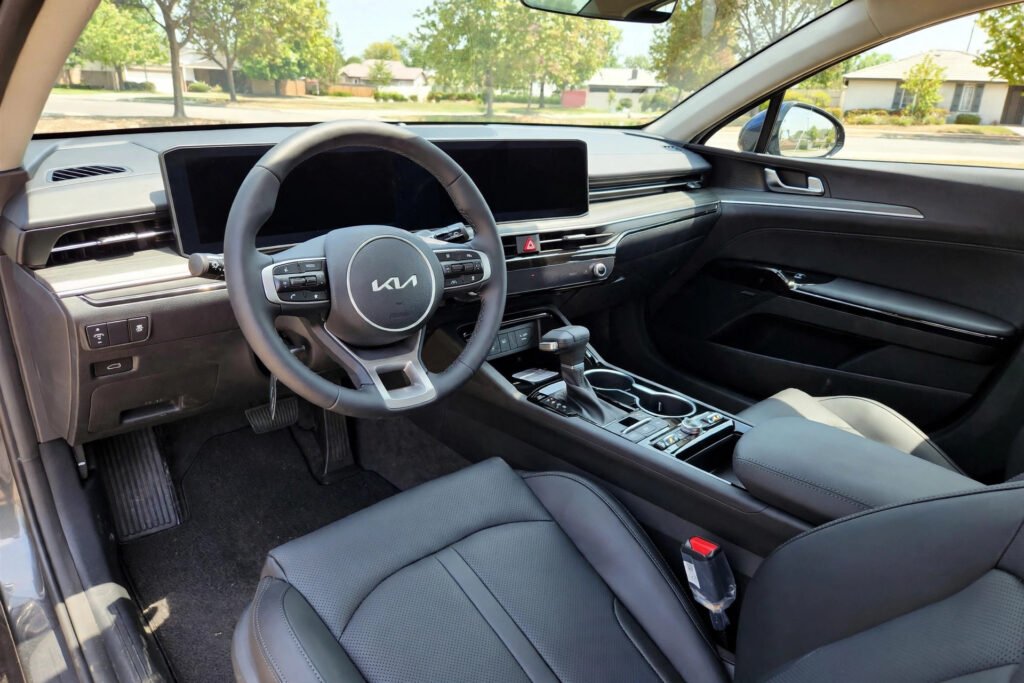
Both cars come generously equipped for the price, and the tech story is another near-tie.
The K5 fits a 12.3-inch touchscreen as standard on every trim, with wireless Apple CarPlay and Android Auto. The Sonata matches it with a 12.3-inch touchscreen of its own, plus Hyundai’s well-regarded driver-assistance suite. Both offer wireless phone charging on higher trims, digital keys, and a full set of safety tech — forward collision avoidance, lane keeping, blind-spot monitoring and adaptive cruise control.
Where they differ is in the details of the driver-assistance tuning. Hyundai’s Highway Driving Assist is one of the better systems in the class at keeping the car centered and managing stop-and-go traffic, and reviewers tend to rate the Sonata’s system slightly ahead of the K5’s. The K5’s infotainment is arguably the easier of the two to use, with a cleaner menu layout. Either way, you are not giving up much tech whichever badge you choose.
Safety: the Sonata’s clearest advantage
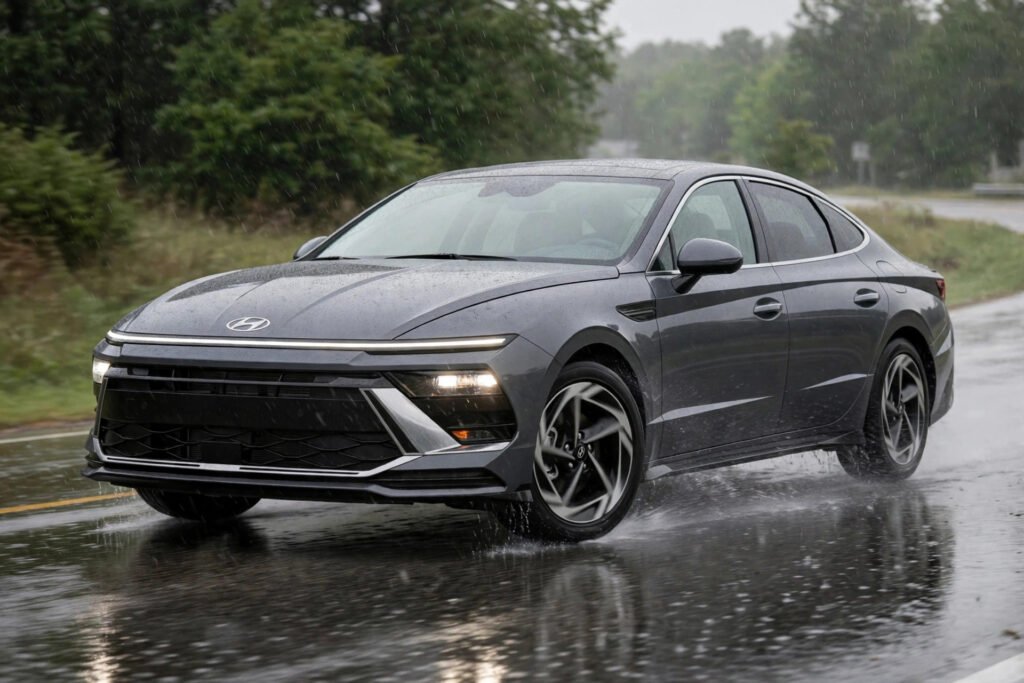
This is the one category with a clear winner. The 2026 Hyundai Sonata earned an IIHS Top Safety Pick+ award, the Insurance Institute for Highway Safety’s highest rating. The Kia K5 did not earn a Top Safety Pick designation in the same round of testing, after scoring Poor on the updated moderate-overlap front crash test.
That result is worth taking seriously. The IIHS updated its moderate-overlap test to measure second-row protection more strictly, and the K5’s rear-seat dummy readings were the problem. It is not that the K5 is an unsafe car — Kia dealers list a 5-star NHTSA overall rating for it, and its driver-assistance features are comprehensive — but on the independent crash-test record, the Sonata is the safer car right now.
If you regularly carry children or other passengers in the back seat, this should weigh heavily in your decision. It is the strongest single reason to pick the Sonata over the K5.
Warranty and ownership costs: identical
Here the two cars tie completely, because the warranty is the same: 5 years or 60,000 miles bumper-to-bumper, and 10 years or 100,000 miles on the powertrain, for both Kia and Hyundai. It is one of the longest factory warranties in the business, and it covers the engine, transmission and drivetrain for a full decade.
Maintenance costs are also similar. Both cars use the same family of engines, both need the same routine service, and parts prices are comparable. The Sonata Hybrid adds a hybrid battery, but Hyundai covers hybrid components under its warranty, and hybrid brakes typically last longer thanks to regenerative braking. Insurance costs are close too, though the Sonata’s better crash-test ratings may help slightly with premiums — get a quote for both before you decide.
Depreciation is the one ownership cost where the Sonata may edge ahead. Its safety award and hybrid option make it a slightly easier car to sell used, while the K5’s missing IIHS award could count against it at resale. The difference is likely small, but it points the same way as the rest of the comparison.
Styling: the subjective decider
Looks will not show up on a spec sheet, but they decide a surprising number of car purchases — and here the two cars genuinely differ.
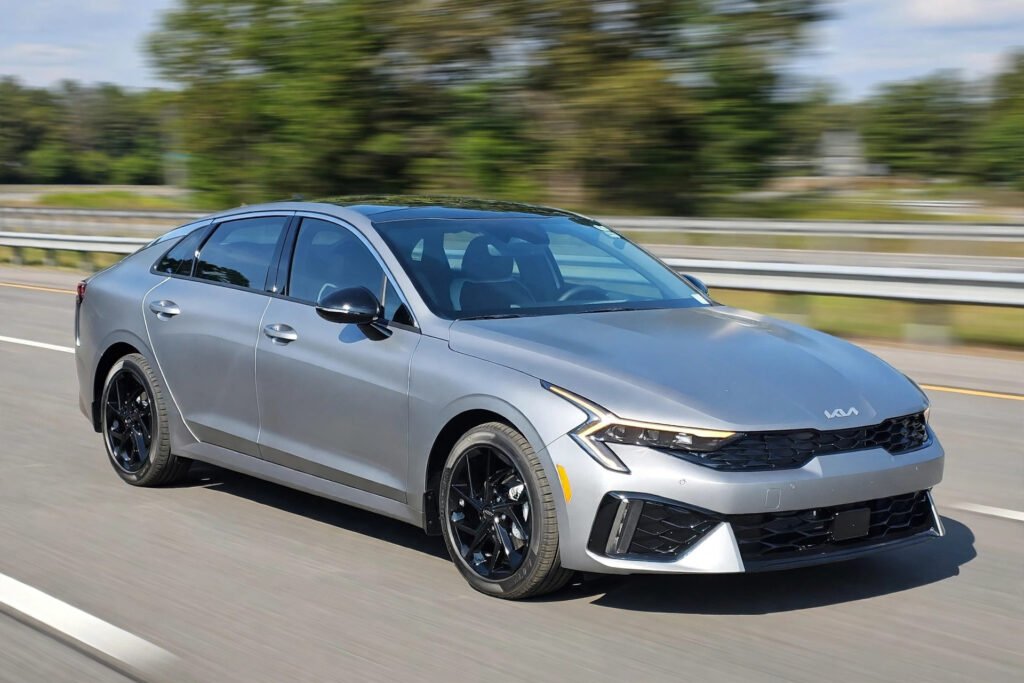
The K5 is the extrovert: a fastback silhouette, an aggressive tiger-nose grille, sharp creases down the sides and GT-Line styling that makes the car look more expensive than it is. It turns heads in a way few $28,000 sedans do.
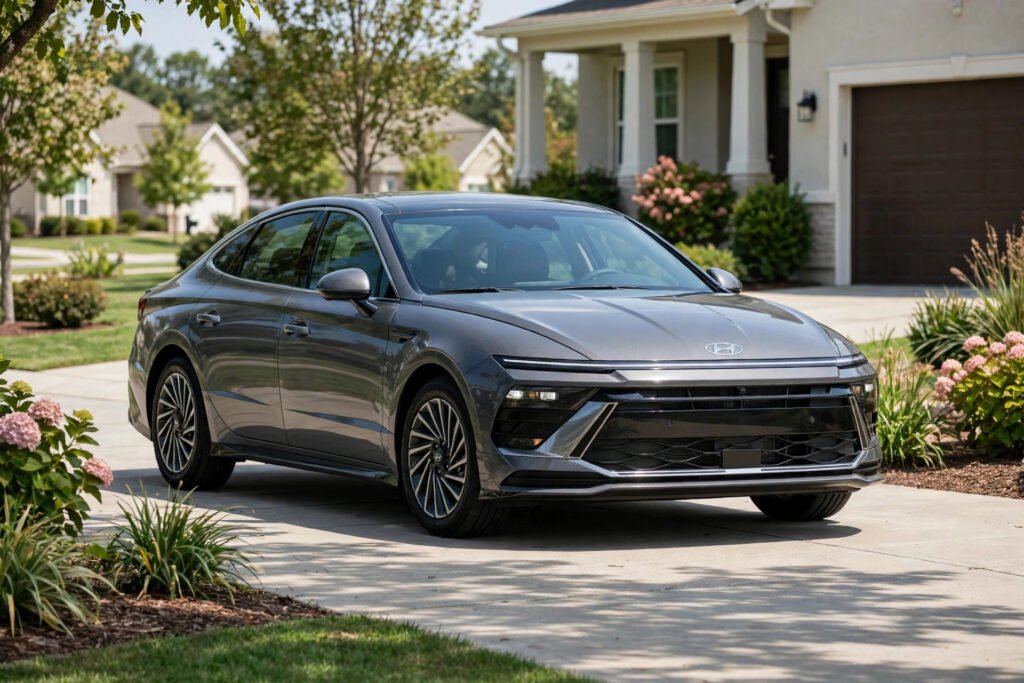
The Sonata is the quieter design: a full-width front light bar, a cleaner profile and a more premium, almost electric-car look. It is futuristic without shouting, and it ages gracefully.
We prefer the K5’s styling, but only just — and this is purely personal taste. Sit in both, look at both, and buy the one you want to walk up to every morning. You will live with the styling far longer than you will remember a $40 price difference.
Which midsize sedan wins in 2026?
Buy the Hyundai Sonata if: you want the best fuel economy (especially the hybrid at up to 47 mpg combined), you carry passengers in the back seat and care about the IIHS Top Safety Pick+ result, or you want the most complete package for the money. The Sonata is the rational winner of this comparison.
Buy the Kia K5 if: you love the fastback styling, you want all-wheel drive on the popular GT-Line trim, you want the cheapest 290-horsepower performance sedan in the class (the GT at $33,590 undercuts the N Line by $2,460), or you want the marginally roomier cabin. The K5 is the emotional winner — and for many buyers, that is enough.
Our pick: the Hyundai Sonata Hybrid. It is the only car in this comparison that changes the ownership math — up to 47 mpg combined, a top safety award, and a starting price around $29,200 that undercuts most rivals’ hybrids. If you do not want a hybrid, buy the Kia K5 GT-Line AWD: it is the best-looking, best-value all-weather sedan in this pair, and its only real weakness is fuel economy the Sonata Hybrid alone can punish.
Either way, you are buying one of the best value sedans on sale in 2026. The midsize sedan class is shrinking, but these two prove it is not dead — it is just down to two very good Korean cousins fighting over the same buyer.
Pros and cons
Kia K5 — pros: sportier styling; available AWD on GT-Line; cheapest 290-hp trim (GT $33,590); slightly roomier cabin; 12.3-inch touchscreen standard. Cons: no hybrid option; worse fuel economy; no IIHS Top Safety Pick award; N Line rival costs more but the K5’s own safety result lags.
Hyundai Sonata — pros: hybrid option up to 47 mpg combined; 2026 IIHS Top Safety Pick+; slightly better gas MPG; same long warranty; elegant, futuristic design. Cons: N Line costs $2,460 more than the K5 GT for the same engine; no AWD on base trims; marginally less rear legroom; styling is less dramatic than the K5.
Frequently Asked Questions
Which is cheaper, the 2026 Kia K5 or Hyundai Sonata?
The Sonata, by a very small margin. The 2026 Hyundai Sonata SE starts at $27,450 and the 2026 Kia K5 LXS starts at $27,490 — a difference of just $40. Some earlier listings showed the Sonata at $27,300, which would make the gap $190. Either way, price alone should not decide this comparison; the two cars are effectively the same price.
Is the Kia K5 the same car as the Hyundai Sonata?
No, but they are close cousins. Kia and Hyundai are sister brands under Hyundai Motor Group, and the K5 and Sonata share engines, transmissions and much of their engineering. The base 2.5-liter engine (191 horsepower) and the turbo 2.5-liter (290 horsepower) are the same in both cars. The differences are in styling, tuning, trim lineups, the Sonata’s hybrid option, and safety ratings.
Which gets better gas mileage, the K5 or the Sonata?
The Sonata, thanks to its hybrid. The Sonata Hybrid reaches up to 47 mpg combined, while the gas Sonata SE is rated at 28 city, 38 highway and 32 combined mpg against 26 city, 37 highway and 30 combined for the K5 LXS. The K5 has no hybrid at all, so high-mileage drivers will spend noticeably more on fuel in the Kia.
Which is faster, the Kia K5 GT or the Hyundai Sonata N Line?
They are effectively tied — both use the same turbocharged 2.5-liter engine making 290 horsepower and 311 lb-ft of torque. AMCI testing recorded 0-60 mph in 5.4 seconds for the K5 GT, and MotorTrend recorded 5.3 seconds for the Sonata N Line. That tenth of a second is within the margin of different test days and drivers.
Does the Kia K5 or Hyundai Sonata have a better warranty?
Neither — they are identical. Both cars come with a 5-year/60,000-mile basic warranty and a 10-year/100,000-mile powertrain warranty, among the longest in the industry. Since both brands share the same warranty, it cannot break the tie between them.
Is the Hyundai Sonata safer than the Kia K5?
On independent crash-test results, yes. The 2026 Hyundai Sonata earned an IIHS Top Safety Pick+ award, the Institute’s highest rating, while the K5 did not earn a Top Safety Pick designation after scoring Poor on the updated moderate-overlap front crash test. Both cars offer a full suite of driver-assistance features, but the Sonata has the stronger independent safety record.
