
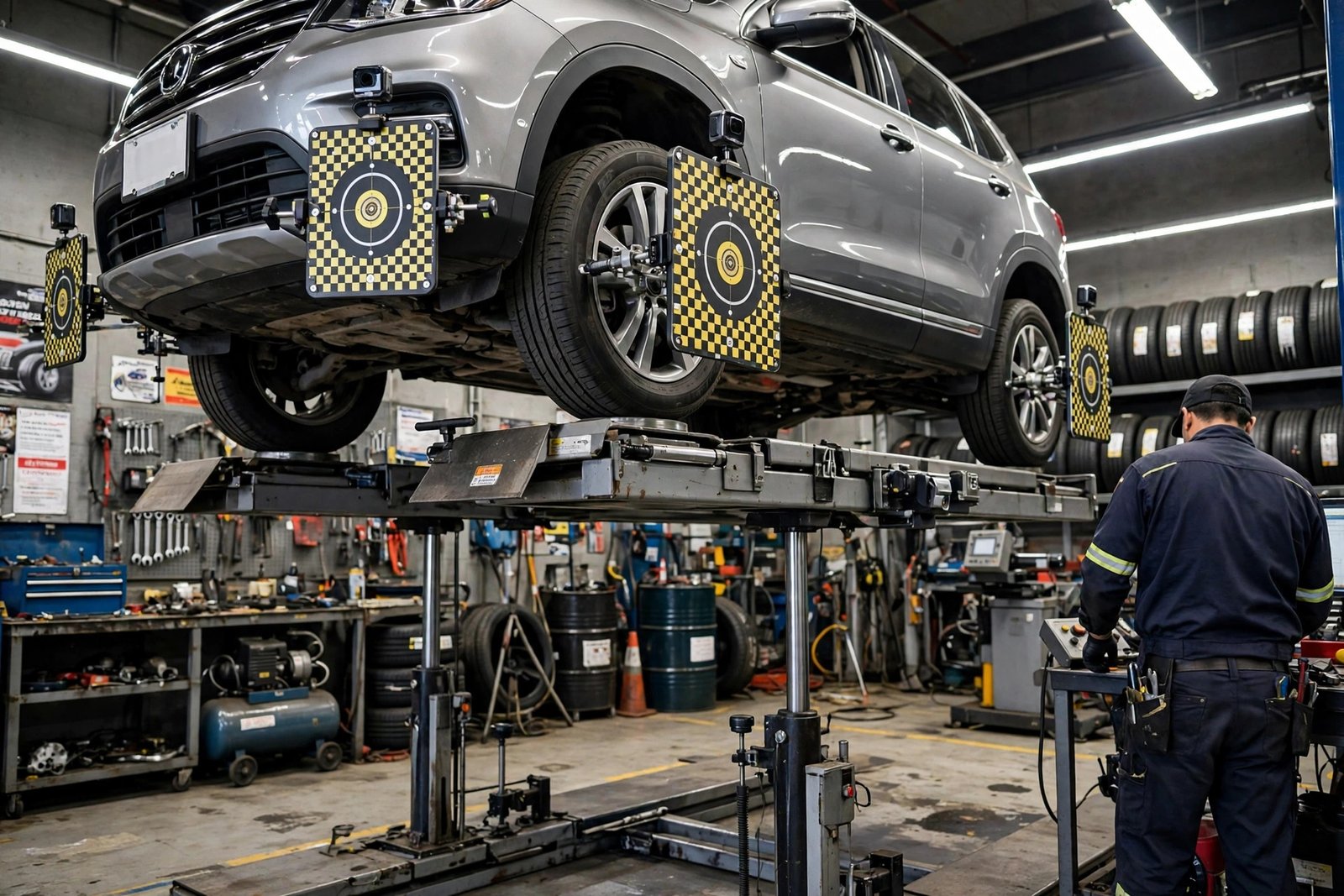
Quick answer: A wheel alignment costs $75 to $200 for most cars in 2026. A two-wheel (front-end) alignment runs $50 to $125, and a four-wheel alignment — the one most modern cars need — runs $100 to $250. Kelley Blue Book puts the dealership average at $183. The job takes about 60 to 90 minutes. Watch out for one thing your quote may not mention: if your car has driver-assist cameras, ADAS recalibration can add $100 to $500 on top, usually billed separately.
| Service | Typical 2026 price | Who needs it |
|---|---|---|
| Two-wheel (front-end) alignment | $50–$125 | Older cars and trucks with a rigid rear axle |
| Four-wheel alignment | $100–$250 | Most modern cars — independent rear suspension or AWD |
| Dealership average | $183 (Kelley Blue Book) | Any car, but especially ADAS-equipped models |
| ADAS recalibration (if needed) | $100–$500 extra | Cars with lane-keep assist, adaptive cruise, or forward-collision warning |
| Lifetime alignment plan | $150–$250 one-time | Drivers who keep the car for years |
Prices are national US averages from the sources at the end of this article. Your local quote will vary with the shop, the car, and where you live — use these numbers to judge whether a quote is fair. In short, how much does wheel alignment cost for your car depends on which of these jobs it needs, where you take it, and whether your car has driver-assist cameras.
What a wheel alignment actually is
A wheel alignment is not about the wheels themselves. It is about the angles at which your wheels meet the road. A technician puts the car on a rack, mounts laser or camera targets on each wheel, and measures three angles — camber, caster, and toe — then adjusts the suspension until all three match the numbers your car’s manufacturer specifies, often to within a hundredth of a degree.
When those angles are right, the tires roll straight and flat, wear evenly, and the car tracks straight without you fighting the steering wheel. When they drift — after a pothole, a curb hit, worn bushings, or just years of driving — the tires scrub sideways against the road instead of rolling cleanly. That scrubbing is what eats tread, pulls the car to one side, and makes the steering wheel sit crooked.
It is worth knowing what an alignment is not. It is not wheel balancing — that is a different job, done on a different machine, that evens out the weight of the tire and wheel assembly. If your car shakes at speed, the problem is usually balance, not alignment. And an alignment does not fix a worn tire. It fixes the geometry that wore the tire out, so the next set lasts as long as it should.
Two-wheel vs four-wheel alignment: which does your car need?
This is the first fork in the price, and it depends entirely on how your car’s rear suspension is built.
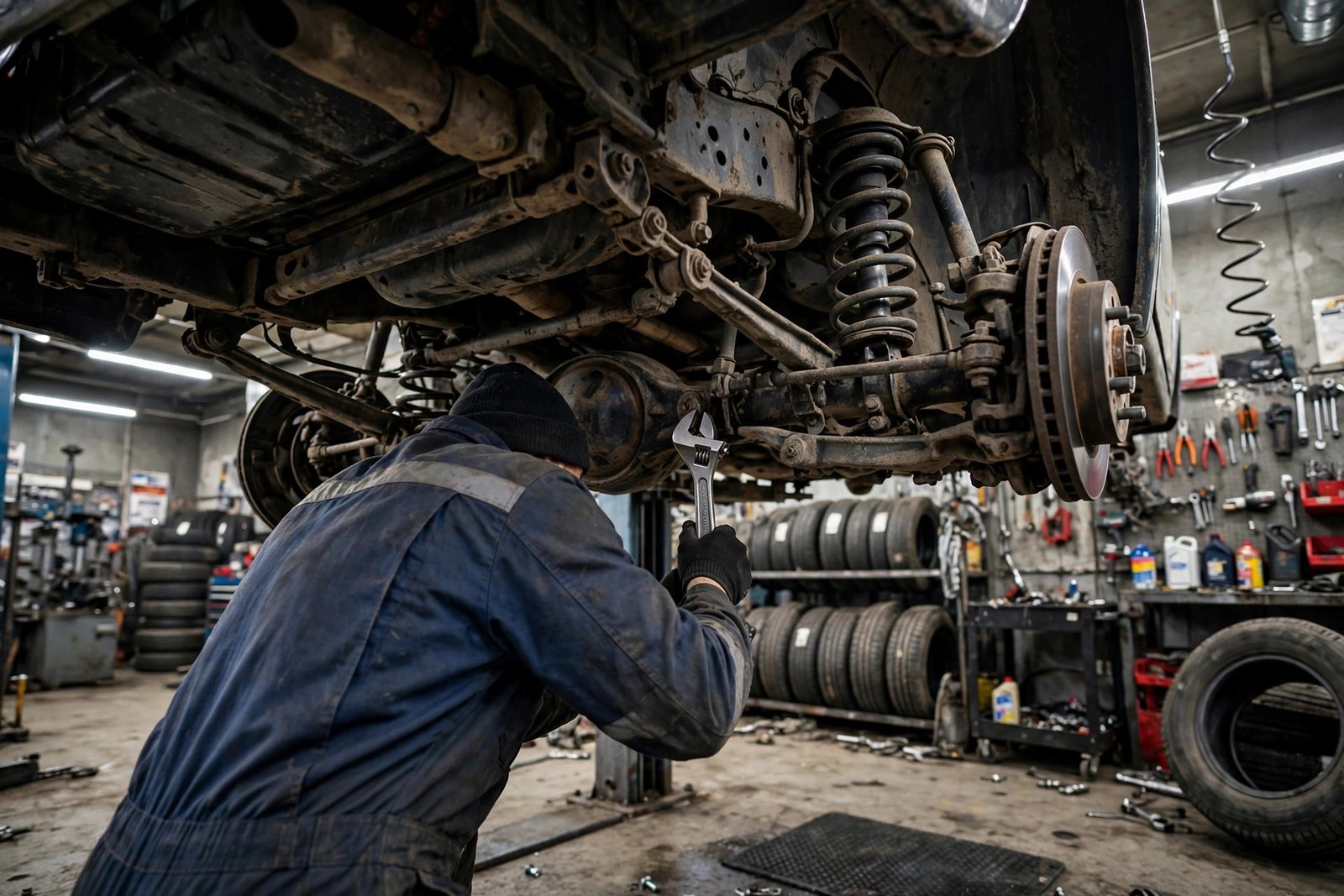
A two-wheel (front-end) alignment adjusts only the front wheels. It is the right job for vehicles with a rigid rear axle — mostly older trucks and a few body-on-frame SUVs — where the rear wheels are fixed in place and cannot be adjusted at all. It typically costs $50 to $125.
A four-wheel alignment measures and adjusts all four wheels, and it also sets the thrust angle — the direction the rear wheels point relative to the car’s centerline. A rear axle that points even slightly off-center pushes the whole car sideways, and the front wheels have to steer against it constantly. Most cars built in the last twenty years have independent rear suspension, which means the rear wheels can be adjusted, and need to be. All-wheel-drive cars need a four-wheel alignment too. A four-wheel alignment typically costs $100 to $250.
In practice, the choice is usually made for you. If your car has independent rear suspension or all-wheel drive, the shop will quote the four-wheel job, and that is the correct one. Paying for a two-wheel alignment on a car that needs four wheels is not a saving — it leaves half the problem unmeasured.
Wheel alignment cost by shop type
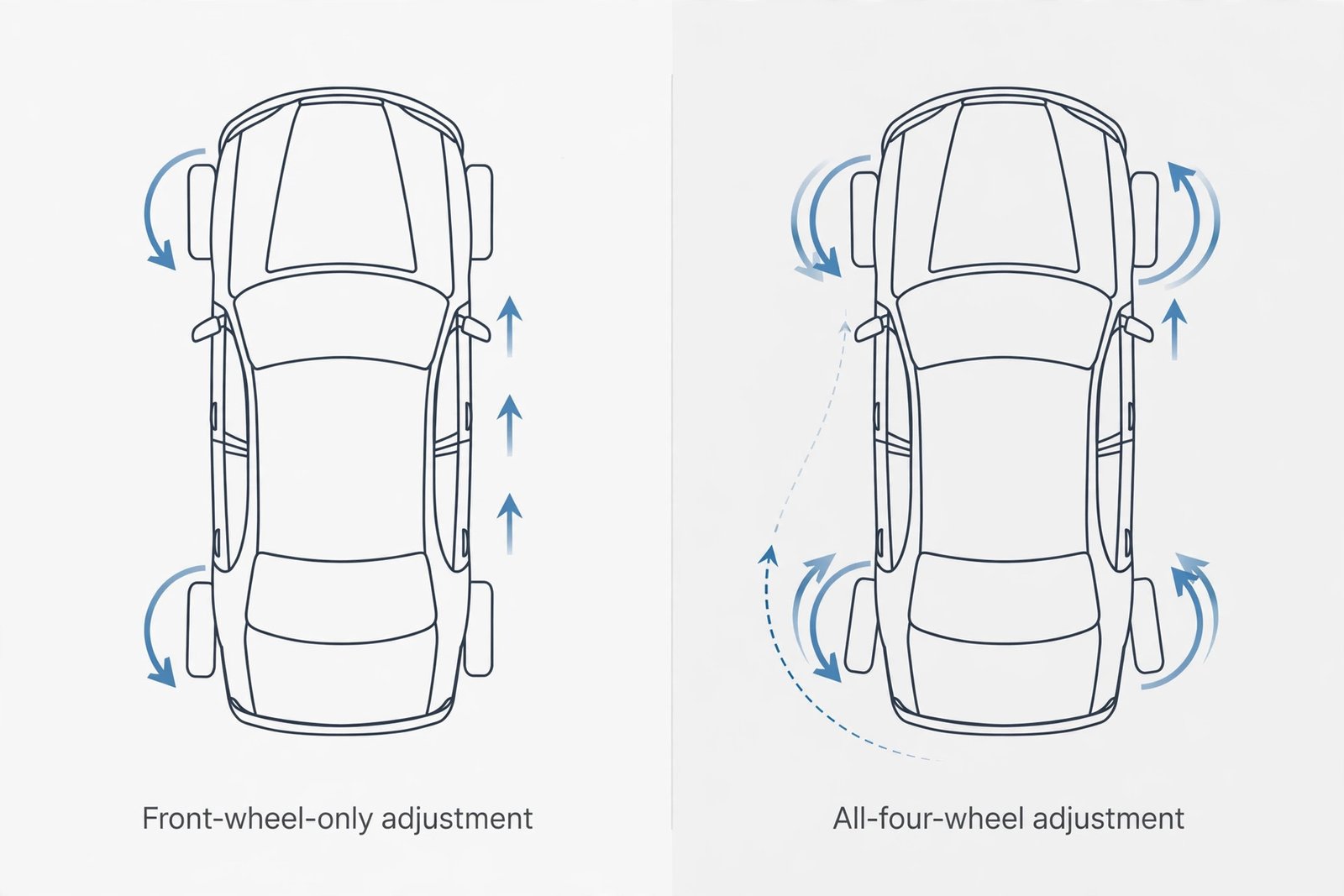
Where you take the car matters almost as much as what you drive. The same alignment, done on the same equipment, can cost twice as much at a dealership as it does at an independent shop. Here is how the main options compare.
| Shop type | Two-wheel | Four-wheel | What you get |
|---|---|---|---|
| Independent repair shop | $50–$100 | $80–$150 | Lowest labor rates; quality varies, so ask for a before-and-after printout |
| National chain (Firestone, Midas, Jiffy Lube) | $100–$180 | $150–$250 | Standardized process, warranty on the work, lifetime plans available |
| Dealership | $150–$250 | $150–$250+ | OEM equipment and specs, warranty-backed; the only option for some ADAS recalibrations |
| Tire shop / warehouse club (Costco, Sam’s Club) | $50–$85 | $70–$120 | Cheapest if you are a member and buying tires there |
The national average sits near $100, according to Express Lube’s 2026 pricing data, but the honest range most drivers should budget for is $60 to $150 before any add-ons appear on the invoice. Dealerships typically charge 30% to 50% more than independent shops for the same job — Kelley Blue Book’s repair data puts the dealership average at $183.
That dealer premium is not always wasted money. Dealers have the manufacturer’s exact specs and, for newer cars, the only scan tools that can recalibrate driver-assist sensors. But for a straightforward alignment on a car without ADAS, a well-reviewed independent shop with modern 3D equipment will do the same job for far less. One practical test: ask whether the shop uses a computer alignment rack and whether they will hand you a before-and-after printout of the angles. If they cannot do either, walk out.
Wheel alignment cost by vehicle type
The car itself moves the price. Bigger, heavier, and more complex vehicles take longer on the rack and need more adjustment, and luxury brands add a premium on top.
Across vehicle types, the total range for standard passenger vehicles spans roughly $75 to $220, according to Express Lube’s 2026 industry cost data. Sedans and small hatchbacks sit at the bottom of that range. SUVs and pickups typically land higher, roughly $110 to $225, because of their size, weight, and heavier suspension components. Luxury and European vehicles run higher still — Groupon’s marketplace data puts four-wheel alignment for European cars at $150 to $250 at retail.
All-wheel drive adds cost too. An AWD car needs the four-wheel job by definition, and some AWD systems need extra steps to set the thrust angle correctly. Luxury and sports cars with adaptive or air suspension can also push the price up, because the ride height has to be set before the angles can be measured accurately.
The practical point is simple: if you drive a compact sedan, expect the low end of the range. If you drive a full-size SUV, a pickup, or a European luxury car, budget for the top end — and get the quote in writing before the car goes on the rack.
The ADAS trap: the fee your quote may not mention
This is the part of the bill that catches people off guard, and it is the main reason a “simple $100 alignment” can turn into a $300 invoice.
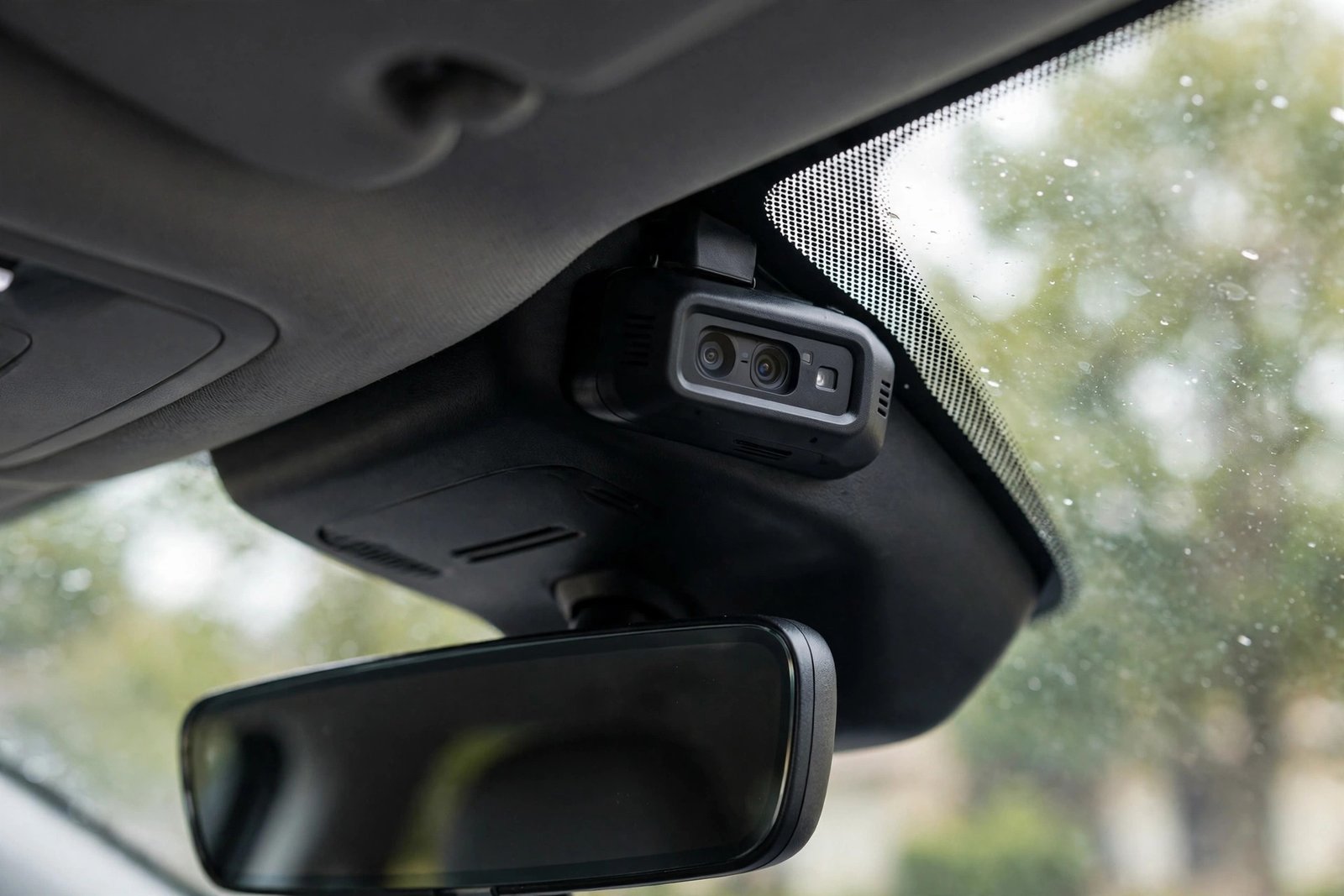
ADAS stands for Advanced Driver-Assistance Systems — the cameras and radar behind your windshield and grille that run lane-keep assist, adaptive cruise control, and forward-collision warning. Those sensors are aimed with extreme precision, and they assume your wheels are pointing exactly where the manufacturer says they should. When an alignment changes the wheel angles, the sensors can end up looking slightly off-target. Many manufacturers therefore require a recalibration after any alignment adjustment.
Recalibrating those sensors typically adds $100 to $500, and it is usually billed as a separate line item — not folded into the alignment price. A simple steering angle sensor reset is cheaper, around $25 to $100, and full camera or radar calibration runs $150 to $500 or more, especially on luxury cars. Some of that work needs dealer-only equipment — target boards, fixtures, and a subscription to each manufacturer’s diagnostic software — which is why a dealer is sometimes the only place that can do it.
Not every alignment triggers a recalibration. Jerry’s repair data notes that full ADAS calibration is rarely needed unless components were disturbed or the ride height changed. The rule that protects your wallet is to ask before you book: does my car need recalibration after this alignment, and is it included in the quote or billed separately? Get the answer in writing.
Is a lifetime alignment plan worth it?
Big chains — Firestone is the best-known — sell lifetime alignment plans: pay once, and the shop realigns your car free for as long as you own it. They typically cost $150 to $250, with Firestone’s plan reported at $180 to $230 when quoted in store.
The math is straightforward. A single four-wheel alignment costs $100 to $250. So the plan pays for itself on the second visit. If you keep the car for years, drive on rough roads, and buy tires regularly, it is a good deal — one pothole season can easily justify it.
Signs you need a wheel alignment
Cars have no dashboard warning light for alignment. The signs show up in how the car drives and how the tires wear.
The car pulls to one side. This is the classic symptom. On a flat, straight road, the car drifts left or right when you let go of the wheel for a moment. Check tire pressure first — a low tire on one side can mimic a pull — but if the pressures are even and the car still pulls, the alignment is the prime suspect.
The steering wheel is crooked. When you are driving straight, the steering wheel sits off-center. This usually means the toe angle is out, and it is one of the most reliable signs there is.
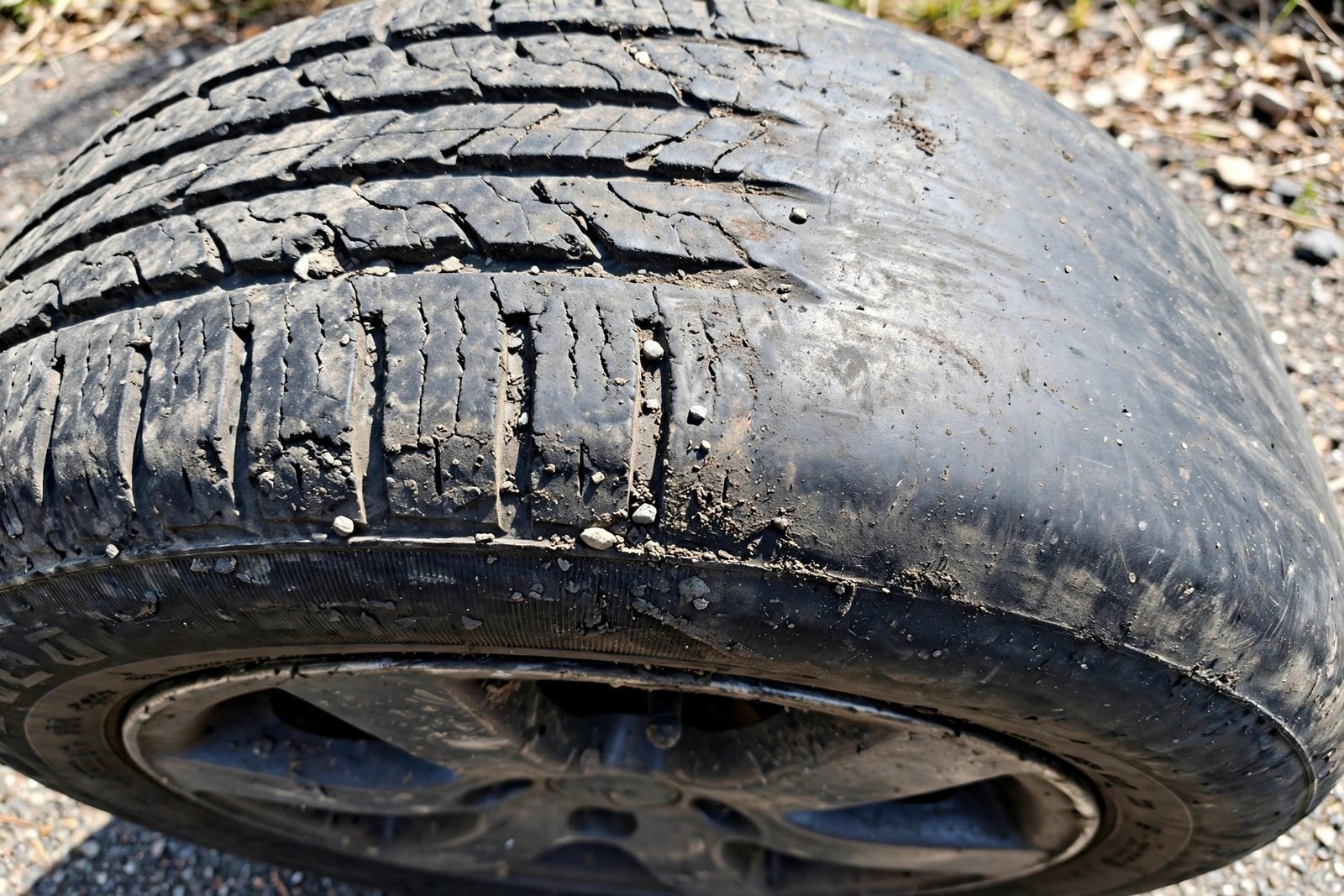
Uneven tire wear. Run your hand across the tread. If one edge is worn smooth while the other still has depth, or the tread blocks feel sharp on one edge and rounded on the other — a pattern called feathering — the wheels have been scrubbing instead of rolling. Cupped or scalloped wear points more at worn shocks, but any uneven pattern is a reason to get the alignment checked. If you want the full picture, see our guide on why tires wear unevenly.
Squealing tires on gentle turns. Tires that squeal at low speed on a normal turn are often fighting the road because of a bad toe setting.
Firestone recommends an alignment check every six months or 6,000 miles, and that is a sensible baseline. A yearly check, or one with every tire rotation, catches most problems before they cost you a set of tires. Speaking of rotation — a tire rotation and an alignment check together are the cheapest tire maintenance you can buy.
What skipping an alignment actually costs
The reason to pay $100 to $200 for an alignment is not the alignment itself. It is the tires you do not have to buy.
Skipping alignments can shorten tire life by 25% to 50%, according to Groupon’s 2026 cost analysis — and that works out to $400 to $800 in premature tire replacement for a full set. A set of four tires costs $400 to $1,200, so losing a quarter to half of their life to a bad alignment is a far bigger bill than the alignment ever was.
The flip side is also true: do not pay for an alignment you do not need. If the car drives straight, the steering wheel is centered, and the tires are wearing evenly, a shop that insists on an alignment at every visit is selling, not servicing. Ask to see the before-and-after printout. A good shop will show you the numbers; a bad one will ask you to take their word for it.
How to save money on a wheel alignment
Get the quote in writing, itemized. The quote should list the alignment itself, any ADAS recalibration, and any parts separately. If the shop finds worn parts — a tie rod end, a ball joint — ask them to show you the play before they replace it. Worn parts have to be fixed before an alignment can hold, but you should see the evidence first.
Book it with new tires. Many tire shops discount or bundle the alignment when you buy a set of tires from them. It is the best time to do it anyway: new tires on a misaligned car start wearing unevenly from day one.
Use a warehouse club or a deal — but check the fine print. Groupon four-wheel deals average $69 to $90, and Costco members pay around $70. Confirm the deal covers a four-wheel alignment on your car, not just a front-end job, and that it includes the before-and-after printout.
Fix worn parts first, align second. An alignment done on worn tie rods or ball joints will not hold. If the shop says parts are worn, replace them, then align. Paying for two alignments because the first one was done on bad parts is the most expensive way to do it.
The bottom line
A wheel alignment costs $75 to $200 for most cars in 2026 — $50 to $125 for a two-wheel job, $100 to $250 for the four-wheel job most modern cars need, with a dealership average of $183 according to Kelley Blue Book. The job takes 60 to 90 minutes. The only number that can surprise you is the ADAS recalibration, $100 to $500 extra, so ask about it before you book. And remember what the alignment is really buying: not a service, but the full life of your tires. Skip it, and you can lose 25% to 50% of a set of tires — $400 to $800 — to a problem a $100 job would have prevented.
Frequently asked questions
Should I get a two-wheel or four-wheel alignment?
Most modern cars need a four-wheel alignment, because they have independent rear suspension or all-wheel drive, so the rear wheels can be adjusted too. A two-wheel (front-end) alignment is only right for vehicles with a rigid rear axle, where the rear wheels cannot be adjusted. If you are not sure which your car takes, ask the shop — a four-wheel alignment covers both cases, and most cars on the road today need it.
How often should I get a wheel alignment?
Have your alignment checked once a year, or every 6,000 miles — Firestone recommends a check every six months or 6,000 miles. You should also get one after hitting a hard pothole or curb, after new tires are fitted, and after any suspension or steering work. If your tires are wearing evenly and the car drives straight, a yearly check is enough.
Does a wheel alignment fix a car pulling to one side?
Yes, in most cases — a car that pulls to one side is the classic symptom of bad alignment, and correcting the toe, camber, and caster angles usually straightens it out. But pulling can also come from uneven tire pressure, a dragging brake, or a tire with a shifted belt, so check your tire pressures first. If the pull stays after an alignment, the shop should look for worn suspension parts or a damaged tire.
Is a lifetime wheel alignment plan worth it?
It can be, if you keep the car for years and drive on rough roads. Lifetime plans at big chains typically cost $150 to $250, and they pay for themselves on the second visit — a single four-wheel alignment already costs $100 to $250. It is a bad deal only if you sell the car within a year or the plan is tied to one shop you rarely visit, so check whether it transfers and what it excludes before buying.
My car has driver-assist cameras — will alignment cost extra?
Probably, yes. On cars with lane-keep assist, adaptive cruise, or forward-collision warning, changing the wheel angles can throw the cameras and radar off, so many manufacturers require an ADAS recalibration after an alignment. That typically adds $100 to $500, usually billed as a separate line item. A simple steering angle sensor reset is cheaper, around $25 to $100. Always ask whether recalibration is included in the quote before you book.
How long does a wheel alignment take?
A standard wheel alignment takes about 60 to 90 minutes from the time the car goes on the rack to the time it comes off. The job itself is mostly measuring — the technician mounts laser or camera targets on the wheels, reads the angles, and adjusts the suspension to the manufacturer’s specs. Add extra time if the shop finds worn parts that need replacing first, or if your car needs ADAS recalibration afterwards.
Related reads
- How Much Does Tire Rotation Cost?
- Why Do Tires Wear Unevenly?
- Tire Vibration at Highway Speed: Causes, Diagnosis & Fixes
- Compare Cars tool — compare any two cars side by side
Sources
- How much does a wheel alignment cost? — Jerry
- $60–$150 Wheel Alignment Cost: 2026 Prices and a Shopping Checklist — Express Lube & Car Care
- Wheel Alignment Cost in 2026: What to Expect & How to Save — Groupon
- Wheel Alignment Cost in 2026: $75 to $200, the Real Math — Kinja (summarizing Kelley Blue Book repair data)
- Wheel Alignment Cost 2026: Two-Wheel vs Four-Wheel — MotorLogic
- Wheel Alignment Check: When You Need It and What It Costs — Motors Minds
