
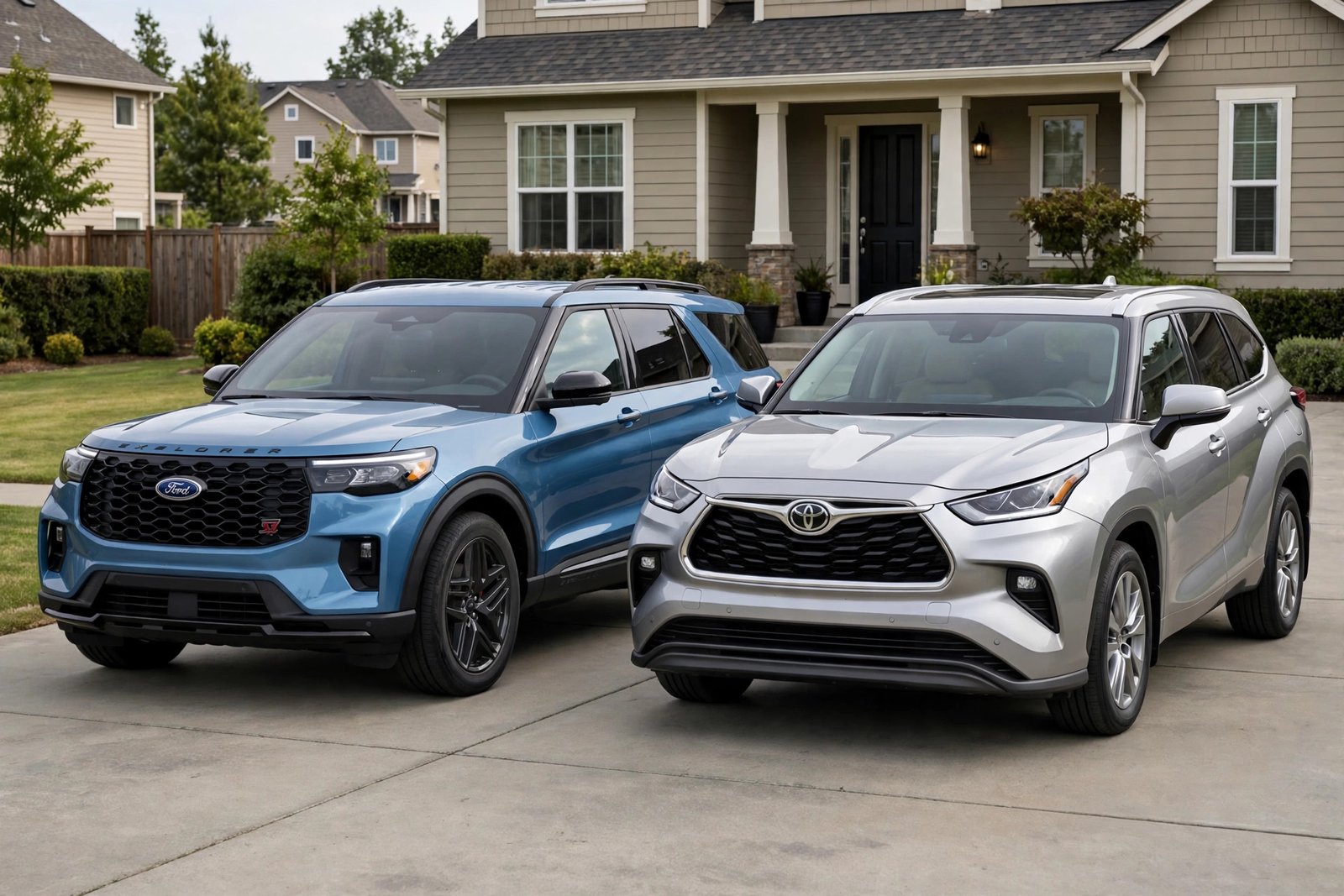
Quick answer: The 2026 Ford Explorer is the better buy for most families: it starts at $38,465, about $7,800 less than the Highlander, its standard engine already makes 300 horsepower, and the available 400-horsepower V6 has no rival in this class. The 2026 Toyota Highlander is the right pick if you want a hybrid — its 35-mpg hybrid is the most fuel-efficient three-row SUV here — or if you need seating for eight, which the Explorer cannot offer. Buy the Explorer for power and value; buy the Highlander for efficiency and Toyota’s long-term ownership reputation.
The Ford Explorer and the Toyota Highlander are the two three-row SUVs American families cross-shop most, and for 2026 the gap between them got wider in both directions. Ford added a new off-road Tremor trim and a stripped-down Active 100A model that pushes the starting price down. Toyota went the other way: it dropped the Highlander’s cheapest trim, made all-wheel drive standard on every model, and pushed the starting price up. The result is two SUVs that now appeal to different buyers more clearly than ever.
This comparison uses 2026 model-year figures from the manufacturers and their published specifications. Prices are MSRP before destination charges, taxes, and dealer fees, and they change during the model year — always confirm the current figure before you buy.
Ford Explorer vs Toyota Highlander at a Glance
| Spec | 2026 Ford Explorer | 2026 Toyota Highlander |
|---|---|---|
| Starting MSRP | $38,465 (Active 100A, before destination) | $46,270 (gas XLE) / $48,020 (Hybrid XLE) |
| Engines | 2.3L EcoBoost I4; 3.0L twin-turbo V6 | 2.4L turbo I4; 2.5L hybrid |
| Max horsepower | 400 hp (3.0L V6, ST) | 265 hp (gas) / 243 hp (hybrid) |
| Max torque | 415 lb-ft (3.0L V6) | 310 lb-ft (gas) |
| Fuel economy | 20 city / 29 hwy / 24 combined (2.3L, RWD) | 21 / 28 / 24 (gas); 35 combined (hybrid) |
| Max towing | 5,000 lbs | 5,000 lbs (gas); 3,500 lbs (hybrid) |
| Seating | Up to 7 | Up to 8 |
| Max cargo | 85.8 cu ft | 84.3 cu ft |
| Drivetrain | RWD standard; AWD available | AWD standard on every trim |
| Standard touchscreen | 13.2-inch | 8-inch (12.3-inch available) |
| Basic warranty | 3 yr / 36,000 miles | 3 yr / 36,000 miles |
| Powertrain warranty | 5 yr / 60,000 miles | 5 yr / 60,000 miles |
Price and Value: The Explorer Wins by $7,800
Price is the single biggest difference between these two SUVs in 2026, and it is not close.
The Explorer range opens at $38,465 for the new Active 100A trim (before the roughly $1,695 destination charge). That is a deliberately stripped-down model — no power liftgate, no heated seats — but it still gets the full 300-horsepower engine, the 13.2-inch touchscreen, and Ford’s Co-Pilot360 Assist+ safety suite. The regular Active trim starts around $40,160, and the lineup climbs through ST-Line, the new Tremor, Platinum, and the ST at about $54,905.
The Highlander starts at $46,270 for the gas XLE, and the Hybrid XLE starts at $48,020 — a $1,750 premium for the hybrid at every trim where both are offered. The range tops out at $55,675 for the Hybrid Platinum. Toyota’s own press release announcing the 2026 model listed a lower $45,270 starting price, but Toyota’s current listings put the gas XLE at $46,270, so treat the higher figure as the one you will actually see.
Why did the Highlander get so much more expensive? Two changes. First, Toyota discontinued the entry-level LE trim, so the XLE is now the cheapest way into a Highlander. Second, all-wheel drive is now standard on every trim — gas and hybrid alike. You no longer pay extra for AWD, but you also can no longer buy a cheaper front-wheel-drive Highlander. Every 2026 Highlander buyer is paying for AWD whether they need it or not.
That makes the value math simple. A family that buys the base Explorer saves roughly $7,800 against the cheapest Highlander — enough to cover years of fuel, insurance, and tires. Even comparing like-for-like family trims, the Explorer stays several thousand dollars cheaper. The Highlander has to earn that premium back through fuel savings and resale value, and as the next section shows, only the hybrid really can.
If you are comparing other three-row SUVs too, our Kia Sorento vs Hyundai Santa Fe breakdown covers two cheaper alternatives, and our most reliable cars for 2026 list puts the Highlander in its long-term context.
Performance: The Explorer Has the Power, the Highlander Has the Hybrid

The Explorer’s standard engine embarrasses the Highlander’s best gas engine. The 2.3-liter EcoBoost four-cylinder makes 300 horsepower and 310 lb-ft of torque, paired with a 10-speed automatic. It is smooth, quiet, and strong enough that most buyers will never feel the need for more.
But more is available. The 3.0-liter twin-turbocharged EcoBoost V6, offered on the ST and the new Tremor, makes 400 horsepower and 415 lb-ft of torque. Nothing else in the mainstream three-row class comes close — the Highlander, Pilot, and Traverse all top out well below 350 horsepower. If you tow regularly, merge onto fast highways with a full load, or simply enjoy driving, the ST is the only SUV in this comparison that feels genuinely quick.
The Highlander counters with two powertrains of its own. The gas engine is a 2.4-liter turbocharged four-cylinder making 265 horsepower and 310 lb-ft, matched to an eight-speed automatic. It is adequate and refined, but it is 35 horsepower behind the Explorer’s base engine and 135 behind the V6. The hybrid pairs a 2.5-liter four-cylinder with electric motors for 243 horsepower combined and a continuously variable transmission. It is the slowest of the four powertrains here, but it is also the reason many people buy a Highlander at all.
One important correction: despite some headlines, the 2026 Highlander is not hybrid-only. Gas models remain on sale in XLE, XSE, Limited, and Platinum grades. What is true is that 2026 is the last year for the gas-powered Highlander as we know it — Toyota has announced the next-generation Highlander will be all-electric. If you want a gas or hybrid Highlander, this is the final model year to buy one new.
Towing is a tie on gas models: both SUVs pull up to 5,000 pounds when properly equipped, enough for a mid-size boat or a camper trailer. The Highlander Hybrid drops to 3,500 pounds, so hybrid buyers who tow should do the math before signing. The Explorer’s new Tremor trim adds a one-inch suspension lift, a Torsen limited-slip rear differential, and all-terrain tires for families who actually leave the pavement — the Highlander has no equivalent off-road trim.
Fuel Economy: The Hybrid Changes Everything
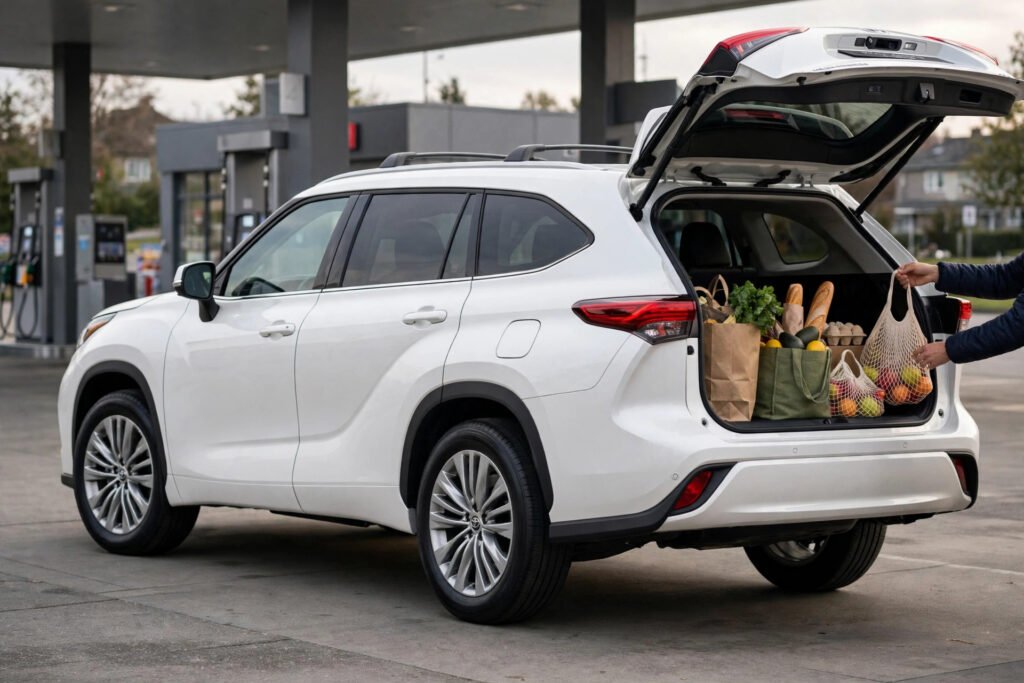
Gas against gas, these two SUVs are effectively tied. The base Explorer is EPA-rated at 20 city / 29 highway / 24 combined mpg in rear-wheel-drive form, and the gas Highlander at 21 / 28 / 24. All-wheel drive trims a mile or two off both. At 15,000 miles a year, the fuel cost difference between the gas models is negligible — a few dollars a month.
The hybrid is a different story. The Highlander Hybrid is rated at 35 mpg combined (35 city / 35 highway on the XLE), which is 11 mpg better than either gas SUV. Over 15,000 miles a year, that saves roughly 200 gallons — around $600 to $700 a year at typical US gas prices. Over five years, the hybrid’s fuel savings cover a large part of its price premium over the gas Highlander, and against the Explorer the math is closer than the sticker prices suggest: the hybrid Highlander costs about $9,500 more than the base Explorer, so fuel alone does not close the gap, but it narrows it every year you own the car.
The honest way to think about it: if you drive mostly highway miles, the Explorer’s 29-mpg highway rating keeps it competitive and the hybrid advantage shrinks. If your driving is city-heavy — school runs, errands, stop-and-go traffic — the hybrid pulls away fast, because that is where electric assistance does its best work.
Space and Seating: Eight Seats vs More Room
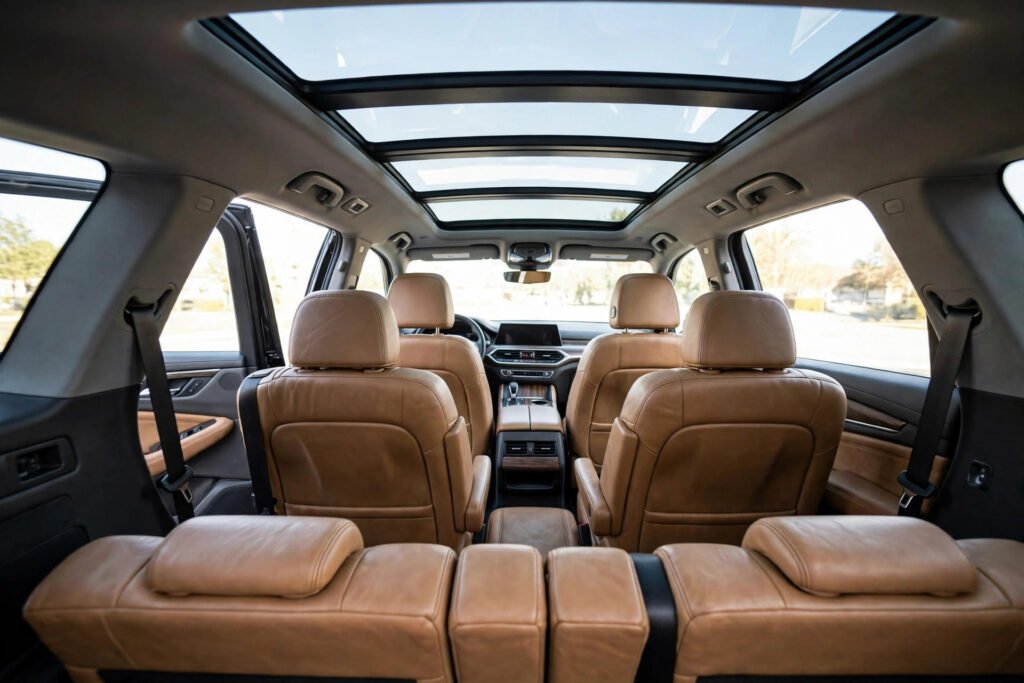
The Highlander wins the headcount. It seats up to eight people, with a second-row bench available on most trims. The Explorer seats up to seven — six with the standard second-row captain’s chairs, seven with the optional bench. If you regularly carry eight people, this alone decides the comparison.
But the Explorer wins the space-per-person argument. It offers about 150 cubic feet of passenger volume against about 140 in the Highlander, and its third row is the more usable one for adults on longer trips. Maximum cargo space is nearly tied: 85.8 cubic feet in the Explorer with both rear rows folded, 84.3 in the Highlander. Behind the third row, both hold about 16 cubic feet — enough for a few grocery bags or a folded stroller, but not a full family’s luggage. For a road trip with six or seven people, plan on a roof box either way.
Both SUVs are easy to live with day to day: wide-opening rear doors, flat load floors, and plenty of cupholders and USB ports. The Explorer’s second-row captain’s chairs make third-row access easier for kids, while the Highlander’s available bench is better for three-across child seats.
Technology and Safety: Big Screen vs Standard AWD
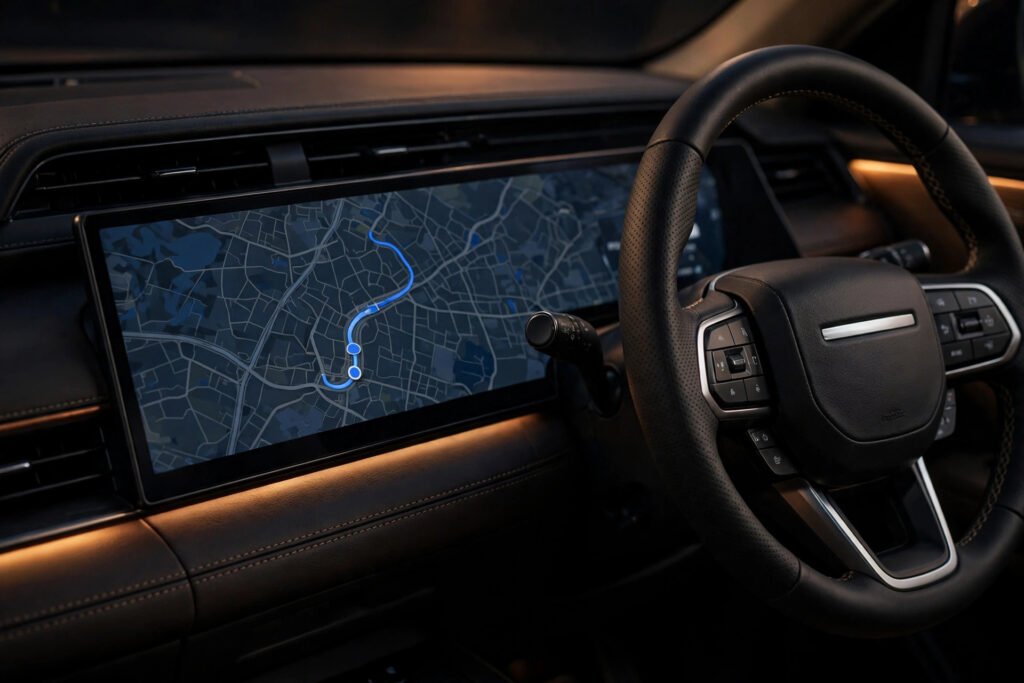
The Explorer’s cabin tech is the stronger package. Every Explorer gets a 13.2-inch touchscreen with wireless Apple CarPlay and Android Auto, plus a 12.3-inch digital instrument cluster. The Highlander makes do with an 8-inch touchscreen as standard, with a 12.3-inch screen reserved for higher trims. In a $46,000 SUV, an 8-inch screen feels behind the times.
Ford also offers BlueCruise hands-free highway driving on upper Explorer trims — a feature the Highlander cannot match. Both SUVs come standard with full driver-assistance suites: Ford Co-Pilot360 Assist+ (adaptive cruise control, lane-keeping, blind-spot monitoring, automatic emergency braking) on the Explorer, and Toyota Safety Sense 2.5+ on the Highlander. Neither charges extra for the safety equipment that matters.
Ownership extras tilt toward Toyota. Every new Highlander includes ToyotaCare — two years or 25,000 miles of scheduled maintenance — which the Explorer does not match. Toyota’s reliability reputation also remains the strongest in the segment, and it shows up in resale values: Highlanders historically hold their value better than Explorers, which softens the price gap over a five-year ownership period. Our Subaru Forester vs Toyota RAV4 comparison covers similar Toyota strengths in a smaller package.
Tires and Running Costs: What to Budget

As a tire-focused site, this is the part other comparisons skip — and on a three-row SUV, tires are a real cost.
| Model | Common factory tire sizes | Wheel sizes |
|---|---|---|
| Ford Explorer Active | 255/65R18 | 18-inch |
| Ford Explorer ST-Line / Platinum | 255/55R20 | 20-inch |
| Ford Explorer ST | 275/45R21 | 21-inch |
| Ford Explorer Tremor | 265/65R18 all-terrain | 18-inch |
| Toyota Highlander XLE | 18-inch wheels | 18-inch |
| Toyota Highlander Limited / Platinum | 20-inch wheels | 20-inch |
The practical takeaway: the Explorer’s base 18-inch tires are the cheapest to replace, while the ST’s 21-inch low-profile tires cost significantly more per tire and wear faster. The Tremor’s all-terrain tires are the only ones here built for dirt and gravel — a genuine advantage if your driveway is not paved. Always confirm your exact tire size on the driver’s door placard before ordering; our guide to what tire numbers mean explains how to read the size. And whichever SUV you choose, budget for a full set of four matching tires — on an all-wheel-drive vehicle, mismatched tires can damage the drivetrain.
Pros and Cons
2026 Ford Explorer
Pros:
- Lowest starting price in the class at $38,465
- Standard 300-horsepower engine; available 400-horsepower V6
- Largest standard touchscreen (13.2 inches) and available BlueCruise
- New Tremor trim for genuine light off-road use
- More passenger volume and slightly more max cargo space
Cons:
- No hybrid option at any price
- Resale value historically trails the Highlander
- Base Active 100A drops comfort features like the power liftgate
- 21-inch ST tires are expensive to replace
2026 Toyota Highlander
Pros:
- Hybrid rated at 35 mpg combined — best in this comparison
- Standard all-wheel drive on every trim
- Seats up to eight people
- ToyotaCare maintenance included; strongest reliability reputation
- Better long-term resale value
Cons:
- Starts about $7,800 higher than the Explorer
- Standard 8-inch screen feels small for the price
- Gas engine is the weakest here at 265 horsepower
- Hybrid towing drops to 3,500 pounds
- 2026 is the final year for gas models
The Verdict
Buy the Ford Explorer if you want the most SUV for the money. It is cheaper, more powerful, better equipped with screens and driver tech, and the ST is the only genuinely fast three-row SUV in this price range. For a family that tows, drives mostly on highways, or simply wants the best value, the Explorer is the clear pick — and the new Tremor adds real off-road ability the Highlander cannot answer.
Buy the Toyota Highlander if fuel economy and long-term ownership matter most to you. The hybrid’s 35 mpg is a real, everyday saving, the eight-seat option is unique here, and Toyota’s reliability and resale record mean the higher sticker price comes back to you over time. Just know that 2026 is the last call for a gas or hybrid Highlander — after this, the nameplate goes electric.
If you want the short version: power and price point to the Explorer; efficiency and eight seats point to the Highlander. Either way, test-drive both with the whole family in the car — third-row comfort and cargo space are things you feel, not things you read in a table.
Frequently Asked Questions
Which is cheaper, the 2026 Ford Explorer or the Toyota Highlander?
The Explorer is cheaper by a wide margin. The 2026 Explorer starts at $38,465 for the Active 100A trim before destination, while the 2026 Highlander starts at $46,270 for the gas XLE. That is a gap of about $7,800, and it grew for 2026 because Toyota dropped the Highlander’s entry-level LE trim and made all-wheel drive standard.
Is the 2026 Toyota Highlander hybrid-only?
No. The 2026 Highlander still offers a gas engine — a 2.4-liter turbo four-cylinder with 265 horsepower — alongside a 243-horsepower hybrid. Toyota dropped the base LE trim and made all-wheel drive standard on every 2026 Highlander, but gas models remain available in XLE, XSE, Limited, and Platinum grades. The 2026 model year is the last one before the Highlander nameplate goes all-electric.
Which has more power, the Explorer or the Highlander?
The Explorer, by a lot. Its standard 2.3-liter EcoBoost four-cylinder makes 300 horsepower, already more than the Highlander’s 265-horsepower gas engine. The available 3.0-liter twin-turbo V6 in the Explorer ST makes 400 horsepower and 415 lb-ft of torque — the strongest engine in this class.
Which gets better gas mileage, the Explorer or the Highlander?
The Highlander Hybrid wins easily at 35 mpg combined. The gas Highlander and the base Explorer are nearly tied at 24 mpg combined. If you drive 15,000 miles a year, the hybrid Highlander saves roughly 200 gallons of fuel a year over either gas SUV.
Which tows more, the Explorer or the Highlander?
They tie on gas models: both the Explorer and the gas Highlander tow up to 5,000 pounds when properly equipped. The Highlander Hybrid is the exception — it is rated at 3,500 pounds, so a hybrid buyer who tows a boat or camper gives up 1,500 pounds of capacity.
Which is better for a big family, the Explorer or the Highlander?
The Highlander seats up to eight people versus seven in the Explorer, so it wins if you regularly carry eight. The Explorer counters with more passenger volume — about 150 cubic feet versus about 140 in the Highlander — and slightly more maximum cargo space, 85.8 cubic feet versus 84.3.
