
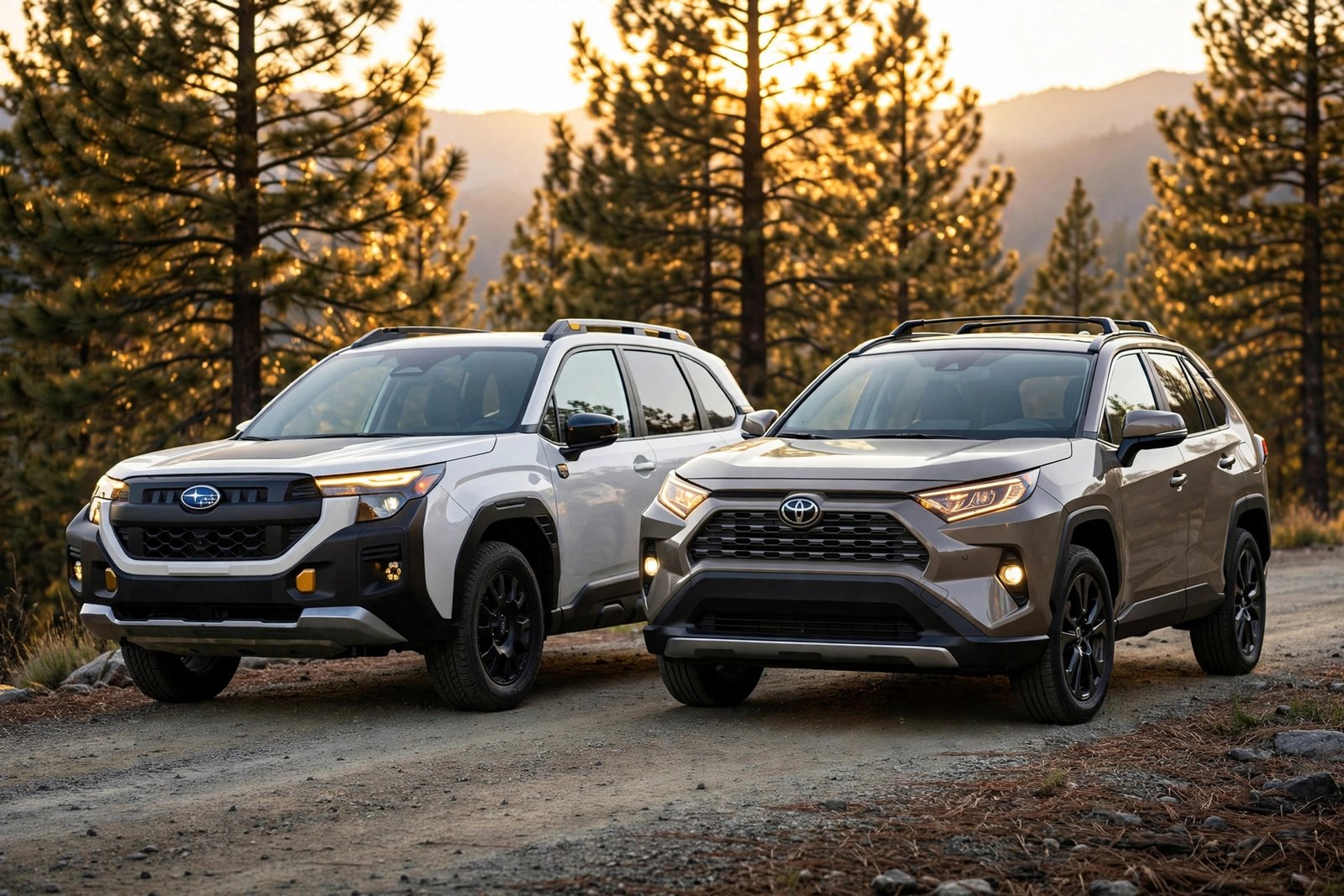
Quick answer: The RAV4 is the efficiency champion — every 2026 model is a hybrid at up to 43 mpg combined, and it is quicker too. The Forester is the value and bad-weather champion — cheaper to buy, all-wheel drive standard on every trim, more passenger room, and an IIHS Top Safety Pick+ award the RAV4 just missed. Pick the RAV4 to save fuel; pick the Forester to save money up front and drive through anything.
Quick Specs Head-to-Head
| Spec | 2026 Subaru Forester | 2026 Toyota RAV4 |
|---|---|---|
| Starting price (excl. destination) | $29,995 | $31,900 (Hybrid LE) |
| Price incl. destination | $31,445 | $33,350 |
| Base engine | 2.5L BOXER flat-4, 180 hp / 178 lb-ft | None — all-hybrid lineup |
| Hybrid | 194 hp total, 35 mpg combined | 226 hp (FWD) / 236 hp (AWD) |
| Plug-in hybrid | No | Yes — 324 hp, ~52 mi EV range |
| Transmission | Lineartronic CVT | Planetary eCVT |
| Best fuel economy | 26 city / 33 hwy / 29 combined (gas) | 47 city / 40 hwy / 43 combined (FWD hybrid) |
| Hybrid fuel economy | 35 city / 34 hwy / 35 combined | 46 city / 39 hwy / 42 combined (AWD) |
| Max towing | 1,500 lbs (3,500 lbs Wilderness) | Up to 3,500 lbs |
| Cargo max (seats folded) | 74.4 cu ft (gas) / 69.1 cu ft (hybrid) | 70.4 cu ft |
| Passenger volume | 110.8 cu ft | 98.9 cu ft |
| Ground clearance | 8.7 in (9.3 in Wilderness) | 8.1 in (8.5 in Woodland) |
| All-wheel drive | Standard on every trim | $1,400 extra on lower trims |
| IIHS | Top Safety Pick+ | No award |
| NHTSA overall | 5 stars | Not yet rated |
| Basic warranty | 3 yr / 36,000 mi | 3 yr / 36,000 mi |
| Powertrain warranty | 5 yr / 60,000 mi | 5 yr / 60,000 mi |
Prices exclude destination unless noted. Figures are typical 2026 US model-year ratings and vary by trim, drivetrain, and options. Confirm exact specs with your dealer before buying.
Price: The Forester Is Cheaper — Especially With All-Wheel Drive
The Forester starts at $29,995 before destination; the RAV4 starts at $31,900. Including destination, the gap is roughly $31,445 versus $33,350 — about $1,900 in the Subaru’s favour.
That gap grows when you add all-wheel drive, which is where most buyers in snow country end up. Every Forester has Subaru’s Symmetrical AWD as standard equipment — it costs nothing extra. On the RAV4, all-wheel drive is a roughly $1,400 option on lower trims, and it is an electronic on-demand system (a rear electric motor, no driveshaft) rather than the Forester’s permanent mechanical setup. An all-wheel-drive RAV4 LE lands around $34,750 including destination — more than $3,000 above a base Forester with all-wheel drive already included.
The RAV4’s price range climbs higher at the top too: the Limited Hybrid reaches $43,300 and the GR Sport plug-in hybrid $48,500, while the Forester tops out at $39,995 for the gas Touring and $41,545 for the Touring Hybrid. If your budget is the deciding factor, the Forester wins. Just remember the fuel math below — the RAV4 claws much of that back over time.
Want to play with the numbers yourself? Our car comparison tool lets you line up any two vehicles side by side on the specs that matter to you.
Engines and Fuel Economy: The RAV4’s Biggest Win
For 2026, Toyota made a bold move: the gas-only RAV4 is gone. Every RAV4 is now a hybrid. The standard hybrid makes 226 hp (front-wheel drive) or 236 hp (all-wheel drive), and the plug-in hybrid makes 324 hp with about 52 miles of electric-only range. There is no slow RAV4 anymore.
The Forester keeps a gas engine: a 180-hp 2.5-litre BOXER flat-four, plus a 194-hp hybrid option. The gas Forester is rated at 29 mpg combined; the Forester Hybrid at 35 mpg combined.
The fuel economy gap is the largest single difference between these two SUVs. The RAV4 hybrid manages up to 43 mpg combined (front-wheel drive) and 42 mpg with all-wheel drive. The Forester Hybrid trails by 7–8 mpg, and the gas Forester trails by 13–14 mpg. Over 60,000 miles at $4 a gallon, the base Forester costs roughly $2,700 more in fuel than the RAV4. If fuel economy is your top priority, the RAV4 wins outright — it is not close.
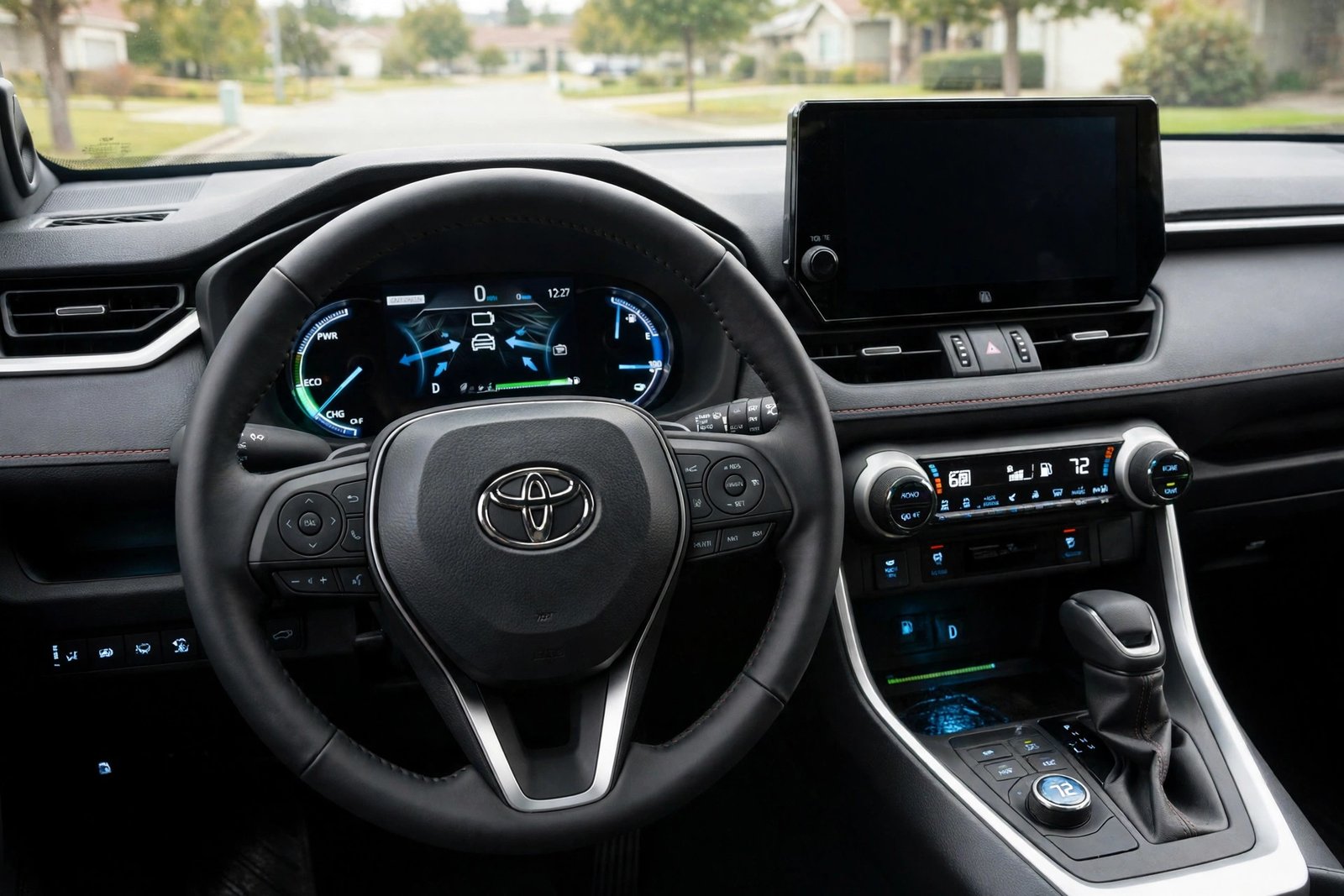
The RAV4 is also quicker. In a 2026 off-road-trim comparison test, the RAV4 Woodland hit 0–60 mph in 7.3 seconds versus 9.4 for the Forester Wilderness, and it stopped shorter too (110 feet versus 118). The plug-in hybrid is quicker still at 5.4 seconds to 60. The Forester is not slow for daily driving, but it is the slower car here by a clear margin.
Check any configuration’s official ratings at fueleconomy.gov before you buy.
All-Wheel Drive and Off-Road: Forester’s Home Turf
This is where the Forester fights back — and wins. Every Forester comes with permanent mechanical Symmetrical all-wheel drive and X-MODE terrain modes at no extra cost. It is the simplest, most capable default all-wheel-drive system in the class, and it works the same whether you are on snow, mud, or a gravel road.

The RAV4’s all-wheel drive is good but different: on lower trims it costs extra, and it is an on-demand system that sends power to the rear wheels only when the front wheels slip. For most drivers in most conditions, that is fine. For deep snow, steep icy hills, or regular off-pavement use, the Forester’s always-on system is the more reassuring choice.
Ground clearance follows the same pattern: 8.7 inches standard on the Forester (9.3 on the Wilderness) versus 8.1 inches on most RAV4s (8.5 on the Woodland). The Forester Wilderness is the most trail-capable vehicle of the pair — skid plates, a full-size spare, 3,500-lb towing, and the best off-road ranking in the 2026 three-way test against the RAV4 Woodland and Honda CR-V TrailSport. The RAV4 Woodland is a strong second, with all-terrain tires and a multi-terrain monitor, but the Wilderness is the one to pick for real trails.

Space: Forester for People, RAV4 for Luggage
The space comparison splits in an interesting way. For passengers, the Forester is clearly roomier: 110.8 cubic feet of passenger volume versus 98.9 for the RAV4, with more front and rear legroom and headroom. The Forester’s tall glass and thin pillars also give it the best outward visibility in the class — a real everyday advantage that numbers do not capture.
For luggage with the seats up, the RAV4 wins: 37.8 cubic feet behind the second row versus about 29.6 for the gas Forester (Subaru’s own figure for the hybrid is 27.5 — cargo figures vary by measurement method and powertrain, so treat any single number with care). With the seats folded, the gas Forester edges back ahead at 74.4 cubic feet versus 70.4 — but the Forester Hybrid drops to 69.1, below the RAV4.
Towing is effectively a tie at the top: up to 3,500 lbs for both (Forester Wilderness and RAV4 AWD models). Standard Forester towing is just 1,500 lbs, so check your trim if you tow.

Safety: The Forester’s Clean Sweep — With a Caveat
The Forester holds the 2026 IIHS Top Safety Pick+ award — the institute’s highest honour — on every trim including the Hybrid and Wilderness, plus a 5-star NHTSA overall rating. It is Subaru’s 20th consecutive year as an IIHS Top Safety Pick or Pick+ winner, and Consumer Reports named the Forester a 2026 Top Pick for the 13th consecutive year.
The RAV4, surprisingly, earned no IIHS award for 2026. Testing published in October 2026 gave it Good ratings for small overlap, side impact, crash prevention, and headlights — but the updated moderate-overlap test rated it Acceptable (hybrid) and Marginal (plug-in hybrid), failing on rear-passenger protection. The RAV4 has not yet received an NHTSA overall rating as of early November 2026.
Two honest caveats. First, the RAV4’s failure is specifically about rear-seat protection in one test — it scored Good in the crash tests that matter most for the driver and front passenger. Second, both SUVs come with full standard driver-assist suites (Subaru EyeSight versus Toyota Safety Sense 4.0), so the day-to-day safety equipment is a wash. Still, on the official scoreboard, the Forester is the safer-rated car right now. You can look up the full crash-test details at iihs.org.
Ownership Costs: Cheaper to Buy vs Cheaper to Run
The Forester is cheaper to buy. The RAV4 is cheaper to run. That is the honest summary.
The RAV4’s fuel advantage (about $2,700 over 60,000 miles) plus lower depreciation and repair costs make it roughly $5,259 cheaper over five years on one independent cost model — even though the Forester costs about $1,900 less up front. Estimated annual repair costs run about $429 for the RAV4 versus $632 for the Forester, and one depreciation dataset shows the RAV4 losing about 30% of its value over five years versus 37% for the Forester.
Counterpoints exist: J.D. Power’s projected resale value ranks the Forester #1 among compact SUVs, and Subaru claims 96% of Foresters sold in the last 10 years are still on the road. Different datasets tell different stories, so treat any single resale claim as directional rather than settled.
Toyota includes two years / 25,000 miles of complimentary scheduled maintenance (ToyotaCare); Subaru does not. The RAV4’s hybrid battery is covered for 10 years / 150,000 miles. Our most reliable cars roundup has more on which brands hold up best.
Which One Should You Buy?
Buy the Subaru Forester if: you want the lowest purchase price with all-wheel drive included, you drive in snow or off pavement regularly, passenger space and visibility matter most, or you want the IIHS Top Safety Pick+ rating and the 5-star NHTSA score.
Buy the Toyota RAV4 if: fuel economy is your top priority (up to 43 mpg), you want the quickest compact SUV in the class, you can charge at home and want the 324-hp plug-in hybrid, or you want the lowest five-year ownership cost.
Either way: drive both back to back, price an all-wheel-drive RAV4 against the Forester (not the front-wheel-drive base price), and confirm the exact MPG and towing of the trim you are buying. Full specs live on subaru.com and toyota.com.

Frequently Asked Questions
Which is better, the 2026 Subaru Forester or the Toyota RAV4?
It depends on your priorities. The RAV4 wins big on fuel economy (up to 43 mpg combined vs 29 for the gas Forester) and speed. The Forester wins on price (from $29,995 vs $31,900), standard all-wheel drive, passenger space, and safety — it holds an IIHS Top Safety Pick+ award the RAV4 does not.
How much does a 2026 Forester vs RAV4 cost?
The 2026 Subaru Forester starts at $29,995 (before destination) and the 2026 Toyota RAV4 starts at $31,900 (before destination). Including destination, the gap is about $31,445 vs $33,350. All-wheel drive is standard on the Forester but costs about $1,400 extra on lower RAV4 trims.
Is the 2026 Toyota RAV4 all hybrid?
Yes. Toyota dropped the gas-only RAV4 for 2026 — every RAV4 is now a hybrid, with 226 hp (FWD) or 236 hp (AWD), and a 324-hp plug-in hybrid is available. The Forester still offers a gas engine (180 hp) alongside its 194-hp hybrid.
Which gets better gas mileage, the Forester or the RAV4?
The RAV4, by a wide margin. The RAV4 hybrid manages up to 43 mpg combined (FWD) and 42 mpg (AWD), versus 29 mpg combined for the gas Forester and 35 mpg for the Forester Hybrid. Over 60,000 miles at $4 a gallon, the RAV4 saves roughly $2,700 in fuel over the base Forester.
Does the 2026 RAV4 have an IIHS safety award?
No. The 2026 RAV4 earned no IIHS Top Safety Pick or Top Safety Pick+ award after October 2026 testing — it scored Acceptable (hybrid) and Marginal (plug-in hybrid) in the updated moderate-overlap test on rear-passenger protection. The 2026 Forester holds the Top Safety Pick+ award and a 5-star NHTSA overall rating.
Which has more cargo space, the Forester or the RAV4?
It depends how you measure it. The RAV4 holds more behind the second row (37.8 cu ft vs about 29.6 for the gas Forester). With the seats folded, the gas Forester edges it (74.4 vs 70.4 cu ft). For passengers, the Forester is roomier — 110.8 cu ft of passenger volume versus 98.9 for the RAV4.