
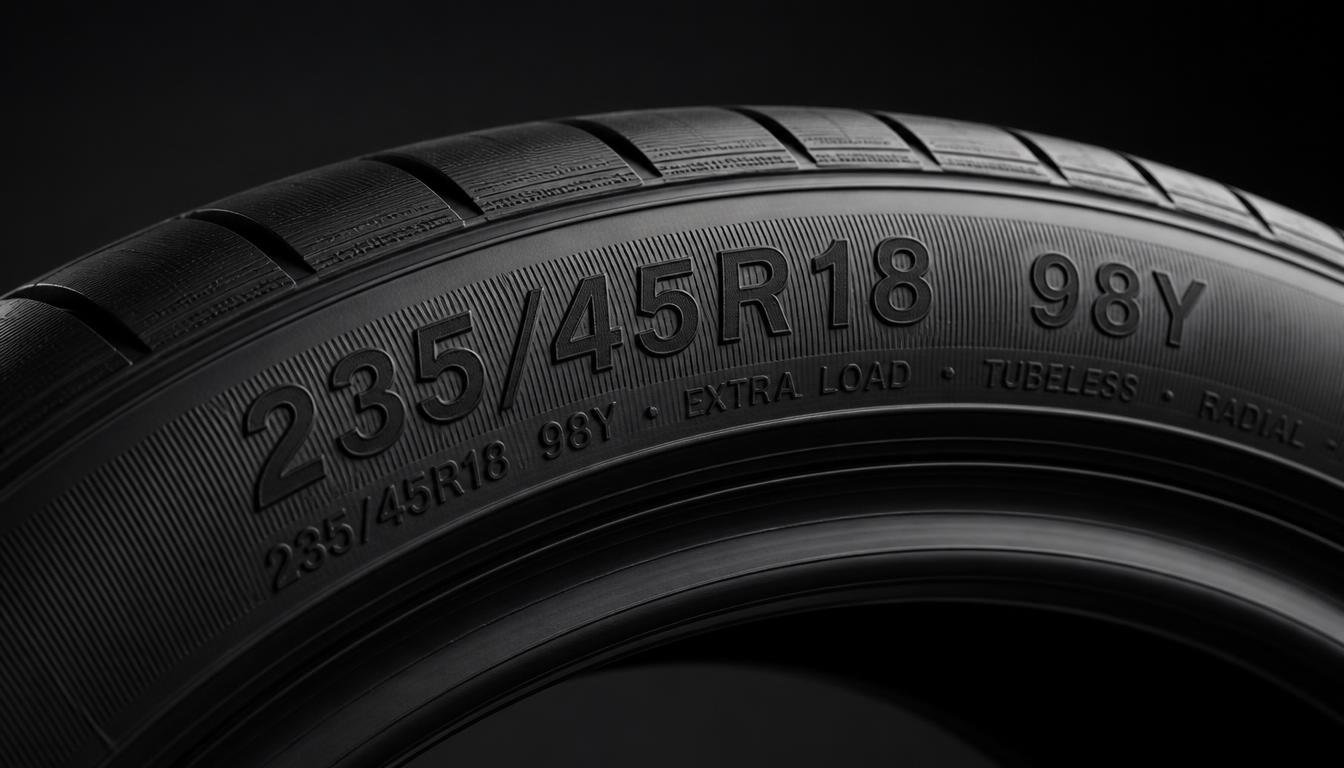
Buying a new set of tires should be simple — until you actually look at the sidewall and see something like 225/65R17 102H. What do all those numbers and letters actually mean, and does it really matter if you get one of them wrong? It does. Here’s how to read tire size markings and pick the correct fit for your car.
Why Tire Size Isn’t Just About the Wheel
It’s tempting to think “I have 17-inch wheels” is all the information you need. It isn’t. A single wheel diameter can pair with dozens of different tire sizes, and your vehicle was engineered around a specific combination of width, sidewall height, and diameter — not just a round number.
Get the size wrong and you can affect:
- Speedometer accuracy
- Ground clearance
- Steering feel and handling
- Ride comfort
- Braking performance
- Fuel economy
- Clearance around suspension and fender components
- Load-carrying capacity
That’s a long list for something that often gets decided by whichever tire happens to be on sale.
Where to Find Your Vehicle’s Recommended Tire Size
Skip the guesswork — your vehicle already tells you the correct size. Look for the tire and loading information label, usually on a sticker inside the driver’s door jamb. Your owner’s manual will list the same information, sometimes with more detail if your vehicle was offered with multiple wheel packages.
That label typically includes:
- Recommended tire size (front and rear, if they differ)
- Recommended cold tire pressure
- Maximum vehicle load
Worth noting: the tires currently mounted on your car aren’t a guaranteed reference. A previous owner may have swapped in something non-standard, so always cross-check against the manufacturer’s label rather than assuming the tire in front of you is correct.
Reading Tire Size Numbers, Piece by Piece
Take the example 225/65R17 102H. Each segment tells you something specific:
| Marking | What It Means |
| 225 | Section width in millimeters |
| 65 | Aspect ratio (sidewall height) |
| R | Radial construction |
| 17 | Wheel diameter in inches |
| 102 | Load index |
| H | Speed rating |
Section Width
The first number — 225 — is the tire’s width in millimeters, measured sidewall to sidewall. A higher number means a wider tire: 205 is narrower than 225, which is narrower than 245. Exact measurements can shift slightly between brands and models, but the relationship holds.
Aspect Ratio
The second number — 65 — is the aspect ratio, expressed as a percentage of the section width, not a measurement in millimeters. A 225/65R17 has a sidewall that’s roughly 65% as tall as the tire is wide. Lower numbers mean a shorter, stiffer-feeling sidewall; higher numbers mean a taller one with a softer ride.
Radial Construction
The letter R simply means the tire is built with radial construction — the standard for essentially every passenger vehicle on the road today. You’re unlikely to encounter much else in this category.
Wheel Diameter
The number right after the R — 17 — is the wheel diameter in inches. This one’s non-negotiable: a tire built for a 17-inch wheel cannot go on an 18-inch wheel, full stop.
Load Index and Speed Rating: The Numbers After the Size
Once you’ve got the core size, the trailing numbers and letter — 102H in this example — tell you how much weight the tire can carry and how fast it’s rated to go.
Load Index
The load index (102) corresponds to a maximum load capacity under standardized testing conditions, using a reference table rather than a direct pounds-to-number conversion. When shopping for replacements, make sure the load index meets or exceeds what your manufacturer specifies — this matters more than people expect, especially if you regularly carry passengers or cargo.
Speed Rating
The letter at the end (H) is the speed rating, indicating the tire’s maximum sustained speed capability under test conditions. Common ratings on passenger vehicles include:
| Speed Rating | Common Use |
| T | Standard passenger cars, everyday driving |
| H | Sedans, crossovers, family vehicles |
| V | Sportier sedans and performance-oriented vehicles |
| W | High-performance vehicles |
| Y | Ultra-high-performance vehicles |
A higher letter isn’t automatically “better” — it’s one spec among several, and it can come with trade-offs in ride comfort or tread life. Stick with what your vehicle manufacturer recommends.
Tire Size vs. Tire Type
Size and type answer two completely different questions. Size tells you the dimensions; type tells you what the tire is built to do. A 225/65R17 could be an all-season, a winter tire, an all-terrain tire, or a performance tire — same numbers, very different tread compound and design underneath. When shopping, think about both the size and the conditions you’ll actually be driving in.
How to Choose the Right Size for Your Car
Check the Door-Jamb Label
This is your primary source. Note the recommended size and cold inflation pressure, and make sure you’re reading the correct axle if your vehicle uses different sizes front and rear.
Check the Owner’s Manual
The manual sometimes lists additional approved sizes, particularly for vehicles that were sold with more than one wheel/tire package.
Check Your Current Tires
Reading your existing sidewall — say, 235/55R18 100V — gives you a useful reference point, but treat it as a cross-check rather than gospel. If the car’s been modified or the tires replaced before, what’s currently mounted might not match the original spec.
Changing Your Tire Size: What to Know
Sometimes a different size is genuinely fine for your vehicle — but it’s not a decision to make casually. Changing size can shift overall diameter, width, load capacity, and speed rating, and it can throw off electronic systems like the speedometer and stability control. If you’re considering something other than the factory spec, run it by a tire shop that can confirm compatibility with your specific wheel and vehicle.
What Is Plus Sizing?
“Plus sizing” means moving to a larger wheel paired with a lower-profile tire, keeping the overall tire diameter close to the original. It’s a common way to change a vehicle’s look and sharpen handling slightly, but it has to be done with the same care as any size change — clearance, load rating, and performance requirements all still apply.
What Goes Wrong With the Wrong Tire Size
Go too big, and the tire can start rubbing against wheel wells, suspension parts, or fender liners. Go too small, and you lose ground clearance and shift the vehicle’s rolling diameter. That diameter change also throws off the speedometer — a larger tire covers more distance per rotation, so the dash shows a lower speed than you’re actually driving. This is exactly why manufacturers try to keep approved alternate sizes close to the original overall diameter.
Other Markings Worth Knowing
The size string is just one part of what’s printed on a sidewall. You’ll also typically find:
- Brand and model name
- DOT identification number
- Maximum load and inflation pressure
- UTQG treadwear, traction, and temperature ratings
- M+S marking
- 3PMSF (severe snow) symbol
- Rotation direction arrows
- Inside/outside mounting indicators
Not every tire carries every marking, but knowing what they mean lets you compare tires on more than just price.
Common Mistakes to Avoid When Buying Tires
A few habits cause most tire-buying headaches:
- Shopping by wheel diameter alone. Knowing you have “17-inch wheels” isn’t a complete tire size.
- Copying the current tire without checking. It might not be the original factory spec.
- Ignoring load index. A tire can physically fit and still be underrated for your vehicle.
- Assuming same size means same performance. An all-season and a winter tire can share a size and behave completely differently.
- Mixing sizes across the vehicle. Only do this if the manufacturer explicitly allows it.
Putting It All Together: A Real Example
Take 235/55R18 100V:
- 235 — section width, roughly 235mm
- 55 — aspect ratio, sidewall height about 55% of the width
- R — radial construction
- 18 — fits an 18-inch wheel
- 100 — load index
- V — speed rating
Once you know what each segment stands for, almost any passenger tire size becomes easy to decode at a glance.
Frequently Asked Questions
How do I know what tire size I need?
Check the tire and loading label on the driver’s door jamb or your owner’s manual, then confirm against your current tire’s sidewall.
What does 225/65R17 mean?
A tire roughly 225mm wide, with a 65% aspect ratio, radial construction, built for a 17-inch wheel.
Can I put a different size tire on my car?
Sometimes, but only if it’s confirmed compatible with your vehicle’s clearance, load needs, and wheel specs — check with a tire professional first.
Does a bigger tire make a car faster?
Not really. It can change gearing, acceleration, fuel economy, and speedometer accuracy rather than simply adding speed.
Should all four tires be the same size?
Usually yes, though some vehicles use different front and rear sizes by design. Always follow the manufacturer’s setup.
What does the R mean in tire size?
It stands for radial construction, the standard build for nearly all modern passenger tires.
What’s the most important number on a tire?
None on its own — size, load index, and speed rating all need to match your vehicle together, not in isolation.
Final Thoughts
Reading a tire sidewall isn’t complicated once you know what each section represents — the challenge is remembering to actually check it instead of assuming last time’s size still applies. Start with your door-jamb label, confirm load and speed ratings, and you’ll avoid the handful of mistakes that cause most fitment problems.