
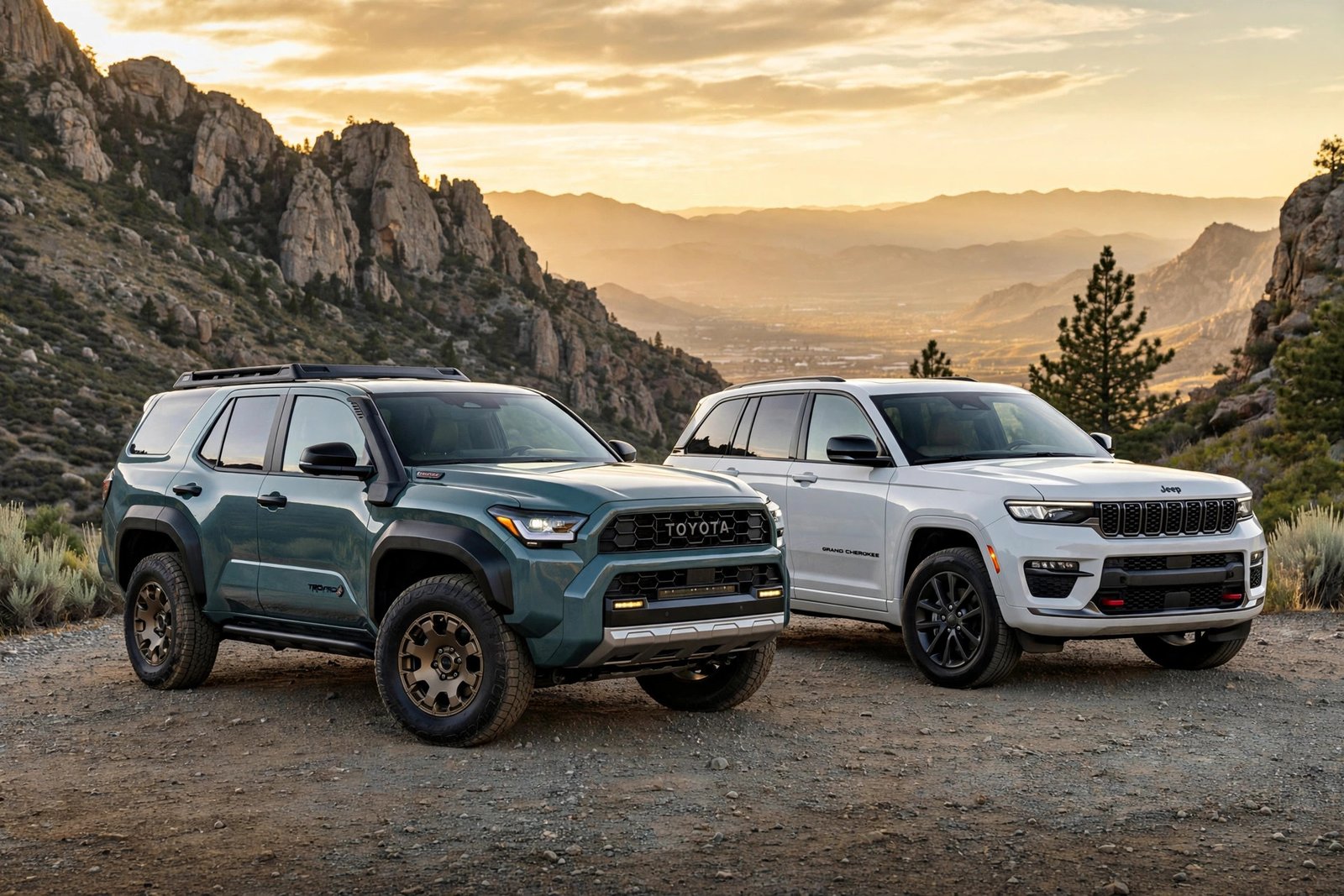
Quick answer: Buy the 2026 Toyota 4Runner if you go off-road for real, keep cars for a decade, or need the extra cargo room and optional third row. Buy the 2026 Jeep Grand Cherokee if your SUV mostly lives on pavement — it rides better, tows a little more, feels more luxurious inside, and costs less at both ends of the price range. The 4Runner is a truck that happens to be an SUV. The Grand Cherokee is a luxury SUV that happens to be a Jeep.
On paper, these two look like direct rivals. Both are midsize, five-passenger SUVs in the low-$40,000s. Both have real four-wheel-drive systems, tow more than 6,000 pounds, and carry famous off-road badges. But spend a weekend with each and the overlap disappears fast. The 4Runner is built like a pickup truck, because underneath it basically is one. The Grand Cherokee is built like a car, because underneath it basically is one. That single engineering choice shapes everything: how they ride and how they handle a rocky trail.
The 2026 model year is a good moment for this comparison because both SUVs changed. The 4Runner is in its second year of a full sixth-generation redesign, with a turbo four-cylinder replacing the old V6. The Grand Cherokee got a mid-cycle refresh for 2026 with new styling, a new turbo engine, and a simpler trim lineup.
If you are comparing other midsize SUVs too, our Ford Explorer vs Toyota Highlander comparison covers the three-row family side of this class, and our Compare Cars tool lets you line up any two models side by side with real photos.
Toyota 4Runner vs Jeep Grand Cherokee at a Glance
| 2026 Toyota 4Runner | 2026 Jeep Grand Cherokee | |
|---|---|---|
| Starting MSRP | $41,570 (+ $1,450 destination) | $38,920 (+ $1,995 destination) |
| Top trim | TRD Pro, about $68,000 | Summit 4×4, $60,600 |
| Platform | Body-on-frame (truck-based) | Unibody (car-based) |
| Engines | 2.4L turbo I4; 2.4L i-FORCE MAX hybrid | 3.6L V6; 2.0L Hurricane turbo I4 |
| Max power | 278 hp (gas) / 326 hp (hybrid) | 293 hp (V6) / 324 hp (turbo) |
| Max torque | 317 lb-ft (gas) / 465 lb-ft (hybrid) | 260 lb-ft (V6) / 332 lb-ft (turbo) |
| Max towing | 6,000 lbs | 6,200 lbs |
| Max cargo | 90.2 cu ft | 70.8 cu ft |
| Cargo behind 2nd row | 48.4 cu ft | 37.7 cu ft |
| Max ground clearance | 10.1 in | About 10.9 in (with air suspension) |
| Combined MPG | 22 (gas) / 23 (hybrid) | 22–23 |
| Seating | 5 or 7 | 5 (7 in the 3-row Grand Cherokee L) |
| Hybrid available | Yes (i-FORCE MAX) | No — 4xe dropped for 2026 |
| Powertrain warranty | 5 years / 60,000 miles | 5 years / 60,000 miles |
Prices are manufacturer MSRP before destination, taxes, and options, and can change. Confirm the current figure with the dealer before you buy.
Price: The Jeep Starts Cheaper and Finishes Cheaper
The Grand Cherokee wins on price at almost every point. Jeep lists the 2026 Grand Cherokee from $38,920 MSRP for the two-row Laredo 4×2, before the $1,995 destination charge. The 4Runner starts at $41,570 MSRP, before a $1,450 destination charge, according to Toyota’s own press release. That is a gap of about $2,650 before destination — and once you add destination, the Jeep still comes out roughly $2,100 ahead at the entry level.
The gap grows at the top. A loaded Grand Cherokee Summit 4×4 starts at $60,600. A 4Runner TRD Pro starts at about $67,900. That is roughly $7,000 more for the Toyota’s flagship — but the two flagships are not really the same thing. The Summit is a luxury SUV with quilted leather, an air suspension, and a 19-speaker stereo. The TRD Pro is an off-road weapon with a locking rear differential, Fox shocks, and skid plates.
In the middle of the range, the value picture flips depending on what you value. The 4Runner TRD Off-Road, at $49,990, is widely considered the sweet spot of the Toyota lineup: it gets the serious trail hardware without the TRD Pro’s price. The Grand Cherokee Limited, around $44,000, is the Jeep sweet spot: turbo engine, heated seats front and rear, and a cabin that feels a class above its price. If your budget is $45,000 to $50,000, the Jeep gives you more luxury per dollar; the Toyota gives you more capability per dollar. The 4Runner’s resale value is famously strong, so a 4Runner that costs $2,500 more today will often be worth several thousand more than the Jeep after five years — the sticker price is not the whole cost story.
Engines and Performance: Two Different Answers to the Same Question
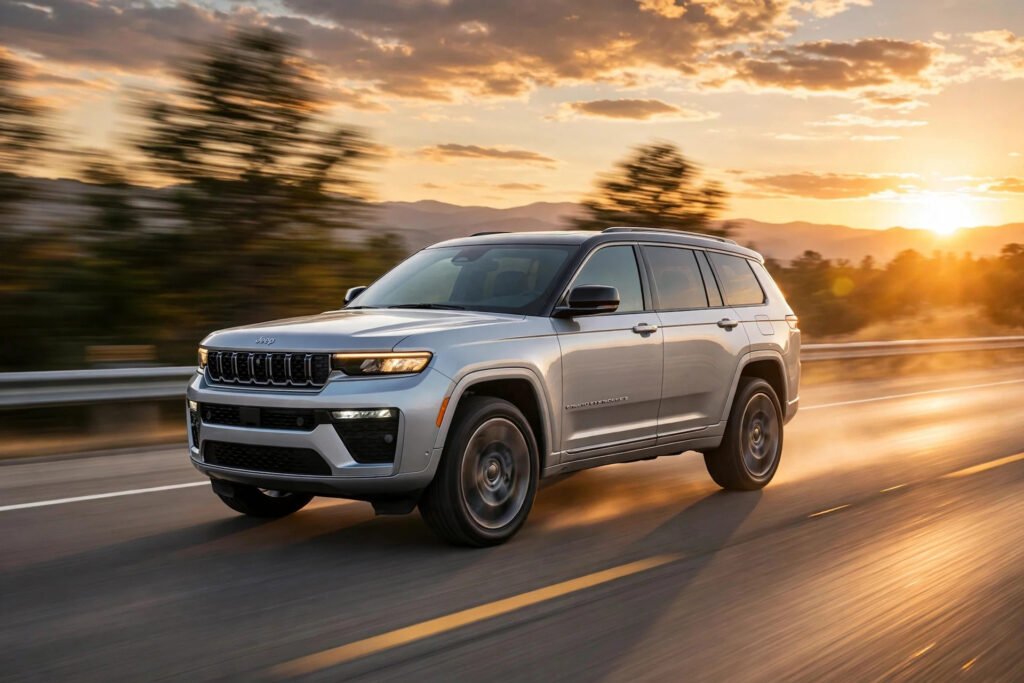
Both SUVs abandoned big engines for 2026, and both did it well — just differently. Independent head-to-head testing reaches the same conclusion: the two SUVs overlap on paper but feel very different from the driver’s seat, with the 4Runner leaning on durability and the Grand Cherokee on polish (Autoblog’s full comparison).
The 4Runner’s standard engine is a 2.4-liter turbocharged four-cylinder making 278 horsepower and 317 lb-ft of torque. It replaces the old 4.0-liter V6, and it is better in almost every measurable way: more torque, better fuel economy, and stronger low-speed pull for towing and trail work. The optional i-FORCE MAX hybrid adds an electric motor inside the transmission for 326 horsepower and a big 465 lb-ft of torque — the most torque in this comparison by a wide margin.
The Grand Cherokee’s base engine is the familiar 3.6-liter Pentastar V6 with 293 horsepower and 260 lb-ft of torque, offered on the entry Laredo trims. The headline for 2026 is the new 2.0-liter Hurricane turbo four-cylinder, now the volume engine, producing 324 horsepower and 332 lb-ft of torque. Jeep claims up to 529 miles of driving range on a tank with the Hurricane engine — the best range figure either SUV posts. The Hurricane is also noticeably quicker than the old V6 in everyday driving, with its peak torque arriving low in the rev range.
On the road, the difference is character more than speed. The 4Runner’s turbo four is strong but vocal — reviewers describe it as growly under hard acceleration, and the truck-based chassis leans more in corners. The Grand Cherokee’s Hurricane is smoother and quieter, and the unibody chassis feels planted and composed. If your daily drive is mostly highway miles, the Jeep is the more relaxing machine.
One thing the 4Runner has that the Jeep no longer offers: a hybrid. Jeep dropped the Grand Cherokee 4xe plug-in hybrid for 2026, so buyers who want electrified power in this pair have exactly one choice, and it wears a Toyota badge.
Off-Road Capability: The 4Runner’s Home Turf

This is the section that decides the comparison for a lot of buyers, and it is not close for serious trail use.
The 4Runner is a body-on-frame SUV — the same kind of construction as a pickup truck. That matters off-road because the frame can flex and absorb punishment that would bend a car-based body. The 4Runner offers up to 10.1 inches of ground clearance on the TRD Pro, part-time or full-time four-wheel drive depending on trim, and a full trail toolkit: an electronically locking rear differential, crawl control that manages throttle and braking on steep descents, and multi-terrain select modes. The TRD Pro and the overlanding-focused Trailhunter are the most capable factory off-roaders in this comparison, full stop.
The Grand Cherokee is no pretender, though. Its available Quadra-Trac 4×4 systems, Selec-Terrain traction modes, and optional Quadra-Lift air suspension — which can raise the SUV to about 10.9 inches of clearance — give it genuine trail ability. For the kind of off-roading most owners actually do — dirt roads, muddy fields, snow, a rutted track to a campsite — the Jeep is more than enough.
The honest split is this: if your off-roading involves rocks, steep grades, and trails rated “difficult,” buy the 4Runner. If your off-roading involves getting to places in bad weather and on bad roads, the Grand Cherokee will do it more comfortably and you will never feel its limits.
Towing: Jeep by a Nose

The Grand Cherokee tows up to 6,200 pounds. The 4Runner tows up to 6,000 pounds. That 200-pound gap is small and will not decide anything for most buyers. Both SUVs will happily pull a small boat, a pair of jet skis, or a modest camper.
What matters more than the headline number is how each SUV tows. The Grand Cherokee’s longer wheelbase, unibody stiffness, and smoother ride make it the more settled tow vehicle on the highway, and its Hurricane engine’s 332 lb-ft of torque pulls strongly at cruising speed. The 4Runner’s hybrid, with 465 lb-ft, is the strongest puller of the bunch from a standstill — useful on boat ramps and steep grades.
Fuel Economy: Basically a Tie
Neither SUV will impress you at the pump, and neither will embarrass you either. The 4Runner’s gas engine is rated at 22 mpg combined (20 city / 26 highway), and the hybrid manages 23 mpg combined. The Grand Cherokee’s engines land in the same place: about 22 mpg combined for four-wheel-drive models, with the rear-drive Hurricane reaching 23 mpg combined.
The practical difference is range. Jeep claims up to 529 miles per tank from the Hurricane engine, which means fewer fuel stops on road trips. The 4Runner’s tank is smaller, so even with similar mpg, you will stop more often. For long highway trips, that is a real quality-of-life difference in the Jeep’s favor.
Interior and Cargo: Jeep Wins Comfort, Toyota Wins Space
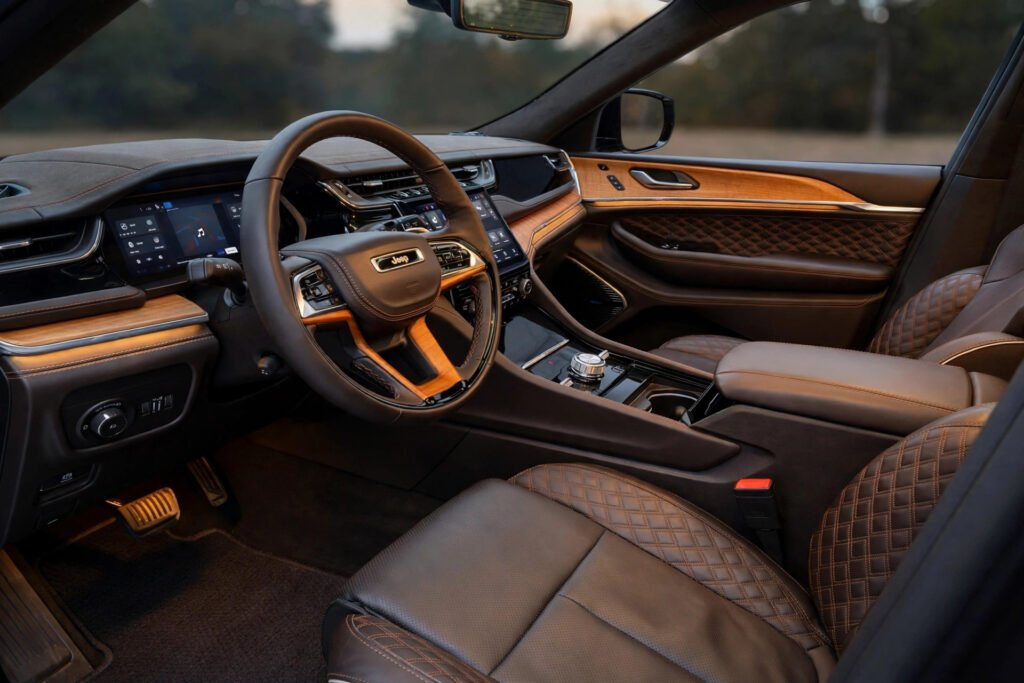
Step inside both SUVs and you will immediately feel the difference in philosophy. The Grand Cherokee’s cabin is the nicer place to sit. Even mid-level trims get soft-touch materials, a clean dashboard, and a standard 12.3-inch Uconnect touchscreen. The Summit trim, with quilted leather and open-pore wood, genuinely feels like a luxury SUV that costs $15,000 more than it does.
The 4Runner’s cabin is tougher and more practical, but less polished. The redesigned interior is a big improvement over the old truck — modern screens, better materials, Toyota Safety Sense 3.0 standard — but it still feels like a working vehicle next to the Jeep. Where the Toyota wins is space: 48.4 cubic feet behind the second row and 90.2 maximum, against the Jeep’s 37.7 and 70.8 — a difference you feel every time you load camping gear, a dog crate, or a furniture run.
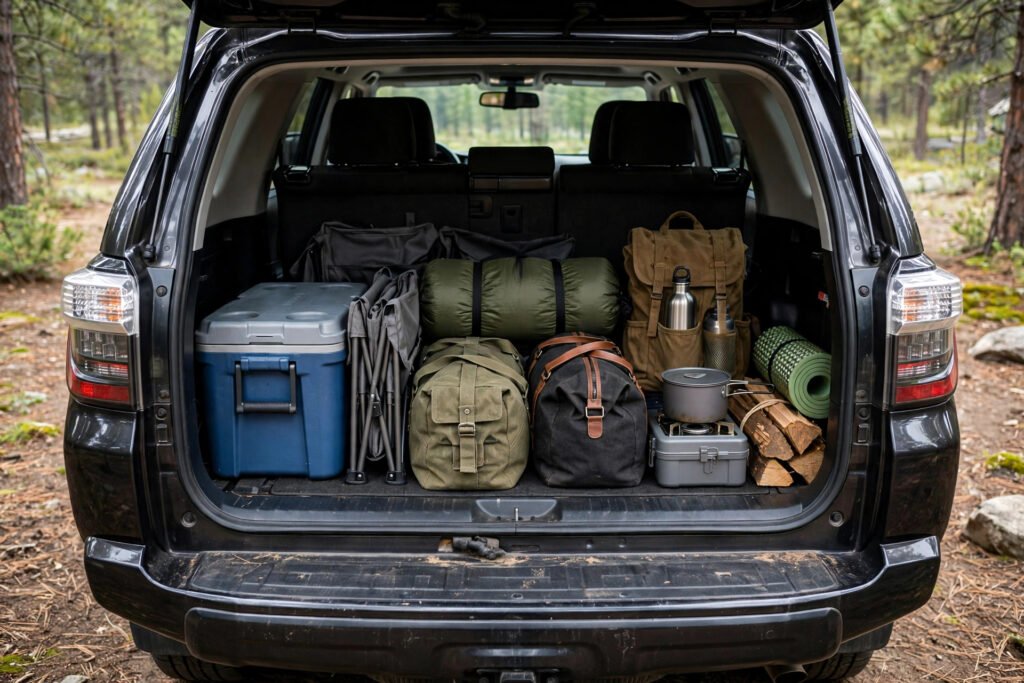
The 4Runner also offers something the two-row Grand Cherokee cannot: an optional third row, seating seven. If you need seven seats from Toyota’s SUV, the 4Runner is your entry point; from Jeep, you need the three-row Grand Cherokee L, which starts about $2,000 more than the two-row model.
Safety: A Split Decision
Both SUVs come with a full suite of driver-assistance features as standard: automatic emergency braking, lane-keeping assistance, blind-spot monitoring, and adaptive cruise control.
The redesigned 4Runner does not hold a current IIHS Top Safety Pick award — it earned only a marginal result in the updated moderate-overlap front test. The Grand Cherokee’s 2026 NHTSA ratings were not yet published at the time of writing, so there is no direct star-rating comparison to make right now.
On balance, neither SUV has a decisive safety advantage you can prove with a rating today. If safety ratings are a top-three priority for you, verify the latest IIHS and NHTSA results for both models before signing anything.
Reliability and Resale: Toyota’s Strongest Card
This is where the 4Runner justifies its price. Toyota’s body-on-frame SUVs have a decades-long reputation for running to 200,000 miles and beyond with basic maintenance, and the 4Runner’s resale value is among the strongest of any vehicle sold in America. The new turbo four-cylinder and hybrid system are newer technology than the old V6, so the very latest powertrain does not yet have a 10-year track record — but Toyota’s hybrid systems in general have an excellent long-term record.
The Grand Cherokee’s reliability record is more mixed. Modern Grand Cherokees are far better built than the Jeeps of twenty years ago, and the Pentastar V6 is a proven, long-running engine. But Jeep has historically trailed Toyota in long-term reliability surveys, and Grand Cherokees depreciate faster.
For tires, both SUVs deserve proper rubber for the job. If yours spends time off pavement, our all-terrain vs highway tires guide explains which tread is right, and when to change your tires covers the warning signs on a heavy SUV.
Pros and Cons
2026 Toyota 4Runner
Pros:
- Genuine body-on-frame off-road ability, best in this pair
- Available i-FORCE MAX hybrid with 465 lb-ft of torque
- Huge cargo space (up to 90.2 cu ft) and optional third row
- Legendary reliability and resale value
- TRD Pro and Trailhunter are factory-ready for hard trails
Cons:
- More expensive at the top of the range
- Firmer ride and more body roll on pavement
- No current IIHS Top Safety Pick award
- Turbo engine sounds coarse under hard acceleration
2026 Jeep Grand Cherokee
Pros:
- Lower starting price and cheaper flagship trim
- Smoother, quieter, more comfortable daily drive
- More luxurious interior for the money
- Tows slightly more (6,200 lbs) with up to 529 miles of range
- New Hurricane turbo engine is strong and refined
Cons:
- No hybrid option for 2026 (4xe dropped)
- Less cargo space and no third row in the two-row model
- Weaker long-term reliability reputation and faster depreciation
- Unibody platform has a lower off-road ceiling
Verdict: Which SUV Wins in 2026?
There is no single winner — there is a winner for your life.
Buy the Toyota 4Runner if: you go off-road beyond dirt roads, you keep vehicles for 8–10 years, you need maximum cargo space or a third row, or resale value matters to you. The 4Runner is the SUV you buy when the SUV is a tool.
Buy the Jeep Grand Cherokee if: your SUV lives mostly on pavement, you want the most comfortable and luxurious cabin for the money, you tow a boat or camper on weekends, or you want the lowest price for a well-equipped midsize SUV. The Grand Cherokee is the SUV you buy when the SUV is where you spend your day.
If we had to pick one for the average buyer — someone who drives to work, takes road trips, and hits a dirt road a few times a year — the Grand Cherokee is the better daily companion, and it costs less. If we had to pick one to own for a decade and take anywhere — the 4Runner, without hesitation.
Whichever you choose, try both back to back on the same day. Drive the 4Runner over broken pavement, then drive the Grand Cherokee over the same road. The difference will tell you everything this article can only describe.
Frequently Asked Questions
Which is better, the Toyota 4Runner or the Jeep Grand Cherokee?
It depends on what you do with it. The 2026 Toyota 4Runner is the better pick for serious off-roading, long-term reliability, resale value, and cargo space, with an available hybrid and an optional third row. The 2026 Jeep Grand Cherokee is the better daily driver: it rides more smoothly, tows slightly more (6,200 lbs vs 6,000 lbs), and its top Summit trim costs less than a loaded 4Runner TRD Pro while feeling more luxurious inside.
Which is better off-road, the 4Runner or the Grand Cherokee?
The 4Runner, for hard trail use. Its body-on-frame construction, up to 10.1 inches of ground clearance, and TRD Pro and Trailhunter trims with locking differentials and crawl control are built for rocks and ruts. The Grand Cherokee is genuinely capable off-road too, especially with its available Quadra-Trac 4×4 systems and Quadra-Lift air suspension, but its unibody platform is tuned more for comfort than for punishment.
How much does a 2026 Toyota 4Runner cost vs a Jeep Grand Cherokee?
The 2026 Toyota 4Runner starts at $41,570 MSRP plus $1,450 destination, and tops out around $68,000 for the TRD Pro. The 2026 Jeep Grand Cherokee starts lower at $38,920 MSRP plus $1,995 destination, and its flagship Summit trim starts at $60,600. The Jeep is cheaper at both ends of the range; the Toyota asks more at the top because its most expensive trims are hardcore off-road machines.
Which tows more, the 4Runner or the Grand Cherokee?
The Grand Cherokee, by a small margin: up to 6,200 lbs versus up to 6,000 lbs for the 4Runner. The gap is only 200 lbs, so either SUV handles a small boat, a pair of jet skis, or a modest camper. If you regularly tow near the limit, the Jeep’s extra margin and smoother highway ride make it the slightly better tow vehicle.
Is the 2026 Grand Cherokee still available as a hybrid?
No. Jeep dropped the plug-in hybrid 4xe from the Grand Cherokee lineup for 2026. The 2026 Grand Cherokee is gasoline-only: a 3.6-liter V6 or the new 2.0-liter Hurricane turbo four-cylinder. The 4Runner is now the only one of the two with an electrified option, its i-FORCE MAX hybrid making 326 horsepower and 465 lb-ft of torque.
Is the Toyota 4Runner more reliable than the Jeep Grand Cherokee?
The 4Runner has the stronger reputation. Toyota’s body-on-frame SUVs are famous for lasting hundreds of thousands of miles, and the 4Runner holds its resale value better than almost any SUV on the market. The Grand Cherokee counters with a more luxurious cabin and more standard equipment for the money, but its long-term reliability record has historically trailed Toyota’s. Both carry a 5-year/60,000-mile powertrain warranty.