

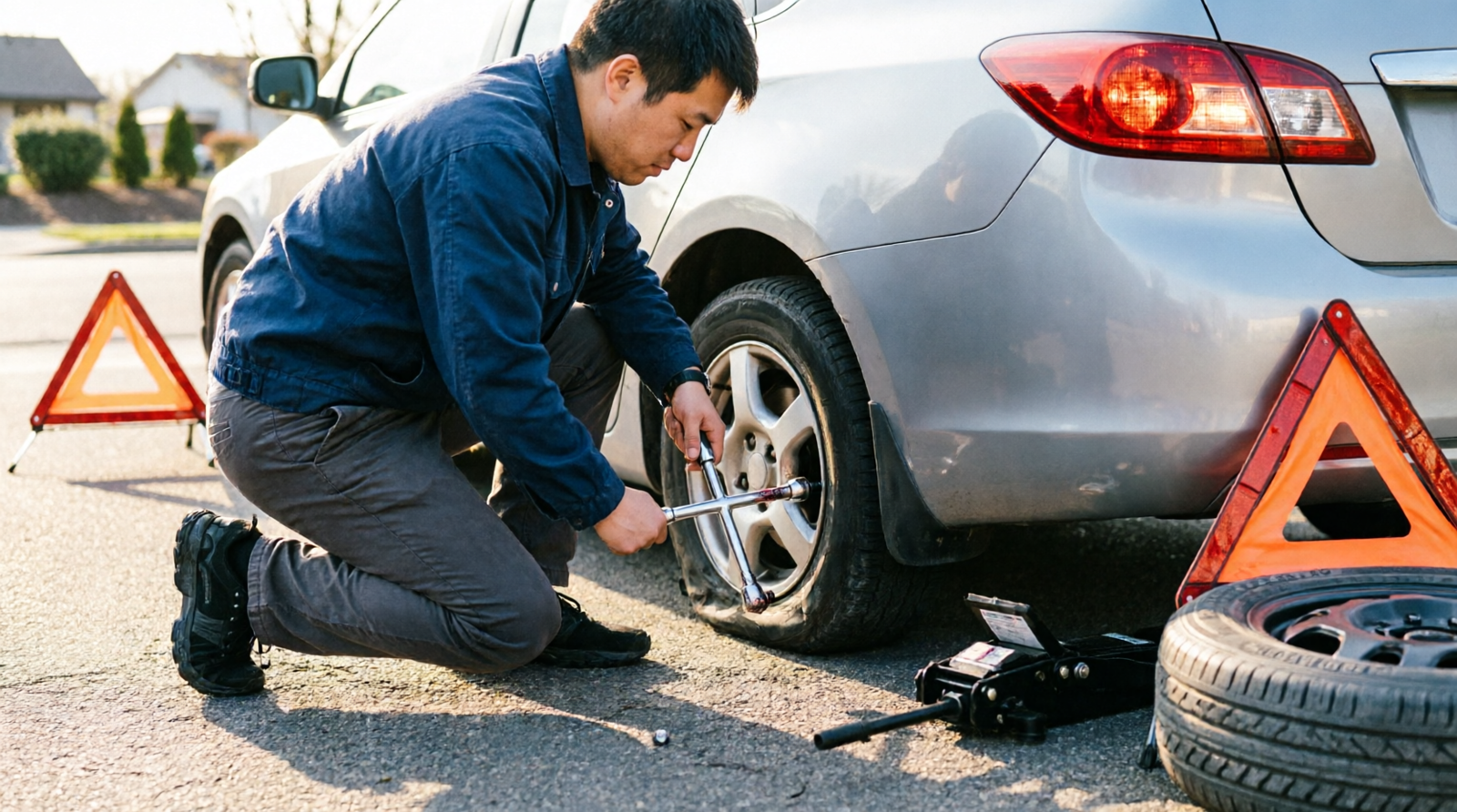
A flat tire has a way of showing up at the worst possible time — on the highway, in the rain, or right before you’re supposed to be somewhere. Knowing how to change a car tire won’t make the situation fun, but it will make it a lot less stressful. Here’s what actually goes into changing a tire safely, the tools you need, and when it’s smarter to just call for help.
What Does Changing a Car Tire Actually Involve?
Changing a tire means removing a damaged or flat wheel and replacing it with a spare. The general process is similar across most vehicles, but the specifics — jack points, spare type, tools included — vary by make and model.
Most cars that come with a traditional spare include a small toolkit:
- A vehicle jack
- A lug wrench
- A spare tire
- A jack handle or extension
- A storage compartment for everything above
Some newer vehicles skip the full-size spare entirely and instead include a compact “donut,” a run-flat tire, or a tire repair/inflation kit. Before you ever need it, check your owner’s manual to confirm what your car actually has, where it’s stored, and which jack points are safe to use.
It’s also worth remembering that a spare — even a full-size one — is generally meant as a temporary fix rather than a permanent replacement. Manufacturers often print speed and mileage limits directly on the tire or in the manual, so it’s worth a quick look before you assume you can drive on it indefinitely.
When Should You Change a Tire vs. Just Add Air?
Not every tire issue calls for a full swap. Sometimes low pressure is the only problem. Other times, the tire is compromised and needs to come off the car entirely.
You’ll likely need to change the tire if:
- There’s a serious puncture
- The sidewall is damaged or bulging
- The tire has gone completely flat
- It’s suffered major impact damage (like hitting a deep pothole)
- It won’t hold air, even after inflating
- A tire professional has already flagged it as unsafe to repair
A small nail in the tread is sometimes repairable, but that call should come from a qualified technician, not a guess on the side of the road.
Warning Signs You Shouldn’t Ignore
Pull over as soon as it’s safe if you notice rapid pressure loss, strong vibration, the car pulling to one side, or visible tire damage. Continuing to drive on a badly damaged or underinflated tire can wreck the wheel and turn a simple fix into an expensive one.
Tools You’ll Need Before You Start
Being ready before a flat happens makes the actual process much less chaotic.
| Equipment | Purpose |
| Spare tire | Temporary replacement for the damaged tire |
| Vehicle jack | Raises the car off the ground |
| Lug wrench | Loosens and tightens lug nuts |
| Wheel chocks | Keeps the car from rolling |
| Gloves | Keeps your hands cleaner and protected |
| Flashlight | Essential for nighttime emergencies |
| Owner’s manual | Vehicle-specific instructions and torque specs |
A cheap flashlight and a pair of gloves cost almost nothing, but they make a huge difference when you’re doing this in the dark or in bad weather.
Preparing Your Car for a Safe Tire Change
Safety comes before speed, every time. If you feel a flat while driving, slow down gradually and look for the safest possible spot to stop — ideally flat, stable ground well away from traffic.
Once you’ve parked:
- Shift into Park (automatic) or an appropriate gear per your manual (manual transmission)
- Apply the parking brake
- Turn on your hazard lights
- Turn off the engine
- Keep passengers away from moving traffic
- Set out warning triangles or reflectors if you have them and it’s safe to do so
Never attempt a tire change on soft, sloped, or unstable ground — the vehicle could shift while it’s raised. If you’re on a highway shoulder and pulling further off the road isn’t possible, it’s often safer to stay buckled in with your hazards on and wait for a tow truck or roadside assistance rather than working inches from moving traffic.
Check the Spare First
Before you go any further, take a look at the spare. It should be properly inflated with no obvious damage. If it looks flat, cracked, or otherwise unusable, stop and call roadside assistance instead of trying to force it.
How to Remove a Flat Tire
Once you’re parked safely and the spare checks out, you’re ready to start.
- Remove the hubcap (if your car has one) to expose the lug nuts.
- Loosen the lug nuts slightly with the lug wrench while the car is still on the ground. Don’t remove them completely yet — the wheel’s weight keeps it from spinning while you loosen the nuts.
- Position the jack at the correct point, per your owner’s manual. Using the wrong spot can damage the car or make the lift unstable.
- Raise the car just enough for the flat tire to clear the ground.
- Fully remove the lug nuts and set them somewhere secure — don’t lose them.
- Pull the wheel straight off the hub. If it’s stuck, don’t force it or crawl under the car. Check your manual or call for help.
How to Install the Spare Tire
With the damaged wheel off, you’re ready to mount the spare.
- Line up the spare against the hub and slide it into place.
- Thread the lug nuts on by hand first to avoid cross-threading.
- Tighten them lightly in a crisscross (star) pattern so the wheel seats evenly.
- Lower the car until the tire touches the ground and feels stable.
- Finish tightening the lug nuts to your vehicle’s specified torque, ideally with a torque wrench, following the same crisscross pattern.
Why Torque Actually Matters
It’s tempting to just crank the lug nuts as tight as they’ll go, but that’s a mistake. Under-tightened nuts can work loose while driving; over-tightened ones can warp the wheel or brake components and make removal difficult later. Your owner’s manual lists the correct torque value — if you don’t have a torque wrench, get the wheel checked by a shop as soon as possible.
Most passenger vehicles call for somewhere between 80 and 100 foot-pounds, but that range varies enough by make and model that guessing isn’t worth the risk. A loose wheel at highway speed is a genuine safety hazard, and it’s one of the easiest things to get right if you take the extra few minutes.
Full-Size vs. Compact vs. Run-Flat Spares
Not every spare is meant to be treated the same way, and mixing them up can lead to unnecessary wear — or worse.
| Type | Typical Use | Key Consideration |
| Full-size spare | Short-term or occasionally longer-term use | Follow your vehicle’s specific guidance |
| Compact (“donut”) spare | Short-distance emergency use only | Usually limited to about 50 mph and 50–70 miles |
| Run-flat tire | Allows limited driving after a pressure loss | Needs manufacturer-specific handling |
| Tire repair/inflation kit | Temporary fix for certain punctures | Not suitable for sidewall damage or blowouts |
Never assume a spare is good indefinitely — check your manual for exact restrictions, and get the original tire repaired or replaced as soon as you reasonably can.
Common Mistakes That Make Tire Changes Dangerous
Even a simple job can go wrong if a few basics get skipped.
- Using the wrong jack point — placing the jack on a rocker panel, plastic trim, or an unsupported section of the frame can damage the car or cause it to slip off the jack entirely.
- Working too close to traffic — if you can’t get far enough off the road, it’s safer to stay in the car with hazards on and wait for roadside assistance.
- Getting under the car — a jack lifts; it doesn’t hold. Never put any part of your body underneath a car supported only by a jack, even briefly.
- Skipping spare maintenance — a spare that’s sat untouched for years may be flat, cracked, or dry-rotted exactly when you need it most.
- Ignoring speed limits on a donut — compact spares aren’t built for highway speeds or long distances, and pushing past those limits can affect handling.
- Not double-checking lug nut torque — an improperly secured wheel can loosen over time and is a serious safety risk, especially on rough roads.
When to Call Roadside Assistance Instead
Changing your own tire isn’t always the right call, even if you know how. Consider phoning for help if:
- You’re stopped on a busy highway or shoulder
- The car is on a slope or unstable surface
- You’re missing the right jack, wrench, or a usable spare
- The wheel or hub looks severely damaged
- Weather or visibility makes it unsafe to work
- You’re simply not comfortable doing it yourself
There’s no shame in calling for backup — a technician can also tell you if the car needs a tow instead of just a spare.
How to Avoid Flat Tires in the First Place
The best tire change is the one you never have to make. A little routine maintenance goes a long way:
- Check tire pressure monthly and match it to the number on your driver’s doorjamb label
- Inspect for uneven wear, cracks, bulges, cuts, or embedded objects
- Rotate tires as recommended in your owner’s manual
- Keep an emergency kit in your trunk: flashlight, gloves, tire gauge, and reflective triangles
- Know whether your car even has a spare — some newer models don’t
A quick way to check tread depth without any special tools is the classic penny test: insert a penny into the tread groove with Lincoln’s head facing down. If you can see the top of his head, it’s time to start shopping for new tires. Catching wear early is almost always cheaper — and safer — than dealing with a blowout later.
Frequently Asked Questions
How long does it take to change a car tire?
For someone with basic experience working in a safe spot, expect roughly 20–30 minutes. It can take longer depending on the vehicle and conditions.
Can I drive normally on a spare tire?
Not usually. Compact spares typically have speed and distance limits, so check your manual before hitting the highway.
What if my car doesn’t have a spare?
You’ll likely rely on a tire repair kit, run-flat tires, or roadside assistance, depending on what your vehicle came with.
Why won’t my flat tire come off the hub?
It may be stuck from rust or corrosion. Avoid forcing it or getting underneath the car — call a professional if it won’t budge safely.
Should I repair or replace a damaged tire?
It depends on the size and location of the damage. A tire shop can tell you whether a repair is safe or if replacement is necessary.
How often should I check my spare tire?
Check it during routine maintenance, at least a couple of times a year, to confirm it’s properly inflated and undamaged.
Is it safe to change a tire on the side of a busy road?
Only if you can pull far enough away from traffic. If not, stay in the vehicle with hazards on and call for roadside assistance.
Do I need a torque wrench to change a tire safely?
It’s not strictly required, but it’s the best way to hit the manufacturer’s exact torque spec. If you don’t have one, have a shop verify the lug nuts soon after.
Final Thoughts
Changing a tire isn’t complicated once you know the steps, but safety has to come first — the right jack point, a stable surface, and properly torqued lug nuts all matter. When conditions aren’t safe or something feels off, calling roadside assistance is the smarter move. Either way, get the damaged tire checked out and make sure your spare is ready before you need it again.