

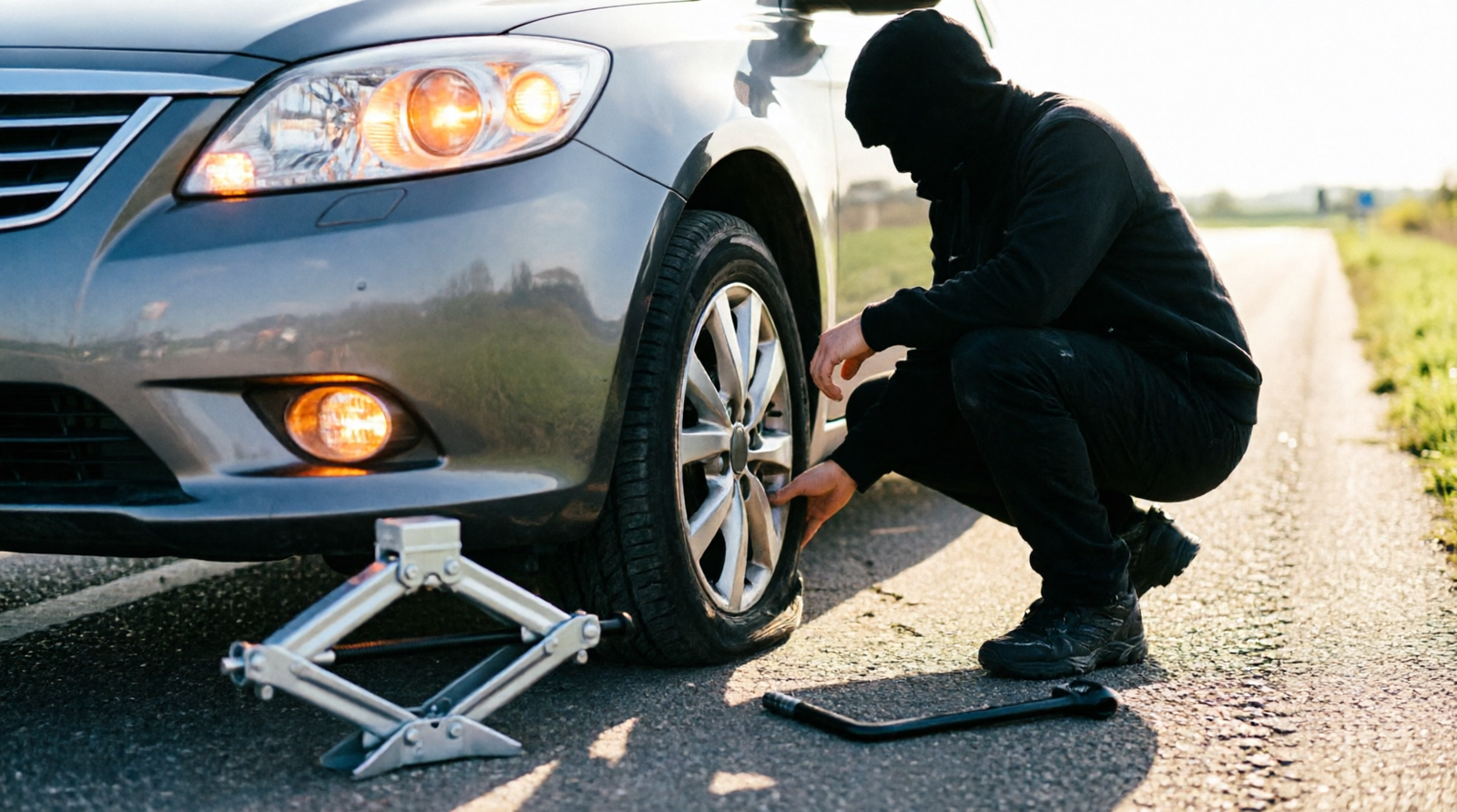
A flat tire rarely announces itself ahead of time. One second you’re cruising down the highway, and the next the steering feels off, the car starts shuddering, or you hear a loud thump coming from one corner of the vehicle.
So, can you actually change a tire while driving? No — and you shouldn’t try. What you can do is stay calm, keep control of the car, and get to a safe spot before dealing with the tire itself. Here’s exactly how to handle it, step by step.
Can You Change a Tire While Driving?
No. A tire can only be changed once the vehicle is completely stopped and safely secured.
Swapping a tire means lifting the car with a jack, removing lug nuts, and pulling the wheel off — none of which is physically possible, or safe, while the vehicle is in motion. The phrase “changing a tire while driving” is often used loosely to mean “what do I do if my tire fails while I’m driving,” and that’s really the more useful question.
If a tire fails while you’re behind the wheel, your first job isn’t fixing it — it’s controlling the car. That means:
- Keeping both hands on the wheel
- Avoiding sudden braking or steering
- Slowing down gradually
- Signaling and moving toward a safe spot
- Stopping completely before you inspect or touch the tire
Once you’re parked somewhere safe, you can figure out your next move.
Warning Signs Your Tire Is Failing
Not every flat happens the same way. A slow leak from a small puncture behaves very differently than a sudden blowout on the interstate, and each calls for a slightly different response. A gradual leak might give you time to notice something feels “off” before things get serious, while a blowout gives you almost no warning at all. Knowing the signs early can buy you precious seconds to react safely, whichever kind of failure you’re dealing with.
Watch for:
- A tire-pressure warning light on your dashboard
- Steering that suddenly feels heavier or looser
- The car pulling noticeably to one side
- Vibration through the steering wheel
- A rhythmic thumping or flapping sound
- Looser handling or reduced stability
- A loud pop, in the case of a full blowout
It’s tempting to assume a tire-pressure warning means you can keep driving as usual, but that’s a mistake. A tire that’s losing air can become harder to control the longer you drive on it, and continuing to drive on a severely underinflated tire can cause additional — and more expensive — damage.
What to Do If a Tire Blows Out While Driving
A blowout is startling, especially at highway speeds. The instinct to slam the brakes or yank the wheel toward the shoulder is strong — but it’s also the wrong move. Sudden reactions can make an already unstable car much harder to manage.
Stay in Your Lane
Grip the wheel firmly with both hands and focus on keeping the car straight. If it starts pulling to one side, make small, controlled corrections rather than fighting it aggressively.
Ease Off the Gas
Instead of braking hard, simply take your foot off the accelerator and let the car slow down naturally. The National Highway Traffic Safety Administration (NHTSA) advises drivers to avoid sudden braking or steering during a blowout and to concentrate on gradually regaining control.
Signal and Move Over Slowly
Once you’ve slowed down and feel back in control, turn on your signal and ease toward a safe stopping point — ideally a wide shoulder, parking lot, or rest area away from moving traffic. Turn on your hazard lights the moment you stop.
Finding the Safest Spot to Pull Over
Where you stop matters almost as much as how you react. A rushed decision to pull over in the wrong spot can put you in more danger than the flat tire itself.
Look for a location with:
- Firm, stable ground
- A reasonably level surface
- Enough space around the vehicle to work safely
- Good visibility so other drivers can see you
- Distance from fast-moving traffic
A parking lot, rest stop, or wide shoulder is always safer than a narrow strip of pavement on a busy interstate. If you have a choice between a spot that’s a little farther away but clearly safer, take the extra minute or two to reach it. Cars traveling at highway speeds cover a lot of ground very quickly, and a stopped vehicle close to the travel lanes is far more vulnerable than most drivers realize.
If traffic is whizzing by just a few feet from your door, it may not be worth changing the tire yourself at all. In that case, staying inside the vehicle with your seatbelt on and waiting for help is often the safer choice.
What If You Can’t Fully Get Off the Road?
Sometimes there’s simply nowhere safer to go. If your car won’t move any further, or you’re stuck in an awkward or exposed position, don’t risk your safety just to swap a tire.
Turn on your hazard lights and call for professional help. If your vehicle is creating a serious hazard for other traffic, or you’re in immediate danger, contact emergency services rather than attempting a roadside repair.
How to Change a Tire Safely After Stopping
If you’re parked somewhere safe and have a usable spare, changing the tire yourself is often straightforward. Before you start, check your owner’s manual — jack points and procedures vary by make and model.
Equipment You’ll Need
| Equipment | Purpose |
| Spare tire | Temporary or replacement wheel |
| Jack | Lifts the vehicle off the ground |
| Lug wrench | Loosens and tightens lug nuts |
| Owner’s manual | Gives vehicle-specific instructions |
| Tire-pressure gauge | Checks the spare’s inflation |
Step-by-Step Process
1. Secure the vehicle. Shift into Park (or follow manual-transmission guidance), engage the parking brake, and turn on your hazard lights.
2. Gather your tools. Pull out the spare, jack, and lug wrench. Note that many newer vehicles skip the traditional spare in favor of a repair kit or run-flat tires.
3. Loosen the lug nuts. Do this before lifting the car — don’t remove them yet.
4. Position the jack correctly. Use only the jacking points listed in your owner’s manual. The wrong spot can damage the car or make the lift unstable.
5. Raise the vehicle. Lift it just enough to clear the flat tire off the ground. Never put any part of your body underneath a vehicle held up only by a jack.
6. Remove the flat tire. Take out the lug nuts fully and pull the wheel free. Set the nuts somewhere safe so they don’t roll off.
7. Mount the spare. Slide it onto the hub and hand-tighten the lug nuts to hold it in place.
8. Lower and tighten. Bring the car back down, then tighten the lug nuts in the correct pattern using the torque spec for your vehicle. If you’re not sure about the torque, a tire shop can double-check it for you.
Can You Drive on a Spare Tire?
It depends entirely on the type of spare you have.
| Spare Type | What to Know |
| Compact spare (“donut”) | Meant for temporary use with speed and distance limits |
| Full-size spare | Closer to a regular tire, but still check manufacturer guidance |
| Run-flat tire | May allow limited driving after pressure loss |
| Tire repair kit | Works only for certain puncture types |
Check the sidewall of the spare itself, along with your owner’s manual, before hitting the road. A compact spare is not meant to be a long-term solution — get your damaged tire repaired or replaced as soon as you reasonably can.
When to Call Roadside Assistance Instead
Changing a tire yourself isn’t always the smart move, even if you know how. Consider calling for help if:
- You’re stuck on a narrow shoulder with traffic passing close by
- The ground is soft, uneven, or unstable
- You don’t have a spare, or it’s damaged or underinflated
- You’re missing the right tools
- The lug nuts won’t budge
- The vehicle has other visible damage
- Weather conditions make working outside unsafe
- You’re simply not comfortable using a jack
There’s no shame in calling for backup. A tire change is easy in a driveway — it’s a different story a few feet from 70-mph traffic. Many auto insurance policies, credit cards, and vehicle warranties include roadside assistance at no extra cost, so it’s worth checking what coverage you already have before you’re stuck on the shoulder wondering who to call.
Mistakes to Avoid After a Tire Failure
Don’t try to change the tire while moving. This can’t be said enough — wait until the car is fully stopped and secured.
Don’t slam on the brakes. Hard braking can destabilize a vehicle with a damaged tire. Let it slow down gradually instead.
Don’t make sharp steering corrections. Aggressive turns can worsen the loss of control that comes with a blown or flat tire.
Don’t keep driving on a totally flat tire. Doing so risks damaging the tire beyond repair and can even harm the wheel itself. If you must move a short distance to reach safety, do it carefully and cautiously.
Don’t get under the car while it’s only supported by a jack. A jack lifts the vehicle for a tire swap — it’s not a substitute for proper support if you need to work underneath the car.
How to Prepare for a Flat Tire Before It Happens
You can’t avoid every nail in the road, but a little preparation makes a flat tire far less stressful when it does happen.
- Check tire pressure regularly. Compare your readings against the manufacturer’s recommendation, usually printed on the driver’s door jamb.
- Inspect your tires often. Look for cuts, cracks, bulges, uneven wear, or embedded objects, and have anything unusual checked by a professional.
- Don’t forget the spare. A spare with low pressure or damage won’t help you when you need it most — check it periodically, especially before a road trip.
- Know where your tools are. Locate your jack, lug wrench, spare, and owner’s manual before an emergency forces you to search for them.
If a flat tire strikes during a long road trip, resist the urge to rush back onto the road. Find a safe place to stop first, then decide whether it’s a good spot to change the tire yourself or whether it’s smarter to call for help. A few extra minutes waiting for assistance beats the risk of working beside fast-moving traffic.
Frequently Asked Questions
Can you change a tire while driving?
No. The vehicle must be completely stopped and secured before a tire can be removed and replaced.
What should I do if my tire goes flat while driving?
Keep both hands on the wheel, avoid sudden braking or steering, slow down gradually, and move to a safe location.
Should I brake hard when a tire blows out?
No. Ease off the accelerator instead and let the car slow down on its own while you keep it steady.
Is it safe to change a tire on a highway shoulder?
It depends on the shoulder’s width and how close traffic is. A narrow shoulder next to fast traffic is risky — roadside assistance may be safer.
How far can I drive on a spare tire?
It depends on the spare type. Check the sidewall markings and your owner’s manual for exact speed and distance limits.
What if my car doesn’t have a spare tire?
Call roadside assistance or a tire service. Some vehicles rely on run-flat tires or repair kits instead of a traditional spare.
Should I repair or replace a flat tire?
Have a tire professional inspect the damage — they can tell you whether a repair is safe or if a replacement is necessary.
Conclusion
You should never attempt to change a tire while the car is moving. Instead, focus on staying in control, slowing down gradually, and reaching a safe place to stop. From there, you can install your spare if conditions allow, or call for roadside help if they don’t. A little routine maintenance — checking your tire pressure, inspecting for damage, and knowing where your tools are — goes a long way toward making a flat tire a minor inconvenience instead of a roadside emergency.