

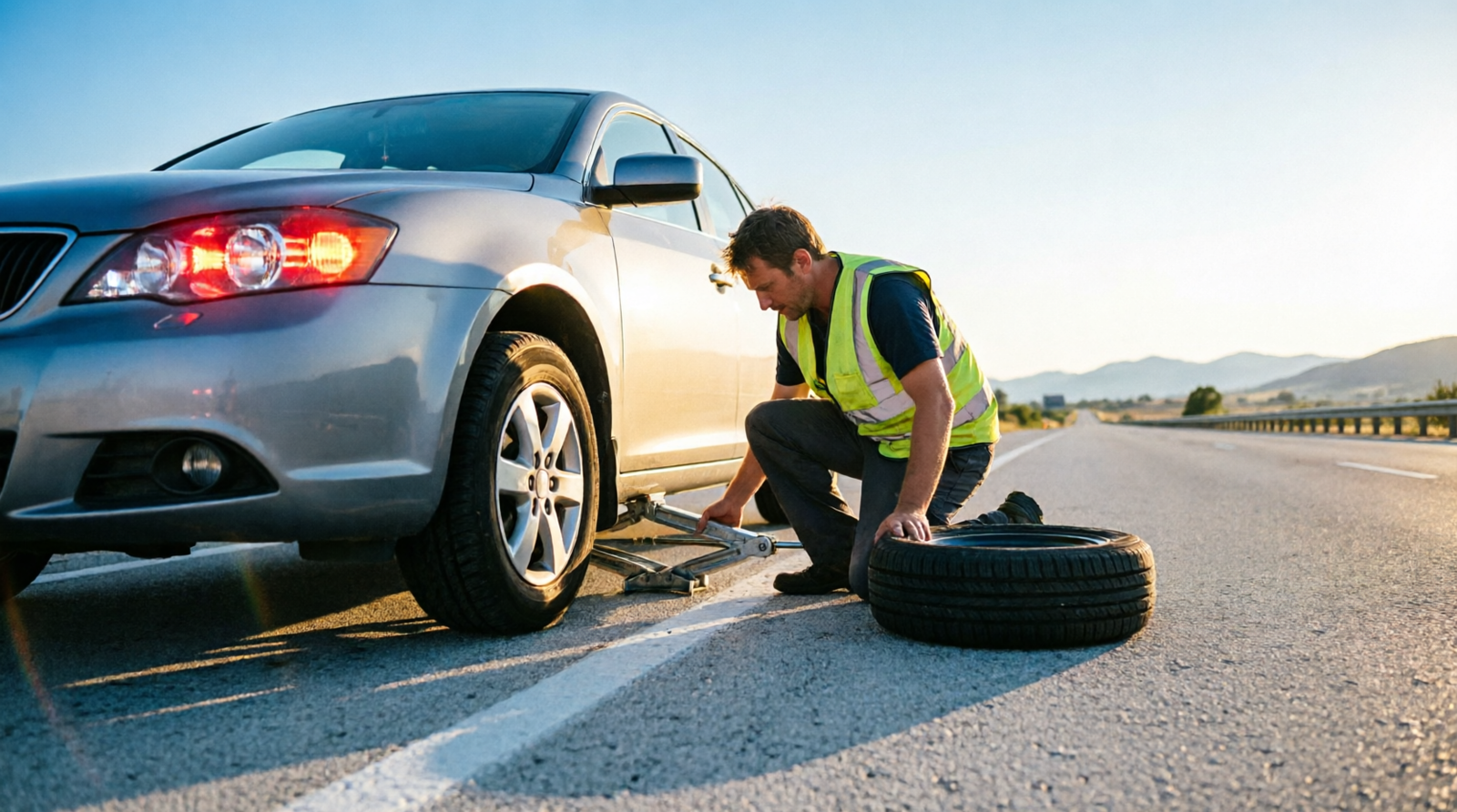
A flat tire has a way of showing up at the worst possible moment — on a highway shoulder, in the rain, or after dark. A roadside tire change service takes the guesswork (and the danger) out of the situation by sending someone to you instead of leaving you to handle it alone. Here’s how it works, when to call, and how to be ready before it happens.
What Is a Roadside Tire Change Service?
A roadside tire change service sends a trained technician to your location to swap a flat or damaged tire for your vehicle’s spare. Rather than limping to a repair shop or working on the shoulder of a busy road, help comes to wherever your car has stopped.
Drivers typically use this service for:
- Punctures from nails, screws, or road debris
- Tires damaged by potholes or curbs
- Sudden blowouts or rapid air loss
- Tires unsafe to drive on any further
- Situations where changing a tire yourself isn’t realistic or safe
The technician removes the damaged wheel, installs the spare, and makes sure the lug nuts are properly tightened before you’re cleared to drive again.
It’s worth noting that this is not the same as a permanent repair. If you’re sent off on a compact spare, a trip to a tire shop is still on your to-do list.
How the Process Works
Requesting help is usually simple. You contact a provider, share your location and vehicle details, and they dispatch a technician if service is available in your area.
Having this information ready speeds things up:
- Your exact location or a nearby landmark
- Vehicle make, model, and color
- License plate number, if asked
- Which tire is affected
- Whether you have a usable spare
- A brief description of the problem
- A phone number where you can be reached
| Step | What Happens |
| Request assistance | You report your location and describe the problem |
| Dispatch | A technician is sent to your location |
| Assessment | The technician checks the tire and spare |
| Tire change | The damaged wheel is swapped for the spare |
| Final check | The wheel is secured and tested before you drive off |
Arrival times shift depending on your location, traffic, weather, and how busy the provider is that day.
When to Call for Help
You don’t need to wait until things get worse. If changing the tire yourself feels risky or impractical, that’s reason enough to call.
This is especially true on a busy highway, where even a well-positioned pullover puts you close to fast-moving traffic. A few other situations where professional help makes sense:
- You’ve never changed a tire before
- The lug nuts won’t budge
- You don’t have the right tools on hand
- Your car is stopped too close to traffic
- It’s dark or hard to see
- Weather conditions make roadside work unsafe
- A physical limitation makes the job harder than usual
If you’re in immediate danger — say, stopped in a live traffic lane — focus on getting to safety first and follow local emergency guidance.
What a Technician Actually Does
The exact process varies by vehicle and conditions, but the basics stay the same. First, the vehicle is positioned as safely as possible and secured. The technician checks the damaged tire and confirms the spare is usable.
From there, the wheel comes off, the spare goes on, and the lug nuts are tightened in the correct pattern. Before you’re sent on your way, the technician double-checks that everything is secure.
What’s Usually Not Included
A standard tire change typically does not cover:
- Repairing the damaged tire on-site
- Supplying a new tire
- Replacing a missing spare
- Fixing bent or damaged wheels
- Suspension or brake work
- Handling unrelated mechanical issues
What’s included depends on your provider and plan, so it’s worth asking upfront.
Do You Need a Spare Tire?
In most cases, yes. A standard roadside tire change means installing the spare already in your vehicle. Without one, a traditional swap isn’t possible.
Some newer cars skip the spare entirely and instead include a repair kit, sealant, or run-flat tires — each with its own limitations depending on the damage.
Before a road trip, it’s worth confirming what your car actually has:
| Spare Type | Best For | Keep in Mind |
| Full-size spare | Temporary or extended use | Check air pressure regularly |
| Compact spare | Short-term emergency driving | Follow speed and distance limits |
| Matching wheel/tire | Near-normal driving | Confirm fit and condition |
| Repair kit | Certain minor punctures | Won’t work for all damage types |
Always defer to your owner’s manual for the specifics on your vehicle.
What Roadside Tire Assistance Costs
Pricing depends on a mix of factors: your location, the time of day, how far the technician has to travel, local labor rates, and whether you already have coverage through insurance, a warranty, or a membership plan.
Even with coverage, limits can apply — a plan might pay for the service call but not for a replacement tire. Before agreeing to a paid visit, ask what the charge covers so there are no surprises. It’s also worth checking your insurance or warranty first; you may already have this benefit without realizing it.
Why Calling for Help Is Often the Better Move
Changing a tire yourself is a useful skill, but it isn’t always the right call. A roadside technician can save you time, effort, and risk — particularly if you’re unfamiliar with the process or stuck somewhere less than ideal.
Help comes directly to your location, which matters most when you’re far from home or in unfamiliar territory. It also takes the pressure off dealing with darkness, rain, or heavy traffic on your own. For drivers who’ve simply never had to do this before, having a professional handle it means you can focus on getting to a shop for the permanent fix.
What to Do While You Wait
Safety comes first. If you can, move the car away from traffic and onto stable ground, then turn on your hazard lights so you’re visible to other drivers.
While you wait, keep your phone nearby in case the provider needs to reach you, and gather:
- Your vehicle registration, if needed
- Roadside membership details
- The spare tire and tools
- Your owner’s manual
- Precise location information
Stay clear of passing traffic, and don’t continue driving on a badly damaged tire unless you’ve been told it’s safe — doing so risks further damage to the tire or wheel.
Preparing for a Flat Before It Happens
A little prep work goes a long way. Check your spare’s air pressure periodically and know exactly where it’s stored — trunk, under the cargo floor, or underneath the vehicle, depending on the model.
It also helps to keep a few things on hand:
- Roadside assistance contact info
- A charged phone or charger
- Your owner’s manual
- A flashlight
- Basic emergency supplies
- Your tire size and coverage details
Regularly inspect your everyday tires for wear, and follow the maintenance schedule your manufacturer recommends. Knowing your coverage ahead of time means you’re not scrambling to find it mid-emergency.
After the Spare Goes On
Getting the spare installed solves the immediate problem, but it’s not the finish line. Have the damaged tire looked at by a professional as soon as you reasonably can.
If you’re driving on a compact spare, stick closely to the speed and distance limits in your owner’s manual. A tire shop can tell you whether the original tire is repairable or needs replacing, and can check the wheel itself for damage while they’re at it.
Choosing the Right Coverage
Before you’re stuck on the shoulder, it’s worth comparing your options. The right plan depends on how much you drive and where you tend to go.
A few things to look into:
- Coverage details — Does the plan include tire changes, towing, battery jumps, lockouts, and fuel delivery?
- Service area — Broad coverage on paper doesn’t always mean fast help in remote areas.
- Limits and exclusions — Some plans cap the number of calls or towing distance, or exclude certain vehicles.
Reading the fine print now means fewer surprises later.
Common Causes of Flat Tires
Understanding why tires fail can help you avoid a few of these situations altogether — and helps a technician diagnose the problem faster when you do call.
- Punctures — Nails, screws, and glass are the most frequent culprits, and they don’t always cause an immediate flat. Slow leaks can build up over days.
- Underinflation — Low tire pressure increases heat and stress, making blowouts more likely, especially on hot pavement or long highway drives.
- Old or worn tread — Tires naturally degrade over time. Worn tread reduces grip and makes tires more vulnerable to damage.
- Potholes and curbs — A hard hit can damage the sidewall or bend the wheel, sometimes without leaving obvious signs until the tire fails later.
- Valve stem issues — A cracked or loose valve stem can leak air slowly, often going unnoticed until the tire is significantly low.
Checking your tires regularly — pressure, tread depth, and visible wear — catches many of these issues before they turn into a roadside emergency.
The Bottom Line
A roadside tire change service turns a stressful flat into a manageable delay. It’s especially valuable when conditions are unsafe, you’re short on tools or experience, or you just need a spare installed quickly and correctly. Check your spare, know your vehicle’s equipment, and understand your coverage now — future you will be glad you did.
FAQs
1. What is a roadside tire change service?
It’s a service that dispatches help to your location to swap a flat or damaged tire for your spare.
2. Can roadside assistance help without a spare tire?
Usually not for a standard swap. Ask your provider what alternatives they offer if you don’t have one.
3. How long does it take for help to arrive?
It varies based on your location, traffic, weather, and how busy the provider is at the time.
4. Does roadside assistance repair the flat tire?
No — most providers install your spare rather than repairing the damaged tire on-site.
5. Is it safe to drive on a compact spare?
Yes, temporarily, as long as you follow the speed and distance limits in your owner’s manual.
6. Will my insurance cover a roadside tire change?
Possibly — check your policy, since coverage and limits vary by provider.
7. What should I do right after the spare is installed? Get the damaged tire inspected soon, and stick to any restrictions that apply to your spare.