

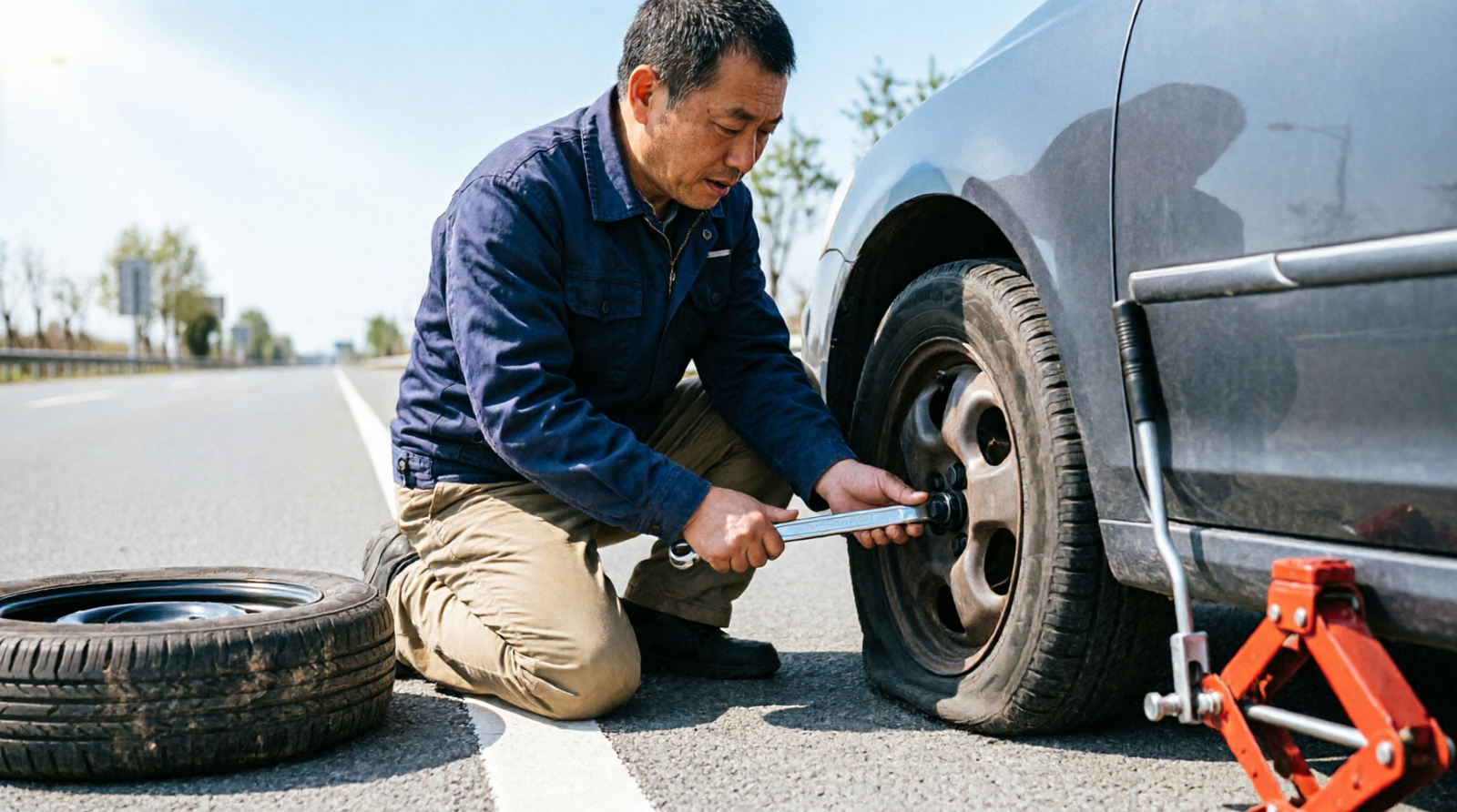
A flat tire always seems to happen at the worst possible moment — on the highway, in the rain, or on the way to something important. The good news is that most drivers can handle it themselves. If your car carries a spare and basic tools, changing a flat is usually a 30-minute job, not a call-a-tow-truck emergency. Here’s exactly how to change a flat tire safely, from pulling over to driving away again.
1. Get to a Safe Location First
Before you think about the tire, think about safety. A flat can make your car harder to steer and brake, so don’t push your luck by driving farther than you have to.
If you feel a tire go flat while driving, ease off the gas, grip the wheel firmly, and avoid sudden braking or sharp turns. Look for a flat, stable spot away from traffic — a parking lot or wide shoulder is much better than a narrow roadside strip.
Once you’ve stopped:
- Turn on your hazard lights
- Shift into Park (or leave a manual in gear)
- Set the parking brake
- Turn off the engine
- Keep passengers away from moving traffic
If you’re on a busy highway or somewhere that feels unsafe, skip the DIY approach and call roadside assistance instead.
How to Tell It’s Actually a Flat
A flat isn’t always obvious right away. Watch for a car that suddenly pulls to one side, a thumping sound as you drive, a steering wheel that vibrates more than usual, or a dashboard tire-pressure warning light. Any of these is a good reason to find a safe spot and check your tires before continuing.
2. Gather Your Equipment
Most vehicles store a spare tire and tools under the trunk floor. Trucks and SUVs sometimes carry the spare underneath the vehicle. Either way, check what you have before you start.
What’s in a Typical Tire-Change Kit
| Equipment | Purpose |
| Spare tire | Temporary replacement for the flat |
| Vehicle jack | Lifts the car off the ground |
| Lug wrench | Loosens and tightens lug nuts |
| Owner’s manual | Shows correct jack points |
| Wheel wedges | Keep the car from rolling |
| Flashlight | Helpful for low-light changes |
Many newer cars come with a compact “donut” spare, which isn’t meant for long-term driving — check its sidewall or your manual for speed and mileage limits. If your car has locking lug nuts, make sure you have the special key before you get started; it’s often clipped inside the glovebox or stored with the jack.
If You’re Missing a Tool
It happens more often than you’d think — a jack goes missing after a previous repair, or a lug wrench never made it back into the trunk. If you’re missing a critical piece of equipment, don’t try to improvise with mismatched tools. A borrowed jack from a passerby, a pipe used as a wrench extension, or a makeshift wedge can all fail at the wrong moment. It’s safer to call roadside assistance or a nearby tire shop.
3. Prepare the Vehicle for the Change
With the car parked and hazards on, place wheel wedges against the tires that will stay on the ground. If you’re changing a front tire, wedge a rear tire, and vice versa.
Never crawl under a vehicle that’s only supported by the factory jack, and don’t leave the car resting on the jack for longer than needed — it’s built to lift, not to hold weight indefinitely.
4. Loosen the Lug Nuts First
This is a step beginners often get backward: loosen the lug nuts before lifting the car, while the tire still has contact with the ground to keep it from spinning.
Remove the hubcap if there is one, then fit the lug wrench snugly over each nut and turn counterclockwise. Loosen each nut about one turn — don’t remove them yet. Work in a crisscross pattern rather than going around the wheel in order; on a five-lug wheel, that means skipping to the opposite nut each time.
If a nut won’t budge, don’t jump on the wrench or add an unsafe extension bar. Excessive force can snap a stud or hurt you. Call for professional help instead.
Dealing with Stubborn or Locking Lug Nuts
Lug nuts seize up over time because of rust, road salt, or a previous mechanic who over-tightened them with an impact wrench. If you’re struggling, try standing on the wrench (with the car still on the ground) and using your body weight rather than jerking the handle. For locking lug nuts, make sure the key is seated fully before applying pressure — a stripped lock nut is much harder to remove later.
5. Jack Up the Vehicle Safely
Your car has specific jack points built to support its weight, and they vary by make and model — check the owner’s manual rather than guessing. Never place the jack under the body, suspension, or engine components.
Set the jack on firm, level ground, line it up with the correct point, and raise the car slowly according to the instructions in your manual.
Why Jack Placement Matters
Using the wrong lifting point can damage the car or make the jack unstable, and a vehicle that shifts or falls off a jack can cause serious injury. If the ground is soft, uneven, or slippery, stop and call for professional help instead.
Lift the car only until the flat tire clears the ground — no higher than necessary. Watch the jack as you go; if it leans or sinks, lower the car and reposition it before continuing.
6. Remove the Flat and Install the Spare
Once the tire is off the ground, finish removing the lug nuts and set them aside somewhere they won’t roll away. Grip the tire with both hands and pull it straight toward you. If it’s stuck from rust or corrosion, avoid forcing it or hitting it — that’s a sign to call for help.
Set the flat tire flat on the ground so it doesn’t roll into traffic, and quickly check the wheel hub for debris before mounting the spare.
Take a Quick Look at the Damaged Tire
Before you put the flat aside, glance at what caused the problem. A visible nail or screw in the tread often means a repairable puncture. A gash along the sidewall, on the other hand, usually means the tire is done for good and shouldn’t be repaired or reused, even temporarily. This quick check can save you a wasted trip to a shop that can’t do anything with a sidewall-damaged tire.
Line up the spare’s holes with the wheel studs, push it onto the hub until it sits flush, and thread the lug nuts on by hand — turning clockwise. If a nut feels like it’s cross-threading, back it out and start again rather than forcing it. Once all the nuts are on by hand, snug them lightly with the lug wrench.
7. Lower the Car and Tighten the Lug Nuts
Lower the vehicle slowly until the spare makes firm contact with the ground — you don’t have to remove the jack completely yet if you need the car’s weight to keep the wheel from spinning.
Tighten the lug nuts in the same crisscross pattern you used to loosen them, so the wheel seats evenly. If your manufacturer specifies a torque value, finish the job with a calibrated torque wrench once the car is fully on the ground. Then lower the vehicle completely, remove the jack, and double-check every lug nut.
8. Know Your Spare Tire’s Limits
Before you drive off, check the spare’s pressure — you’ll find the recommended PSI in the owner’s manual, on the driver’s door-jamb sticker, or on the tire itself.
If it’s a temporary “donut” spare, keep these limits in mind:
- Stay under the posted speed limit (often 50 mph)
- Avoid long-distance driving
- Drive a bit more cautiously than usual
- Get the damaged tire repaired or replaced as soon as possible
- Return the spare to its storage spot once you’re done
No Spare? Here’s What to Do
Not every car carries a traditional spare anymore — some rely on run-flat tires or a tire repair kit instead. If that’s your situation, check the owner’s manual for what’s actually on board. A repair kit can handle some tread punctures, but sidewall damage or a badly shredded tire usually needs a tow or professional service.
Run-flat tires are reinforced to keep you moving for a limited distance (often 50 miles) at reduced speed after losing pressure, giving you time to reach a shop rather than pulling over immediately. A tire repair kit, by contrast, typically includes a sealant and a small air compressor — useful for a slow leak, but not a fix for a tire that’s already shredded or has a large puncture.
9. When to Call Roadside Assistance Instead
Changing a tire yourself works well when you’re safe and properly equipped — but plenty of situations call for backup instead.
| Call for help if… | Because… |
| You’re on a busy or narrow shoulder | Changing a tire next to traffic is dangerous |
| A lug nut won’t loosen | Excessive force can cause injury or damage |
| The wheel is stuck or corroded | Forcing it can damage the hub |
| The ground is soft or uneven | The jack can slip or sink |
| You’re missing the jack or wrench | You can’t safely lift the car |
| The spare is flat or damaged | You’d have no usable tire afterward |
| You’re just not comfortable doing it | There’s no shame in calling a professional |
A little preparation also goes a long way: check your spare’s pressure occasionally, confirm your jack and lug wrench are actually in the car, and keep a flashlight and your owner’s manual within reach. Knowing where everything is stored beats digging through your trunk in the dark.
Building a Simple Roadside Kit
Beyond the factory-supplied jack and wrench, a small emergency kit can make any tire trouble easier to handle. Consider keeping these items in your trunk:
- Reflective triangles or road flares, so other drivers can see you
- Work gloves to protect your hands
- A tire pressure gauge
- A small can of tire sealant as a backup option
- A phone charger or portable battery pack, so you can call for help if needed
None of this is required, but it turns a stressful roadside moment into a manageable one — and most of these items cost very little compared to the peace of mind they provide.
FAQs About Changing a Flat Tire
How long does it take to change a flat tire?
Most people can do it in 15–30 minutes with the right tools. Beginners or stubborn lug nuts can add extra time.
Can I change a flat tire without a jack?
No — you need a jack to safely lift the vehicle. Without one, call roadside assistance rather than improvising.
How far can I drive on a spare tire?
It depends on the spare type. Temporary “donut” spares usually have speed and distance limits listed in your manual.
Should I repair or replace a flat tire?
Minor tread punctures can often be repaired, but sidewall damage typically means the tire needs full replacement.
Why won’t my lug nuts come off?
Corrosion, over-tightening, or rust can make them stubborn. If reasonable force doesn’t work, get professional help.
Can I drive right after installing the spare?
Yes, as long as it’s properly inflated and installed. Just follow its speed and distance limits to a repair shop.
Do all cars still come with a spare tire?
No — many newer vehicles use run-flat tires or repair kits instead. Check your owner’s manual to see what yours has.
Final Thoughts
Changing a flat tire comes down to a simple sequence: pull over safely, loosen the lug nuts, jack up the car at the right point, swap in the spare, and tighten everything back down. But knowing when not to do it yourself — because of traffic, terrain, or a stuck wheel — matters just as much as knowing the steps. The tire can always be fixed later; your safety comes first.