

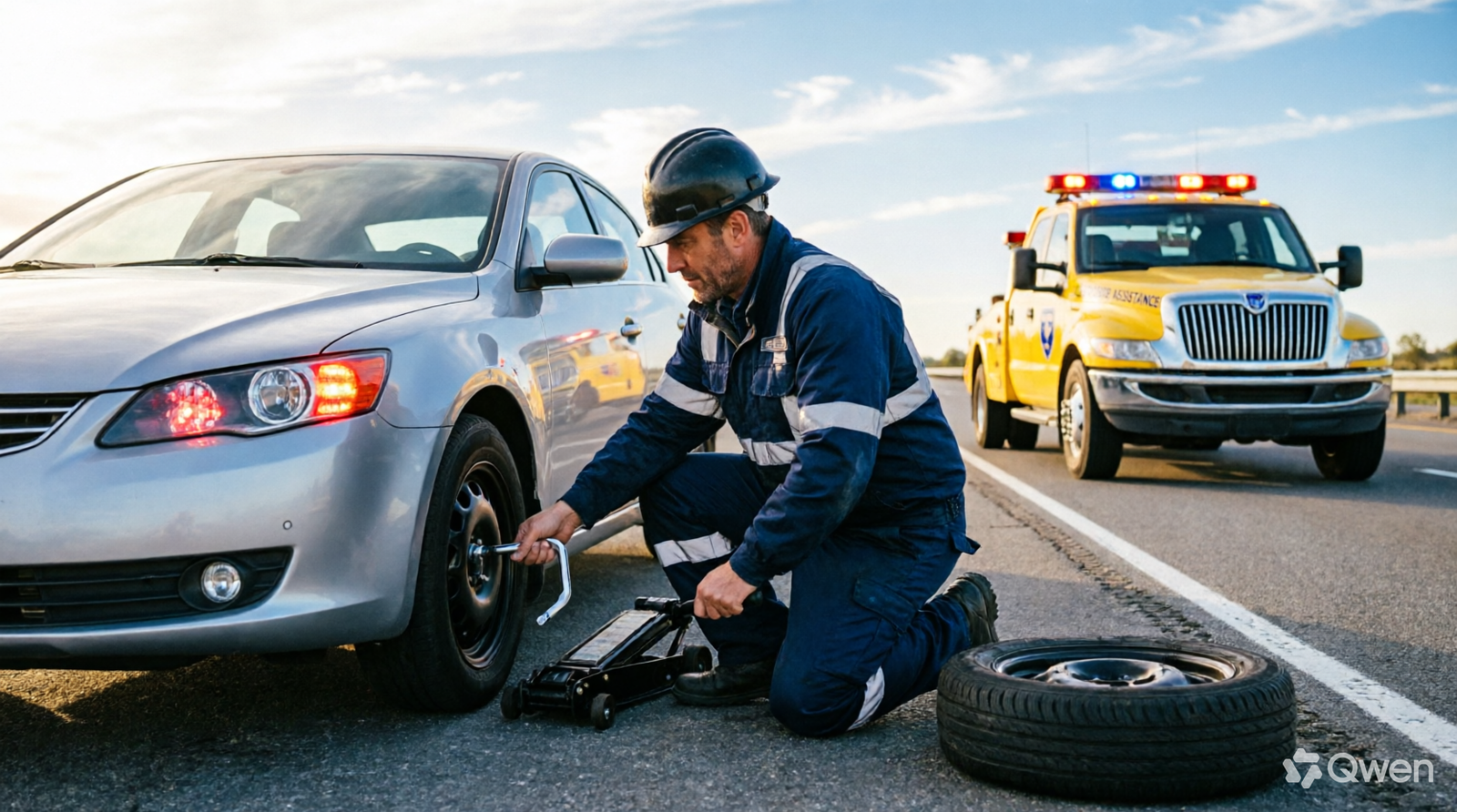
A flat tire never happens at a convenient time. If you’re stranded on the shoulder wondering whether to call for help, you’ve probably asked yourself: does roadside assistance change tires, or do you need to find a shop?
The short answer is yes, in most cases. But how much help you get, and what it actually involves, depends on your provider, your plan, and your vehicle. Here’s what to expect.
Does Roadside Assistance Change Tires?
Most roadside assistance programs include tire-change service as a standard benefit. If you have a flat and a usable spare, a technician can typically come to your location and swap the damaged wheel for the spare.
That said, roadside assistance isn’t the same thing as a tire shop. A technician can usually install your spare, but they’re not equipped to repair or permanently replace a tire on the side of the road.
Coverage also varies by company. Before you’re ever stuck, it’s worth checking your membership details to see whether tire service is included and whether there’s a limit on how many service calls you get per year.
Above all, safety comes first. If your car is stopped somewhere risky, like a narrow shoulder on a busy highway, trying to change the tire yourself may not be worth it. Calling for help is usually the smarter move.
What Roadside Assistance Actually Does for a Flat Tire
Roadside assistance exists to get you back on the road, or somewhere safer, when something goes wrong. For a flat tire, that generally means sending someone out to install your spare.
Depending on your vehicle and provider, a technician may:
- Assess the situation and make sure the area is safe
- Remove the damaged wheel
- Install your spare tire
- Inflate the spare if needed
- Let you know whether it’s safe to keep driving
If your car doesn’t have a spare, the technician may not be able to fix things on the spot. In that case, towing to a repair shop is often the next step. Think of roadside assistance as emergency help rather than a mobile tire shop.
The exact scope of service also depends on your membership tier. Some basic plans cover only a limited number of calls per year or charge extra beyond a certain mileage radius. Premium plans, on the other hand, often include unlimited tire-change calls, longer tow distances, and faster response-time guarantees. If you’ve never actually read through your plan’s fine print, it’s worth five minutes to do so before you need it.
Will They Bring Their Own Spare Tire?
Generally, no. Most roadside technicians work with the spare already stored in your vehicle rather than carrying a replacement tire that matches your make and model.
That’s why it’s worth knowing, ahead of time, whether your car even has a spare. Some newer vehicles skip the spare entirely in favor of an inflator and sealant kit, run-flat tires, or another built-in system. If you’re not sure what your car has, check the owner’s manual or the trunk.
If Your Spare Is Flat or Damaged
A spare that’s lost air or been sitting unused for years isn’t much help in an emergency. Temporary spares also come with speed and mileage limits since they’re built for short-term use, not daily driving.
If your spare turns out to be unusable, the technician may need to arrange a tow instead of a simple tire swap. Checking your spare’s condition every few months is a small habit that can save you a headache later.
Can Roadside Assistance Repair a Flat Tire?
Sometimes, but it depends on the damage. A small puncture in the tread may be repairable, while sidewall damage or a badly shredded tire usually isn’t something that can be fixed roadside.
| Tire Issue | Likely Roadside Outcome |
| Flat with a usable spare | Spare gets installed |
| Small, repairable puncture | May be patched, depending on provider |
| Sidewall damage | Usually needs full replacement |
| No spare available | Towing may be required |
| Damaged or flat spare | Alternative solution needed |
| Multiple flat tires | Towing is typically necessary |
The goal of roadside service is to get you to a safe next step, not to perform a full repair. If the tire can’t be safely handled where you are, towing to a shop is the standard fallback.
When Should You Call for Help?
You don’t need to be a mechanic to know when it makes sense to call. A few common situations where roadside assistance is the better choice:
- You’re on a busy highway. Working next to fast-moving traffic is dangerous, even for a quick tire swap.
- You’re missing the right tools. A damaged or mismatched jack and lug wrench shouldn’t be improvised with.
- There’s no spare in the car. You’ll need help figuring out the next step anyway.
- You’re just not comfortable doing it. There’s no rule that says you have to change your own tire.
- The weather or location makes it risky. Rain, darkness, ice, or unstable ground can turn a simple job into a dangerous one.
When in doubt, safety wins over saving a few minutes.
A Quick Real-World Example
Picture this: it’s dark, raining, and you’ve just felt your car pull to one side on the interstate. Even if you know how to change a tire, this isn’t the moment to attempt it. Between the poor visibility, wet pavement, and traffic speeding by, the smarter move is to turn on your hazards, stay buckled in if you can’t safely exit the vehicle, and call for professional help. This is exactly the kind of situation roadside assistance is built for.
How the Roadside Tire Service Process Works
The process is fairly straightforward from the driver’s side. You call your provider, explain that you have a flat, and give them your location and vehicle details.
A technician is then dispatched to you. Once they arrive, they’ll assess whether it’s safe to work and whether your spare is usable. If everything checks out, they’ll swap the flat for the spare. If not, they’ll usually recommend a tow to the nearest shop.
The more detail you can give upfront, whether you have a spare, where exactly you’re parked, and any safety concerns, the faster and smoother the process tends to go.
What to Do While You Wait
Once help is on the way, your main job is staying safe. If you’re somewhere secure, stay there and keep an eye out for the service vehicle. If you’re on a highway shoulder, follow any instructions from the roadside provider or local authorities rather than trying to fix things yourself.
Avoid starting the tire change on your own just because the wait feels long, especially if traffic is close by. If it’s safe to do so, you can pull out your spare and jack ahead of time so they’re ready when the technician arrives. It’s also smart to keep your membership information handy so you’re not digging for it mid-emergency.
Not All Tires Are Handled the Same Way
A standard car with a conventional spare is usually the easiest case for roadside service. But plenty of vehicles are set up differently, including those with:
- Run-flat tires
- Tire repair or inflator kits
- Temporary (compact) spares
- Full-size spares
- Specialty wheel and tire setups
Run-flat tires, for example, don’t always require the same urgent response as a standard flat, since they’re designed to keep you moving at a reduced speed for a limited distance even after losing air. That can buy you time to reach a safer spot before calling for help.
Larger trucks, RVs, and vehicles with less common tire sizes can also complicate things. A standard roadside van may not carry a jack rated for a heavy-duty pickup, and specialty tires aren’t always something a general technician can source on short notice. If you drive a larger or less common vehicle, it’s worth confirming with your provider ahead of time that they can actually service it. Giving accurate details about your vehicle when you call helps make sure the right kind of help gets sent the first time, rather than after a wasted trip.
Roadside Assistance vs. a Tire Shop
Roadside assistance and tire shops solve different problems. One gets you out of an immediate jam; the other handles the tire long-term.
| Service | Roadside Assistance | Tire Shop |
| Install a spare | Usually available | Usually available |
| Emergency help on-site | Yes | No |
| Permanent tire replacement | Rare, may require towing | Yes |
| Full tire inspection | Basic only | Comprehensive |
| Tire balancing | No | Yes |
| Towing | Often included | May arrange it |
If you’re stuck on the road right now, roadside assistance is the practical first call. Once you’re parked safely and need a real fix, a tire shop is where that happens.
How Much Does Roadside Tire Assistance Cost?
Cost comes down to whether tire service is part of your membership. If it is, you may pay nothing extra at the time of service, though the membership itself has an annual or monthly cost. Without coverage, you’ll likely be billed for the service call directly.
Several factors can affect pricing, including your location, the time of day, how far the technician has to travel, your vehicle type, and whether towing ends up being necessary. A late-night call in a rural area, for instance, often costs more than a daytime call in a city with several providers nearby.
Many auto insurance policies, dealerships, and manufacturers bundle roadside assistance into a larger package, so it’s worth checking what you already have before assuming you need to pay out of pocket. Credit card companies sometimes offer it too as a cardholder perk. Before buying a standalone membership, take a few minutes to review what’s already included with your insurance, car warranty, or credit card, since you may find you’re covered without realizing it.
How to Prepare Before a Flat Tire Happens
A little prep work goes a long way when a flat catches you off guard.
- Check your spare. Make sure it’s properly inflated and in good shape.
- Know where your jack is. Many drivers have never actually looked at theirs.
- Save your provider’s contact info. Keep it somewhere you can find quickly.
- Inspect your tires regularly. Catching wear early beats dealing with a blowout later.
- Know it’s okay to ask for help. You don’t have to handle every roadside problem solo.
Final Takeaway
So, does roadside assistance change tires? In most cases, yes, a technician can install your usable spare and get you moving again. But coverage varies, and not every tire problem can be solved on the spot. Know what your plan covers, keep an eye on your spare’s condition, and don’t hesitate to call for help when the situation feels unsafe.
Frequently Asked Questions
Does roadside assistance change tires for free?
If tire service is part of your plan, there’s usually no extra charge for the call. Coverage depends on your provider and membership level.
Will roadside assistance bring a new tire?
Not typically. Most services use the spare already in your car. Without a usable spare, towing may be needed instead.
Can roadside assistance fix a flat tire?
It depends on the damage. Minor punctures are sometimes repairable, but serious damage usually requires a shop.
What if my car doesn’t have a spare?
Let the provider know when you call. They’ll determine whether another option is available or if towing is necessary.
Can roadside assistance change a tire on the highway?
They can try, but safety comes first. If your location is dangerous, towing may be the safer route.
Does roadside assistance replace a tire permanently?
No, it’s meant as a temporary fix, usually installing your spare. A permanent replacement requires a tire shop.
Should I change the tire myself or call for help?
If you’re safe and have the right tools, doing it yourself can work. If you’re near traffic or unsure, calling for help is the better call.