

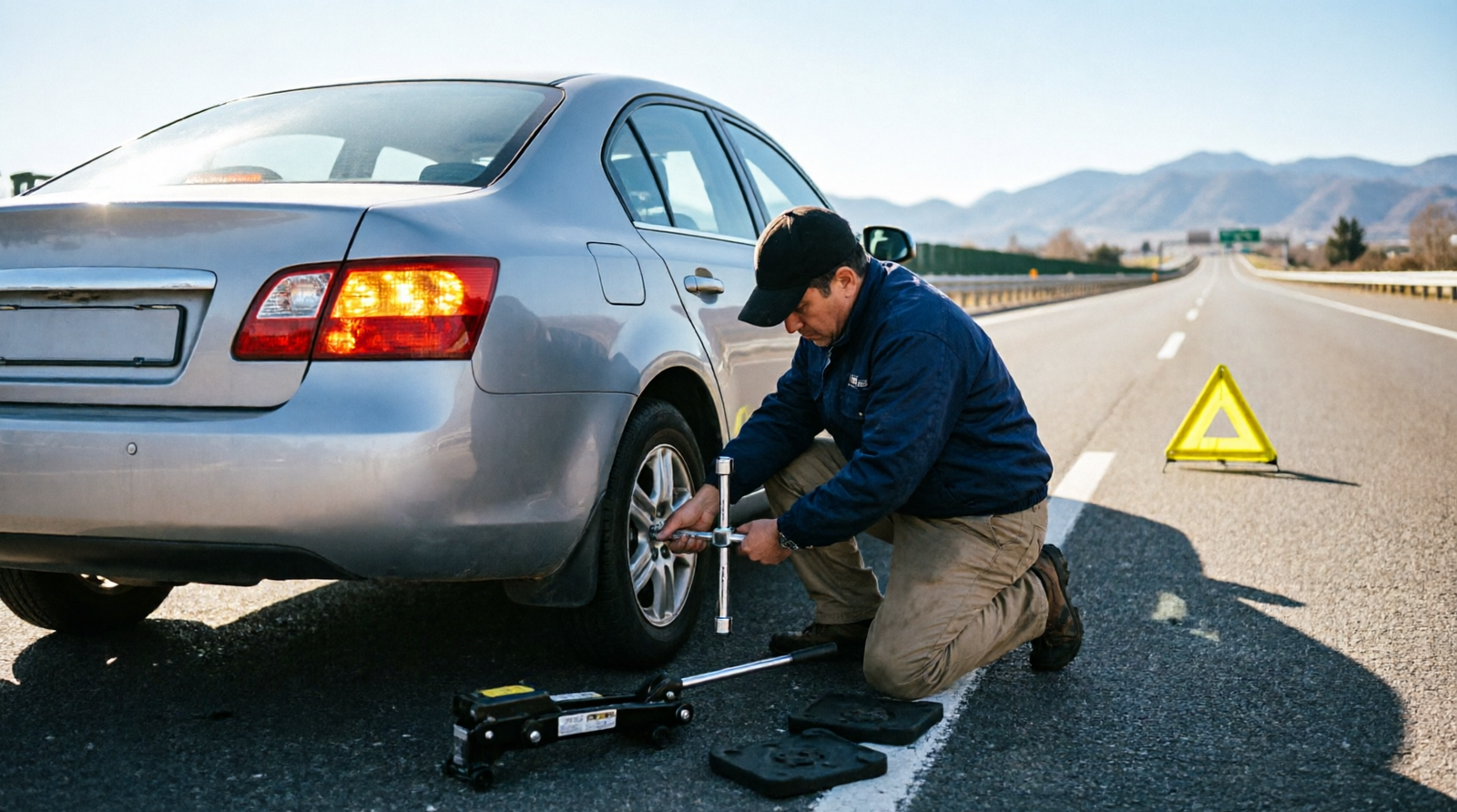
A flat tire always seems to happen at the worst possible moment. One second you’re cruising along, the next you hear a thump, feel the wheel pull, or notice the car just doesn’t feel right anymore. Here’s the short version: you can’t change a tire while the car is moving, and trying to would be dangerous. What actually matters is what you do in the first few seconds after you notice the problem, and how you handle the tire change once you’re safely stopped.
Can You Change a Tire While Driving?
No — and this isn’t just a technicality. Swapping a wheel requires the vehicle to be completely stopped, in Park, and supported by a jack on solid ground. A jack can’t do its job under a moving car, and trying to loosen lug nuts or remove a wheel while rolling would put you and everyone nearby at serious risk.
It helps to think of a flat tire as two separate problems, handled one after the other:
- Control the car once you notice something’s wrong.
- Change the tire only after you’ve come to a complete, safe stop.
A slow leak might just make the car feel a little off. A blowout is more sudden — you’ll likely hear a loud pop and feel an immediate change in handling. Either way, the National Highway Traffic Safety Administration (NHTSA) recommends keeping both hands on the wheel, easing off the gas gradually, and steering gently to correct the car’s path as you slow down.
Warning Signs of a Flat Tire or Blowout
Catching a tire problem early buys you more time to react safely. Common signs include:
- The steering wheel pulling to one side
- Vibration through the seat or wheel
- A repetitive thumping or flapping sound
- The car feeling harder to steer than usual
- A tire-pressure warning light
- A loud pop followed by a sudden handling change
- One corner of the car sitting noticeably lower
Don’t brush off these signals. Continuing to drive on a badly damaged tire can wreck the wheel, suspension, or other parts of the car. AAA advises getting out of traffic as soon as it’s safe to do so once you notice any of these symptoms.
A Tire-Pressure Light Doesn’t Always Mean “Just Low Air”
If that warning light comes on alongside unusual handling, treat it seriously. Rapid pressure loss usually points to a puncture or real damage, not just a tire that needs topping off. When in doubt, start looking for a safe place to pull over.
What to Do the Moment You Notice a Flat Tire
Your first job is keeping the car under control — not getting the spare out. Here’s how that plays out in practice.
Keep both hands on the wheel. A damaged tire changes how the car responds to steering input, so avoid sudden or jerky movements and just hold a steady line.
Resist the urge to slam the brakes. Hard braking on an unstable car can make things worse. Instead, ease off the accelerator and let the car slow down gradually. NHTSA specifically warns against overreacting — no sudden braking, no yanking your foot off the gas.
Signal and work your way out of traffic. Once you feel like you have control, flip on your turn signal and start looking for somewhere safe to stop — a parking lot, rest area, or wide shoulder well away from moving cars.
Stop, then secure the vehicle. Shift into Park, set the parking brake, and turn on your hazards so other drivers know something’s wrong. AAA recommends getting as far out of the traffic flow as you can and choosing ground that’s solid and reasonably level.
Finding a Safe Place to Stop
Pulling over is only step one — where you stop matters just as much as how quickly. Before you touch the jack, take a moment to look around and ask yourself a few questions.
| Question | Why It Matters |
| Is the car fully clear of moving traffic? | Reduces risk of being struck while working |
| Is the ground firm and level? | A jack needs stable footing to work safely |
| Is there enough room to work around the car? | Prevents injury while lifting and swapping the wheel |
| Can other drivers see you clearly? | Hazard lights alone may not be enough in poor visibility |
| Is traffic passing uncomfortably close? | A busy shoulder can be more dangerous than waiting for help |
If the answers make you uneasy, it’s fine to skip the DIY tire change and call for roadside assistance instead. Having a spare in the trunk doesn’t mean you’re obligated to use it on the side of a busy highway.
Keep Passengers Out of the Traffic Lane
Anyone riding with you should stay away from the roadside while you work — that includes kids who might want to watch. If there’s a genuinely safer spot nearby, use it, even if it means walking a short distance from the car.
How to Change a Tire Safely
Once you’re stopped somewhere safe and have a usable spare, the actual tire change is fairly routine. Before you start, check your owner’s manual — jack points, spare storage, and lug-nut procedures vary by vehicle.
You’ll typically need:
| Item | Purpose |
| Spare tire | Replaces the damaged wheel |
| Vehicle jack | Lifts the car off the ground |
| Lug wrench | Loosens and tightens lug nuts |
| Owner’s manual | Shows jack points and vehicle-specific steps |
| Tire-pressure gauge | Checks the spare’s pressure before driving on it |
Step-by-Step Process
- Secure the car. Confirm it’s in Park (or the manufacturer’s recommended gear for a manual), parking brake set, hazards on.
- Gather your tools. Locate the spare, jack, and lug wrench. Note that some newer cars carry a repair kit or run-flat tires instead of a traditional spare — don’t assume you have one just because the car is large.
- Loosen the lug nuts. Do this while the car is still on the ground, but don’t remove them yet.
- Position the jack correctly. Use the exact jack point specified by the manufacturer — an improvised spot can damage the car or make the lift unstable.
- Raise the vehicle. Lift just enough to clear the flat tire from the ground, and never put any part of your body underneath the car.
- Remove the damaged wheel. Take out the lug nuts fully and set them somewhere they won’t roll away or collect dirt.
- Mount the spare. Slide it onto the hub and hand-tighten the lug nuts — this isn’t the final tightening.
- Lower the car and finish tightening. Once it’s back on solid ground, tighten the lug nuts the rest of the way, typically in a star or crisscross pattern, following your manual’s instructions.
AAA recommends checking the spare’s air pressure once it’s on and getting the damaged tire looked at or replaced as soon as possible.
Driving on a Spare Tire: What You Need to Know
Whether you can drive normally on your spare depends on what kind you have.
| Spare Type | What to Expect |
| Full-size matching spare | Closest to a regular tire, but still confirm manufacturer guidance |
| Full-size temporary spare | May differ in specs from your other tires |
| Compact “donut” spare | Limited speed and distance — check the sidewall or manual |
| Tire repair kit | Only appropriate for certain types of minor damage |
| Run-flat tire | May allow limited driving after a pressure loss, within manufacturer limits |
A donut spare is meant to get you to a repair shop, not to serve as a long-term replacement. AAA notes that spares are built for limited use, and the sooner you get the original tire repaired or swapped out, the better.
When to Call Roadside Assistance Instead
Changing the tire yourself isn’t always the right call. Consider phoning for help if:
- You’re stopped somewhere that doesn’t feel safe
- Traffic is passing uncomfortably close to the car
- The ground is too soft, sloped, or uneven for a jack
- You don’t have a spare, or it’s damaged or flat
- You’re missing the right tools
- The lug nuts won’t budge
- There’s other visible damage to the car
- The flat resulted from a collision
- Weather or poor visibility makes the job risky
- You’re not confident using your vehicle’s jack
There’s no upside to pushing through a job that doesn’t feel safe just to avoid a tow-truck fee. AAA specifically points to unsafe locations, missing equipment, or driver uncertainty as good reasons to call for backup.
Mistakes to Avoid With a Flat Tire
A handful of instinctive reactions can turn a manageable situation into a dangerous one.
- Trying to change the tire while moving. This is the one rule that matters most — always come to a complete stop first.
- Slamming on the brakes. Sudden hard braking after a blowout can make the car harder to control. Ease off the gas instead.
- Yanking the steering wheel. A damaged tire already affects stability; abrupt steering inputs can make it worse.
- Continuing to drive on a destroyed tire. Going further than necessary risks damaging the wheel, brakes, or suspension.
- Improvising a jack setup. Never place a jack in a spot other than the one specified by the manufacturer, and never work underneath a car held up only by a jack.
How to Prevent a Flat Tire Emergency
You can’t eliminate every risk of a puncture or blowout, but regular maintenance goes a long way.
- Check tire pressure often, using the number on your door-jamb label — not the figure printed on the tire’s sidewall.
- Inspect tires regularly for cracks, bulges, cuts, uneven wear, embedded objects, or low tread.
- Check your spare periodically — it’s no help if it’s flat when you actually need it.
- Know where your gear is. Locate your spare, jack, lug wrench, and owner’s manual now, not during an emergency.
A few minutes of prevention can save you a stressful roadside scramble later.
What If the Tire Blows Out on the Highway?
Highway blowouts are especially unnerving because of the higher speeds involved, but the core response doesn’t change: keep control first, then get off the road. NHTSA recommends holding the wheel firmly with both hands, gradually releasing the accelerator, and avoiding sudden braking or steering as you guide the car toward a safe stopping spot.
Once you’re stopped, turn on your hazards right away. If you land on a narrow shoulder with traffic passing close by, it’s often smarter to call roadside assistance than to attempt the repair yourself. Getting everyone safe matters more than getting the tire changed quickly.
Frequently Asked Questions
Can you change a tire without stopping the car?
No. The vehicle needs to be fully stopped, secured, and properly positioned before you attempt to remove a wheel.
What should I do if my tire blows out while driving?
Hold the wheel with both hands, avoid sudden braking or steering, ease off the gas, and pull over once it’s safe to do so.
Is it safe to drive on a flat tire?
Generally no — it can damage the wheel and make the car hard to control. Stop as soon as you safely can.
Can I change a tire on the highway shoulder?
Only if the spot is genuinely safe with enough room to work. If traffic is close or conditions feel risky, call for roadside help instead.
How long can I drive on a donut spare?
Compact spares are for temporary use only — follow the speed and distance limits printed on the tire or listed in your owner’s manual.
What if my car doesn’t have a spare tire?
Some vehicles skip the spare entirely. If you’re stuck without one, call roadside assistance or arrange a tow.
Should I repair or replace a flat tire?
It depends on the damage, its location, and your tire’s condition. Have a professional inspect it before deciding.
Conclusion
You can’t change a tire while driving — the only safe path is to keep control, slow down gradually, and pull into a secure spot. From there, it’s your call whether to swap in the spare or wait for roadside assistance. Knowing where your tools are and checking your tires regularly makes the whole ordeal a lot less stressful when it actually happens.